MD🩺 | Observations from the ward and beyond
Medicine • Life • Growth
Translating ward truth into everyday health. Correcting what the internet gets wrong.
Patient presents with BP 70/50.
Known case of liver & kidney failure.
Grossly fluid overloaded (anasarca) + respiratory distress.
This is a classic scenario where new residents often make a critical error. Do you give IV fluids?
How confident are you in your IV fluid game?
Whether you are a med student building your foundation or a doctor running the casualty, mastering fluids is critical.
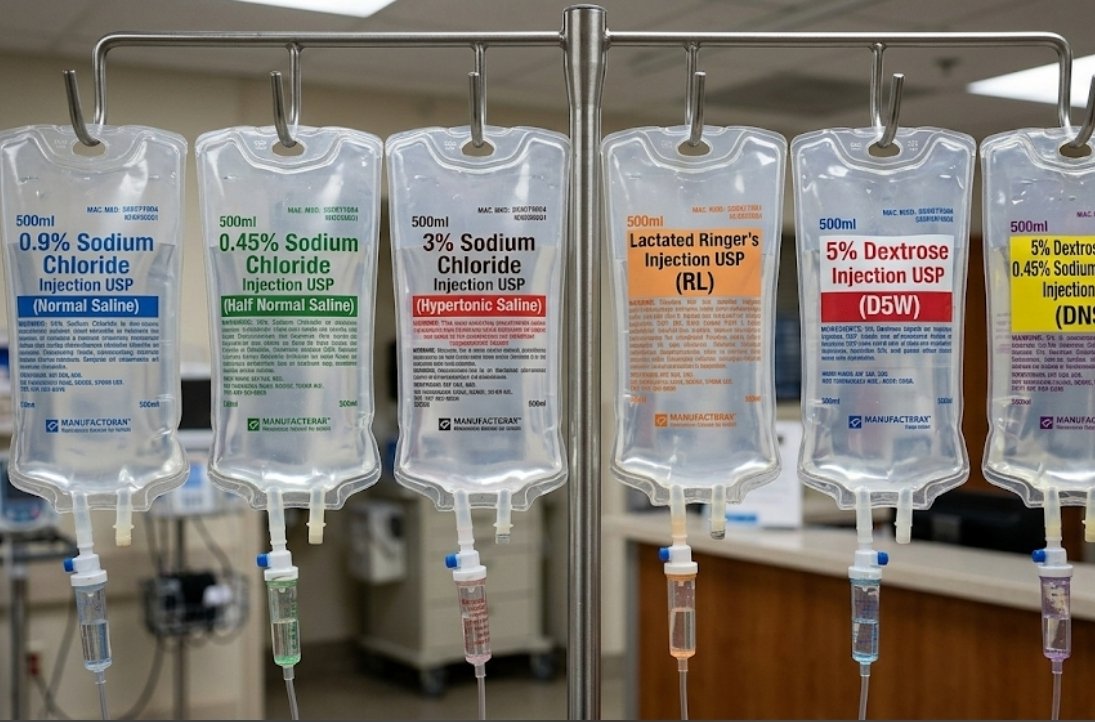
Let’s break down the 6 most common IV fluids, when to use them and when to avoid them. 👇
Influencers love pushing "morning routines" to flush out toxins after a weekend of heavy eating and drinking.
Medically speaking, what is the best way to DETOX?
A) Warm lemon water
B) Apple cider vinegar
C) Green juices
D) Detoxing is a scam
STROKE at the age of 34.
Runs 5k on weekends.
Normal blood pressure.
No diabetes. No smoking.
But ONE common stress relief habit quietly tore a major blood vessel and caused a massive brain attack.
A medical thread on what actually happened 👇
Dynamic Digital Radiography (DDR) allows you to observe movement like never before.
This novel low-dose X-ray imaging technique enables visualization of anatomy in motion.
The research on this is more nuanced than the claim suggests, and the nuance matters.
Several large observational studies have found associations between regular napping and reduced cardiovascular risk, particularly in populations with significant sleep debt from nighttime sleep loss. The proposed mechanism is straightforward. A short nap lowers cortisol and blood pressure temporarily, offsetting some of the cumulative stress load from poor nighttime sleep.
But other studies have found the opposite association, longer or more frequent naps linked to increased mortality risk, particularly in older adults. The likely explanation is reverse causation. People who nap excessively are often already unwell, and the napping is a symptom of underlying disease rather than a cause of earlier death.
The duration and reason for the nap appear to matter more than napping itself. A 20 to 30 minute nap to offset short sleep looks beneficial across multiple studies. Long, frequent daytime sleep in someone who slept adequately the night before is a different signal entirely, and not necessarily a good one.
Napping is not a longevity intervention on its own. It is sometimes a useful patch for a sleep debt that should not exist in the first place.
A Hungarian doctor named Ignaz Semmelweis in 1847 noticed something that should have made him famous instead of destroying him.
Two maternity wards in the same Vienna hospital had wildly different death rates. In one, staffed by doctors and medical students who came straight from autopsies to deliver babies, roughly 1 in 10 mothers died of a fever within days of giving birth. In the other, staffed by midwives who had no contact with cadavers, the death rate was a fraction of that.
Semmelweis spent months testing every explanation doctors offered him. Overcrowding, ventilation, the position women gave birth in, even the order priests walked through the ward ringing a bell for last rites, which some doctors believed frightened patients into illness. None of it explained the gap. Then a colleague died after cutting his finger during an autopsy, developing symptoms identical to the women dying on the maternity ward, and Semmelweis made the connection nobody else had.
The doctors were carrying something invisible from the dead to the living, on their own hands.
He ordered everyone on his ward to wash with a chlorinated lime solution before touching a patient. The mortality rate dropped from nearly 10% to under 2% within months. He had the data. He had the result. What he did not have was an explanation anyone in 1847 would accept, because germ theory did not exist yet and nobody could see what he was insisting they wash away.
The medical establishment responded by rejecting him outright. Senior physicians were offended at the implication that their own hands, the hands of educated gentlemen, were killing patients. Semmelweis grew increasingly desperate and combative as colleagues dismissed data that should have spoken for itself, writing furious letters accusing other doctors of being murderers. His behavior, which today might be read as the breakdown of a man watching preventable deaths continue while he held the answer, was used against him.
In 1865, he was committed to an asylum, and died there three weeks later from an infected wound, the same category of death his discovery might have prevented, beaten by guards before the infection took him.
It would take another twenty years and Louis Pasteur's germ theory for the medical world to accept what Semmelweis had proven with nothing but a chlorine solution and a death count. Doctors now wash their hands before touching a patient as the most basic, unquestioned habit in medicine. The man who discovered why died unable to convince anyone it mattered.
A med student asked me: "Sir, why do I feel uncontrollably sleepy the second I open a textbook at 9 PM, but if I close the book and put on a movie or go to a party, I can easily stay wide awake until 2 AM?
Run your tongue along your gums right now. If they bleed when you brush, that is not normal. That is the earliest stage of a disease most people have walked around with for years without ever calling it a disease.
Bleeding gums are not a sign that you brushed too hard. They are a sign that inflammation is already present and your gums are too fragile to withstand normal contact.
That is the body's earliest possible warning, arriving while the damage is still completely undoable. Most people ignore it for years, because it does not hurt and does not interfere with anything. By the time it hurts, the bone underneath has often already started to go.
The disease was never silent. It was speaking from the very first time you spat pink into the sink.
Run your tongue along your gums right now. If they bleed when you brush, that is not normal. That is the earliest stage of a disease most people have walked around with for years without ever calling it a disease.
The intervention that prevents all of this is unglamorous to the point of being easy to dismiss. Brushing twice daily disrupts the plaque before it hardens into tartar. Flossing reaches the contact points between teeth that a toothbrush cannot access, which is where a significant proportion of early disease begins. Professional cleaning removes tartar that has already hardened, because at that point no amount of home care can remove it.
None of this requires sophistication. It requires consistency, and a willingness to take bleeding gums seriously the first time they appear rather than the fifth.
In 1733, an English clergyman named Stephen Hales walked up to a horse, tied it down, and cut directly into its artery.
He inserted a long glass tube, nearly nine feet of it, vertically into the cut, and watched as the horse's blood rose up the tube and settled at a height of about eight feet above the heart. He had just measured blood pressure for the first time in recorded history, and he had done it by opening a living artery and letting the body's own force answer the question.
The horse, remarkably, survived the procedure. Hales went on to repeat it on dogs and other animals over the following years, refining a method that worked but that no physician could reasonably perform on a conscious human patient. The pressure inside an artery had been quantified. The means of measuring it without cutting someone open did not yet exist.
That gap lasted nearly 150 years. In 1881, an Austrian physician named Samuel Siegfried Karl Ritter von Basch built the first device that could estimate blood pressure from outside the body, a water-filled bag pressed against the artery until the pulse disappeared. It was crude, but it worked without a blade.
The modern cuff arrived in 1896, when an Italian physician named Scipione Riva-Rocci designed an inflatable rubber cuff wrapped around the upper arm, connected to a mercury column. Inflate until the pulse at the wrist vanishes. Release slowly. Note the number where the pulse returns. The principle inside that cuff is the same one inside the device on your doctor's wall today.
What changed across those 150 years was not the question. Hales already knew exactly what he wanted to measure and why it mattered. What changed was finding a way to ask the artery the same question without opening it. The number on a blood pressure cuff is the same physical force that once required a glass tube standing eight feet in the air above a restrained horse to see at all.
You can live on the equator, get sun every single day, and still run low on vitamin D. In a 2026 study of factory workers in Indonesia, 87 percent tested below the healthy line.
So when an office worker takes zinc, magnesium, and vitamin D on a psychologist's advice and his coworkers say he turned calmer, there is a clear biological story underneath. Those three are not a random stack. They are three of the most common nutrient shortages on the planet, and a desk job pushes all three the wrong way: no sun for vitamin D, and processed food low in magnesium and zinc.
Vitamin D first. It acts more like a hormone than a vitamin, with docking sites all over the brain. Sitting indoors, sunscreen, covered commutes, and air pollution all stop the skin from making it. Across Asia, a study of nearly 8 million people found about 77 percent below the healthy mark.
Zinc is the quiet one. It sits at the tips of brain cells next to glutamate, the brain's main "go" signal, and helps set how strongly they fire. It also feeds BDNF, a protein that works like fertilizer for brain cells. A review of more than 450 depressed patients found that adding zinc to their medication lowered their symptoms. Roughly 1 in 6 people worldwide does not get enough. In South Asia it climbs toward 1 in 3.
Magnesium, taken at night, mostly works on sleep. It raises melatonin, the hormone that makes you drowsy, and lowers cortisol, the stress hormone that keeps you wired. A recent trial of 155 poor sleepers found a clear drop in insomnia after four weeks, though not a cure.
The 30-day mark is not random either. Vitamin D takes a few weeks to climb in the blood. One month-long study moved people from deficient toward sufficient, but not all the way. Taking all three together roughly doubles the brain effect compared to vitamin D alone.
One honest caveat on the complete 180. Fixing a deficiency tends to lift mood, steady sleep, and take the edge off anxiety. It rarely deletes a whole personality. A swing that big is usually better sleep plus the therapy itself plus a little friendly exaggeration. Calmer is not the same as cured, and more pills is not better. Too much zinc can backfire and leave the brain worse off.
The catch is that you cannot feel a deficiency from the inside. The only way to know if you are in that 80 percent is a blood test.