3rd word Immigrants have set fire to The Gothic Basilica of Saint-Michael in Bordeaux which was built between the late 14th century and the 16th century (1330 to the 1500s).
European heritage & history will soon be nothing but ashes without Remigration.
Tyler Robinson’s attorney Kathy Nester has objected to the admissibility of every exhibit introduced by the State, including videos capturing the moments Charlie Kirk was shot. Nester argued that the videos cannot be authenticated because the individuals who recorded them are not present in court to testify.
However, state attorney Sturgill responded by presenting an affidavit from Teryll Farnsworth, a videographer with Visual Impulse who was contracted by TPUSA, authenticating the video.
The judge also viewed a close-up video of Charlie Kirk’s murder. As it played, he did not conceal his reaction. His expression appeared visibly emotional while watching the footage.
REPORT: Jeff Metcalf, the father of Austin Metcalf, received a “cease and desist”, directing him to stop using the phrase “Watermelon Felon,” claiming the term is “privately copyrighted/patented,” valued at $100 million in .999 pure silver, and owned by a “Foreign Trust.”
It referenced the “New Moon” as part of the date and demands that he remove the phrase not only from social media, but from his “mouth” and “vocabulary.” To top it off, it threatens legal consequences if he doesn’t comply within seven days.
Here’s the problem: copyright law doesn’t protect short phrases, patents don’t protect words, and simply dressing a document up with barcodes, seals, and references to trusts doesn’t magically give it legal authority. If this was intended to intimidate a grieving father into silence, it missed the mark.
I asked Jeff to send me a video that perfectly captured how he felt about this cease-and-desist. So… here you go. 👇
It appears CitySide Records can take their “cease and desist” and shove it right up their fourth point of contact.
I will share the letter in the thread.
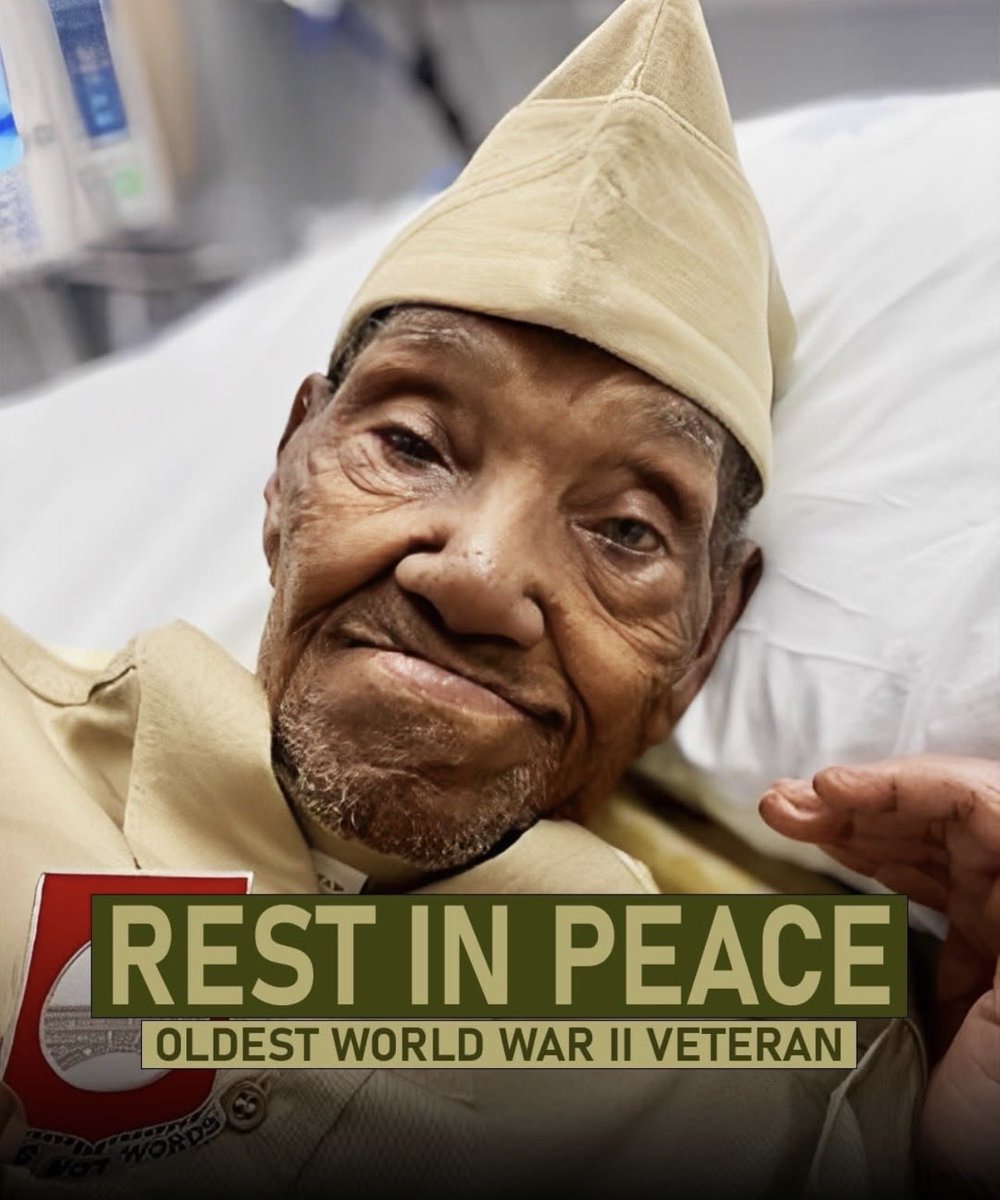
Lawrence Brooks, the oldest World War II veteran in the United States and believed to be the oldest man in the nation passed away at the remarkable age of 112.
With his departure, the world loses not only a man, but a living witness to history, a member of the Greatest Generation whose courage, endurance, and quiet dignity carried him across more than a century of change. His life stands as a testament to service, sacrifice, and unwavering strength.🕊️🇺🇸
#TheGreatestGeneration #RIP
Christian children praying at their church in Iraq.
In the last 25 years, Iraq’s Assyrian Christian population has collapsed from over 2 million to just 100,000. A true genocide.
Even after the horrors of the Islamic State, their faith remains unshaken.
THIS IS JUDGE MAGGIE SCOTT
She let child rapist Daniel Cieslak who pleaded GUILTY to raping a 12YEAROLD girl — WALK FREE from her courtroom with an ABSOLUTE DISCHARGE. No jail,No punishment, said there was “no public interest” punishing him because he thought the girl was older!!
NOBODY tells Americans this part of the story.
In 2009, Japan elected a government that treated your alliance like garbage.
Our Prime Minister looked your President in the eye and said "Trust me."
Then he broke his word.
Your bases were called a burden. Your soldiers were treated like a problem. US-Japan relations hit their COLDEST point in 50 years.
And our economy? Two lost decades. Deflation. Despair.
Then March 11, 2011.
America had EVERY excuse to say "not our problem."
A government that insulted you.
An ally that acted ungrateful.
A country that seemed to have forgotten you.
You know what America did?
24,000 troops. 24 ships. 189 aircraft.
You didn't ask if our politicians deserved it.
You saw old people freezing in the dark with no food, no water, no heat.
That was enough for you.
Here is what every Japanese person understood that day:
You didn't come for our government.
You came for US. The people.
Governments fight. Governments fail. Governments apologize and lie.
But you dug through black mud for strangers whose leaders had spit on you.
That autumn, 82% of Japanese said they felt friendly toward America. The highest ever recorded.
Not because of a treaty.
Because when we were at our weakest, and you had every reason to turn away —
YOU. SHOWED. UP.
Japan will never forget who came when even our own leaders had failed us. 🇺🇸🇯🇵
Christopher Hitchens: ”In 1786, when the United States was barely a country, it was having its sailors taken as slaves by the Barbary states, the states of the Ottoman Empire and North Africa. Tripoli, shores of Tripoli. Ships stopped, its crews carried off into slavery. We estimate 1.5 million European and American slaves taken between 1750 and 1815.
Jefferson and Adams went to their ambassador in London and said, why do you do this to us? The United States has never had a quarrel with the Muslim world of any kind. We weren't in the crusades. We weren't at war with Spain. Why do you do this to our people and our ships? Why do you plunder and enslave our people? The ambassador said very plainly, Mr. Abdul Rahman said, because the Quran gives us permission to do so, because you are infidels, and that's our answer. Jefferson said, well, in that case, I will send a navy which will crush your state, which he did.
Islamic fundamentalism is not created by American democracy. It's a lie to say so. It's a masochistic lie, and it excuses those who are the real criminals, and blames us for the attacks made upon us.”
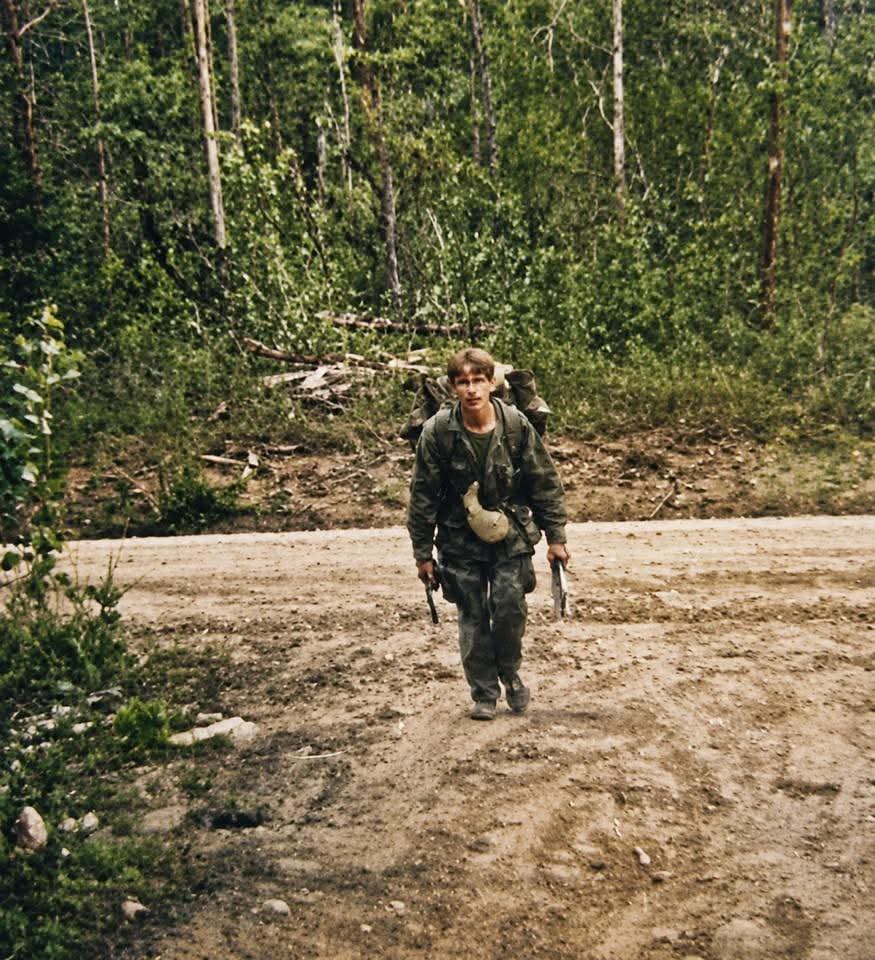
An Army veteran who served several years in the 82nd Airborne back in the 70s and early 80s had this photo colorized for me. It depicts my finishing the 40 miler.
I've been asked what the prerequisites for Delta are. They could be different today, but these were the prerequisites for Delta in 1978:
Male, volunteer, military occupational specialty (MOS)/branch immaterial, grade E-5 on second enlistment, E-6 or E-7, no limiting physical profile, minimum 22 years old, U.S. citizen, GT score 110 or higher (may be retested), pass Delta Force physical, pass five-event Physical Combat Proficiency Test (PCPT) (sit-ups, the horizontal ladder, run-dodge-jump, inverted crawl, and two-mile run - the youngest age standard was the benchmark) and 100 meter swim in Battle Dress Uniforms (BDUs) and boots (no time standard), qualified in current primary Military Occupational Specialty (MOS), pass formal selection course, and airborne qualified or willing to volunteer for airborne training/duty.
The incentives were advertised as: Most realistic and rigorous training in the U.S. Army, work with dedicated, professional soldiers, opportunity to earn and assume real responsibility, tour stability (6 years if job proficiency is maintained - for NCOs), opportunity for world-wide travel, satisfaction of belonging to a unique team, advanced military schooling opportunities, additional incentive pay and allowances, and a true sense of immediacy and importance in serving your country.
The Physical Fitness Test has changed as the standards changed, and the military post no longer has horizontal bars and a run-dodge-crawl course. The swim test was done in a pool or open water. If you passed, but it was noted that you were a weak swimmer, you would be given swim lessons in the Operator Training Course.
On the night of July 6, 1943, an American cruiser called the USS Helena was torn apart by torpedoes in the dark waters of the Solomon Islands. That much is a normal war story. What happened to her crew over the following ten days is the part worth telling, because most of them lived through something that reads more like an adventure novel than a naval report.
First, the setting. The fighting in the Solomons had settled into a strange nightly rhythm. Japan needed to keep feeding troops and supplies to its island garrisons, and the only way to do it was to send fast destroyers racing down the channel under cover of darkness, drop off men and cargo, and be gone before American planes could catch them in daylight. The Americans called this the Tokyo Express, and stopping it meant fighting at night, which is where the Japanese navy was terrifyingly good. Their sailors were superbly trained in night combat, and they carried a weapon the Americans badly underestimated, the Long Lance torpedo, which could travel enormous distances at high speed and hit with devastating force.
On this particular night an American force of cruisers and destroyers under Admiral Walden Ainsworth went in to intercept one of these runs, and a savage close-range gun and torpedo brawl erupted in the pitch black. Early on, American gunfire smashed the lead Japanese destroyer and killed the enemy admiral. But the Helena had a problem. She was firing her guns so fast, and had switched to ordinary gunpowder after using up her flashless supply, that every salvo lit her up with a huge muzzle flash. In a night battle, that is like standing in a dark room waving a flashlight at people who are aiming at the light. The Japanese fired a spread of Long Lance torpedoes right at those flashes. The first ripped the bow clean off the ship. Two more slammed into her body, and the Helena broke apart and went down fast.
Around 168 men died in the sinking. But more than seven hundred survived the water, and now their real ordeal began, scattered across miles of dark, enemy-controlled sea. Some clung to the shattered bow of the Helena, which stubbornly refused to sink and stayed bobbing on the surface like a life raft. American destroyers, still in the middle of a battle, braved the danger to circle back and haul as many men out of the oily water as they could that night, packing survivors aboard by the hundreds.
But hundreds more drifted away in the currents and could not be found before the ships had to leave. For days these men floated in the open ocean in small clusters, clinging to rafts and debris, burned and exhausted and slowly drifting toward the horizon. And where they drifted was not friendly territory. A large group, well over a hundred men, washed up on the shores of Vella Lavella, an island firmly held by the Japanese.
This is where the story turns almost miraculous. Living in secret on that island were coastwatchers, a handful of incredibly brave Allied men, often Australians, who hid in the jungle behind enemy lines with radios and reported on Japanese movements. Together with the local Solomon Islanders, who risked their own lives to help, they took in the shipwrecked American sailors, hid them from Japanese patrols, fed them, and cared for them for days. Then they radioed out the sailors' location and worked out a plan to get them off the island.
Around ten days after the Helena went down, American ships crept back into those dangerous waters in the dark, right under the enemy's nose, and pulled the survivors off the beach. Nearly the entire group was saved. When you add it all up, the overwhelming majority of the Helena's crew came home, rescued in stages across more than a week, first from the water, then from the floating wreck of their own bow, and finally from a Japanese-held jungle island by a network of coastwatchers and islanders who owed them nothing and helped them anyway.
There is one more detail that makes the ship's story land even harder. The Helena had been at Pearl Harbor on December 7, 1941, and was hit in that attack too. She had been there at the very start of the war for America, survived it, fought her way through the brutal battles of the Solomons, and now finally went to the bottom off New Georgia. She became the first ship in the US Navy ever awarded the Navy Unit Commendation. But her real legacy is those men on the beach at Vella Lavella, alive because a few hidden watchers and a village of islanders decided to save them.
He ran off from home as a teenager after a fight with his father and turned up on the Virginia frontier with nothing but his fists and a bad attitude. He hauled wagons, drank hard, gambled harder, and beat men senseless in taverns for fun. Nobody looked at young Daniel Morgan and saw a future war hero. They saw trouble with a strong back.
Then came the lashing. During the French and Indian War a British officer struck him with the flat of a sword, and Morgan knocked the man out cold. For hitting an officer he was sentenced to 500 lashes, a punishment meant to kill. He lay there and counted every stroke himself. He lived. And for the rest of his days he told it as a joke, that the drummer miscounted in the dark and only gave him 499, so the British crown still owed him one lash and he intended to collect.
He nearly died more than once before the Revolution even began. A musket ball tore through the back of his neck and out through his cheek, taking teeth with it. He clamped onto his horse's neck, sure he was finished, and rode until he didn't fall off. He carried that scar and a lifetime of chronic pain, and sciatica so brutal that in later years men sometimes had to lift him onto his horse.
When war came he raised a company of frontier riflemen and marched them hundreds of miles to Boston in the dead of the campaign. At Quebec in 1775 he stormed the walls in a blizzard, kept fighting after the assault fell apart around him, and when he was finally cornered he refused to hand his sword to the enemy. He pressed his back to a wall, dared them to shoot him, and surrendered only to a clergyman standing nearby so no redcoat could ever say he'd taken Daniel Morgan's blade.
His riflemen were something the world had barely seen. They could kill a man at 250 yards while regular armies still fired in massed volleys and prayed. At Saratoga his marksmen hung in the trees and picked off British officers one at a time. One of his men dropped General Simon Fraser from an impossible distance, and with that shot the fight went out of the British line. That campaign ended in a whole British army surrendering and brought France into the war on the American side.
Then came the day that made him immortal. January 1781, a cold field in South Carolina called the Cowpens. Morgan was sick, outnumbered, and staring down Banastre Tarleton, the young cavalry commander who left burned farms and slaughtered prisoners behind him and who no one wanted to face. So Morgan did the unthinkable. He put his weakest, jumpiest militia right up front, walked the line the night before, and told them plain: give me two good volleys, boys, just two, then fall back and I'll ask no more of you.
Tarleton saw ragged militia running and thought he'd won. He charged straight into the trap. The militia peeled away exactly as planned, the British came on howling, and Morgan's real line rose up and hit them while cavalry swept around the flank and the whole thing snapped shut like a jaw. In under an hour Tarleton's force was destroyed. Morgan pulled off a perfect double envelopment, the kind generals dream about and almost never land, and he did it with a broken-down body and a militia most officers wouldn't trust to hold a fence line. They still teach that battle at West Point.
Cowpens broke the British in the South and set the road to Yorktown. Congress struck a gold medal for him. The wagon driver with no schooling, a back that barely worked, a mouth full of missing teeth, and 499 scars on it, out-generaled the best they had and helped win a nation.
Daniel Morgan. Remember the name.
🇺🇸 This is Frances Caroline Chamberlain, the wife of Joshua Chamberlain.
Joshua Chamberlain volunteered to leave her and their two young children to fight for the 20th Maine.
She met Joshua at Bowdoin College’s required church services. They had a long courtship and engagement and finally married on December 7, 1855, in her father’s church in Brunswick.
Together, they endured the heartbreak of losing three of their five children in infancy.
Only two survived past their first year: their eldest daughter, Grace Dupee “Daisy” Chamberlain, and their only surviving son, Harold Wyllys Chamberlain, who never married and lived with his father in his later years.
Their marriage was tested by the Civil War. She resented the Army’s disruption and feared for his safety.
She would nurse him devotedly after his near-fatal hip wound at Petersburg in 1864.
Though the marriage nearly ended in separation around 1870, they ultimately reconciled and remained together.
Fanny battled lifelong eye problems that eventually led to blindness later in life.
She died at home in Maine in 1905 after breaking her hip.
Joshua was devastated and wrote a moving tribute to her.
He outlived her by nine years, dying in 1914.
CCTV Footage of a house with a pool in La Guaira, Venezuela really shows the intensity of the earthquake.
That might be the most violent motion from an earthquake I’ve ever seen. The thought of being in a pool during something like this is so so scary! Mother nature is terrifyingl. You'd get slapped against the concrete. Ouch.
That is one well built house. The owner should be thanking the builders big time.
On this day in 1777, the fortress Americans called impregnable was abandoned in the dark without a real fight, and the shock of it rang across two continents. Fort Ticonderoga was supposed to be the "Gibraltar of America," the iron gate guarding the route from Canada. Losing it felt like a catastrophe. It nearly was.
The British general John Burgoyne came south with a powerful army, and instead of throwing his men at the fort's walls, his officers looked up. Towering over Ticonderoga was a steep hill called Mount Defiance that the Americans had left undefended, sure that no one could ever haul cannon up such a slope. The British did exactly that. As one officer supposedly put it, "Where a goat can go, a man can go, and where a man can go, he can drag a gun."
When the American commander, Arthur St. Clair, woke to find British artillery staring down into his fort from above, he knew the game was over. Any bombardment from that height would slaughter his outnumbered garrison. So on the night of July 5 into the 6th, he made the agonizing call to evacuate, slipping his 3,000 men out under cover of darkness rather than see them destroyed. Burgoyne marched in the next morning without a real fight.
Americans were furious and humiliated. St. Clair was accused of cowardice and court-martialed, though later cleared. Across the ocean, King George III reportedly burst in on the Queen shouting, "I have beat them! I have beat all the Americans!"
Here's the twist history loves. Taking Ticonderoga lured Burgoyne deeper and deeper into the American wilderness, stretching his supply lines to the breaking point. A few months later that same overconfident army was surrounded and forced to surrender at Saratoga, the victory that convinced France to join the war. The "disaster" at Ticonderoga was the first step in one of the biggest American triumphs of all.
Two air forces started the Pacific war.
One trained its pilots, then kept them fighting until they died. The other trained its pilots, then often pulled many of its experienced combat pilots out to teach everyone else.
This is one of the reasons America won the Pacific air war, let's dive in..
Japan's Elite Aviators
At the start of the war, Japan had some of the finest fighter pilots in the world.
The aviators who attacked Pearl Harbor were elite. Many had hundreds of hours in the cockpit and real combat experience from the fighting in China. Flying the nimble A6M Zero, they cut through Allied opposition in the early months of the war and earned a fearsome reputation.
But Japan made a fateful choice about these men. It kept them in combat, more or less indefinitely. Japanese pilots flew mission after mission with no real system to rotate them home. They fought until they were shot down, crippled, or killed.
It seemed ruthless and efficient. In reality, it was a slow-motion disaster.
The Difference in Philosophy
Because every time Japan lost one of those veterans, everything he knew died with him.
America did the opposite. It regularly rotated many of its experienced combat pilots back home once they had done their share of fighting. There, they became instructors, pouring everything they had learned in real air combat directly into the next generation of pilots.
So the two systems pulled in opposite directions. Japan's pool of skill drained away with every ace it buried. America's pool of skill grew, as each returning veteran multiplied his knowledge across hundreds of students.
One nation was teaching. The other was simply dying.
The Training Gap
The gap became a chasm, and it was made worse by sheer scale.
By 1944, the United States was training around 8,000 new aviators every month, each of them getting well over a year of instruction and hundreds of hours in the air before they ever saw combat.
Japan could not come close. As its veterans vanished, its training program collapsed, and it was crippled by something else, too. Fuel. Japan was running so short of it that many trainees could barely fly enough hours to learn their trade. By the later part of the war, Japanese pilots were being rushed into battle with barely 100 hours of flying time, and sometimes far less. They were teenagers with almost no training, being sent up against American veterans who had been taught by the best combat pilots in the fleet.
The outcome was no longer a contest. It was a slaughter.
The Great Marianas Turkey Shoot
Nowhere was that clearer than in the skies over the Mariana Islands in June 1944.
When the Japanese launched hundreds of aircraft against the American fleet, they flew into a wall of Hellcat fighters, guided by radar and expert fighter direction that positioned the Americans at the perfect height and moment to strike. The green Japanese pilots in their now outdated Zeros never had a chance.
In and around that battle, Japan lost nearly 480 aircraft, while the Americans lost only a few dozen. It was so one-sided that the American aviators nicknamed it the Great Marianas Turkey Shoot.
Japan's naval air power, once the terror of the Pacific, was broken in a matter of days.
Better Aircraft, Better Technology
It was not only the pilots. It was the machines too.
America kept producing better and better aircraft, like the tough, heavily armed F6F Hellcat, designed after studying a captured Zero and built to beat it. It could take punishment, out-dive and out-gun its opponent, and it was forgiving enough that even a less experienced pilot could survive his first fights and become a veteran. Over the war, Hellcat pilots claimed more than 5,000 enemy aircraft for a tiny fraction of that in losses.
Japan, meanwhile, kept sending men up in the aging Zero, a plane that had been revolutionary in 1941 but was now underpowered, fragile, and outclassed. It was fast and agile, but a single burst of American fire could tear it apart, because it had traded armor and protection for maneuverability.
Better pilots, in better planes, backed by better technology. The advantages stacked on top of one another.
The Spiral Ends
By the end, Japan had reached the final, desperate stage of the spiral.
With almost no trained pilots left, and no way to make more in time, it turned to the kamikaze. A pilot did not need 500 hours of training to crash his aircraft into a ship. He only needed to take off, aim, and die. It was the last resort of an air force that had run out of the one thing it could never mass produce. Experienced men.
America won the Pacific air war for many reasons. Its factories out-built the enemy. Its radar and intelligence gave it eyes the Japanese lacked. Its aircraft grew deadlier every year.
But underneath all of it was something simpler. America treated its best pilots as a resource to be protected and passed on. Japan treated them as fuel to be burned. One of those choices built an air force that kept getting stronger. The other burned brightly, and then burned out.
This was why America won the Pacific air war.
I post a story like this every single day. Most people never see them. Follow so you don't miss the next one.