Just for a throw in, 3 players had to swap. It was already in extra time too. They waste their time, then cry afterwards.
Just look for yourself.
They waste all the time in the world for these demonic activities 😭😂😂😂
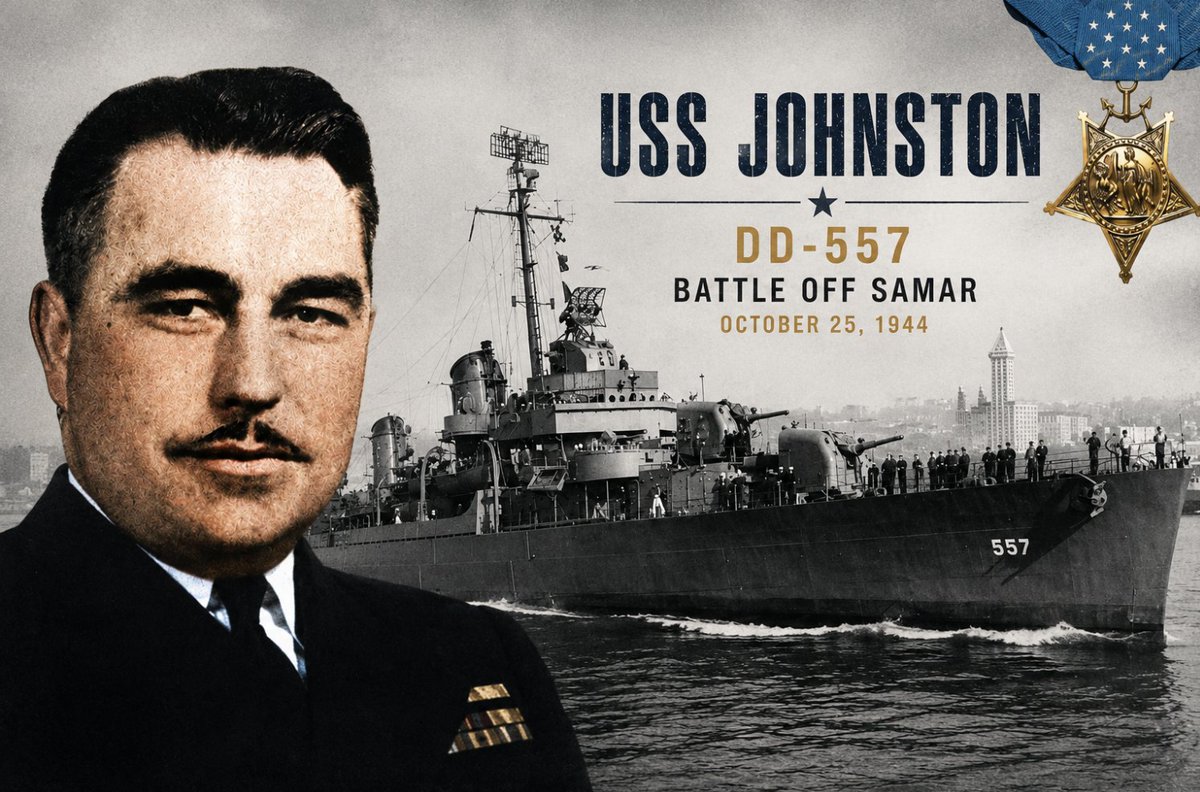
A tiny American destroyer charged first into the path of the Yamato, the largest battleship ever built.
Her five inch shells could not seriously hurt battleship armor.
She charged anyway, leading the way into an entire enemy fleet.
What her crew did saved thousands of American lives.
This is the story of the USS Johnston..🧵1/6
On this day in 1941, the British Empire saved its oil supply with a force smaller than a London police precinct.
Almost nobody remembers it.
Two months earlier, a pro-Nazi colonel named Rashid Ali had seized power in Baghdad in a four-man military coup. He immediately offered Iraq's oil fields, airfields and railways to Hitler in exchange for German support against the British, who had controlled Iraq under treaty since the 1930s.
Hitler said yes. Luftwaffe squadrons were dispatched to Mosul. A handful of Heinkels and Messerschmitts painted in Iraqi colors were already on the ground.
If Iraq fell, Britain lost its main wartime oil supply, the route to India through Basra, and any chance of holding the Middle East against Rommel pushing east and the Germans driving south through the Caucasus.
Britain had almost nothing in Iraq to stop it.
What it had was RAF Habbaniya. A flight training school on a desert plateau 50 miles west of Baghdad. The aircraft were obsolete biplane trainers: Hawker Audaxes, Airspeed Oxfords, a handful of Gloster Gladiators meant for student pilots. The garrison was 1,200 men: airmen, mechanics, flight instructors, six companies of Assyrian Christian Levies, and a few hundred student pilots who had never seen combat.
On May 2, an Iraqi army of 9,000 men with field artillery surrounded the plateau on the surrounding cliffs and ordered them to surrender.
They didn't.
For five days the obsolete trainers flew 647 sorties against the Iraqi positions, instructors leading their own students into combat over the wire. They lost a third of their aircraft. They lost 13 men. They broke the siege and chased the Iraqi army back toward Baghdad.
Meanwhile a scratch relief column called Habforce had set out across 500 miles of open desert from Transjordan with no maps and almost no water. At its head rode a column of Arab Legion soldiers led by an Englishman who had gone native, John Bagot Glubb, whose Bedouin troops called him Abu Hunaik, "father of the little jaw," after a wound he had taken in the trenches in 1917.
Glubb's men reached the outskirts of Baghdad on May 30.
The coup leaders fled to Iran in the night. The Mufti of Jerusalem went with them. Rashid Ali eventually made it to Berlin and spent the rest of the war as Hitler's guest.
Iraq's oil kept flowing west for the next four years.
Hitler had been hours from controlling the Persian Gulf and never knew it.
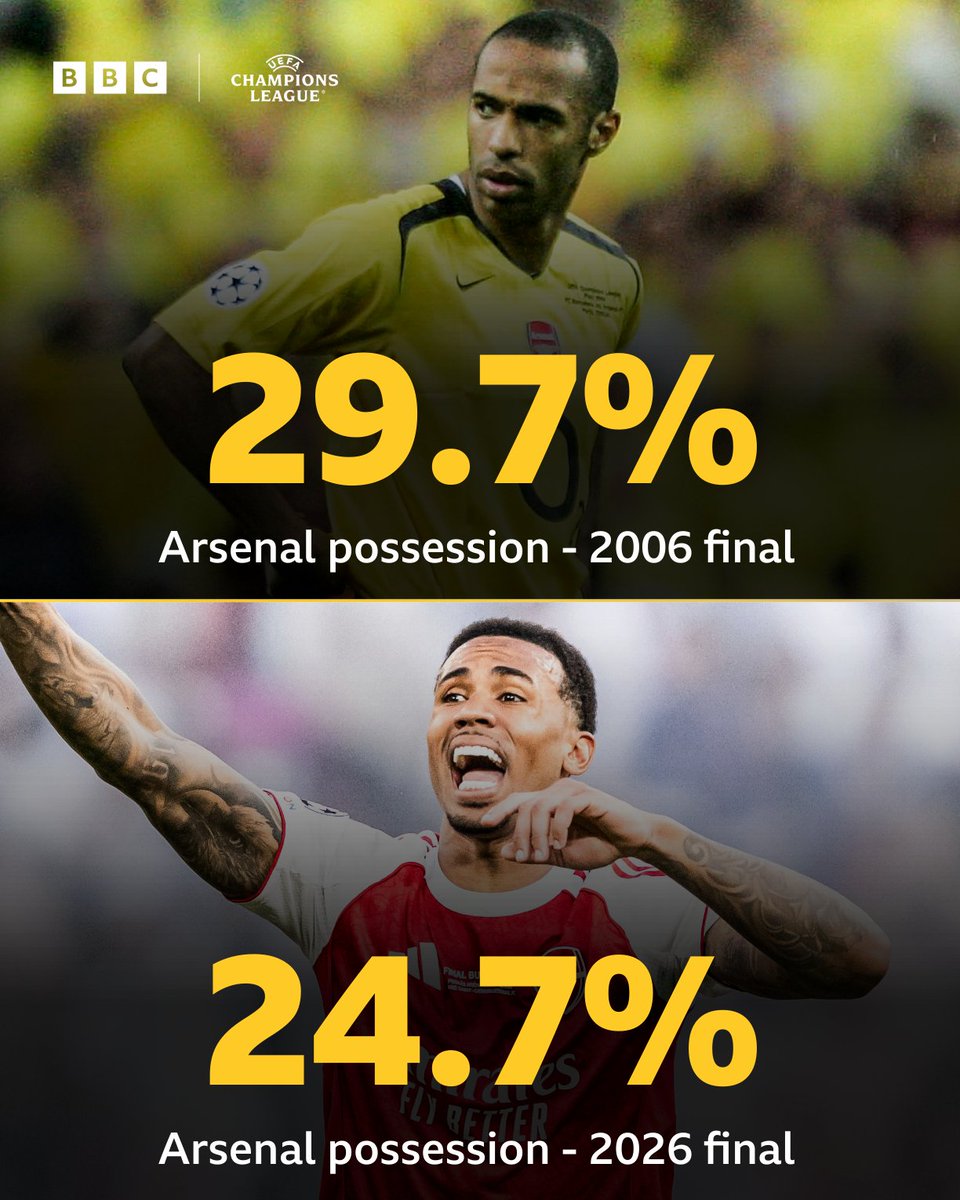
Arsenal have set the record for the lowest possession percentage for a team playing in a Champions League final (since records began in 2003-04).
The previous lowest record was also Arsenal, set in the 2006 Champions League final, which they played 72 minutes with 10 men.
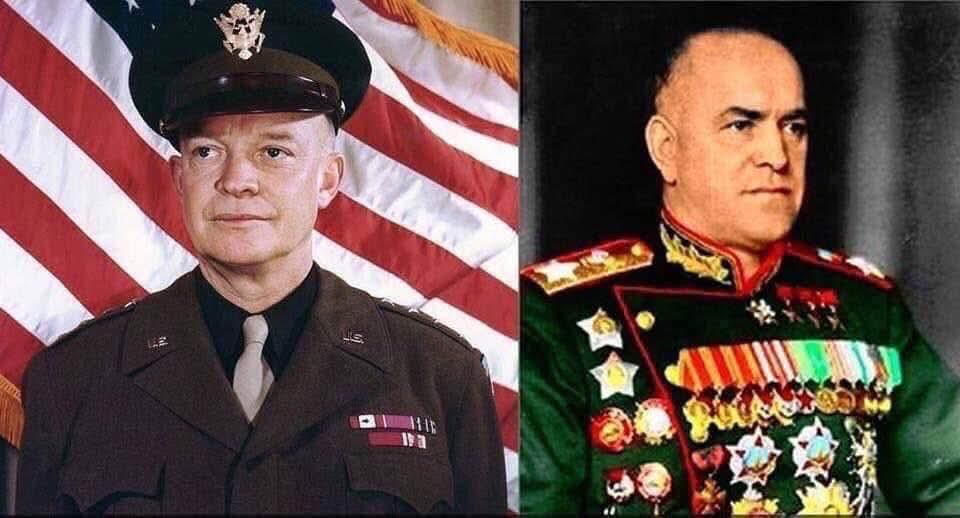
Interesting excerpts from the memoirs of Supreme Allied Commander General Dwight D. Eisenhower (later President of the United States from 1953–1961) about Marshal Georgy Zhukov:
“During the several hours we spent together in the airplane, Marshal Zhukov and I often discussed military operations... A great revelation to me was his description of the Russian method of attacking through minefields. German minefields, covered by enemy defensive fire, were tactical obstacles that caused us heavy casualties and many delays. Breaking through them was always difficult, despite the fact that our engineers had invented every imaginable mechanical device for the safe clearing of mines.
Marshal Zhukov casually remarked to me: ‘There are two kinds of mines: antipersonnel and antitank. When we encounter a minefield, our infantry continues the attack as though it were not there at all. We consider the losses from antipersonnel mines to be equal to the losses we would have suffered had the Germans defended that sector with concentrated manpower instead of minefields. Advancing infantry does not detonate antitank mines, so once they have crossed the minefield and secured the opposite side, the engineers then come forward and clear lanes through which vehicles can pass...’
I could vividly picture what would have happened to any American or British commander who attempted to use such tactics, and an even clearer picture of what the men in any of our divisions would have said if we had tried to make such practices part of our tactical doctrine...
Americans measure the cost of war in human lives, while the Russians measure it in the total expenditures of the nation.
As far as I could see, Zhukov cared little for the methods we considered essential to maintaining the morale of American troops: systematic rotation of units, opportunities for rest and recreation, short leaves, and above all the development of methods designed to avoid exposing men to combat risks that were not absolutely necessary. All of this, common practice in our army, was largely unknown in his army.
...The fundamental difference between American and Russian attitudes toward the treatment of people was illustrated in another incident. In a conversation with a Russian general, I mentioned the difficult problem of caring for large numbers of German prisoners of war — a problem we faced at various stages of the war. I noted that we gave German prisoners the same food ration as our own soldiers.
‘Why would you do that?’ Zhukov exclaimed in astonishment.
I replied that, first of all, my country was bound to do so under the Geneva Conventions. Secondly, thousands of American and British servicemen were prisoners in German camps, and I did not want to give Hitler any excuse to treat them even worse than he already did.
Zhukov was even more astonished by this answer and exclaimed: ‘But why should you care about soldiers captured by the Germans?! They were prisoners already and could no longer fight anyway!’
The excerpts are quoted from Dwight D. Eisenhower, Crusade in Europe, The Johns Hopkins University Press, 1997 (first published in 1948), pp. 468–470.
Interestingly, in the Russian translation of Eisenhower’s memoirs (2000 edition), these passages — seemingly of particular interest to Russian readers — were removed.
Everyone shouting “we can do it again” should remember that they would be sent to fight using Zhukov’s methods and traditions.
On the first anniversary of the victory parade incident in Liverpool city centre, the thoughts of everyone at the club continue to be with those affected by this terrible incident.
View a variety of free mental health support services available to anyone struggling a year on:
In a single afternoon on May 22, 1941, the Royal Navy lost two cruisers and a destroyer off the coast of Crete to German dive bombers. The fleet commander was urged to withdraw what was left.
His reply has been quoted ever since, but the situation that produced it is less well known. By the morning of the 22nd, the German airborne invasion of Crete was four days old and on the brink of failure. Of the seven thousand paratroopers Kurt Student had dropped on the first day, roughly half were already dead. The Germans had taken huge losses trying to capture Maleme airfield in the west of the island. Without an airfield, no reinforcements could land. Without reinforcements, the invasion would collapse.
What the Germans needed was a seaborne convoy of mountain troops, heavy weapons, and ammunition. Two such convoys were assembled in Greek ports and put to sea under Italian destroyer escort, hoping to slip across the Aegean to Crete.
The Royal Navy intercepted the first convoy on the night of May 21. In a confused action in the dark, British cruisers and destroyers tore through a fleet of small Greek caïques crammed with German soldiers. Roughly three hundred Germans drowned. The convoy was destroyed.
But by morning the Royal Navy was south of Crete in clear daylight, within range of the Luftwaffe's Fliegerkorps VIII, the most experienced and lethal dive-bomber force in the world. And the British ships were running low on anti-aircraft ammunition because they had spent most of it sinking the convoy.
The Stukas came in waves. The cruiser Gloucester took two direct hits and capsized, taking 722 men with her. The cruiser Fiji was hit by a single bomb that ruptured her hull. She sank slowly, with most of her crew getting off, but 241 men were lost. The destroyer Greyhound was bombed and went down in fifteen minutes. The battleships Warspite and Valiant were both damaged, Warspite badly enough that she had to go to the United States for repairs.
By nightfall on May 22, Admiral Andrew Cunningham, commanding the Mediterranean Fleet from Alexandria, was looking at a casualty list that included two cruisers, a destroyer, two damaged battleships, and roughly fifteen hundred dead British sailors. The army on Crete was asking for naval evacuation. The army on Crete also had thirty two thousand troops on it.
Cunningham's staff, looking at what the Luftwaffe had done in a single afternoon, urged him not to commit the rest of the fleet. He could not protect transports from Stukas in daylight. Anything he sent into the waters north of Crete would be sunk. The navy had taken enough.
Cunningham listened, and then he gave the order that is still quoted at Dartmouth Naval College.
"It takes the Navy three years to build a ship," he said. "It would take three hundred years to build a tradition. The evacuation will continue."
The fleet went back. Between May 28 and June 1, the Royal Navy evacuated 16,500 men from the south coast of Crete under continuous air attack. They lost three more cruisers and six more destroyers doing it. Thousands of British soldiers were left behind and became prisoners. But the navy did not abandon the army.
The German victory at Crete was so expensive that Hitler never authorized another major airborne operation for the rest of the war. The paratroopers had taken the island, but the airborne arm as a strategic weapon was effectively destroyed in the process.
Cunningham's decision was not a calculation about morale. It was a statement about what kind of institution the Royal Navy was, made in the moment when the institution was being tested. He was sixty years old. He had spent forty four years at sea. He understood, in a way that staff officers in London did not, that an institution that abandoned its soldiers in 1941 would still be remembered for it in 2041.
Three hundred years to build a tradition. Eighty five years ago today, the bill came due, and Cunningham paid it.
Retiring from the British Army can be complicated...
Lt. Colonel Robert Maclaren retired from the British Army in 2001 after a long fulfilling career. On the day that he retired he received a letter from the Personnel Department of the Ministry of Defence setting out details of his pension and, in particular, the tax-free ‘lump sum’ award, (based upon completed years of service), that he would receive in addition to his monthly pension.
The letter read:
“Dear Lt. Colonel Maclaren,
We write to confirm that you retired from the Royal Scots Dragoon Guards on 1st March 2001 at the rank of Lt Colonel, having been commissioned into the British Army at Edinburgh Castle as a 2nd Lieutenant on 1st February 1366.
Accordingly your lump sum payment, based on years served, has been calculated as £68,500. You will receive a cheque for this amount in due course.
Yours sincerely,
Army Paymaster”
Col Maclaren replied:
“Dear Paymaster,
Thank you for your recent letter confirming that I served as an officer in the Royal Scots Dragoon Guards between 1st February 1366 and 1st March 2001 – a total period of 635 years and 1 month.
I note however that you have calculated my lump sum to be £68, 500, which seems to be considerably less than it should be bearing in mind my length of service since I received my commission from King Edward III.
By my calculation, allowing for interest payments and currency fluctuations, my lump sum should actually be £6,427,586,619.47p.
I look forward to receiving a cheque for this amount in due course.
Yours sincerely,
Robert Maclaren (Lt Col Retd)”
A month passed by and then in early April, a stout manilla envelope from the Ministry of Defence in Edinburgh dropped through Col Maclaren’s letter box, it read:
“Dear Lt Colonel Maclaren,
We have reviewed the circumstances of your case as outlined in your recent letter to us dated 8th March inst.
We do indeed confirm that you were commissioned into the Royal Scots Dragoon Guards by King Edward III at Edinburgh Castle on 1st February 1366, and that you served continuously for the following 635 years and 1 month.
We have re-calculated your pension and have pleasure in confirming that the lump sum payment due to you is indeed £6,427,586,619.47p.
However,
We also note that according to our records you are the only surviving officer who had command responsibility during the following campaigns and battles:
*The Wars of the Roses 1455 -1485 (Including the battles of Bosworth Field, Barnet and Towton)
*The Civil War 1642 -1651 (Including the battles Edge Hill, Naseby and the conquest of Ireland)
*The Napoleonic War 1803 – 1815 (including the battle of Waterloo and the Peninsular War)
*The Crimean War (1853 – 1856) (including the battle of Sevastopol and the Charge of the Light Brigade)
*The Boer War (1899 -1902).
We would therefore wish to know what happened to the following, which do not appear to have been returned to Stores by you on completion of operations:
*9765 Cannon
*26,785 Swords
*12,889 Pikes
*127,345 Rifles (with bayonets)
*28,987 horses (fully kitted)
Plus three complete marching bands with instruments and banners.
We have calculated the total cost of these items and they amount to £6,427,518.119.47p.
WE have therefore subtracted this sum from your lump sum, leaving a residual amount of £68,500, for which you will receive a cheque in due course.
Yours sincerely . . . .”
We've dropped points in 19 games this season. Out of 36. That's 52.78% of games.
Palace A was not after Europe.
United H was not after Europe.
Forest H was not after Europe.
Sunderland H was not after Europe.
Leeds A was not after Europe.
Leeds H was not after Europe.
Fulham A was not after Europe.
Arsenal A was not after Europe.
Burnley H was not after Europe.
City H was not after Europe.
Wolves A was not after Europe.
United A was not after Europe.
Chelsea H was not after Europe.
That's 13 of the 19 games we've dropped points in that were not after Europe.
So no, Arne, it wasn't mainly after playing in Europe. Only 6 of the 19 came after playing in Europe.
Neither were the embarrassing cup exits to Palace or City either.
Only
Chelsea A
Brentford H
City A
Bournemouth A
Spurs H
Brighton A
Were after Europe.
6. Of the 12 European games. Meaning we won the other 6.
You absolute waffler.
@battymoth “You take the lowest white man, and tell him he’s better than the greatest black man, he won’t even notice you’re picking his pockets. In fact, give him someone to look down on, and he’ll empty his pockets for you in gratitude.”
-LBJ, on opposition to the Civil Rights Act
And just like that, the very wealthiest party in the U.K. backed by foreign billionaires is supported by the very poorest members of society who dislike foreigners. You couldn’t make this shit up.
History of the USA:
- King of England imposes taxes
- America declares independence
- Things go well for nearly 250 years
- America elects a moron
- Moron imposes taxes
- King of England gets taxes removed