I’ve been thinking about how animals might perceive time different than us.
In the book “An Immense World” by Ed Yong, he talks about animal vision and critical flicker fusion frequency, often loosely compared to frames per second. Think of a hand drawn animation. Flip the pages slowly and you see separate pictures. Flip them fast enough and they merge into continuous movement.
For humans, it’s roughly 60 “frames” per second in good light. Many flies can process around 350 while a leatherback turtle has been measured at about 15. To a fly, our quickest movements may unfold in slow motion. Through a turtle’s eyes, we might move lightning fast like we perceive flys moving with our vision.
If you’re receiving more or less “frames” per second, would that change how you perceive time passing?
wat, all of us sat here eating, you sat in the corner quietly saying nothing, no one knew who you were, no one cares you were there, it was just a normal conversation about the event lol
@pavenraven@TheOmniLiberal Mostly write stuff on Substack for now: https://t.co/3t5W9p1U5h definitely wanna pick your brain about the debate and media literacy classes you said you teach. Will let you know when I get some debates lined up. I think I'm doing one next week on Substack.
Whenever I have a song stuck in my head, I try to figure out how it got there. Most people experience it as random. A song just “appears” in consciousness and loops for hours. But if I stop and trace it backward carefully enough, there’s always a chain of causes behind it. Usually I didn’t even hear the song itself. Someone said a phrase that reminded me of a lyric. Or I heard another song with a similar melody. Or I saw an object associated with a word from the song title. Something triggered it.
The trigger often disappears immediately, leaving only the song behind. So it feels spontaneous unless you actively reconstruct the path that led there.
Thoughts don’t simply emerge from nowhere. Something started the chain reaction that led to it, even if you can’t immediately see the path. The brain is constantly associating, linking, pattern-matching, and triggering related concepts beneath conscious awareness. What feels random is just a causal chain you didn’t consciously notice in real time.
These two books totally change how you think about animals and plants. I started An Immense World for a second time the other day and it’s mind blowing.
I’m caught between two principles I hold: liberalism and tit for tat.
I believe in rights, pluralism, due process, and limits on power. But I also believe that when one side repeatedly breaks the rules, they have no incentive to stop unless the other side retaliates proportionally.
Right now, I don’t see how liberals can respond at anything close to the same scale without becoming illiberal themselves.
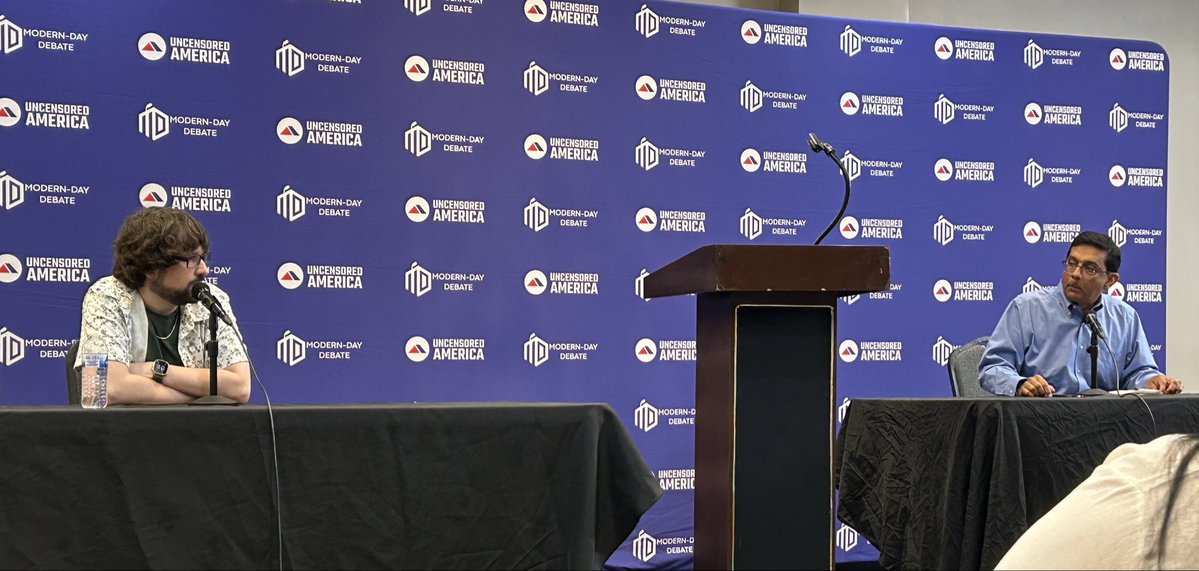
Lol @TheOmniLiberal quote talking about @hasanthehun "You failed the easiest GED trolly problem in history, which was Harris vs. Trump, how the fuck can you complain about the outcome now?"
@GovanJones Also, the whole "don't take God's name in vain" thing I assume was meant to apply to what you just said. Using God's name to advance your agenda, not just saying his name out loud like people think.
One thing I’ve noticed in political debates is that people are often far more confident in their conclusion than in any of the claims supporting it.
They’ll make a point, concede it when challenged, then move to another point and concede that too. By the end, none of the individual claims survive scrutiny, yet their confidence in the overall conclusion hasn’t changed.
It’s as if a hundred weak arguments somehow add up to one strong intuition.
Politics seems especially vulnerable to this. A pile of suspicious stories, half-remembered statistics, and unverified anecdotes can create the feeling that “there must be something there,” even when each individual piece falls apart.
The conclusion survives because it was never really resting on the evidence. The intuition came first, and the evidence was collected afterward from anything that seemed to support it.
There’s a weird asymmetry in how people talk about atheism and religion. A lot of people hear “atheist” and assume it means: “I’m 100% certain there is no God.” But saying you’re agnostic often goes too far the other direction and implies you could lean either way.
But we don’t apply that same standard to religious people. Many Christians would admit they aren’t absolutely certain God exists if you pressed them on it. They still identify as Christian because they think it’s most likely true, not because they’re absolutely certain.