Sharing some of my diligence regarding $PEPG, which helps explain why I remain quite bullish into the 10mg / kg MAD readout. I may share more if I have time to get the rest into a distributable format and think it adds something.
The headline takeaway is twofold. One, I think the outlier in the 5mg / kg MAD has little bearing on its chances of EDODM1 continuing to show best in disease efficacy in the higher MAD cohorts like it showed it in the SAD cohorts. Two, I think the EDO51 safety data and how it has tracked with EDODM1 substantially increases the likelihood there will be no SAEs at the 10mg / kg MAD dose for EDODM1, and EDODM1 will deliver a strong and commercially competitive safety profile.
$PEPG is a one drug company, early stage, and the most advanced drug in its class. So, efficacy and safety risks will always exist and can never be fully ruled out. If EDODM1 fails, it's over and the stock will be crushed, albeit perhaps some value can still be extracted from the remaining cash balance given the heavy institutional ownership and sway over management. This remains a very risky investment.
However, if it's successful, I would say that it is at least a 10x return from current levels, possibly a good bit more, especially with a buyout premium, and I think the probability of a strong 10mg / kg MAD make the company highly compelling at currently trading levels if position is appropriately sized.
Thread below:
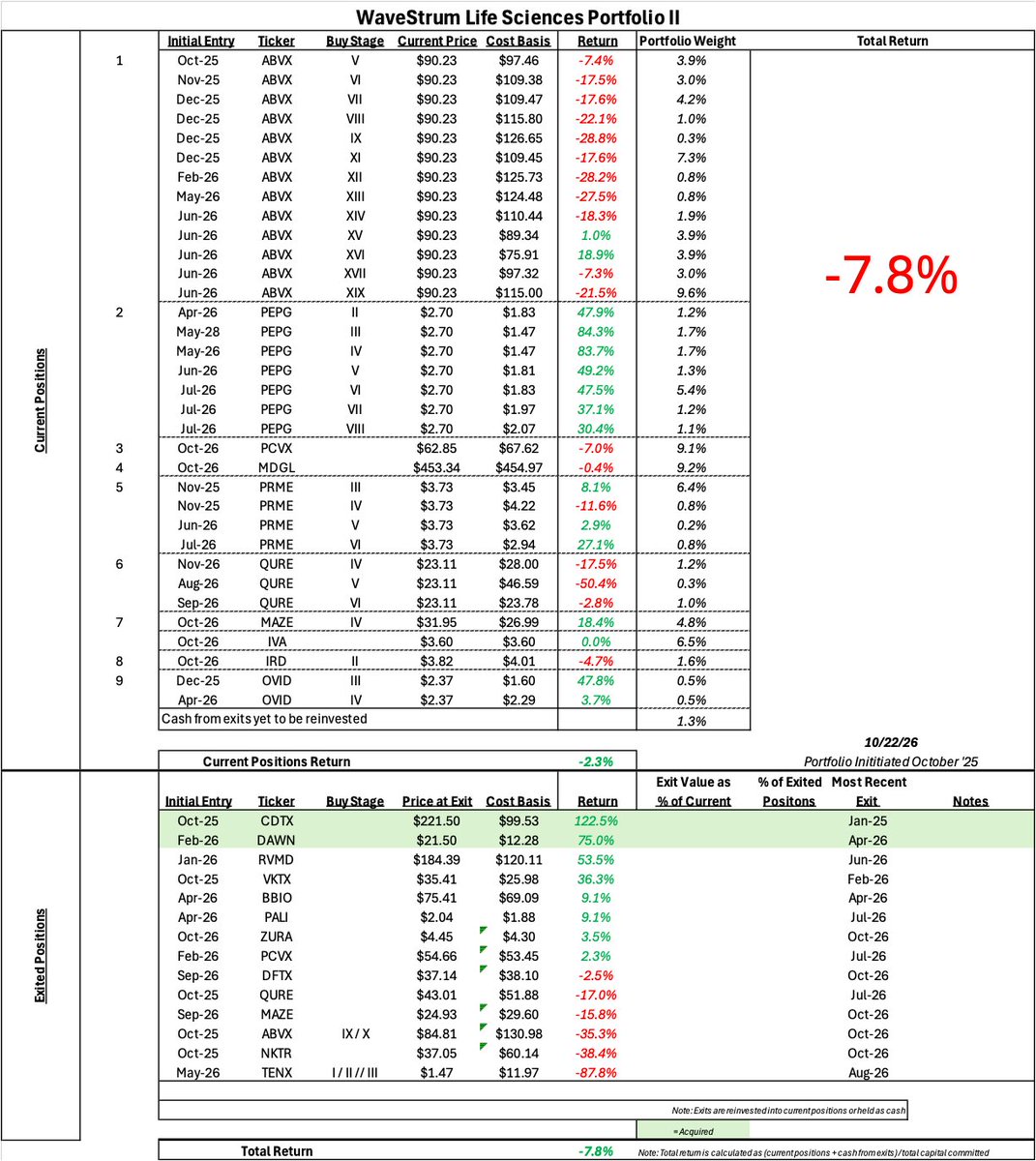
Time for a portfolio update.
TL;DR $ABVX and $NKTR seriously tanked the portfolio since the last one ($TENX was also an L but that was a small position so was quite a small contribution). $PEPG, $QURE, and $IVA are really critical readouts coming up in the next few weeks that are likely to move the portfolio substantially, one way or another. Wanted to put out where things sit ahead of then for accountability
As noted previously, majority of capital was committed many months after each portfolio's start date, so start dates are somewhat misleading in that regard (e.g. for WSLS II about 40% of capital...a lot of it $ABVX post-cancer freakout... committed from May 2026 onwards). Probably going to combine them into one and have a better display layout when I have time, don't really want to do a more classic time weighted approach here bc I think that would paint a rosier view of performance than is warranted.
_______________________
Re $ABVX, my brilliant strategy of loading up time and again since Fall 2025 with more and more non-biotech allocated capital because hey the market will totally figure it out this time and you know I think I'll be able to flip that into other positions with readouts further out, plus its really derisked and probably getting bought anyways, and where else can you find an opportunity like that in the market has all worked out about as well as you would think...pretty terribly. WSLS II in particular is really living or dying by the VAX at the moment.
However, I have continued to hold basically my full position, with the exception of selling a small silver to get a little tax loss harvesting motion going (cope) and free up a little capital for some diversification in an ugly market and to play a few nearer term binaries.
I made a judgment call on $NKTR pricing dynamics that there was a reasonable probability there would be little buying support after it nose dived following off treatment data based on the broader market conditions, the apparent lack of confidence in management across the Street and the lack of near-term catalysts, and closed out a big part of the position.
I took that capital and did the following:
I took a position in $ZURA on the basis of Adam's really thoughtful work. All of the arguments made sense to me for why IL-17A was the critical driver of Bimzelx's superior efficacy. However, I became concerned about tibulizumab's IL-17A target engagement in vivo. Briefly, my concern arises from the fact that a) tibulizumab's binding affinity is 14pM to ixekizumab's 1.8pm in vitro b) I think there is a risk that the very high concentrations of BAFF in vivo relative to IL-17A further interfere with target engagement w/ IL-17A, perhaps as may have happened with sonelokimab and IL17-F, recognizing $ZURA's bispecific has two ends so this view is predicated on things like aggregation dynamics, membrane bound BAFF etc and c) the only in vivo metric of target engagement w/ IL-17A I have been able to find across the IL-17A antibodies / small molecules is an increase in Total - IL17A and cosentyx and tibulizumab show a similar ~50x ish increase (see 2020 article in Dermatology) (https://t.co/iflzpI1cB1, https://t.co/1bZlvsBCle).
Increase in Total IL17-A is a really imperfect metric, and is highly susceptible to measurement error at baseline, differing clearance rates, etc. which could all seriously mess with results.
However, collectively that represented too much risk for me to want to take on, especially given the important upcoming binaries with 10mg / kg MAD for $PEPG, $QURE's BLA filing decision, and $IVA (more on that later). So, I sold the position for a tiny gain. Depending on how $ZURA reads out, might be back in for SSc.
I went back into $MAZE in reasonable size.
I opened a position in $IVA (some brief commentary here: https://t.co/wniXbERfZH)
I went back into $PCVX after it dumped into the 60s following data.
I opened a position in $MDGL.
The thought process with $PCVX and $MDGL was basically these late stage companies got torched from their highs in a manner somewhat akin to $ABVX. If you believe this reflects short term pricing dynamics that don't reflect underlying value (degrossing, etc.) but have hit quality names really hard, at some point that will turn around and so you’ll get more of a return than you should for a company at this stage, while not exposed to drug failure / trial risks the same way. For $MDGL, I also used it as somewhat of a hedge against $IVA. If $IVA fails and sentiment swings back in favor, I expect $MDGL will rise and hopefully offset some of the $IVA loss. If $IVA succeeds, my hope is that it will have relatively minimal impact next to the $IVA gains.
I further increased my $QURE position after the 4 year data. I have written about this elsewhere but the likelihood that this is having disease modifying effect is near certain in my opinion based on the totality of data. If that's true, I think it should be approved.
As mentioned, if $PEPG, $IVA and $QURE do what I hope they do in the next few weeks, we hopefully will be back on a good growth path with the port. If not, that will suck.
I do continue to believe for all the many reasons previously discussed that $PRME has the kind of upside potential to be a true marquee VC style investment wherein everything else could get crushed and, if it reaches its full potential, the portfolio still delivers beats the market over the long-term. (And as always, I think its very derisked at this price sans a black swan safety event given the $VERV acquisition at the depths of the bear market for 1 - $1.3Bn, the actual platform nature of the technology, the evolving FDA approval environment that favors said platform, etc.)
I was in and then out of $DFTX, decided I liked other opportunities better
Long $IVA, $IRD, $MDGL, $PCVX, more $MAZE and more $QURE over the past couple of weeks. Sold a bunch of $NKTR to fund. Will post portfolio update over the weekend
Re $IVA ..
Dr. Ralph DeFronzo (his work was a big part of why I was skeptical of $WVE's obesity play) has discussed in a number of public forums and written a lot on the ppar-y agonist pioglitazone as a standalone therapy and as part of a combo therapy (which includes an old school GLP-1 exenatide on top of metformin) in diabetes (65ish% of T2D patients have MASH). Worth a listen, as liver dysfunction is a key part of insulin resistance / diabetes and I think provides good insights into how ppar-y interfaces with both the liver and the multiplicity of systems that effect the liver.
The below papers speak to the likely impact of GLP-1's on the minor weight gain that was seen in previous trials of ppar-y agonist pioglitazone
Standalone Therapy: In ACT NOW pioglitazone demonstrated a significant average weight gain of 3.9kg over .77kg placebo. (https://t.co/YghjM7ByOU)
Combo Therapy: The EDICT Trial which combined pioglitazone, metformin and exenatide demonstrated a 1.3kg weight gain over .6kg placebo at 3 years (39% lost weight).
(https://t.co/WU7xWGemYN)
Different patient populations and cross trial comparison caveats. However, given how much stronger the current GLP-1's are than exenatide, I would expect any associated weight gain to be entirely mitigated in current GLP-1 users (who have been allowed to participate in the trial and will have a sub-group analysis).
This sits on top of a few other constructive facts:
- 51% of patients in the $IVA PhaseIIb trial having stable weight or weight loss with standalone therapy
- $IVA's drug shows meaningfully less weight gain than historical ppar-y agonists like pioglitazone
- SGLT2i's in combo w/ ppar-y agonists have historically shown weight loss and the LEGEND study confirmed SGLT2i's mitigate weight gain with $IVA's drug as well, I think any worries about weight gain have a pretty low-risk of being a commercial concern. (https://t.co/crMrEwmpox)
- Any reported weight gain is really more of a weight redistribution, less visceral fat, etc, combined with fluid retention anyways
@jasonryanmd Yes very much agreed that was the biggest failure. Especially bc the whole approach didn’t make sense on multiple levels just reasoning from first principles (tissue fluid contamination w/ a pin prick, hemolysis, etc)
I’m watching The Dropout on Hulu about Theranos and Elizabeth Holmes and maybe this is all hindsight but I can’t believe people weren’t more skeptical of the tech. She had zero scientific or medical background. Sad commentary on human gullibility.
There is certainly precedent for triple therapy working best in other chronic diseases w/ multi-vector pathophysiology!
EDICT Trial: https://t.co/UWqspdilXd
https://t.co/OrkY6HDEKh (DeFronzo..inventor of SGLT2i's, brought metformin to the US..pretty handily refutes Nathan's counter argument here imo)
https://t.co/vZdQGlF40s
Here's some more work by DeFronzo that I think is a good foundational paper to read on underlying T2D diabetes mechanism, which will drive a lot of what's going on in MASH. Thought I included this initially and forgot: https://t.co/MRBWl06x1K
Should be open access
Here's some more work by DeFronzo that I think is a good foundational paper to read on underlying T2D diabetes mechanism, which will drive a lot of what's going on in MASH. Thought I included this initially and forgot: https://t.co/MRBWl06x1K
Should be open access
Long $IVA, $IRD, $MDGL, $PCVX, more $MAZE and more $QURE over the past couple of weeks. Sold a bunch of $NKTR to fund. Will post portfolio update over the weekend
Re $IVA ..
Dr. Ralph DeFronzo (his work was a big part of why I was skeptical of $WVE's obesity play) has discussed in a number of public forums and written a lot on the ppar-y agonist pioglitazone as a standalone therapy and as part of a combo therapy (which includes an old school GLP-1 exenatide on top of metformin) in diabetes (65ish% of T2D patients have MASH). Worth a listen, as liver dysfunction is a key part of insulin resistance / diabetes and I think provides good insights into how ppar-y interfaces with both the liver and the multiplicity of systems that effect the liver.
The below papers speak to the likely impact of GLP-1's on the minor weight gain that was seen in previous trials of ppar-y agonist pioglitazone
Standalone Therapy: In ACT NOW pioglitazone demonstrated a significant average weight gain of 3.9kg over .77kg placebo. (https://t.co/YghjM7ByOU)
Combo Therapy: The EDICT Trial which combined pioglitazone, metformin and exenatide demonstrated a 1.3kg weight gain over .6kg placebo at 3 years (39% lost weight).
(https://t.co/WU7xWGemYN)
Different patient populations and cross trial comparison caveats. However, given how much stronger the current GLP-1's are than exenatide, I would expect any associated weight gain to be entirely mitigated in current GLP-1 users (who have been allowed to participate in the trial and will have a sub-group analysis).
This sits on top of a few other constructive facts:
- 51% of patients in the $IVA PhaseIIb trial having stable weight or weight loss with standalone therapy
- $IVA's drug shows meaningfully less weight gain than historical ppar-y agonists like pioglitazone
- SGLT2i's in combo w/ ppar-y agonists have historically shown weight loss and the LEGEND study confirmed SGLT2i's mitigate weight gain with $IVA's drug as well, I think any worries about weight gain have a pretty low-risk of being a commercial concern. (https://t.co/crMrEwmpox)
- Any reported weight gain is really more of a weight redistribution, less visceral fat, etc, combined with fluid retention anyways
Yes agreed w/ @Biolo_gic. If we assume a broadly similar percentage as seen in Phase IIb will show stable weight or better on lani monotherapy, and there’s a clear trend on GLP-1’s combo therapy, that should be enough. Plus again the weight gain you’re taking about here is a) not large and b) largely reflects a healthy / metabolically beneficial weight redistribution plus some fluid retention. From a pure metabolic health perspective doesn’t really matter
Very interesting, thanks for sharing! I hadn’t seen that study and had been more looking at it through the lens of better pioglitazone plus better GLP-1 should mitigate weight gain (and to your point you should actually see weight loss), plus I didn’t mention this above specifically but DeFronzo showed in that EDICT trial mentioned above that triple therapy in diabetes is far superior to monotherapy (again w/ pio plus weaker GLP-1), so tie that out with metabolic liver dysfunction being heavily implicated in T2D and 65% of T2D patients having MASH and would seem good probability it’s a winner
Frankly a little surprised it’s trading where it’s trading
Just read the abstract so I’ll read the study in full tonight
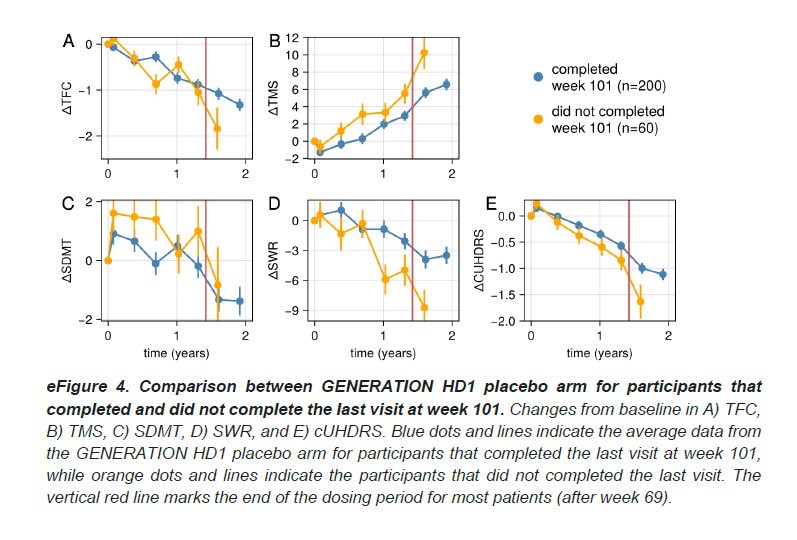
Yet ANOTHER datapoint indicating $QURE 's AMT-130 has disease modifying effect. Look at the drop off in cUHDRS in those who did not complete Week 101. Data point after data point after data point all point in the same direction.
And, the most notable data point of them all remains the updated 3-year data showing highly stat sig 80% slowing on cUHDRS and the stat sig TFC on both 3 AND 4 year, DESPITE the presence of dropouts in the control arm even at 3 year which of course will bias towards being the worst progressors.
Okay boys who is the asshole that went levered long $MRNA into ESMO and now has to sling their long book to cover?
That’s what’s happening right? Right!?!?!?
Hashtag always be coverin'
$ABVX
I think $PRAX is fairly likely to end up in the news in future years.
The Phase III studies were 8 weeks and 12 weeks respectively. That’s very short. The drug is a once daily oral drug. Easy to take.
Nevertheless, 35% and 38% of patients dropped out of the Phase III study vs. 5% on placebo. The most notable complaint was brain fog.
I cannot tell you how poorly set up these studies are to detect “brain fog” in a quantitative way beyond self-report. Same holds true for cognitive impacts or really any other deleterious brain insults in the short-term, and they of course can say nothing about the long-term.
However, “brain fog” and a 35-38% drop out rate w/ a 30%+ delta over placebo is a MAJOR red flag that there’s something going on here that patients really don’t like, and it comes on quickly.
This delta is particularly concerning because there are a lot of mechanistic reasons to worry about what this type of inhibition in the brain does long-term.
One warning sign I would look for is elevated conversion rates to PD.
Long-term follow up studies really should be run.
Actually pretty concerned about this given how prevalent ET is. Though, beta-blockers are bad news for the brain too.