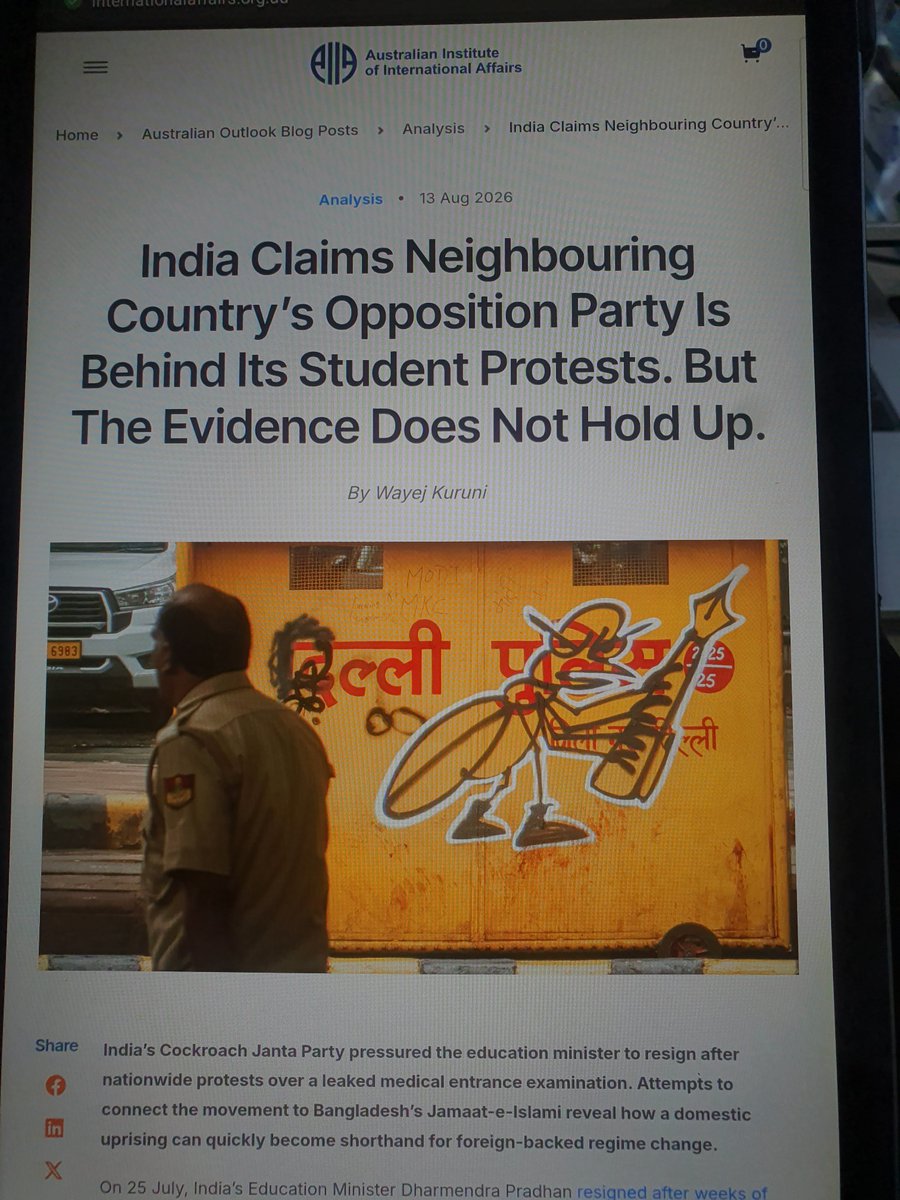
... what happens when the political memory of Bangladesh’s 2024 uprising becomes a framework through which unrest elsewhere in South Asia is interpreted? The evidence for foreign sponsorship, I argue, does not withstand scrutiny #India#Bangladesh#CJP
While condemning the recent police high-handedness and repressive measure against the protesters, let's recall how the same police treated th protesters and activists of anti-CAA movement. Year: 2020!
[Do you recall the video of the Police brutality from which the screenshot is taken and which is attached to this post?]
"When and where present, the police, instead of acting against the killers, attacked the unarmed, helpless people. For instance, the police kicked nine-month-pregnant Parveena in her stomach, beat her with a baton, and insultingly hurled the following:
“Yē lō āzādī” (here, take your freedom). "
"This was the police’s revenge against the protestors, many of whom had raised slogans for freeqom — such as from discriminatory policies and an unjust system as well as for fairness, equality, dignity, and justice. The complicity and culpability of the police were further evident from the brazen ways in which the mob, while coercing Muslims to chant the Hindu slogans,for instance, of Jai Shri Ram, shouted, "long live police" and ‘it is our administration, they are with us, it is our law.’ "
"To wipe out evidence, the police also broke CCTV cameras. In front of the police station in Bhajanpura, a Muslim mazar (mausoleum/shrine) of a saint was set on fire. "
Caption of the Photo
Screengrab of a video that went viral during the Delhi pogrom showing five severely injured men lying on a street while being beaten by men in police uniform and forced to sing the national anthem. All the injured turned out to be Muslim; one of them, Faizan, died on 27 February, two days after the incident.
My essay, "Violence after Violence: The Politics of Narratives over the Delhi Pogrom," from which the above is excerpted is accessible below.
https://t.co/eU2MrWbg8Z
An early version @project_polis
https://t.co/2R1wzKBEkC
@suchitrav
#protest #delhi #stduents #jobseekers #education #India #democracy
Mahremiyet aynı zamanda kimin bize, günün hangi saatinde ve ne kadar hızlı ulaşabileceği de mahremiyetin bir parçasıdır. Akıllı telefon çağında insanın yeniden savunması gereken haklardan biri, gerektiğinde ulaşılamama hakkıdır.
Wayej Kuruni yazdı.
https://t.co/hMkpNWSM5y
My new piece in *New Age* examines the Halala Center controversy, secret second marriages and shadow polygyny in Bangladesh, arguing from sociological and Islamic Shariah perspectives that nikah must not become a loophole for male desire without responsibility.
#NewAge#Marriage
The Hero Alom controversy was never only about bad singing. It exposed how Bengali secular culture treats Tagore as quasi-sacred and polices who is “worthy” to sing him. The anxiety was not that Tagore was sung badly, but that he was sung by the wrong body.
Link - comment section
Savaşlar sadece sınırları değil, ekonomik merkezleri de değiştirir. Ortadoğu’da risk algısı değişirken, Türkiye çok merkezli yeni düzende önemli bir alternatif olarak öne çıkıyor.
Among many other things, the BNP regime has apparently been following the old pattern of detaining citizens for exercising freedom of expression. This shows that it still lacks a new way of governing that can ensure its political continuity, similar to the former fallen regime. Prime minister Mr. Tarique Rahman has lived for nearly two decades in a “democratic” and “civilised” country where he enjoyed freedom of expression. This should not be forgotten so quickly.
This was the same system that continued until the July uprising, under which the BNP faced 15 years of political persecution; mass arrests of opposition activists, using the “ghost cases”, and laws to silence criticism.
It is not acceptable to arrest or detain anyone simply because they criticise the government.
After a hopeful democratic return, the old authoritarian practices should not be brought back under any excuse.
Human Rights Watch
#Freedom_of_expression
#womenrights
My opinion piece is published on a Bangladeshi prominent (Bangla) newspaper @samakaltw--discussed the ongoing debate and political crisis on July Charter, referendum, etc.
Link in the comment
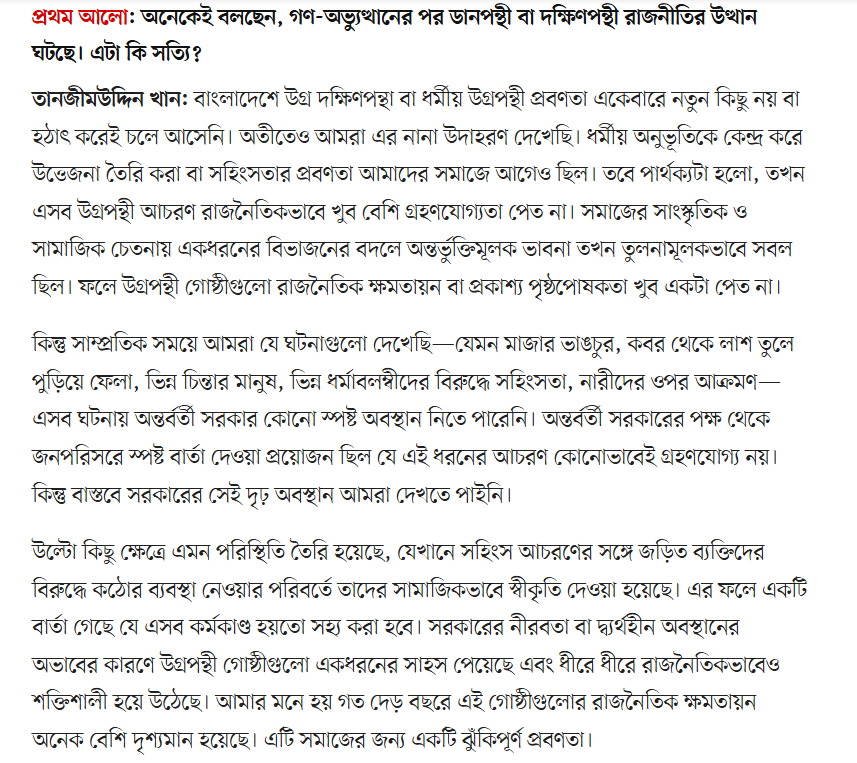
A recent claim says “extremists are politically empowered” in Bangladesh. But what does that mean? Social violence is real—but is it new, or newly framed? Without clarity, “empowerment” risks becoming a narrative tool, not an analytical one.












![IrfanHindustan's tweet photo. While condemning the recent police high-handedness and repressive measure against the protesters, let's recall how the same police treated th protesters and activists of anti-CAA movement. Year: 2020!
[Do you recall the video of the Police brutality from which the screenshot is taken and which is attached to this post?]
"When and where present, the police, instead of acting against the killers, attacked the unarmed, helpless people. For instance, the police kicked nine-month-pregnant Parveena in her stomach, beat her with a baton, and insultingly hurled the following:
“Yē lō āzādī” (here, take your freedom). "
"This was the police’s revenge against the protestors, many of whom had raised slogans for freeqom — such as from discriminatory policies and an unjust system as well as for fairness, equality, dignity, and justice. The complicity and culpability of the police were further evident from the brazen ways in which the mob, while coercing Muslims to chant the Hindu slogans,for instance, of Jai Shri Ram, shouted, "long live police" and ‘it is our administration, they are with us, it is our law.’ "
"To wipe out evidence, the police also broke CCTV cameras. In front of the police station in Bhajanpura, a Muslim mazar (mausoleum/shrine) of a saint was set on fire. "
Caption of the Photo
Screengrab of a video that went viral during the Delhi pogrom showing five severely injured men lying on a street while being beaten by men in police uniform and forced to sing the national anthem. All the injured turned out to be Muslim; one of them, Faizan, died on 27 February, two days after the incident.
My essay, "Violence after Violence: The Politics of Narratives over the Delhi Pogrom," from which the above is excerpted is accessible below.
https://t.co/eU2MrWbg8Z
An early version @project_polis
https://t.co/2R1wzKBEkC
@suchitrav
#protest #delhi #stduents #jobseekers #education #India #democracy](https://pbs.twimg.com/media/HN6jyI2XcAAVKBU.png)


