The high cost of politeness
This week, @build_canada, a non-profit organization with links to Canada’s entrepreneurial and start-up community, published a memo titled “Say It” that deserves credit for raising issues too few business-facing organizations have been willing to confront directly.
Its core argument is that Canada’s secular economic problems are real, serious, and compounded by a culture of avoidance and euphemism. As the memo puts it: “The cost of politeness is not zero. It compounds.”
That line captures something important about modern Canada. And Build Canada’s distinctive voice in our public policy debates.
Canada’s model of “Laurentian capitalism” is one in which governments provide protection and subsidies to certain industries and firms in exchange for them carrying out quasi-public functions like sustaining unprofitable news organizations or providing financing to marginal companies or households or maintaining transportation options to small regions and communities.
This proximity between business and politics can deter business leaders from speaking out against bad public policy and its economic and social consequences. Doing so risks unsettling the political compact that rewards them with protected markets or regulated profits. The incentive, therefore, is often to go along to get along.
The result is a permissive environment for policy drift, weak accountability, and economic underperformance. Governments face less pressure to reform because many of the actors best positioned to challenge bad decisions are also among those most invested in preserving the broader arrangement. Business becomes less a counterweight to state overreach and more a junior partner in its administration.
That helps explain why Canada can sustain persistently poor outcomes—weak productivity, slow business investment, housing scarcity, and declining living standards—without a commensurate level of elite dissent.
And make no mistake, policy failures are at the heart of many of Canada’s challenges. They were shaped in part by the Trudeau government’s sweeping policy experimentation, including elevated spending and chronic deficits, unsustainable immigration levels and a shift in favour of low-skilled immigration, and climate policies too often detached from competitiveness and affordability.
Build Canada is uniquely positioned to “say it” about these policies because many in its networks aren’t participants in the Laurentian capitalism model. They’ve built successful businesses despite government rather than because of it.
What makes Build Canada’s intervention healthy, though, isn’t just that they said something. It’s also what they said. It’s fundamentally a message of agency.
If misguided policies helped produce our current economic malaise, then sounder policies can restore growth, investment, and confidence. If we contributed to our own problems, we’re capable of solving them.
But that process starts with honesty. It requires acknowledging what has gone wrong, why it happened, and what must now change. It means being more candid about trade-offs and more ambitious about reform.
Build Canada deserves credit for pushing that conversation forward. Canada needs a renewed willingness to tell the truth—and then act on it.
Self recommending must-read for Canadians.
“The path Canada is on, economically and culturally, is no longer sufficient to make us a flourishing world class nation.”
Self recommending must-read for Canadians.
“The path Canada is on, economically and culturally, is no longer sufficient to make us a flourishing world class nation.”
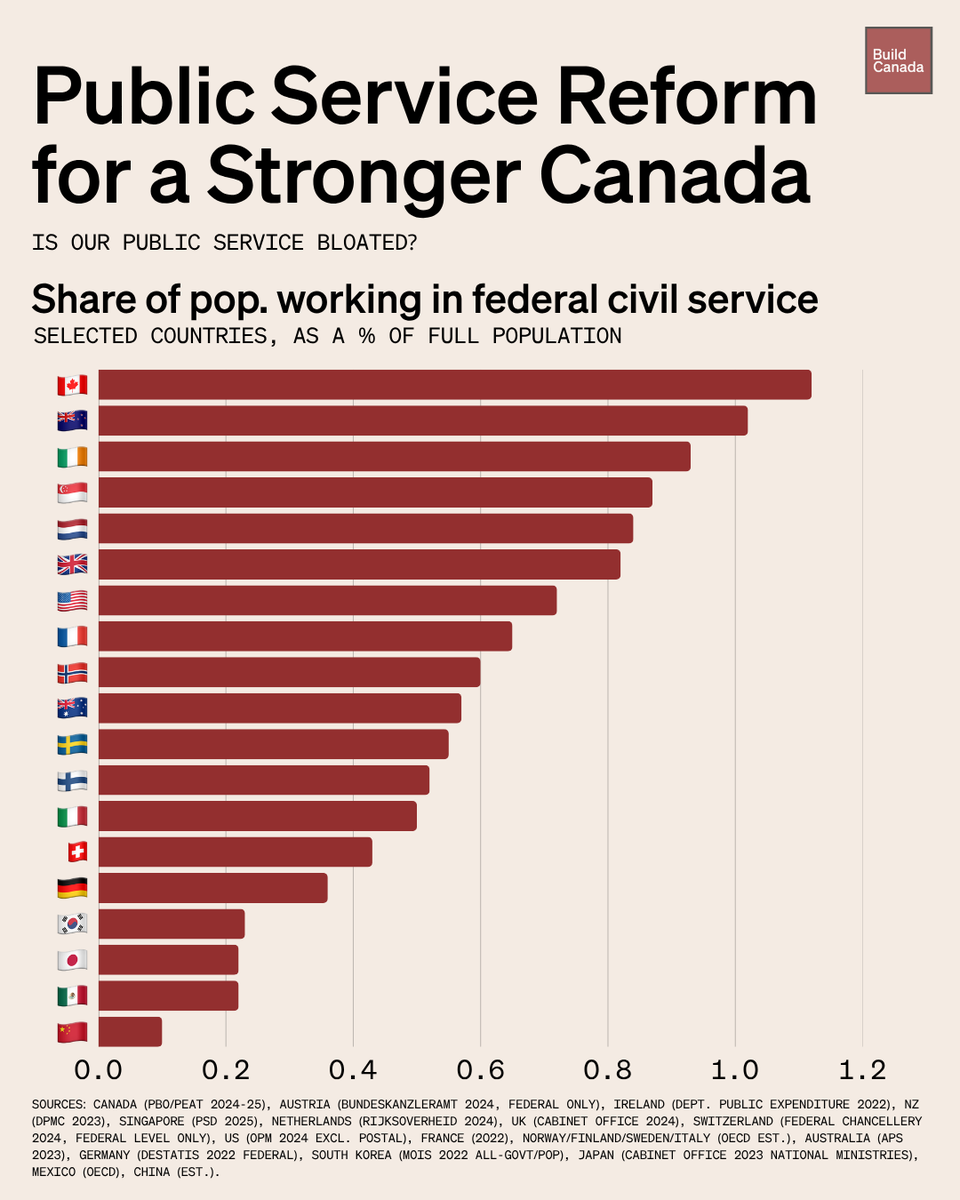
Our federal public civil service headcount has grown 31% in the last decade.
Per capita, that's more than anywhere in the (core) G7.
Despite this, only 16% of Canadians say they receive good value from government services.
We can reform 🇨🇦's federal public service. 👇
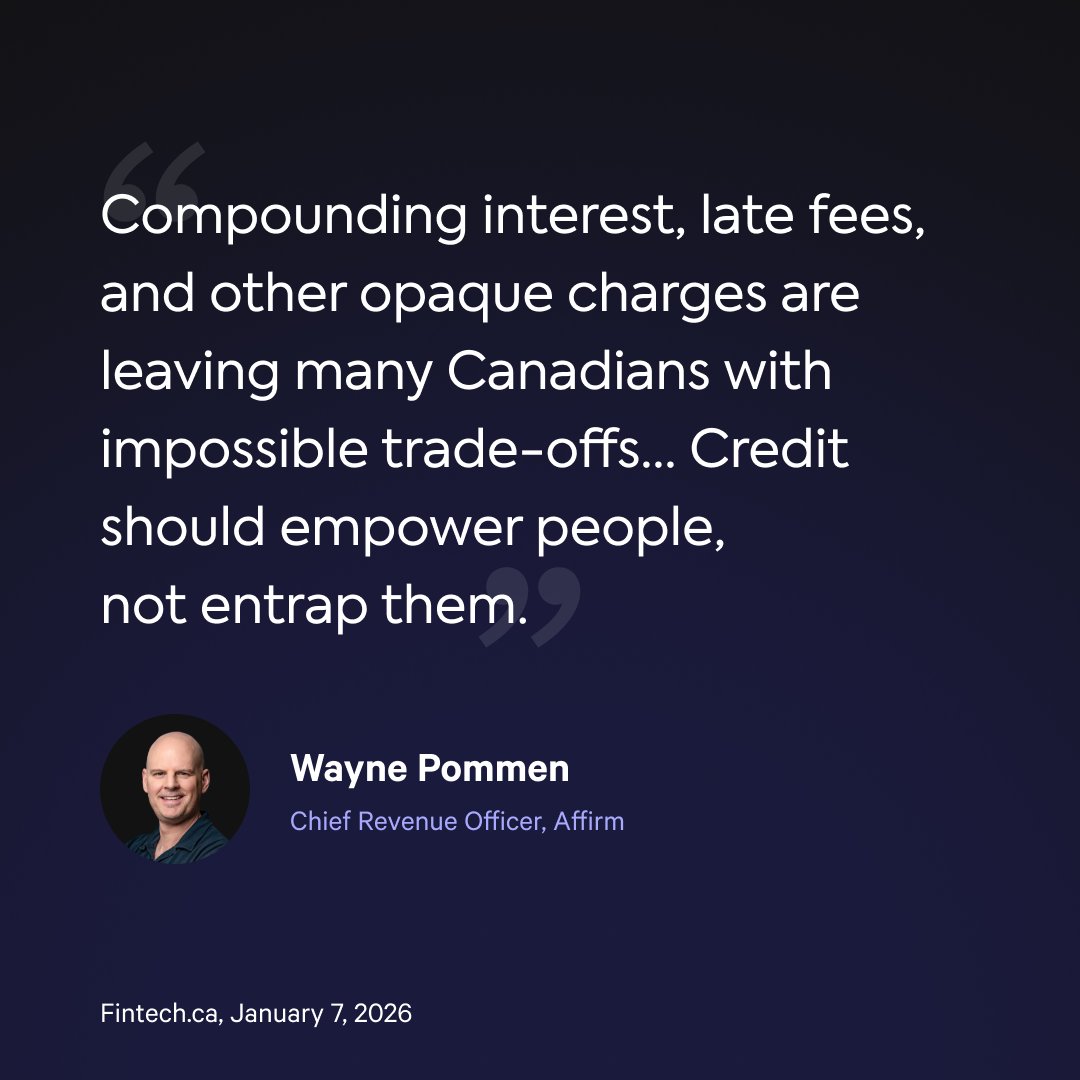
Just in 🗞️🇨🇦 Affirm CRO Wayne Pommen shared his thoughts on the future of Canadian credit with @FintechCanada and why credit “should empower people, not entrap them.”
More below 👇
My conversation with @WaynePommen, the Chief Revenue Officer at @Affirm!
Affirm is a fintech company specializing in buy-now-pay-later solutions, enabling consumers to split purchases into affordable installments.
Founded in 2012 by PayPal co-founder Max Levchin, it partners with thousands of retailers to offer flexible payment plans. Its transparent terms and no-hidden-fee approach aim to provide a consumer-friendly alternative to traditional credit.
We discussed...
- Transitioning to CEO: The Learning Curve
- Early Days of PayBright: Landscape and Opportunities
- Catching the Ecom Wave
- The $340M Acquisition by Affirm
- Integration and Staying at Affirm
- Lessons from Max Levchin
- Moral Integrity in Consumer Finance
- The Future of BNPL
- The Evolution of Consumer Credit
- Partnerships With Amazon, Shopify and More
- Navigating International Expansion
- The Affirm Card: Becoming Top of Wallet
- Advice for Founders: Thinking Bigger
On all listening platforms
https://t.co/MG63nsOrat
Affirm CRO Wayne Pommen spoke w/ @RetailInsider_@MTone123 about the lessons he learned as a competitive rower 🚣 & how these helped guide his professional career in consulting & private equity, before serving as Paybright CEO & eventually joining Affirm. https://t.co/1rg1ERVgwv
What do you do when the two candidates for Prime Minister don't have a platform for the public to see? Make one in realtime, using their own words!
Here's how we did it 👇
🔥🔥🔥BREAKING🔥🔥🔥
The new Canada Spends platform is live!
We’ve redesigned the site from the ground up - with powerful, interactive visuals and clearer breakdowns of how your tax dollars are spent, department by department.
Transparency has never looked this good 🚀🤩🚀
Check it out! 🔗 in 🧵
It's time to give Canadians control of their data.
This will increase competition and lower pricing across a host of industries. Let's start with financial services, where progress has begun on open banking, but work remains. Let's get it done!
See my new @build_canada memo 👇
My turn. Today, @build_canada released the 11th memo. I poured decades of experience fighting a very difficult telecom oligopoly to provocatively change the narrative to prioritize consumers and small businesses. Let's build.
This should be extremely concerning to all Canadians. The federal civil service has suffered from organizational and cultural decline, and it's leading to a loss of state capacity. Fixing this needs to be a high priority for the next government.
The most shocking thing so far about @build_canada are the multiple senior civil servants (current & retired) who have reached out to say things like:
"You wouldn't believe the mess"
"We need to cut 100k [federal employees] much faster than suggested"
"My team [of regulators] didn't care at all about the business outcomes or competitive impact of the regulations they promoted. They didn't want me to even mention industry impact."
"We knew we had fentanyl problems way before Trump told us, but we didn't do anything about it"
"Government will always be somewhat inefficient. But it's now become ineffective - it can't carry out lawful direction of ministers in some cases."
"not one person under me had the technical skill to evaluate the programs - and billions of dollars - we were spending on"
"You can't fire anyone in the Federal gov't so why bother?"
"Everything starts and is focused with a EDI lens. You can't do anything without Gender-Based Analysis+. The mission comes second."
"Risk tolerance is so low its led to paralysis"
"Follow the rules, forget about the outcomes"
"It took 2 years and 30% of another managers time to terminate one seriously underperforming person".
"My performance has never been assessed on program outcomes. Instead, its politics."
To me, these calls are shocking.
These are not ideological partisans. They care deeply about public service. They don't want to "run gov't like a business". They just want good government, run well & effectively in the service of Canadians. It's not that right now.
In private conversations they have shared that @build_canada is pointing at issues that urgently need attention for Canada to thrive.
"A country that can't build is a country that is falling behind".
"We fix this by doing things right."
We have to "restore the belief that Canada can dream big and deliver."
🏗️🇨🇦 fan 💌
“In these unsettling times I am very worried about the future of our country.
Groups like you give me hope.
When a friend asked me today "where are the Canadian patriots?", I pointed to your https://t.co/AdpqXMTEfe site.
So thank you and please continue your work. “
🙏🙏🙏🙏🙏🙏🙏🇨🇦🍁🇨🇦🍁🇨🇦
Encouraging news if true, but we need to go one step further and streamline differing regulations and standards.
If it's good in one province, it should be good in all.
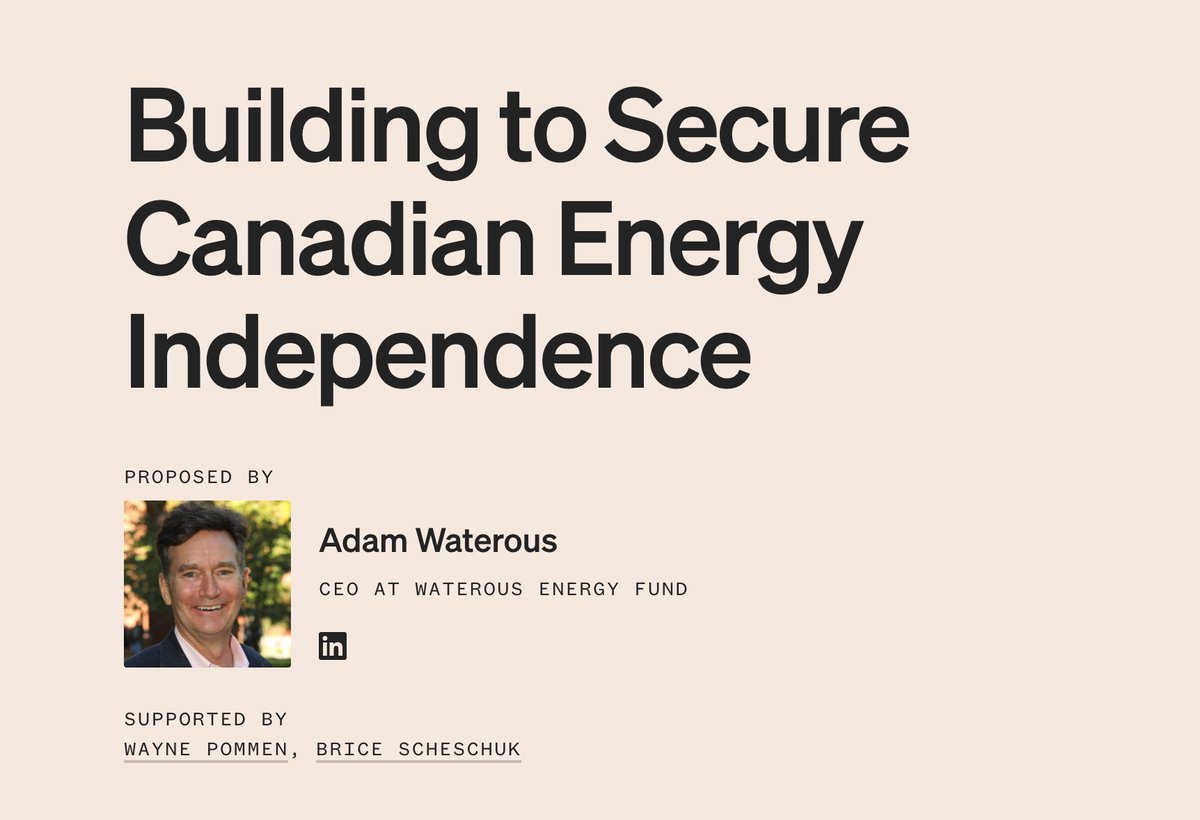
Canada cannot afford to be held hostage to changing geopolitics. We need to be able to easily access and sell Canadian energy.
A lack of pipelines and infrastructure means we are unable to fully transport or refine our oil and gas domestically.
This means we are forced to sell 96% of our crude oil to the US at a steep discount and then buy back refined products at a premium. This has left us dangerously dependent on a single partner, meaning that any tariffs will cost us billions. At the same time, other trade partners have come to us urgently seeking partnership.
Let's fast-track critical infrastructure so that we can easily access and sell Canadian energy globally:
- Immediately issue Orders in Council to push for high-priority projects specifically the expansion of TransMountain, construction of Energy East and Northern Gateway.
- Amend the National Energy Board Act and Impact Assessment Act to streamline approvals, reducing the average timeline from years to months. This will remove unnecessary regulatory bottlenecks while maintaining rigorous environmental standards.
- Establish the Emergency Energy Infrastructure Office (EEIO) as a centralized agency to coordinate federal, provincial, and private sector efforts. This office will be mandated to cut bureaucratic delays and ensure immediate action on critical projects.
- Mandate a 90-day approval timeline for essential projects by replacing sequential reviews with concurrent risk-based assessments focusing on unique risks versus standard or common risks mitigated through established processes.
- Create an Indigenous Partnership Acceleration Office to accelerate consultations by providing funding and capacity to ensure meaningful participation, clear decision-making and equitable economic benefits for Indigenous communities, respecting historical rights and title.
- Maintain accountability by establishing quarterly progress reports to Parliament and create a public energy infrastructure dashboard tracking project timelines and completion rates.
With immediate action, Canada can begin exporting greater volumes to new markets within 36 months. This is not just about oil and gas, it is about economic security, job creation, and the long-term strength of our nation.
Success builds on success: we are excited to expand our amazing partnership with @Shopify to their home base 🇨🇦 and to set the stage for 🇬🇧 and beyond! Thank you for the trust and extraordinary collaboration, @tobi, @harleyf, and @nejatian.
https://t.co/TxQGXwcbKe