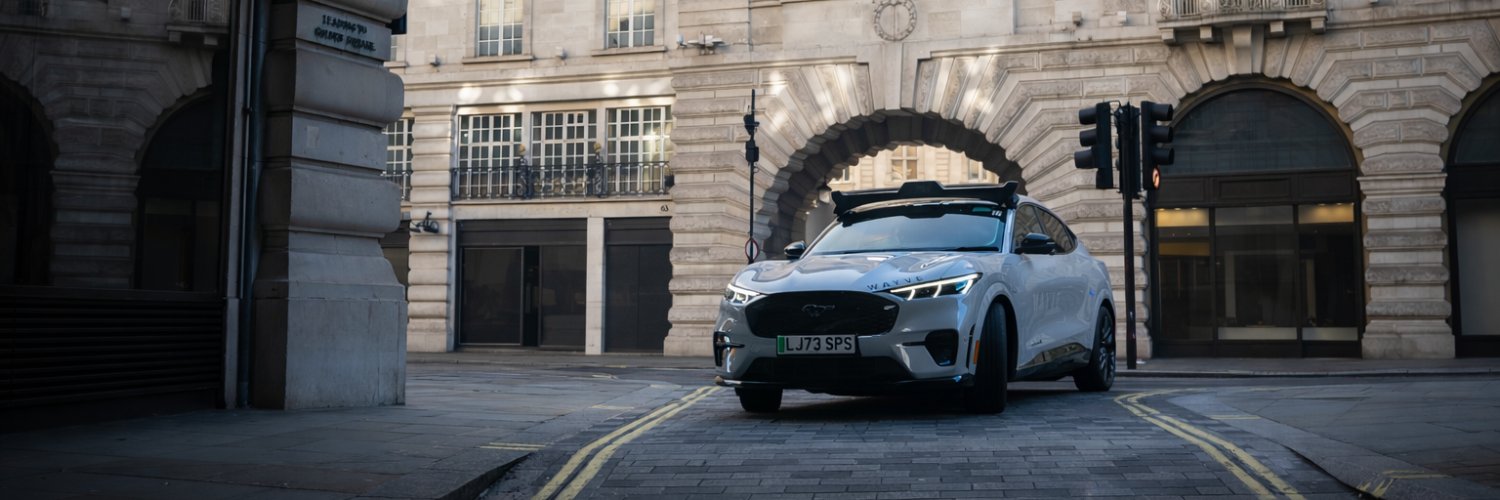
Since 2017, Wayve has been developing end-to-end embodied AI to help AVs handle the long tail of driving: situations that can’t be anticipated in advance through maps or hand-written rules.
As we bring the AI Driver to production with our partners, the question is no longer “can end-to-end AI work” - it’s how we build and validate safety at global scale.
Today, we’re sharing how we approach that challenge through Learned Safety.
Together, these pillars are designed to make validation scale with data, generalize across platforms, and support trustworthy products across all levels of autonomy. Find out more 👇
https://t.co/omiEc6hDyu
1/4 For end-to-end AI to scale, how we evaluate it has to keep pace. Validation 2.0 is our approach to this challenge, built on three key pillars.
GRADER is a learned reward model that evaluates driving across geographies, vehicles, and operating domains, without a hand-coded rule for every variation.
3/4 Statistical evidence transfer helps carry relevant evidence across software releases, vehicles, and conditions. In an internal analysis, customer fleet data reduced the validation data needed for a new release by more than 20x.
"The way that we've built the driving stack is with safety as an intrinsic property vs. an extrinsic bolt-on property".
Revisiting Brandon Basso on @MTSlive last week, where he explained our learned approach to embedding safety in our AI Driver, visualized through the Wayve LSE.
Excited to be featured in the inaugural 2026 AI 100, in a year that's seen us scale our AI Driver to even more partners, vehicles, platforms, and cities. Recongition of the end-to-end approach we've been pioneering since 2017.
Thanks @NewcomerMedia and @BessemerVP for including us alongside some amazing companies.
https://t.co/wvdpeXI4oK
The AI Driver combines this risk anticipation with distinct driving and self-awareness tasks.
All three draw on a shared understanding of a scene, giving end-to-end AI something people often assume it cannot have: real, auditable roles, without fragmenting the driving architecture.
Read more on how we embed safety into driving behavior: https://t.co/oLMumFc9pv
Meet the Wayve Learned Safety Envelope (LSE) ✉️
Learned from driving data, the Wayve LSE provides a live visualization of risk around the vehicle, showing which actions the AI Driver judges safe or unsafe at that moment and how much margin is available.
An end-to-end learned approach means the AI Driver can respond to partial evidence, like a cyclist emerging from behind a parked car, before they’re fully visible, instead of waiting for a complete object to match to a predefined rule.
Thank you, Governor Koike and @Tokyo_gov, for visiting our London HQ and riding with our AI Driver on London’s streets. A privilege to exchange ideas on the future of urban mobility. 🇬🇧 🇯🇵
A glimpse of tomorrow's commute.
Governor KOIKE took a test ride in Wayve’s autonomous vehicle in London. Wayve is pursuing the rollout of robotaxis while seeking to balance innovation with existing jobs. The visit explored its potential to address urban transport challenges.
Today we announced a multi-year agreement with @wayve_ai to train its AI Driver's foundation models on CoreWeave Cloud.
Wayve will track, evaluate, and compare every model on the Coreweave platform. None reaches the road until it beats the one already there.
That's how every fleet mile makes the next model version measurably better. https://t.co/u5LhFMyQOd
Wayve's Brandon Basso demos how its self-driving AI learns what safe driving looks like, rather than relying on HD maps and external safety checkers:
"The way that we've built the driving stack is with safety as an intrinsic property vs an extrinsic bolt-on property."
"Lots of systems have high-definition maps that are really like checkers. What if the stop sign isn't there? What if it moved? What if there's a temporary stop sign? What if the stop sign is connected to a bus that's moving?"
"The checker systems tend to be the ultimate bottleneck and limit of system performance."
"What you see on the screen here is a learned representation of safety. You can think of this as like a future occupancy map. The red areas are the don’t drive in areas."
"We use this system not as a bolt-on checker, but as an explicit head, a task that we learn, on how to drive safely."
@wayve_ai
Since 2017, I've been repeatedly told that end-to-end AI can't be safe, and traditional rule-based systems are required for autonomous driving.
But we persevered. Today we are releasing our strategy for Learned Safety, the result of a decade of research.
https://t.co/WHOslJ5sZx
Wayve's Brandon Basso argues self-driving cars face the same fundamental AI safety challenge as OpenAI and Anthropic, except the consequences play out in the physical world:
"The status quo today for driving is not great. It is a very risky thing that we do."
"We have this novel approach to self-driving that we refer to as AV 2.0 or end-to-end systems, and there hasn’t been a lot of rigorous thinking yet about how we prove the safety of those systems."
"It's exactly the same problem that folks at Anthropic and OpenAI think about when they're thinking about frontier safety. It’s the same problem but the physical interpretation of it."
@wayve_ai
Learned safety, scalable validation, and richer understanding each play a part in building trustworthy embodied AI.
Explore how these ideas come together in our approach to end-to-end learned safety.
https://t.co/ghU7tIuJsb
Since 2017, Wayve has been developing end-to-end embodied AI to help AVs handle the long tail of driving: situations that can’t be anticipated in advance through maps or hand-written rules.
As we bring the AI Driver to production with our partners, the question is no longer “can end-to-end AI work” - it’s how we build and validate safety at global scale.
Today, we’re sharing how we approach that challenge through Learned Safety.
Language can help an AI Driver understand unfamiliar situations, anticipate hazards, and inform intent, like we first explored with LINGO. The challenge is turning that intelligence into measurable safety benefits.
A plausible chain of thought doesn’t prove that the action was caused by the stated reasons, that the trajectory is physically feasible, or that the system will remain safe when language is late, ambiguous, contradictory, or wrong.
Language should ride “shotgun,” complementing learned safety capabilities and rigorous validation of the complete system; it doesn’t replace them.
https://t.co/T8auEBMbt1