$WEALD is now live on Pons, on Robinhood Chain.
WEALD is programmable liquidity infrastructure built around user-owned Uniswap V3 positions.
Create single-sided Groves, define how price should move through your range, and optionally set onchain exit rules with TWAP confirmation, expiry, minimum output protection, and revocable approvals.
A few things WEALD is built for:
🟢 Single-sided concentrated liquidity
🟢 Gradual onchain range orders
🟢 User-owned V3 LP NFTs
🟢 Verified market discovery
🟢 Programmable auto-close conditions
🟢 New V3 market creation and liquidity bootstrapping
🟢 Permissionless execution, without giving up custody
The idea is simple:
🟢 You define the strategy.
🟢 Your wallet keeps the position.
🟢 WEALD handles the execution logic.
Official info:
Website: https://t.co/hoJApipfqn
X: https://t.co/X2WbvG5Fee
Pons: https://t.co/b5fC0ot9vc
CA: 0xf0D4453a74581B4Fa074a062b684cf120f875722
Robinhood Chain liquidity infrastructure, taking root.
DeFi becomes more useful when intent is explicit.
Which range? How long should price hold? When does the rule expire? What is the minimum acceptable output?
WEALD turns each answer into a bounded transaction.
Hello! Current $WEALD utility is straightforward:
🌳 $WEALD serves as a routing asset across its crypto and tokenized RWA pools. Aggregators can route trades through it when that path offers better execution.
🌳 Grove creation and optional automated-exit fees support $WEALD buybacks and burns. LP trading fees remain with liquidity providers.
🌳 The token is the live liquidity hub demonstrating WEALD’s routing infrastructure on Robinhood Chain.
We are also evaluating additional utility, including sustainable protocol revenue sharing.
Deep-rooted liquidity turns $WEALD into routing infrastructure. 🌿
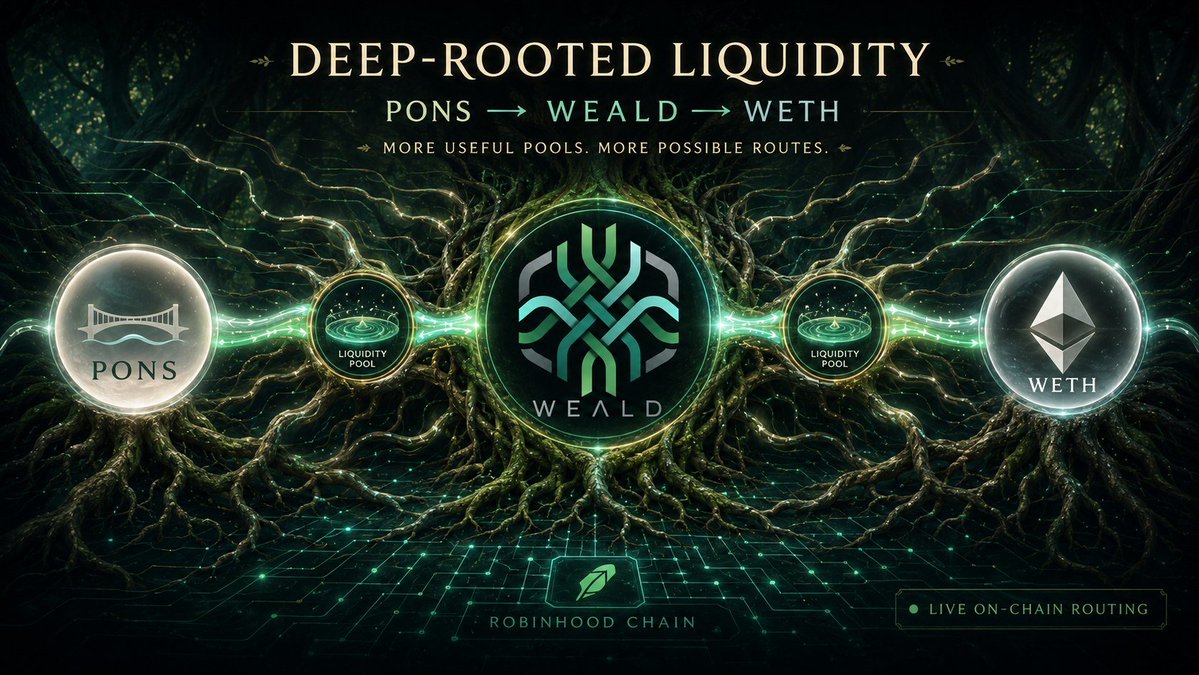
A trader might request PONS → ETH, while an aggregator finds a stronger path through PONS → WEALD → WETH. That trade can cross two WEALD pools, creating volume and LP fees even though the trader never selected WEALD.
Each additional WEALD pair opens another possible route across Robinhood Chain. When our liquidity offers better execution, aggregators can send trades through those roots.
More useful pools mean more opportunities for WEALD liquidity to serve the whole ecosystem. Every path is visible on-chain through our live Routes page.
A brief wick should not be enough to trigger an automated liquidity exit.
WEALD checks two views of price before an auto-close becomes eligible:
• the current spot tick must be beyond the stored boundary
• the pool’s time-weighted tick must also be beyond that boundary for the configured confirmation window
Spot answers “where is the pool now?” TWAP answers “where has the pool been over time?”
Requiring both makes a one-block excursion insufficient on its own. If price returns inside the boundary, the confirmation state resets and the sustained-crossing condition must begin again.
TWAP is still not a universal oracle guarantee. Its quality depends on pool observations, liquidity, window length and market conditions. Thin pools can be easier to influence, and a pool without sufficient observation history cannot satisfy the read.
The mechanism has a focused goal: turn “price touched the line” into “price crossed the line and remained there long enough to meet the owner’s stored rule.”
@gg_0xxx Hi. They return directly to your wallet as the two underlying pool assets. The exact amounts depend on the pool price and your position’s range when you withdraw.
WEALD liquidity is planned against HOOD, NVDA, SPY, GLD, TSLA, AAPL, COIN, RDDT, GME and seventeen more markets.
Each competitive WEALD/RWA pool can become another potential route through Robinhood Chain’s wider onchain economy.
An ordinary WEALD → WETH trade could create volume in a WEALD/RWA pool even when the trader never selected that RWA directly.
Imagine two candidate paths:
WEALD → NVDA → USDG → WETH
WEALD → PONS → WETH
A routing engine can quote both paths at the user’s actual trade size. It may also compare direct pools and other intermediate assets. If splitting the order across pool-disjoint routes improves net execution after gas, an aggregator can divide the input. If one path is better, it can keep the trade on one path.
Robinhood Wallet documents same-chain routing through 0x API and https://t.co/ZYd5MoyPdn. Umbra documents Robinhood Chain quoting across Uniswap V2, V3 and V4, including multi-hop and split routes that win only when they improve execution.
That creates the opportunity for WEALD/RWA pools to participate in ordinary flow. It does not guarantee inclusion. The pool must be indexed, the position must have active in-range liquidity, and the complete route must beat alternatives after fees, gas and price impact.
Liquidity earns the route one quote at a time.
WEALD now has approximately $105K in scanner-reported liquidity across 30 indexed markets, including roughly $56K in the main V4 pool and $49K across the wider V3 network.
Those markets processed more than $900K in combined volume over the past 24 hours.
For holders, broader liquidity means more routes for aggregators to compare, more arbitrage activity connecting prices, and less dependence on a single market for execution.
WEALD is growing into an interconnected liquidity layer spanning ETH, PONS and tokenized RWA stocks, ETFs, commodities and treasury assets across Robinhood Chain. 🌳
Live estimates; liquidity and volume change with market conditions.
@Professor_Push We use a private repository for development, but we can consider to release some stuff publicly later, just need to see what we can. However all functionality is available to everyone to use anyhow.
A token0-only Grove must sit entirely above the live tick. A token1-only Grove must sit entirely below it.
WEALD checks this orientation onchain before minting the standard V3 position NFT.
WEALD’s two-sided bootstrap path brought permissionless canonical V3 market creation into the application.
Pool creation, initial price, token deposits, fee accounting, refunds and NFT delivery settle in one transaction.
Introducing WEALD Swap and Routes.
https://t.co/h87TrrFPed compares live Robinhood Chain liquidity and executes through the strongest available route.
https://t.co/zeyOwJl0iR shows what happened onchain: the pools used, WEALD moved and fees generated.
Find the route. Execute it. Verify it.
Markets need exit infrastructure as much as they need launch infrastructure.
Creating liquidity is one transaction. Managing its range, conversion and eventual withdrawal is the longer lifecycle WEALD is built around.
9/9 — What role does the WEALD token play?
The WEALD token is a live example of the network itself: deep liquidity routes connecting assets across Robinhood Chain and creating more paths for traders, aggregators and arbitrage bots.
WEALD charges a 1% protocol fee when liquidity positions are created or closed. Trading fees earned by the LP belong entirely to the user.
Protocol fees are used to buy back and burn WEALD—turning infrastructure usage into recurring token demand and permanently reducing supply. 🌳
7/8 — Why does Robinhood Chain benefit?
WEALD connects liquidity across crypto, stocks, ETFs, commodities and treasury assets.
More connected markets can create better routes, more arbitrage opportunities and more reasons for capital to remain active on Robinhood Chain.
Watch those paths form on-chain:
https://t.co/zeyOwJly8p
8/8 — Why does the PONS ecosystem benefit?
Every token launched through PONS needs somewhere for its liquidity to grow.
WEALD gives those projects infrastructure to create and manage additional markets, connect with RWAs and become part of wider routing paths across Robinhood Chain.
When those routes offer better execution, PONS-launched tokens can receive aggregator flow, arbitrage activity and direct trading volume.
PONS launches the assets. WEALD helps build the liquidity network around them. 🌳
6/8 — Why do deeper routes matter?
More usable liquidity gives routers more paths to compare.
When liquidity is deep and positioned near the current price, larger trades can execute with less price impact. That can produce smoother markets and reduce the ability of a single trade to move the chart sharply.
Liquidity does not prevent volatility—but it improves market structure.
5/8 — Why is it useful for whales?
Whales can deploy capital across deliberate price ranges while retaining custody of every position.
Optional exit rules reduce constant monitoring and make execution conditions explicit.
Automation manages the position. Ownership stays with the user.
4/8 — Why is it useful for projects?
Projects can create markets, deploy single-sided or two-sided liquidity and manage positions through their full lifecycle.
That means simpler liquidity operations without needing to build custom infrastructure.