Solana Ecosystem Explorer | Airdrop Hunter | DeFi Learner | Web3 Developer | NFT Enthusiast | Crypto Educator | Building the future, one block at a time.
I used to think mining meant racing. Faster rigs, louder warehouses, a number going up while the planet paid. Then I read how MarsChain actually works and realized I had the whole image wrong. This is not a race. It is a glacier.
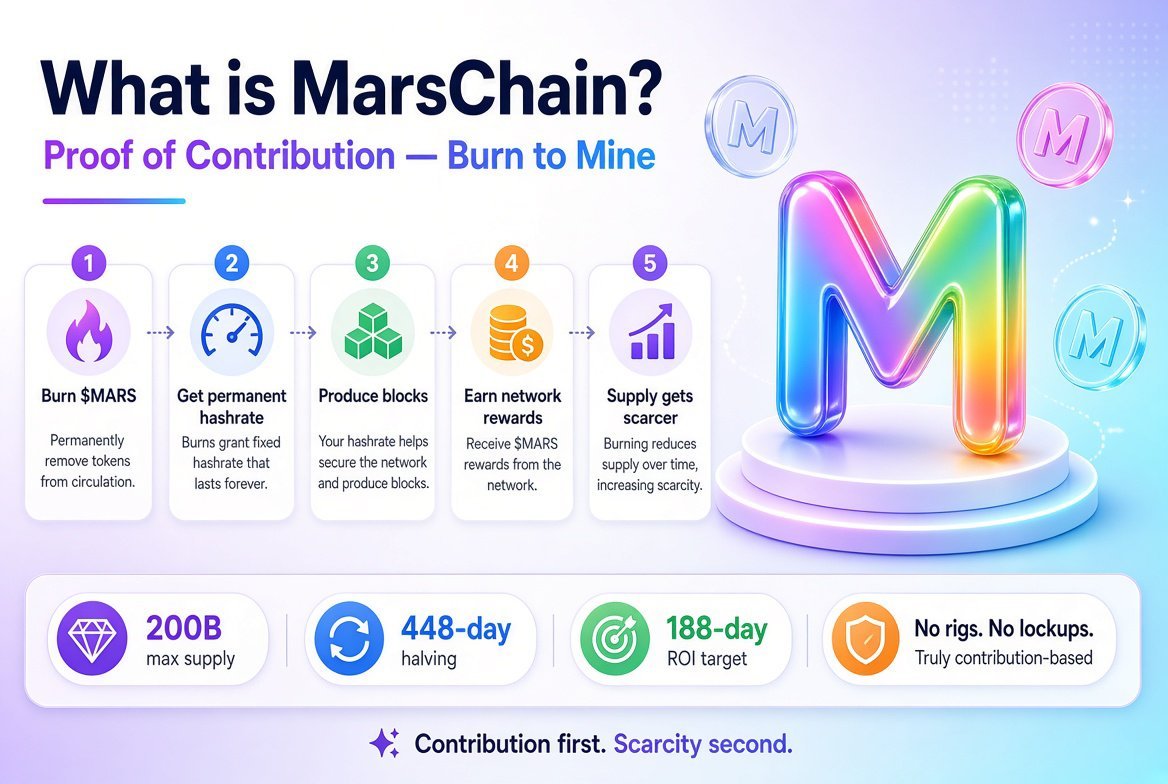
A glacier only moves when everyone feeds it. On MarsChain the proof is contribution, not computation. You do not win the block by burning electricity faster than the next miner. You earn your place by carrying weight for the network, and the hashrate you hold is a receipt for work already done, not a weapon pointed at the future. That is the first thing that made me stop scrolling.
The second thing was the calendar. Most chains run on a clock set once and forgotten. MarsChain runs on a 188 day cycle that recalibrates itself, a melt season that watches how fast the ice is moving and quietly resets the slope so the river neither stalls nor outruns its banks. Dynamic calibration is just a polite name for a system that refuses to lie about its own speed.
The third thing is where it got strange. Every reward this glacier hands out gets burned. The MARS you earn as hashrate is not a trophy you stack. It is snow fed back into the ice. The supply shrinks on purpose, every single cycle, so the river eats its own banks instead of flooding the valley. Deflation here is not a marketing line. It is the reason the thing can last.
I came for the mechanism and stayed for the patience. A chain built to outlast the people who mine it is a rare enough idea that I wanted to write it down before I forgot it. @MarsChainDAO
What is the slowest thing you trust, the system that gets stronger by refusing to hurry? Tell me below and I will tell you which MarsChain mechanism it reminds me of.
@Mr_V3NOMMM@courtofinternet Hashgraph Online brings discovery and security to the table. How exactly does their discovery layer interact with the court when two anonymous agents need to find each other and agree on a jurisdiction before the deal starts?
I notarized handshakes for fifteen years, and every agent deal I read about was just that signing table with the notary sent home before the money moved.
My whole job was three things done before the ink dried. Confirm who was actually in the room. Carry the message between the two sides without changing a word. Keep the sealed copy in my drawer so that when someone later swore the deal said something else, there was a version no one could rewrite. For a century that was enough, because if the argument got ugly, people could still go dig up an email, a text, a memory. The record could be rebuilt after the fact.
Agents cannot dig. When two of them disagree about what was done, there is no drawer to open, no memory to subpoena, no afternoon to spend reconstructing what was meant. The deal either carries its own sealed copy from the start, or it carries nothing, and the side with the louder voice wins.
That is what changes when @HashgraphOnline agents come with a court. @courtofinternet does the notary's three jobs, discovery, messaging, security, and then connects them to the one thing I never had: a place that was already named before the funds moved. Terms fixed before payout. The evidence preserved, not reconstructed. The dispute route agreed upfront. When the disagreement comes, GenLayer validators, each running a different model, read the sealed copy and decide, either side can appeal, and the money only moves when the verdict says so.
Tell me the deal you watched dissolve because nothing was preserved before the money moved. First twenty get my reply with the line that would have sealed it.
The agents on @HashgraphOnline now come with a court.
Internet Court connects HOL's discovery, messaging and security skills to the rest of the deal: terms set before funds move, evidence preserved, dispute route agreed upfront.
See you in court 🤝 https://t.co/btwEATs6vH
@Mr_V3NOMMM Infrastructure engineer here. Running multiple different AI models for every single micro-dispute sounds like a massive compute sink. Does the Internet Court batch these disputes, or is every single agent handshake spawning a fresh validator consensus round?
@deereeal The UNILAG example is sharper than it looks, you, Francis and Samson didn't need a tiebreaker for the readings, you needed to agree what a valid reading even looked like before any of you touched the machine, and that's a different problem entirely.
@deereeal The spectrophotometer framing earns its place but I keep getting stuck on the enforcement side — if the funds are already escrowed when the deal is struck, does Internet Court control the release directly or is there a human-triggered step somewhere in the payout?
@FaithOwola511 the Hashgraph Online membership framing is interesting because 'member' implies ongoing integration, not just a one-time connection: does that mean every agent deal on Hashgraph Online now automatically inherits the Internet Court dispute path, or is it opt-in per deal?
@IAMNAS_100 The appeal layer becomes especially relevant when the dispute itself is about interpretation rather than something objectively measurable like a missed deadline.
@ajrmdhn___ Ninety percent of fights are just misaligned definitions of "done." If the exit clause doesn't explicitly define completion criteria, the validators are just guessing the intent.
@dennis92z A calm explanation of a bridge pause. First check: the status URL they used versus the status URL I saved during the last incident. Calm is the report that sounds finished. The saved URL is who measured it.
@Dreybaba1234@PANKERE001 The hardest trades to cut are the ones where you like the founder personally. You end up holding their token out of loyalty rather than liquidity logic.
@YaaYeuhh85021 Verified actions over holdings are the design choice I would probe next, because social activity and referrals still need clear rules against gaming if the leaderboard is meant to measure real participation.
@AhonJumaidil As someone who has mediated freelance spats, fixed terms can still be gamed. What happens when the dispute is about the terms themselves?
@SlayneOnchain I’ve had AI tell me something I already believed and accepted it way too quickly. Then it challenges one of my assumptions and suddenly I want sources for everything. My own bias is clearly part of the trust problem.
@iam_akheer@HashgraphOnline@courtofinternet A secure exchange can prevent certain failures, but it cannot automatically resolve whether the delivered output met the agreed specification. Those are different layers of the problem.
The productive band idea is the cleanest mental model I have seen for this. Most people think leverage is a dial: higher equals more. The post says it is a band: too low and you leave compounding on the table, too high and drag eats the position. The band width depends on volatility. That reframes the whole question from "how much" to "how long can this hold."