🤝 Looking back at Day 1 of Private Money Forum 2026
The event brought together investors, entrepreneurs, and business leaders from across the investment industry, creating a great environment for conversations about capital, real assets, and long-term opportunities.
One topic came up again and again throughout the day: growing interest in assets backed by real economic activity, tangible infrastructure, and clear value creation.
During the forum, Web3Eco Founder & CEO @FilippBolotov presented our vision for industrial paulownia plantations, agricultural infrastructure, and the role tokenization can play in expanding access to real-world assets 🌳
The discussions that followed covered plantation economics, land-based assets, portfolio diversification, and the long-term potential of agriculture as an investment sector.
A big thank you to everyone who met with our team, shared ideas, and took part in these conversations.
Events like this remind us how many people are looking beyond short-term trends and focusing on assets built for decades, not quarters📈
More highlights and key takeaways from the forum coming soon.
📈 This week the Web3Eco team attended Private Money Forum 2026!
The forum brought together investors, entrepreneurs, business owners, and wealth management professionals to discuss capital, long-term strategies, and the growing role of real assets in modern portfolios.
For us, the event was important not only because of the discussions and meetings.
Our team operates across different countries, so opportunities to gather in one place are rare. It was a great chance to spend time together, align on priorities, exchange ideas, and strengthen the relationships behind the project 🤝
We also had the opportunity to meet investors, partners, and industry professionals, sharing our vision for agricultural assets, agroforestry, and tokenization as part of the evolving #RWA market.
Web3Eco was represented by our Founder & CEO, @FilippBolotov , who participated in meetings and discussions throughout the forum.
Thank you to everyone who took the time to connect with our team. Strong projects are built not only on assets and technology, but also on the people who share the same vision.
We'll be sharing more photos, meetings, and insights from the event soon.
Weekly Highlights: Ecology and Blockchain
This week once again showed how closely environmental assets and blockchain infrastructure are becoming connected.
Large capital continues moving into forestry, climate projects, and tokenized financial products.
🇧🇷 Brazil is launching a $617M program focused on Amazon preservation, sustainable infrastructure, and the development of the regional bioeconomy.
🌳 In the U.S., Chestnut Carbon became the first forest management project to receive FSC biodiversity verification, an important milestone for natural and carbon-based assets.
🏦 At the same time, the tokenized asset market keeps accelerating:
@OndoFinance USDY surpassed $1B, @FTI_US is expanding institutional infrastructure, and BlackRock continues scaling tokenized funds after #BUIDL crossed $2.3B in assets.
The direction of the market is becoming increasingly clear.
Real assets, environmental infrastructure, and blockchain-based finance are gradually integrating into one ecosystem 🌍
At Web3Eco, we are building in exactly this direction through agricultural and agroforestry assets, combining real sector infrastructure, green finance, and tokenization within one long-term investment model.
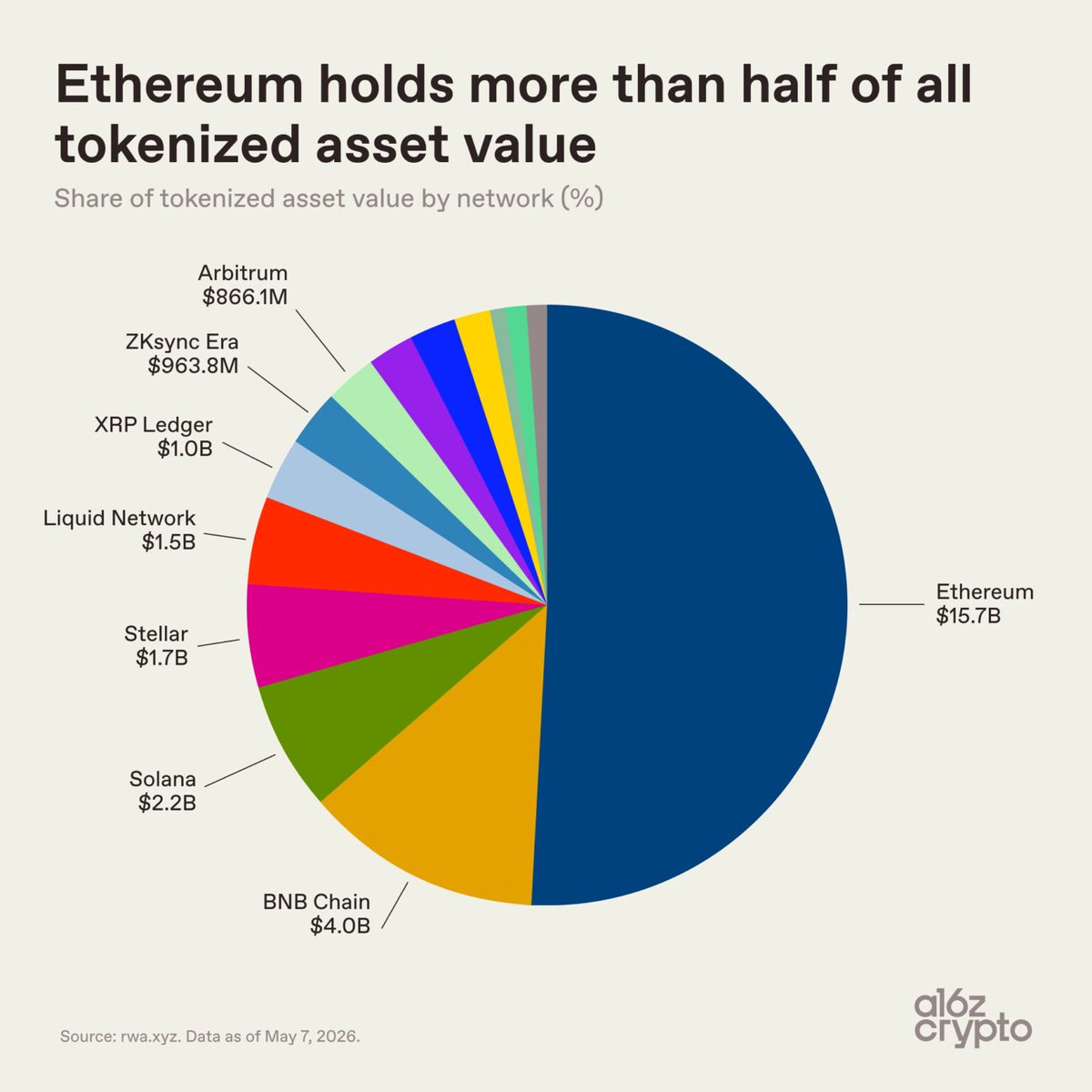
Interesting to see how the tokenized asset market is naturally spreading across different ecosystems.
Ethereum remains the institutional center because of liquidity, infrastructure, and deep integration with DeFi.
At the same time, chains like BNB Chain, Solana, XRP Ledger, and zkSync are building strong positions around payments, scalability, trading activity, and regulated infrastructure.
This is exactly how large financial markets evolve. Different networks are finding their role inside a much bigger onchain economy 🌐
At Web3Eco, we see the same shift happening in real asset tokenization.
Agricultural and biological assets require long-term infrastructure, transparent ownership models, and global accessibility. Blockchain makes that possible at scale, especially for sectors like agroforestry that historically remained difficult to access for international investors 🌳
Ethereum still dominates tokenized assets, consistent with its headstart in DeFi and institutional adoption.
Ethereum: $15.7 billion
BNB Chain: $4B
Solana: $2.2B
Stellar: $1.7B
Liquid Network: $1.5B
XRP Ledger, ZKsync Era, Arbitrum: ~$1B each
Rather than converging around a single chain, tokenized assets are spreading across multiple blockchain ecosystems — given criteria like cost, liquidity, compliance requirements, and go-to-market relationships.
🪙Is crypto actually legal?
In the “Millionaires” podcast, Web3Eco CEO @FilippBolotov shared an important perspective on how digital assets should be evaluated today.
The crypto market includes thousands of different projects, but the real distinction is not between “crypto” and “traditional finance.”
It is between structured models with legal foundations and speculative systems built without them.
Some projects operate without transparency or accountability. Others are backed by registered companies, contractual obligations, documented ownership structures, and clearly defined investor rights 🔐
For investors, the core question is not the token itself, but the framework behind it: who issues the asset, how investor rights are secured, what legal agreements exist, and how the economic model is structured.
In the episode, Filipp explains why legal architecture is becoming one of the most important factors in the digital asset market and how investors can better distinguish real financial infrastructure from pure speculation 🌐
🌳Paulownia vs Oak and Pine: why fast-growing timber is attracting investor attention
The global timber market is already worth more than $1 trillion and continues growing alongside demand from construction, furniture, packaging, and sustainable materials.
But not all timber works on the same timeline!
▪️Oak is considered one of the most valuable hardwoods in the market, yet full maturity can take 80–120 years.
▪️Pine and spruce remain key industrial species, though commercial harvesting still often requires decades.
Paulownia follows a completely different model.
The Shan Tong hybrid used in #Web3Eco plantations can reach commercial harvesting size within 6–8 years while maintaining strong industrial characteristics valued across multiple sectors 📊
What makes paulownia stand out:
• rapid growth and straight trunk formation
• lightweight but durable timber
• moisture and fire resistance
• natural regeneration after harvesting without replanting
• demand across furniture, interiors, construction, and processing industries
This is exactly why fast-growing plantations are starting to attract attention as a separate category of real assets.
At Web3Eco, we develop industrial paulownia plantations together with agricultural crops, combining long-term timber growth with additional yearly income from the land itself 🌿
While financial markets continue moving through cycles, biological assets keep growing physically year after year.
🚨 $19B of real assets just moved one step closer to DeFi
Animoca-backed @NUVAFinance is bringing tokenized assets from Figure onto Ethereum infrastructure. The launch includes tokenized Treasury products and blockchain-based private credit connected to real home equity portfolios.
What’s interesting here is not only the scale!
RWA is already becoming a massive part of Web3. The next stage is deeper integration between tokenized assets, liquidity, lending markets, and #DeFi infrastructure itself.
This changes the role of tokenization completely.
A few years ago, most discussions around RWA were theoretical. Today, infrastructure is already being built around real financial products with institutional volumes behind them 🌿
The direction becomes clearer with every month:
• more institutional capital moving onchain
• tokenized products integrating into DeFi markets
• blockchain turning into infrastructure for global capital movement
At #Web3Eco, we strongly support this shift toward tokenization and actively contribute to the growth of the RWA market through agricultural infrastructure and real biological assets 🌳
Our model combines industrial paulownia plantations, agricultural production, and tokenization infrastructure around real-world assets connected to land, timber, and food production.
At the same time, these assets contribute to ecosystem restoration, carbon absorption, and the expansion of sustainable agriculture.
We believe the future of tokenization will be built not only around finance, but also around real sectors that create long-term value for both investors and the planet!
🌳 The first commercial harvest of paulownia on our plantations is planned for 2029.
What makes this especially interesting is that paulownia continues to grow after harvesting. The tree regenerates from the stump and can go through 8 to 10 growth cycles. In other words, this is not a “cut and replant” model, but a long-term operating system.
Why does this matter?
Because the global timber market is already valued at over $1 trillion and, according to FAO and UNECE forecasts, could reach nearly $1.9 trillion by 2030.
At the same time, traditional species require decades to mature:
pine takes 25 to 60 years,
oak can take 100 years or more.
🌿Paulownia reaches industrial timber maturity in about 7 to 8 years.
That is why fast-growing plantations are starting to take an increasingly important position in the market 🌱
Paulownia — a tree that most people still know surprisingly little about 🌳
Everyone knows it grows fast, but there are details that even agronomists still find impressive.
1️⃣ It can help clean soil from heavy metals. Its root system works like a natural filter and supports the restoration of polluted land.
2️⃣ It survived Hiroshima. After 1945, paulownia was among the first plants to grow back on devastated areas, becoming a symbol of recovery in Japan.
3️⃣ It is used as animal feed. In some countries, the leaves are added to livestock diets because of their high nutritional value.
4️⃣ The wood is highly stable. Lightweight and durable, it has been valued in Japan for centuries for its resistance to moisture and time.
5️⃣ It blooms before the leaves appear. In spring, the tree turns into a purple cloud before any greenery shows up.
6️⃣ It can regrow after cutting. A new trunk develops from the same root system without the need for replanting.
Paulownia feels like a tree from the future: fast growth, strong timber, soil restoration, and dozens of real-world applications in one 🌍
At Web3Eco, we cultivate paulownia and other agricultural crops at an industrial scale, allowing us to generate sustainable profitability for the company and our investors.
Want to learn more about our projects and plantations? Visit our Telegram channel 🌱
https://t.co/wtF8nWXCvj
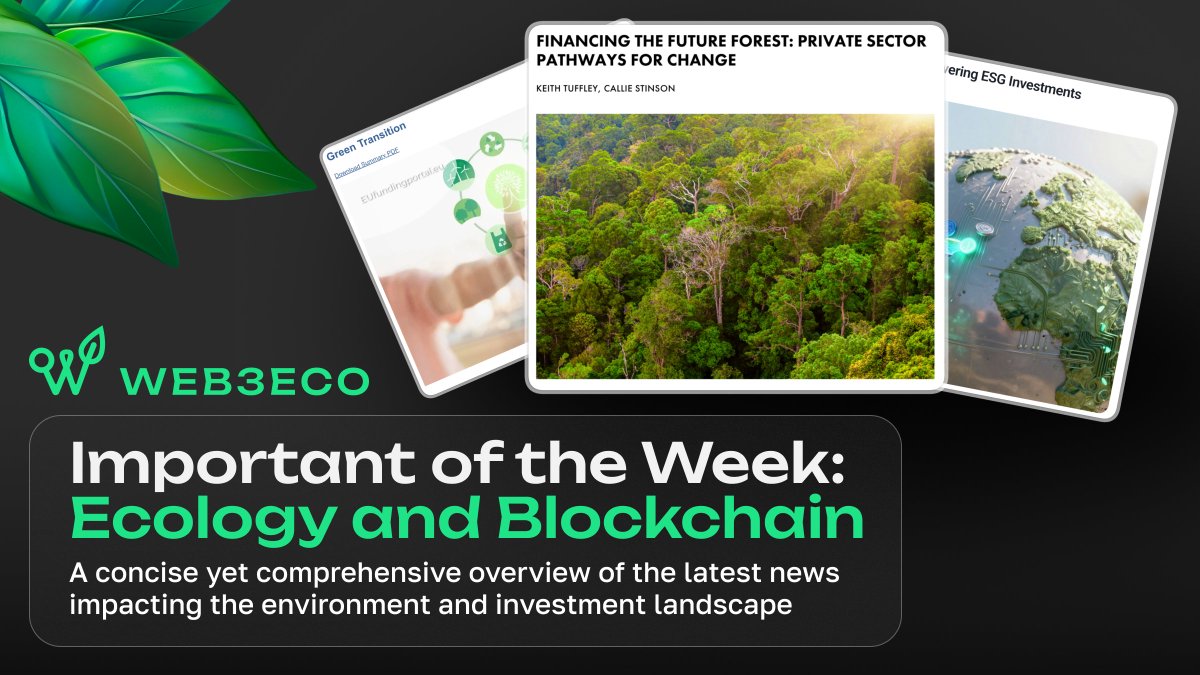
🌿 Weekly highlights: Ecology, capital and tokenization
This week once again showed how quickly environmental assets are becoming part of the global investment market.
1⃣The EU continues expanding climate financing through programs like LIFE and Horizon, allocating millions of euros toward circular economy projects, sustainable infrastructure, and climate adaptation initiatives.
2⃣At the same time, industry groups and investment funds are increasingly emphasizing the role of private capital in forestry, carbon markets, and natural asset development.
Large-scale environmental transformation is no longer driven only by governments.
3⃣Another important trend is the growing integration of tokenization into ESG and environmental markets.
More projects are exploring blockchain infrastructure for carbon credits, natural resources, and other real-world environmental assets.
Step by step, the connection between #RWA, sustainability, and institutional capital is becoming stronger.
At Web3Eco, we see this as part of a much bigger shift where real assets, agricultural infrastructure, and tokenization gradually form a new layer of the global investment economy 🌍
🌿 Who actually invests in agricultural assets today?
In a recent podcast, @FilippBolotov shared an interesting observation: the majority of investors entering the sector aren't newcomers.
What brings them into agriculture is usually the same thing. The search for assets connected to the real economy and long-term demand.
Food production, land, timber, agricultural infrastructure… these sectors continue operating regardless of market sentiment or daily volatility.
In the episode, we discuss:
• who is entering agricultural investments today
• why hybrid plantation models are gaining attention
• how experienced investors approach diversification in 2026
🌍 CO₂ emissions are easy to talk about, but much harder to visualize in real terms — especially when it comes to how much does a tree actually offset?
That’s where data matters more than narratives!
Trees, through photosynthesis, naturally absorb CO₂ and turn it into biomass. According to the IPCC, global forests remove ~2.6B tons of CO₂ per year.
In our work with fast-growing paulownia (Shan Tong), this becomes more measurable at scale:
~33 tons of CO₂ can be absorbed per hectare annually (depending on conditions)
a single car emits ~4.6 tons per year (US EPA data)
But the real question is usually personal: what does my footprint look like, and how many trees would offset it?
To make this practical, we built a simple CO₂ calculator that anyone can use to estimate their footprint and see the equivalent number of trees needed to offset it:
👉 https://t.co/4LZabHEZO7
It helps you:
• estimate personal emissions
• compare against global benchmarks
• understand real offset requirements in tree equivalents
At Web3Eco, this is the direction we focus on — turning climate data into something measurable, structured, and tied to real assets rather than abstract targets 🌳
#Web3Eco #Paulownia #Ecology
Recently, Web3Eco CEO @FilippBolotov shared his view on tokenization and one key misconception that still dominates the market.
Here are the core takeaways:
1⃣A token is not ownership
A token is just a record onchain. Real rights only exist through legal agreements that define ownership, profit distribution, and obligations.
2⃣Blockchain ≠ investor protection
Transparency doesn’t equal security. Without a legal structure behind it, a token is just a digital object with no enforceable rights.
3⃣The order matters
First comes the asset and legal framework. Only then should it be tokenized. Reversing this logic is where most risks begin.
4⃣Tokenization adds efficiency, not meaning
Lower entry, fractional ownership, faster transactions — all of this works only if there is a solid legal base underneath.
5⃣The strongest model today is hybrid
A legally structured asset combined with its tokenized layer. Protection on one side, flexibility and access on the other.
The market is growing fast, but the difference between a real investment and a “token narrative” still comes down to one thing: what actually stands behind the tokenization!
🌳 The foundation of reliable investments, where do risks actually end?
In investing, you can talk about returns, scaling, and growth potential, but every decision ultimately comes down to one factor: the stability of the model and capital protection.
That is why attention is increasingly shifting toward real assets, where value is created not through expectations, but within a clear and structured economic system.
In this context, agribusiness is becoming one of those directions.
Plantations of fast growing paulownia and agricultural crops are assets that develop according to their own biological logic. Their growth does not depend on news flow, market volatility, or external narratives.
Wood continues to accumulate volume, crops are produced within established agricultural technology, and product value is determined by real market demand 📈
This creates a foundation where capital is tied to a physical asset and its long term value.
Within Web3Eco, this logic is reinforced by a structured approach to investor protection!
Legal structure and transparency
All key company documents are publicly available including Swiss company registration, land documentation in Uzbekistan, lease agreements, site coordinates, and ownership structure.
This allows investors not only to understand the model but also to verify it on a factual level.
🇨🇭 Investments are structured through Web3Eco AG, providing an international legal framework.
This structure enables global participation, ensures geographic diversification, and secures investor rights within a clear legal system with a high level of protection.
Contract model and safeguards
Each investment is formalized through a Revenue Sharing Agreement (RSA), which defines participation terms such as share size, investment amount, and profit distribution rules.
🔐 The agreement also includes protection mechanisms, including the possibility of capital repayment in case of breach of obligations by the company.
It is also important that investor rights are long term and can be transferred through inheritance under Swiss law.
As a result, the structure combines several key elements:
• long term asset in the form of paulownia timber
• additional annual cash flow from agricultural crops
• legally defined investor rights
• transparent and verifiable infrastructure
This combination creates a framework where the investment functions as part of a structured system with a clear logic and a stable foundation.
🌳 Paulownia — the green #Bitcoin of the real world!
In a recent podcast, Web3Eco CEO @FilippBolotov explained how the model actually works and why this comparison keeps coming up.
The idea is simple: the asset grows every year, increasing in volume and value over time, without being tied to daily market noise.
In this structure, paulownia plays the role of a long term core asset. As the trees grow, so does the underlying value of the timber, creating a gradual and predictable form of capital formation 📈
At the same time, it’s not just about returns. Plantations transform empty land into functioning ecosystems, forming their own microclimate and restoring soil quality along the way!
It’s a different way to look at growth. Not through volatility, but through biology.
“Tokenization can enable real-time or near-real-time settlement, reducing settlement risk and increasing transparency for everyday investors.
“Tokenized delivery-versus-payment may make sale proceeds available faster, which could improve liquidity and reinvestment flexibility.”
“Tokenization can support fractional ownership and potentially extended trading hours, making investing more accessible and flexible.”
Tokenization = the future of finance.