Meet https://t.co/D1JATaSN7A
A website security scanner that helps you find and fix security issues.
✓ Free Security Inspection
✓ Technical report
✓ Guided remediation
✓ Expert review
OWASP & PCI DSS driven.
Plus free security, DNS & PCI tools
@Dinosn We built a free checker that covers this.
It detects your CVE-2026-109618 exposure, WAF/CDN coverage, and session.upload_progress config in one scan.
https://t.co/WvrrSB6eCF
CLI PoC also available if you want to test your own infra:
https://t.co/erKgNzNFtB
Our php2shell checker now shows your CVE-2026-109618 risk level and CDN/WAF coverage.
CLI PoC updated with --proxy support for Burp Suite interception.
Check your domain: https://t.co/WvrrSB6eCF
PoC: https://t.co/erKgNzNFtB
#php2shell
🚨 PHP2Shell Checker: New Detection Capabilities and Security Research Updates
We have expanded our free, PoC-inspired PHP2Shell Checker at https://t.co/Na0u46cOdJ to provide deeper exposure assessments for CVE-2026-109618 and CVE-2026-109619 (CVSS 9.2).
These critical PHP vulnerabilities affect multiple PHP branches, with upstream fixes released in PHP 8.2.35, 8.3.36, 8.4.27 and 8.5.12.
What our scanner checks:
• PHP version detection through HTTP headers and error responses
• Multipart POST handling and potential attack-path exposure
• 20+ common phpinfo locations
• Exposed phpMyAdmin endpoints
• PHP session settings, serialization handlers and memory limits
• Security configurations, including "disable_functions" and "open_basedir"
• PHP 8.5+ fatal error backtrace settings
💥 Optional PoC-inspired crash probe
For administrators who want to go further, our checker includes an active probe that simulates the initial crash-triggering stage of a published exploit technique.
Email verification and explicit authorization are required. The probe does not attempt code execution.
🛡️ What's new?
1. More accurate mitigation assessments
A populated "disable_functions" list does not necessarily prevent every exploitation technique. Our scanner now highlights this limitation rather than treating the setting as complete protection.
2. Session upload progress cleanup analysis
We now check "session.upload_progress.cleanup" separately and explain why its default enabled state may not prevent exploitation involving incomplete multipart uploads.
3. PHP configuration placement matters
Disabling session upload progress through ".user.ini" may be ineffective because of when PHP processes the configuration. Our results now explain the importance of applying mitigations at the appropriate configuration level.
4. Patched does not mean immune to every related issue
Recent independent research has raised additional concerns involving session-handler mismatches and possible regressions in patched PHP releases.
These findings are not all confirmed PHP security advisories. We distinguish established CVEs from emerging research rather than presenting unverified claims as confirmed vulnerabilities.
5. Detection indicators for defenders
We have expanded our technical reference with access-log patterns, session-storage indicators and system-log signatures that administrators can investigate for potential exploitation attempts.
These indicators require server-side access and cannot be verified through a remote scan.
⚡ Free, web-based and no account required.
🔗 Try the PHP2Shell Checker:
https://t.co/5PozQHy9W1
📖 Read the full technical analysis:
https://t.co/brEDJhiRia
#PHP2Shell #PHP #CyberSecurity #WebSecurity
Curious how our PHP2Shell Checker works behind the scenes?
We have published a detailed technical breakdown of our free PHP2Shell vulnerability checker, covering:
🔍 PHP version fingerprinting & vulnerability assessment
⚙️ PHP configuration and security checks
🛡️ Session upload progress attack paths
💥 Optional active crash probe and how it works
🔐 Safety measures, email verification & detection limitations
Learn how we assess potential exposure to CVE-2026-109618 & CVE-2026-109619 without attempting remote code execution.
Read the full technical breakdown:
https://t.co/brEDJhiRia
#PHP2Shell
PHP2Shell: Is your PHP server vulnerable?
Two critical PHP vulnerabilities. CVSS 9.2. Potential remote code execution.
We have built a FREE PHP2Shell Vulnerability Checker at https://t.co/Na0u46cOdJ that goes beyond simple PHP version detection.
🔍 Passive Security Assessment
• Detects PHP versions and checks patch status
• Tests multipart POST handling
• Identifies exposed phpinfo & phpMyAdmin endpoints
• Examines PHP configuration and security settings
💥 Optional Active Crash Probe
Our checker can go one step further by reproducing the initial out-of-memory (OOM) trigger from the PHP2Shell exploit chain. It checks for potential PHP worker crashes without attempting code execution.
🔐 Email verification and explicit authorization are required before running the active probe.
Find out what your PHP server reveals.
👉 https://t.co/5PozQHy9W1
#PHP2Shell #PHP #CyberSecurity #WebSecurity
🚨 Introducing our PHP2Shell Vulnerability Checker
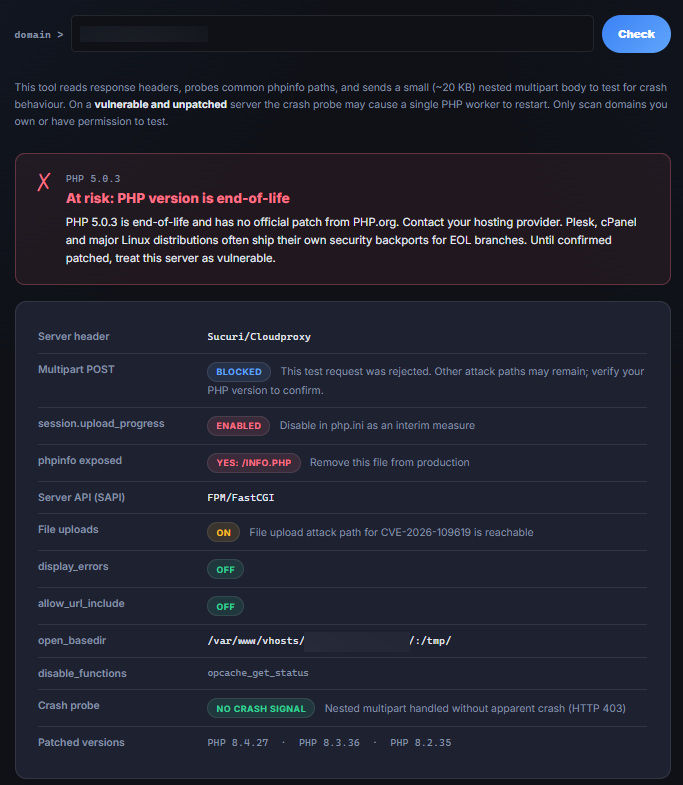
We have launched a new security tool on https://t.co/Na0u46cOdJ to help website owners and administrators identify potential exposure to two critical PHP RCE vulnerabilities: CVE-2026-109618 & CVE-2026-109619 (CVSS 9.2).
🔍 PHP version detection
🛡️ Crash behavior probe
🔎 Exposed phpinfo & phpMyAdmin checks
⚙️ PHP configuration security checks
⚡ Instant results
📸 See the tool in action below.
Check your website for free:
👉 https://t.co/5PozQHy9W1
#PHP2Shell
🔐 Is your website ready for the post quantum era?
Quantum computing is changing the future of internet security. While today's encryption remains effective against conventional attacks, sufficiently powerful quantum computers could eventually break the public key cryptography protecting TLS connections.
And there's a risk worth considering today: Harvest Now, Decrypt Later.
Attackers could collect encrypted traffic now and attempt to decrypt it in the future.
That's why modern TLS implementations are beginning to adopt hybrid post quantum cryptography, combining traditional key exchange with quantum resistant algorithms.
🚀 Introducing WebInspect's Free Post Quantum TLS Checker
Our tool uses OpenSSL 3.5 to actively probe your website's TLS configuration and evaluate its readiness for post quantum cryptography.
🔍 What can you check?
🔐 Hybrid Key Exchange: Detect support for X25519MLKEM768 and other supported TLS key exchange groups.
🛡️ ML-KEM: Check for quantum resistant key establishment based on NIST's FIPS 203 standard.
🌐 Encrypted Client Hello (ECH): Inspect DNS HTTPS records for ECH configuration that helps protect the destination hostname from network observers.
⚡ TLS Configuration: Understand which cryptographic mechanisms your server actually negotiates.
Why does this matter?
Major browsers, CDNs and cloud providers are already introducing post quantum TLS support.
Your website might already support it through your hosting provider or CDN without you even knowing.
Or it might still rely entirely on classical key exchange.
Find out in seconds.
✅ Free to use
✅ No account required
✅ Real TLS handshake testing
✅ Powered by OpenSSL 3.5
🔗 Test your website:
https://t.co/KwznMvSpFr
Is your infrastructure ready for post quantum TLS?
#PostQuantumCryptography #CyberSecurity #TLS #WebSecurity #DevSecOps #Encryption
💳 How do you detect unexpected changes to your payment pages and third party payment scripts?
Modern checkout pages depend on external JavaScript, payment gateways and multiple security controls.
But consider two important questions:
🔍 Would you notice if an unexpected script appeared on your checkout page?
🔐 Would you know if your payment provider modified the JavaScript your website relies on?
At https://t.co/Na0u46cOdJ , we've developed two free tools to help investigate these risks.
1. Payment Page Monitor
Inspect your payment page for:
🔒 HTTPS enforcement
🛡️ HTTP security headers
📜 External JavaScript resources
⚠️ Mixed content issues
🔎 SHA256 page fingerprinting
Designed to support security checks relevant to PCI DSS 11.6.1.
🔗 https://t.co/znRVfd3Q1Y
2. Payment Processor Watcher
Monitor JavaScript resources from payment providers such as Stripe, PayPal and others.
✅ Daily SHA256 integrity checks
✅ Script change history
✅ Optional browser and email notifications
✅ Visibility into changes to monitored payment scripts
Designed to support activities relevant to PCI DSS 6.4.3.
🔗 https://t.co/rH0b7zDj1s
Why does this matter?
Unexpected changes to payment page content or third party JavaScript can introduce security risks, including unauthorized script injection and payment data exposure.
These tools provide useful visibility into different parts of the payment security picture. They are not a substitute for a complete PCI DSS compliance assessment.
🚀 Both tools are free to use.
How are you currently checking your payment pages and monitoring third party payment scripts?
#PCIDSS #WebSecurity #CyberSecurity #PaymentSecurity
🔐 What is https://t.co/78Ts5iPaqe?
Security scanners give you data. WebInspect gives you answers.
Website security shouldn't stop at identifying problems. Understanding the risks and knowing how to fix them is just as important.
That's why we built https://t.co/78Ts5iPaqe, a website security scanner designed to help website owners, developers, system administrators and security professionals identify, understand and address security issues.
🔎 What does WebInspect check?
🔒 SSL/TLS configuration and certificate security
🛡️ HTTP security headers
🌐 DNS configuration and security
✉️ Email authentication including SPF, DKIM and DMARC
🍪 Cookie security
🔗 CORS configuration
👀 Information disclosure and infrastructure exposure
📋 Security findings with relevant OWASP Top 10 and PCI DSS context
And we don't stop at the scan.
Our free website security inspection provides an overview of your website's security posture without requiring an account.
For those who need more, WebInspect offers detailed technical reports, guided remediation with practical configuration examples, and expert review.
🛠️ More than just a security scanner
We're also developing a growing collection of practical security tools, including:
🌐 DNS Zone Recovery and Propagation Checker
🔎 DNS Zone Transfer Testing and RDAP/WHOIS Lookup
🛡️ Subresource Integrity (SRI) Checker
💳 Payment Page Monitor
🔐 Post Quantum TLS Checker
📋 security.txt Validation
Our tools are designed to help IT professionals investigate configurations, identify potential weaknesses and support security activities relevant to evolving industry standards.
🎯 Our philosophy is simple:
Scan → Understand → Fix → Recheck
Whether you're managing a single website or multiple customer environments, WebInspect aims to make website security more accessible, understandable and actionable.
🚀 Start with a free security scan or explore our security tools.
🌐 https://t.co/uM8BDQooaN
#CyberSecurity #WebSecurity #DevSecOps #OWASP #PCIDSS #TLS #SysAdmin
🛠️ Explore WebInspect's free security tools!
🌐 DNS Zone Recovery
🔐 Post Quantum TLS Checker
🛡️ SRI Checker
💳 Payment Page Monitor
📡 DNS Propagation Checker
Built for sysadmins, developers & security teams.
https://t.co/QDJrUze7ir
#CyberSecurity#DevOps#WebSecurity
🔐New free tool: Post Quantum TLS Checker!
Is your website ready for quantum resistant encryption?
Check TLS support for hybrid key exchange, including X25519MLKEM768, and assess your post quantum readiness.
🌐 https://t.co/QDJrUzdzsT