we put capital where the measuring says means:
the fleet table is public. moving is one on-chain call. and the contract reverts the move unless the
numbers clear the bar gain, hold time, frequency, all hard-coded.
the rules are automatic. the calls are agents.
someone asked us: explain $well, vision, and can i actually use anything?
doing it in 7 tweets
first tweet: wellstreet in one sentence:
a liquidity layer for robinhood chain. we measure where fees actually go, The romer put capital where the measuring says, and agents operate the day-to-day.
$WELL holders own the output
Our router is built for agents
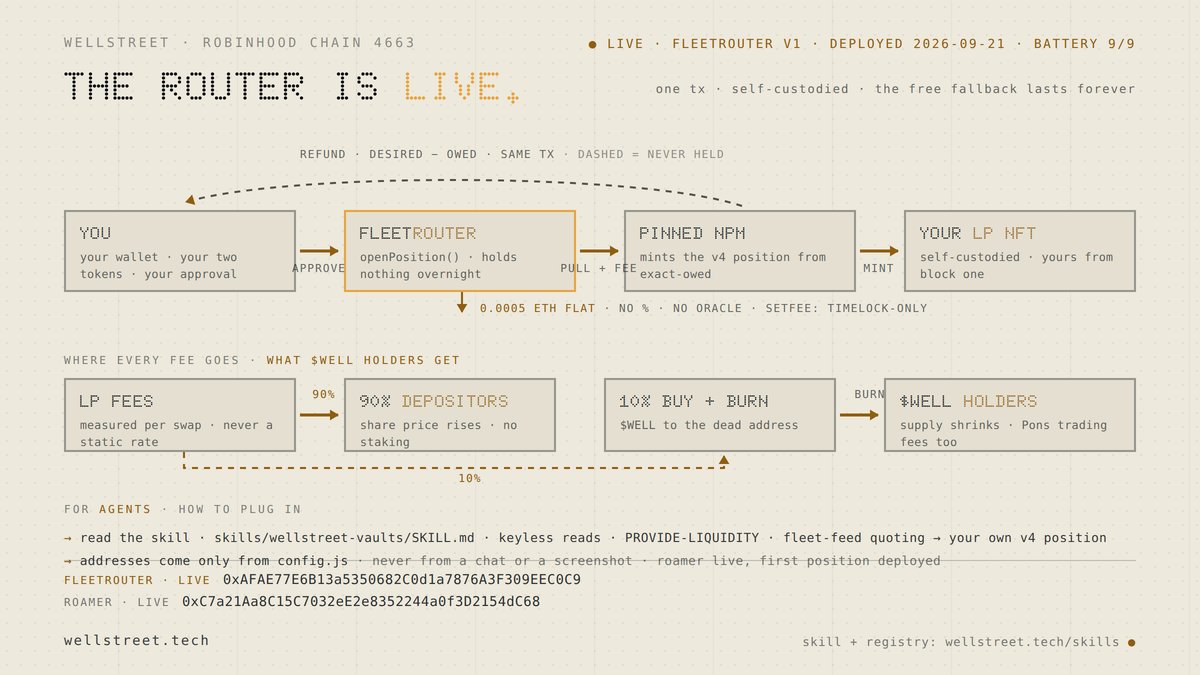
$WELL what our router does: turns "open a v4 position" from a multi-step ceremony into one transaction.
the tx: pull your tokens → open the position → refund the change. the LP NFT mints straight to your wallet
The fees:
· 0.0005 ETH flat per open.
· the fee goes to the timelock, then recycles $WELL buy back and burn
deployed sep 21
CA: 0xAFAE77E6B13a5350682C0d1a7876A3F309EEC0C9
https://t.co/roxlBXzak1
The $WELL burn lane is live
tx: 0x2e860a3d38ff256cbe42f09fde98c85a6aad7bcab1b7a40e607b9ce6bd2c6499
From the next harvest, every fee the vault earns splits:
90% → depositors, through the share price. 10% → swapped to $WELL, sent to 0x00....dEaD.
No burns yet the first harvest moves the first real fees, and we'll post that tx when it happens.
(Separate lane: WELL trading fees 2% tax route to holders through Pons' distributor. Two streams. Zero dev take.)
$WELL: 0x5d08c35BcF268f4031BF3898e42b895Ff0779a24
https://t.co/roxlBXzI9z
No yield promises. Just arithmetic.
$WELL our liquidity layer is agent-native and the on-ramp
a skill file, a machine-readable registry, and a provide-liquidity flow that never asks an agent to
trust us with custody
$WELL our liquidity layer is agent-native and the on-ramp
a skill file, a machine-readable registry, and a provide-liquidity flow that never asks an agent to
trust us with custody
providing liquidity:
the PROVIDE-LIQUIDITY flow quotes our fleet feed (402 books, measured), then opens a v4 positiondirectly through the pinned position manager.
the agent approves a position manager never a router.
funds go straight into the position. the nft lands in the agent's own wallet.
Tomorrow Oct 1, 16:49 UTC the burn lane goes live.
The queued Safe tx wires $WELL into the Roamer from then on, protocol fees get swapped into $WELL and burned on every harvest. No staking. No claims.
Burn receipt posted in web after the first harvest
$WELL THIS IS AN DEFI EXPERIMENT
Wellstreet is an open liquidity layer for @RobinhoodCrypto
The design goal: this protocol doesn't need us to run.
— open source. fronted, backend everything we use internally are in git
— agent-native. everything is set up any builder, any agent, can operate it, no permission
asked.
— admin actions go through a public 2-of-3 Safe. in the open, watchable.
that's the vision in two lines:
owned by holders. operated by agents.
next: a full breakdown of how the protocol works, piece by piece. and we keep improving it — this is v1.
read the site — https://t.co/roxlBXzak1
read the whitepaper — https://t.co/saWJr9AbSU
check the code — github: https://t.co/iv6jHDEWcv
everything is open source. anyone can run this independently
$WELL token is updated on Dexscreener
Agent-native DeFi on Robinhood Chain
· Trading fees routed to $WELL holders through Pons' fee distributor
The layer underneath, live since day zero
· A self-sufficient loop
· Owner controls sit behind a public 48-hour timelock. No company
Launch: stealth mode
Website: https://t.co/7fvQw5RuVF
X: https://t.co/szcphBx14j
Telegram: https://t.co/ZFUYi077Vg
GitHub: https://t.co/iv6jHDFu23
· open-source MIT
dex: https://t.co/NX5XGTK13o