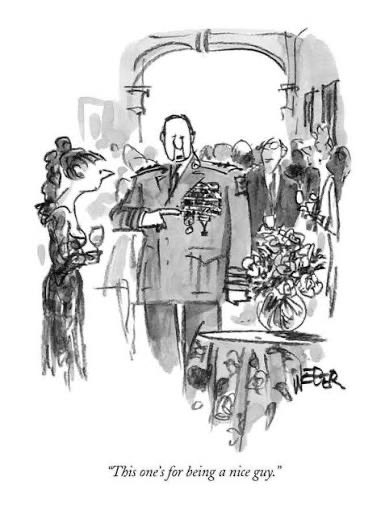
We are being destroyed by agreeable men.
It's easy to like an agreeable man, at least at first. He presents himself as polite, reasonable, and warm. He avoids friction. He avoids awkward or uncomfortable topics. He smiles and nods wherever he can. A conversation with him at a backyard BBQ or in the church foyer can make for a pleasant time.
And those pleasant times can keep on rolling, unless you disturb what the agreeable man mistakes for peace. That is something he will not tolerate. In many cases, he'll simply avoid anything disagreeable. He would truly rather be in the room with a repugnant man who plays along with his desire for agreeableness than with a virtuous man who won't. Tolerance and avoidance are the twin pillars of his modus operandi. False peace is his idol.
But when the agreeable man's idol is touched, and he is forced to confront friction he can no longer avoid, the façade quickly evaporates. He lashes out. What follows is usually an irrational, emotional warpath. And because violating the shallow rules of decorum is, in his mind, the greatest sin, he must lie. He must misrepresent. He must spin the story lest the bystanders see him for what he really is. His goal is to preserve the appearance of reasonableness while shutting down and driving away those with reasonable objections that inevitably create discomfort.
He is an enemy of the reformer, who must press the issue and do so forthrightly. He is a friend of the smiling subversive who quietly corrodes institutions under the camouflage of false peace.
He is a destroyer.
A disturbed Joe Rogan sharply exhales after his guest reveals the real origin story behind Planned Parenthood.
In 1921, Margaret Sanger founded the American Birth Control League, which became Planned Parenthood in 1942.
What this woman openly endorsed stopped Rogan cold.
According to author @Rach4Patriarchy, Planned Parenthood was really founded as a “eugenics program” disguised as reproductive rights.
Wilson says Sanger was “so evil” that writing a chapter about her in her book gave her “nightmares.”
Sanger believed “birth control must lead ultimately to a cleaner race” and that we should limit procreation from “the unfit.”
Curiously, Planned Parenthood started popping up heavily in Black communities.
And here’s the Sanger quote that was too dark for even Rogan to process:
“The most merciful thing that a large family does to one of its infant members is to k*ll it.”
She didn’t say that casually. She wrote that in a book!
@GavinNewsom We Californians welcome the monitoring of our elections! Why? Because we want free and fair elections. We know the California elections do not currently represent the majority of Californians because we talk about it in our communities.
Imagine being the person who sent in that question 😂
R.C. was one of the greatest men of our age. His humor aside, we will continue to heed his wisdom for generations.
The power of giants and dragons lies in fear. This is Satan’s greatest weapon as well: to make men afraid—especially of death. But this is precisely why Christ came—to destroy that power and free His people from the tyranny of fear.
Bitterness is placing a fellow image-bearer in a prison—if only in your heart—where you say they can pay off their debt, but deep down, nothing they do will ever be enough, because your pain and your wrath are too great.
Here's my father-in-law and Pastor. He doesn't have an X account. He rarely uses Facebook. He flies drones, though.
He is many decades into a ministry served in relative obscurity. He has his D Min, yet he has pastored our small country church in a town called Cottonwood for close to 30 years.
His eyes are not on an earthly prize—but the upward call. He has preached Christ crucified in feast and in famine. He's married and buried. Like all pastors: beloved and betrayed.
He modeled all the restraint, deference, and humility I was sorely lacking (and still lack). Though I married his daughter, he was a father to me long before marrying us.
I am thankful today for Mark and men like him. May God richly bless them.
Nice Guys and the Church
For years, I’ve watched men in the church try to gain respect by being nice and fail miserably. They serve, they sacrifice, they bend over backwards to please everyone around them, especially their wives. But it doesn’t lead to the life they expected. Instead of respect, they get resentment. Instead of admiration, they get indifference. They’re overlooked, not honored. Their efforts go unnoticed, their sacrifices unappreciated. These are the so-called "nice guys." And understanding what drives them is key to understanding why so many Christian men feel lost, ineffective, and ashamed.
One of the most helpful frameworks I’ve come across for diagnosing this is Robert Glover’s No More Mr. Nice Guy. While it wasn’t written for a Christian audience, it’s clear-eyed about what’s going on in men’s lives. Glover describes what he calls “Nice Guy Syndrome,” a way of living where a man believes: “If I’m good, people will love me, meet my needs, and life will go smoothly.” It’s a covert contract—one that only exists in his mind, and one that no one else agreed to.
This leads him to perform. He tries to be what he thinks others want. He hides anything unpleasant. He avoids conflict. He anticipates needs without being asked, expecting others to do the same for him. He believes that if he does everything right, life will finally work. He’ll get the girl. He’ll earn the respect. He’ll find peace.
But none of that happens. And so, he becomes bitter.
This kind of man is everywhere in the church. He often becomes a servant-leader in the worst possible sense: deferential, passive, afraid to take initiative. He thinks leadership means laying down, not laying hold. He gives and gives, but it’s not a gift—it’s a transaction. He hopes his sacrifice will be repaid. When it’s not, he doesn’t just feel exhausted. He feels betrayed.
Nice guys don’t serve out of strength. They serve out of emptiness. They’re trying to earn what they believe they lack: approval, affection, significance. Glover traces this to what he calls “toxic shame”—not the conviction of sin, but the belief that being a man is itself wrong. That masculinity itself is inherently corrupt and dangerous.
This belief didn’t come from nowhere. For decades now, we’ve been raising boys to despise their nature. We tell them to sit still, speak softly, be sensitive, suppress aggression, and emote more. In short, we train them to be more like girls. Gloria Steinem famously said we should raise our sons more like our daughters—and the culture obeyed.
Nowhere is this more obvious than in public education, where for 13 formative years, boys are immersed in a system designed by women, staffed mostly by women, and optimized for girls. Masculine traits—risk-taking, roughhousing, competitiveness—are pathologized. Boys learn early that their instincts are bad, that manhood is a problem, that strength must be tamed. They carry that shame into adulthood. And many of them find their way into churches where male virtue is modeled after a distorted picture of Jesus—one that emphasizes meekness and mildness while stripping them of their true strength. In this version, meekness becomes passivity, and kindness becomes niceness. But the real Jesus was meek and mighty, kind and commanding—full of grace and truth, not neutered of initiative, boldness, or authority.”
So they try harder. They try to be nice. They volunteer more. They “lead” by constantly deferring to their wives. They think sanctification requires the death of their masculinity, rather than the sanctification of it. But sacrifice is part of masculinity—you sacrifice for your mission, for your people, for your God. What you don’t sacrifice is masculinity itself. They think being a good Christian means being a doormat with a Bible verse. And it doesn’t work.
The core problem is that their self-sacrifice is rooted in a falsehood. It's not motivated by strength or obedience to God—it’s motivated by insecurity and fear. It’s a performance designed to win approval, and that kind of sacrifice always backfires. It’s manipulative, even if the man doesn’t realize it. He’s not giving freely—he’s giving with strings attached.
That’s not how Christ gave himself.
Jesus laid down his life in obedience to the Father. He was not manipulated into it. He did not do it because the Church asked him. He did it because he was fulfilling a plan formed before the foundation of the world. He went to the cross not to please the Church, but to glorify the Father and redeem his Bride. He took action. He led. He bled. He rose again. And he did it all from a position of abundance, not need.
His sacrifice wasn’t the fruit of insecurity. It was the fruit of mission. He had what we needed. He didn’t need what we had. He wasn’t trying to get something from us—he was giving everything to us.
This is the essential difference between nice guys and godly men. Nice guys serve to be filled. Godly men serve because they are full. Nice guys are needy. Godly men are generous. Nice guys give because they’re desperate for approval. Godly men give because they know they’re already approved.
The root issue here is one of control. Specifically, where a man believes control lies in his life. Psychologists call this a “locus of control.” A man with an internal locus believes his choices, his actions, his mindset—these determine the outcome. A man with an external locus believes it’s fate, luck, other people, systemic obstacles—things beyond his control.
Nice guys almost always have an external locus. Their entire worldview is built around the idea that someone else is responsible for their happiness. That’s why they feel like victims. That’s why they’re constantly frustrated. That’s why they think if they just please everyone, things will finally go their way. But that day never comes.
Scripture blows this mindset apart. Proverbs teaches that a man’s life reflects his heart. His outer world mirrors his inner world. His fruit comes from his roots. And if his house is a wreck, his finances are a mess, his health is in decline, and his relationships are shallow, the first place he needs to look is the mirror.
Yes, there are always other factors. But the man is the main one. That’s the default assumption Scripture teaches. Not that everything is his fault—but that he is responsible. And if he takes responsibility, God will meet him there.
This brings us to the concept of the male burden of performance. Simply put: men are judged by what they do. They are expected to build, to protect, to provide, to lead. That’s not a social construct. That’s Genesis. Adam was given a mission before he was given a wife. Dominion is in the male DNA. We are made to work. We are made to act.
That’s why passivity is so soul-killing. That’s why unemployment crushes men. That’s why retirement often leads to depression. A man without a mission is like a sword left in its sheath—unused, dulled, and wasting away.
This is why women are attracted to competence. To strength. To leadership. To performance. It’s not shallow. It’s built into them. Just as men are drawn to beauty and warmth and receptivity, women are drawn to a man who can get things done. Who has a direction. Who doesn’t need her to be his emotional crutch.
When a man tries to win a woman’s heart through neediness—through niceness—he repels her. She may not even know why. But she’ll feel it. She’ll feel like she’s the one carrying the relationship. She’ll feel like she’s being led by a limp handshake. And that breeds contempt.
So what’s the way forward?
First, we must abandon the false gospel of nice guyism. You don’t need to earn love through performance. You don’t need to beg for scraps of approval. You already have the love of the Father in Christ. You are a son. You are an heir. You are accepted.
Second, you must embrace your design. You were made to be a man. That’s not a flaw. That’s a feature. You were built for action. Built to lead. Built to build. Yes, the fall makes it harder. Yes, the ground resists you. Yes, the curse presses down. But your design is good.
Third, you must live mission-first. Christ came to do the will of his Father, and so must you. That mission gives meaning to your work, your sacrifice, and your relationships. It frees you from people-pleasing because your eyes are fixed on the throne, not the crowd.
Finally, you must believe that your labor in the Lord is not in vain. Not every effort will be rewarded in this life. But all of it matters. Even the mundane. Even the overlooked. Even the painful. “Whatever you do, do it heartily, as for the Lord and not for men.” That is the abundance mindset. That is freedom.
The way of Christ is not easy, but it is light. It is not safe, but it is good. And it leads to real joy, real peace, and real masculinity. So stop being nice. Start being good. And live like it’s good to be a man.
P.S. This is a heavily rewritten series of posts that Bnonn and I wrote for It's Good to Be a Man in 2019.