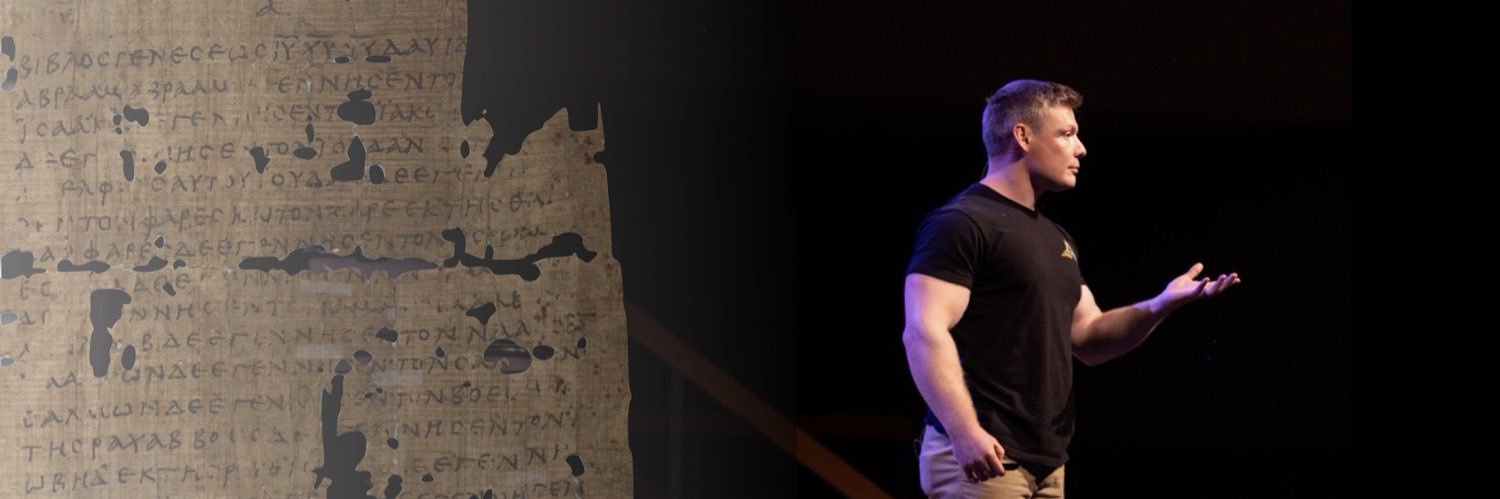
Did a fourth-century church council invent Christianity as we know it? It's one of the most popular claims made by skeptics today — that the divinity of Jesus and the contents of the Bible weren't ancient convictions, but later inventions, decided by committee at the Council of Nicaea in 325 AD.
In this the 3rd episode of Can I Trust the Bible?, Wes and Andy head to Turkey and Italy, going straight to the source to find out whether there's any truth to these claims. Did the Council of Nicaea really vote on the Bible, or invent Christ's divinity? The answers might surprise you.
Join us on this next adventure as we dig into one of church history's most misunderstood moments, separating myth from fact, and following the evidence where it leads.
https://t.co/skjRLm1Azc
Celebrating 11 amazing years of marriage today.
11 years, 6 moves, 5 degrees, and 4 children later. I am incredibly blessed to spend life with such an amazing, beautiful, supportive, intelligent, and gracious woman.
While in London recently my colleague @AWSteiger and I sat down with @alphacourse's @nickygumbel. We explored how evangelism has changed in a post Christian culture and why genuine friendship, not pressure, continues to be a powerful means to introduce people to Jesus.
https://t.co/hZ7qW4I7NG
Interesting tid-bit: David Livingstone is my grandpa's great uncle's brother. Since the name was lost due to a female relative marrying and becoming a Huff, the first born male in my family has the name in our family -- Livingstone is my son and I's middle name, my father's, grandfather's, and great-grandfather's name.
https://t.co/x8uCL5Yv5X
I've often thought that it's because John's significance operates on multiple levels. He functions as a transitional figure linking the Old and New Testaments, with one foot planted in the old covenant and the other in the new. As the New Elijah who prepared the way of the Lord, he recapitulates the witness of all the prophets and represents the Promise of the Old Testament, pointing his finger to Jesus and defining the relationship between the two covenants.
I also seem to remember someone writing (Henri Blocher?) about there being a a polemical dimension. Decades after the crucifixion/resurrection events, there were apparently still disciples of John the Baptist refusing to acknowledge that he had directed people to believe in the one coming after him, namely Jesus. By opening their narratives with John’s testimony to Jesus’s superiority, the evangelists addressed a real historical situation where the Baptist’s followers needed to understand his subordinate role in God’s redemptive plan.
Genesis 7 marks a turning point in the biblical narrative. As the flood begins, questions of judgment, mercy, creation, and re-creation come into focus. Watch our latest discussion exploring the text, its ancient context, and its enduring significance.
YouTube | 7pm BST | 2pm ET
If your theological convictions are not actively making you more gracious, humble, and repentant than your beliefs are not being shaped by Jesus they’re motivated by a desire to be argumentatively “right.”
Joshua 2: "Rahab the prostitute"
Matthew 1: "Rahab, the grandmother of the Messiah."
God has the redemptive capability to change labels and rewrite stories for his purposes and our better.
Meditating this afternoon on the truth of assurance of salvation.
What has typically been called the "perseverance of the saints" sits solidly on God’s sovereign commitment to complete what He has begun in believers’ lives. God pledges to bring to completion the good work He started in believers at the day of Jesus Christ (Phil 1:6), establishing a foundation that transcends my weakness and circumstance.
Christ promises that those who follow Him will never perish because no one can snatch them from His hand or the Father’s hand (John 10:27–29). This dual security, held by both Christ and the Father, reveals an unbreakable grip. Nothing in creation: whether death, life, spiritual forces, present circumstances, or future events, can separate Christians from God’s love in Christ (Rom 8:38–39). The robustness of this list removes the possible threat to salvation.
God’s faithfulness grounds this doctrine. All whom the Father gives to Christ will come to Him, and Christ will lose nothing of what has been entrusted to Him (John 6:37–40). God’s gifts and calling are irrevocable (Rom 11:29), they do not hinge on changing circumstances or human performance. The Lord is faithful and will establish and guard believers against the evil one (2 Thess 3:3).
The work of the Holy Spirit provides active protection. Thank goodness I as a Christian am sealed with the promised Holy Spirit, who serves as a guarantee of our inheritance (Eph 1:13–14). By God’s power, those found in Christ are guarded through faith for salvation ready to be revealed at the last time (1 Pet 1:3–5). Christ is able to save completely those who approach God through Him, since He continually intercedes for them (Heb 7:25).
This treasured Scriptural truth punctuates that those whom God foreknew and predestined are also called, justified, and glorified -- a chain of divine action that ensures completion (Rom 8:29–30). It's a progression moveing from eternity to final glorification, with no breaking point.
All who believe in Christ will have eternal life and be raised up on the last day (John 6:37–40), and believers may know with certainty that they possess eternal life (1 John 5:13). If you are a Christian rejoice in this reality, and if you are not a Christian let me tell you about the most amazing assurance you could ever experience!
Started a small and completely unnecessary controversy last week with my post on the Complutensian Polyglot, noting that its overseer (Cardinal Jiménez) divides the OT Apocrypha from the OT scriptures. The @TextandCanon just published an excellent article going into some more background on the Polyglot that’s worth your time.
https://t.co/KHpKyIwbst
Reading the longest section in Calvin’s Institutes, the topic of which is prayer.
Calvin, accurately I think, understood prayer as foundational to Christian faith and practice. He called prayer “the chief exercise of piety,” viewing it not as optional devotion but as essential to spiritual life. Regardless of outward circumstances or prosperity, believers face constant need that compels them to pray; even those with abundant resources remain dependent on God’s continuing favour, and the perpetual threats surrounding human existence demand unceasing prayer.
Within the Institutes, authentic prayer required 2 critical dispositions. 1st, genuine preparation for prayer demands being so impressed with God’s majesty that one engages in it free from earthly distractions. Wandering thoughts during prayer contradict the reverence God deserves, yet Calvin recognized this struggle as nearly universal, most people experience intrusive thoughts that either interrupt or derail their prayers.
2nd, prayer must align with God’s will rather than indiscriminately pursue every desire, since God does not surrender to human caprice. Lawful prayer demands repentance, and only sincere worshipers of God pray rightly and receive answers.
It is also emphasized that prayer’s structural role in daily life is essential. Christians should pray continuously, but also pause at specific intervals throughout the day; offering morning thanksgiving for rest and the new day, prayers before and after meals, petitions for guidance in daily work, and evening prayers to conclude the day.
Calvin notes that the Lord’s Prayer serves as the blueprint, though believers were not restricted to these exact words as long as they followed their meaning, intention, and heart.
Gotta love the depth of Calvin.
John Lennox has spent decades defending the Christian faith as a mathematician, philosopher, and apologist. But I’m not sure he’s ever said anything more beautiful than this.