Boston Dynamics shows how Atlas learns industrial tasks through reinforcement learning, simulation, and real-world testing. Engineers train Atlas to lift heavy, awkward objects using whole-body coordination, balance, and adaptive control. Millions of simulated training cycles enable rapid skill development before deployment, allowing the humanoid to handle changing loads and environments with robust, human-like movement.
Video Credit: Boston Dynamics
#engineering #technology #robotics
Embedded systems have become harder to debug as event-driven code, multicore architectures, real-time constraints, and power sensitivity add complexity.
This on-demand webinar examines debugging techniques that go beyond basic breakpoints and printf statements. Learn how conditional breakpoints, trace and stack analysis, log breakpoints, skip counts, power debugging, automated testing, and static and dynamic analysis can help engineers identify defects and understand system behaviour.
Watch the full session to explore practical debugging strategies for modern embedded development: https://t.co/Kns9hJptQW
#engineering #technology
In this demonstration, GITAI’s R1 rover collects regolith simulant and stores it onboard using dual-arm coordination. The Moon will need robots that can dig, move, and manage surface material without constant human hands on site.
Video Credit: GITAI HQ
#engineering#technology #robot
This demo shows how AI-powered computer vision can help restaurants measure drive-thru performance in real time.
Plainsight’s visual AI detects vehicles, tracks queue activity, measures wait times, and identifies abandonment events when customers leave before completing an order. These insights can help quick service restaurants and fast casual brands better understand speed of service, lost sales, operational bottlenecks, staffing needs, and customer experience across the drive-thru.
Instead of relying only on manual observation or transaction data, computer vision can provide real-time visibility into what is happening outside the restaurant, including how long cars wait, where delays occur, and how drive-thru congestion may impact revenue.
Video Credit: @PlainsightAI
#engineering #technology #ai #artificialintelligence
Embedded systems have become harder to debug as event-driven code, multicore architectures, real-time constraints, and power sensitivity add complexity.
This on-demand webinar examines debugging techniques that go beyond basic breakpoints and printf statements. Learn how conditional breakpoints, trace and stack analysis, log breakpoints, skip counts, power debugging, automated testing, and static and dynamic analysis can help engineers identify defects and understand system behaviour.
Watch the full session to explore practical debugging strategies for modern embedded development: https://t.co/Kns9hJptQW
#engineering #technology
A research team developing minimally invasive surgical technologies has demonstrated remote magnetic levitation for moving objects inside the body.
Their objective is to control guidewires and catheters using magnetic fields. Because magnetic levitation is inherently unstable, it requires solving difficult control challenges, including nonlinear magnetic field behavior, real-time system modeling, and control algorithms that can operate across different electroMagnetic Navigation Systems (eMNS) and device types.
A key challenge is tracking position and orientation. Once a catheter or microrobot is inside the body, direct visual feedback is often unavailable, leaving researchers to rely on magnetic field and current measurements for localization and control.
Credit: Jasan Zughaibi, Dominik Isler, Michael Muehlebach, and Bradley J. Nelson
Video Credit: Jasan Zughaibi
#engineering #technology #levitation
Figure 03 has begun work at BMW’s Spartanburg plant, handling complex parts sequencing in automotive logistics. Powered by Helix 02 AI, the humanoid robot combines perception, dexterous manipulation, and whole-body movement to adapt to changing environments, extending the success of Figure 02’s deployment in vehicle production.
Video credit: Figure
#engineering #technology #robotics
Flexible sensors enable applications that rigid sensors cannot by delivering precise motion detection with high resistance to electromagnetic interference, direct curvature-based measurements without inertial drift, and two-dimensional deflection sensing for structural monitoring. The sensor shown was printed using NOVA, a direct ink writing dispensing system.
Video Credit: @voltera_io
#engineering #technology #printedelectronics
Not every world-changing technology needs to be flashy. Sometimes, the biggest breakthroughs come from overlooked technologies quietly improving how we live, build, move, and work.
What’s one “boring” technology you think could quietly change the world?
#engineering#technology #communityfeedback #wevolver
Taylor Frey-Baker, a mechanical engineer at Boston Dynamics, answers questions about why the current iteration of Atlas has a head, how the brain of the robot works, and how Atlas understands the world around it.
Video Credit: Boston Dynamics
#engineering#technology#robotics
Chiplet architectures are emerging as a practical alternative to increasingly complex and costly monolithic semiconductor designs. By dividing systems into smaller, specialized dies, engineers can improve manufacturing yields, reuse components across products, combine different process technologies, and upgrade individual functions independently.
But making these chiplets work together requires fast, efficient die-to-die communication.
The UCIe standard provides a common framework for high-bandwidth, low-latency, and low-power connectivity between chiplets from different vendors and technologies.
ForwardEdge ASIC’s UCIe IP implementation provides a validated approach to integrating this connectivity, helping accelerate the development of scalable, interoperable multi-die systems.
See the link in the comments to learn more.
#chips #semiconductors #engineering #technology
Neuralink has been exploring how clinical trial participants can control a powered wheelchair using only their minds.
The Neuralink implant decodes movement intentions in real time to control an on-screen cursor. The cursor operates a custom app displaying a live camera feed of what is in front of the participant.
Moving the cursor up drives the wheelchair forward, down moves it backward, while left and right control steering. The farther the cursor moves in a direction, the faster the wheelchair travels.
The video offers an early look at Neuralink’s work on telepathic wheelchair control, an important step toward restoring independent mobility for people with paralysis.
Video Credit: Neuralink
#engineering #technology #neuralink
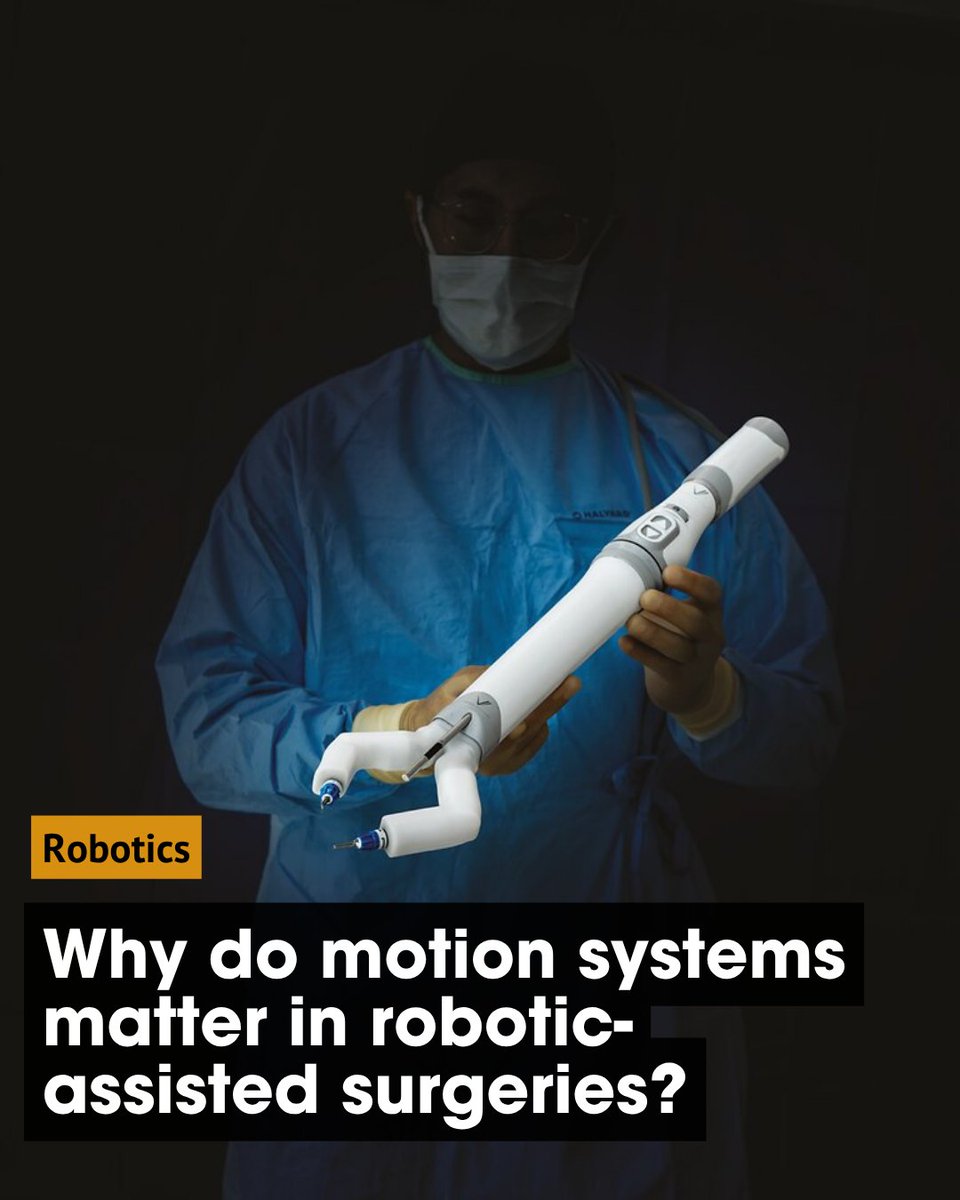
The future of surgery is becoming smaller and more precise.
Robotic-assisted surgery requires motion systems that can translate a surgeon’s movements into accurate, controlled actions within highly confined spaces. Achieving this requires engineers to balance precision, torque, responsiveness, thermal management, vibration, sterilisation, and reliability.
maxon is helping address these challenges with compact drive systems designed for demanding surgical robotics applications, including motors, gearheads, encoders, controllers, and integrated solutions.
As surgical robots become more compact and capable, precision motion technology will be critical to their development.
See the link in the comments to learn more.
#robotics #engineering #technology
@maxonglobal
Tacta Systems develops advanced robotic systems with human-like dexterity and touch. Its technology combines robotic hands, tactile sensors, skill-capture gloves and AI, enabling robots to learn from humans, adapt to physical tasks, and perform precise, complex work in industrial environments.
Credit: @TactaSystems
#engineering #technology #robotics
South China’s Greater Bay Area is becoming an important hub for additive manufacturing, with Shenzhen at the centre of developments in 3D printing, electronics and advanced manufacturing.
TCT Shenzhen 2026, taking place October 14–16, will bring together 250+ exhibitors and an expected 25,000 visitors to explore technologies and applications across polymer 3D printing, smart manufacturing, electronics, healthcare, aerospace, footwear and more.
Beyond the exhibition floor, over 80 conference sessions will examine how additive manufacturing is being integrated into the region’s established industries.
The event offers a closer look at how South China is shaping the next phase of industrial AM.
To learn more, check the link in the comments.
#manufacturing #engineering #technology #3dprinting #additivemaanufacturing