Huge news!
🇨🇦Thanks to @SeeTorontoNow we've extended regular price ROSCon Global registration until 2026-08-27 at 11:59pm.
💰Save $300 when you register before the deadline!
We're looking forward to seeing you in Toronto this September 22nd-24th.
⬇️⬇️
Want some feedback on your project?
Have a question that AI can't answer?
Want to get involved with #ROS development?
Join us for our bi-weekly ROS office hours tomorrow at 9am PT.
https://t.co/JgyVmZPrOM
We're pleased to announce that the latest #ROS release, Lyrical Luth, is now marked as stable/released in ros2_control, ros2_controllers, control_toolbox, & realtime_tools. This release includes many breaking changes, so make sure to read about it here:
https://t.co/ZBnR3Tbn3h
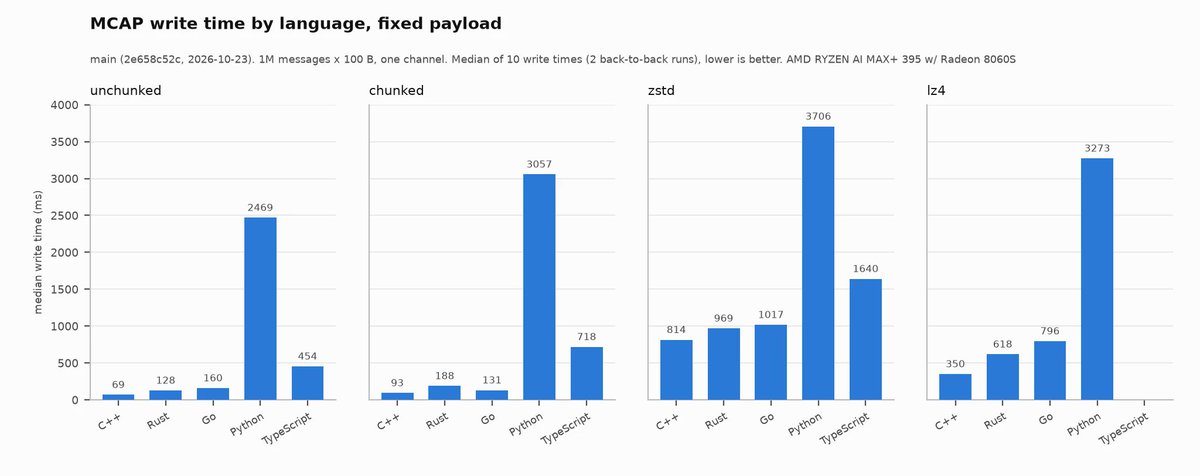
MCAP writes got a lot faster this year, and we can now show it with numbers that compare across every language.
A single lidar or high-resolution camera can produce dozens to hundreds of megabytes a second. If the logger can't keep up, the robot drops data or burns CPU it needs for autonomy. Every training dataset and every bug investigation starts as a recording, so the recorder has to keep pace with the sensors.
MCAP is the open-source log format we created at Foxglove, and it is the default recording format for ROS 2. Until this year, the C++, Rust, Go, Python, and TypeScript libraries each had their own micro-benchmarks, so nobody could say whether a change made things faster or how the languages compared. We built a shared harness that feeds byte-identical data to every library, including a simulated robot recording with five channels from a 200 Hz IMU up to 512 KB camera frames. Each run checksums its input and counts what it reads back, so a fast result from dropped messages gets caught.
Since January, C++ LZ4 writes are about 8x faster on the fixed-payload benchmark, and Rust fixed-payload write time is down by more than half. Batched, SIMD-accelerated CRCs cut chunked write time about 46% in C++ and 31% in Go. The Python ROS 2 decoder uses 90% less memory on nested messages. Most of this arrives with an upgrade, and the post covers where the new compression defaults trade file size against write speed.
Several of these changes came from the community, including Cody Smith's zstd context reuse in Rust and Sebastian Lipponer's buffer pre-allocation in C++. Next, we're exploring a faster Python library that wraps the Rust core. Chris Lalancette wrote up the full results:
https://t.co/OyTDc3kzZV
Introducing GR00T 2: our most advanced, open System One model for robotics. It runs entirely on your robot’s onboard compute, fully untethered, and you own every weight of it. GR00T 2 features:
1. Long-horizon tasks: dexterous manipulation and whole-body control chained over 20+ steps and 5+ minutes, such as performing chemistry lab experiments or assembling model airplanes end to end.
2. X-Adapt: adapting from easy data sources (human wearables and simulation) and deploying zero-shot to diverse real robots.
3. Unified Cognition: native integrations with frontier agents for advanced physical reasoning, robust error recovery, and safety monitoring.
It's an open-source buffet! We are releasing not only the model weights and X-Adapt recipes (coming December), but also our agentic framework, simulation engine, annotation engine, hardware design, and even training data (100K hours, that's ~11 yrs of experience), all available today!
Everything that moves will be autonomous. Anyone can become a roboticist.
Lock in, build with us!
Deep dive in thread:
We've lined up some amazing guests for November Gazebo Community Meeting!
Our colleagues Abdullahi Weheliye and Jose Banos from @OTTOMotors will be joining us next Wed, Nov. 18th, at 9am PT to discuss how Otto uses Gazebo to simulate AMR deployments.
https://t.co/pIjGKpxZWl
Early bird registration for ROSCon India closes on November 12! Register now for the best price on three days of #Robotics learning and community in the heard of Bengaluru!
https://t.co/zpIu4J2y57
#OpenSource#ROS#ROSCon
Building upon work in the #ROS community, OSRA has adopted a revised #genAI use policy. It gives clearer grounds for rejecting slop, provides more guidance, and requires disclosure on PRs & optional on commits. Review it here: https://t.co/31A4nXJF6G #OpenSource#Robotics
The Open #Robotics Annual Survey is open until November 30th. Please contribute back to the community by taking the time to complete it! The responses help us direct our efforts to serve the community better. (plus you may win schwag 😉)
https://t.co/jAREgCq9ck
#OpenSource
Today I am releasing #BehaviorTreeCPP 4.11.0
A part from a ton of hardening and bug fixes, contributed by many users, there are two important highlights:
- New pre-conditions: "onlyIf" and "onStart"
- New Controller Node: "Finally" (no pun intended)
- XML validation
We also release Groot2 (not the other one) 1.10.0, to support these new functionalities ❤️
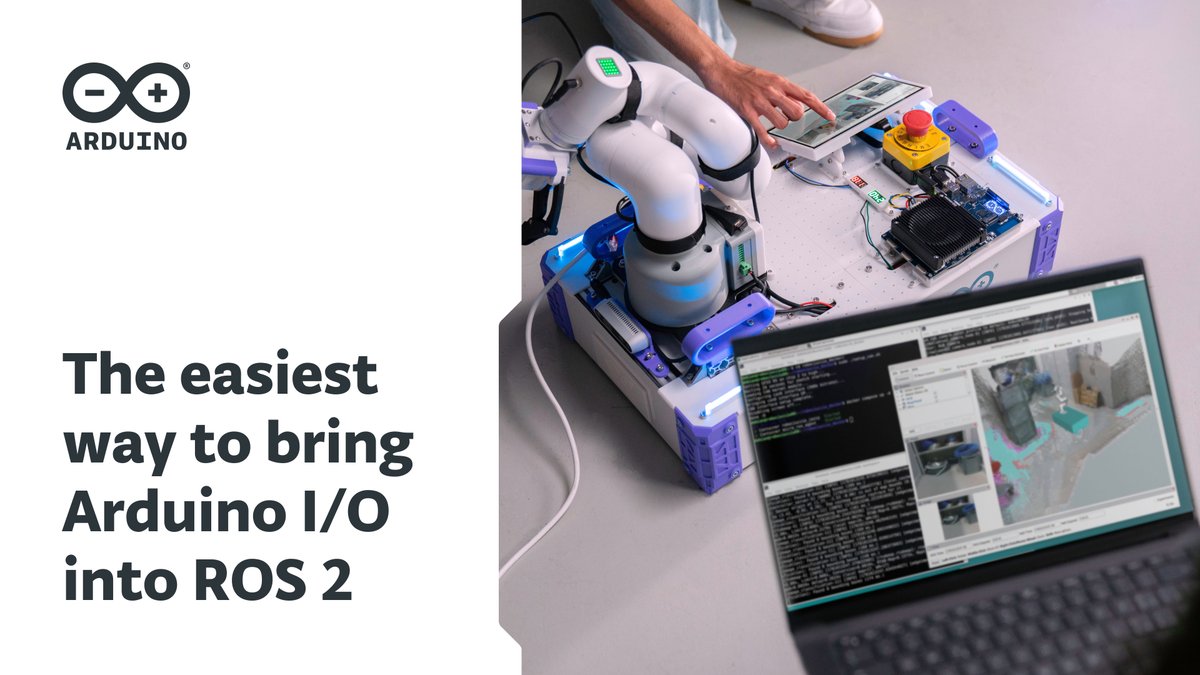
Running ROS 2 on dual-brain boards just got a whole lot easier!
At ROSCon Global 2026 in Toronto, Giovanni Bruno from the Arduino R&D team revealed Arduino_RouterBridge_ROS – an open-source library that is built to let your real-time microcontroller I/O publish and subscribe directly to ROS 2 topics on the MPU using an RPC transport built on MsgPackRPC.
Check out our blog post for a technical breakdown, explore the GitHub repo, and browse our new documentation to get started with ROS 2 on UNO Q: https://t.co/qKxBV6L8b5
autowarefoundation/autoware_off-road_sim
The Autoware-RoboRacer Off-road Simulator is a multi-vehicle high-fidelity simulation framework for Autoware and RoboRacer off-road race cars, built on NVIDIA Isaac Sim with ROS 2 Humble integration. This simulator was developed for the Autoware Off-road project to facilitate the training and evaluation of autonomous driving algorithms within off-road and racing ODDs. This research is part of an ongoing collaboration between the Autoware Off-road/Racing Working Group and the Autoware Center of Excellence (CoE) at the University of Pennsylvania.
We've lined up some amazing guests for November Gazebo Community Meeting!
Our colleagues Abdullahi Weheliye and Jose Banos from @OTTOMotors will be joining us next Wed, Nov. 18th, at 9am PT to discuss how Otto uses Gazebo to simulate AMR deployments.
https://t.co/dHJPjNmaZF
StrataSLAM: open-source multi-floor SLAM for #ROS2 🏢
https://t.co/98KCcsE40l
Stairs, ramps, elevators, drones between floors. One map per floor, and identical floors never collapse into one.
Camera, LiDAR or both · IMU optional · Apache-2.0
Here is you #ROS and open source robotics news for the week of November 2nd, 2026:
🍕ROSCon Italy 2026 is a smashing success!
🍕ROS Meetup in Cartagena Colombia tomorrow
🍕ManyForge: a graphical manipulation framework
🍕Lopsy: a ROS 2 cable robot with a full sim
⬇️⬇️⬇️
@rosorg India is back with #ROSCon2026 to IISc Bengaluru from 2 to 4 December.
It brings together developers, researchers, students, startups and industry teams building India’s robotics future with ROS. Last year in Pune, it drew 1,000+ attendees a day, and this year the community meets in Bengaluru.
Here’s what’s lined up:
🎤 Keynotes and technical talks
🏭 Industry spotlight
🛠️ Hands-on workshops
💬 Panels and fireside chats
🚀 Startup showcase
Hosted by @rigbetellabs, powered by ARTPARK, in association with @OpenRoboticsOrg.
Building something with ROS? Submit your talk before proposals close on 8 November: https://t.co/5PELCDICwy
Early bird passes close on 12 November, so lock yours in now at https://t.co/6ScSza8Iiq
See you at JN Tata Auditorium, IISc! 🤖
#ROSConIndia #ROS #Robotics #OpenSource #ARTPARK #IISc