Narrow list. 37 tickers, names I'd be fine owning if a put gets assigned. That constraint does more work than any single signal in the scoring.
And you've got the CC problem right. If the stock drops, the call I sold goes worthless and books as a win, but I'm sitting on a loss in the shares that never shows up on that trade. The option leg looks great, and the position
doesn't.
Two things I'd add on the CSP side. The 200% stop is the same number for both put and call in my system, no distinction. And a put that goes deep enough to hit it usually means the stock has moved a long way, so the stop tends to fire around the same time you'd be facing assignment anyway.
The honest part: my paper tracker doesn't model owning the shares. When a put gets assigned there, it books the premium and closes. That's optimistic, and I document it as such, because a real assignment usually is a loss.
https://t.co/7cV2G5nZBk
18 setups scored 90+ on my board today. I took 2.
The best one, IREN at a perfect 100, pays 162.9% annualized on $4,000 of collateral. I declined it, because IREN is already in the book.
Instead, I'm tracking two TSLA calls at a third the yield.
Sixteen declines today, every one for concentration. The highest score and the right trade are different questions.
Good question. The 200% is measured on the premium only, not on the shares.
Say I sell a call and collect $1.00 per share, so $100 for one contract. That $100 is the only money in play on that leg. To get out early, I have to buy the option back at whatever it costs right then.
If the stock goes nowhere, the option gets cheap. Buy it back for $20, and I keep $80.
If the stock runs hard, the option gets expensive. Buy it back for $300, and I am down $200. That is the 200%. Took in $100, paid $300 to close, so it cost me three times what I was paid.
So yes, it is per contract, and it is based on what the option costs to close, not on the share price directly.
You are right that I could just let the shares get called away instead. That is often the better path, and it is what usually happens. The stop is not there to protect the shares. It is there so one leg does not keep getting worse while a stock keeps climbing, because the buyback price climbs with it.
The tradeoff: the stop books a real loss on the option even on trades that end up fine overall, because the shares still go at a strike I picked.
https://t.co/7cV2G5nZBk
18 setups scored 90+ on my board today. I took 2.
The best one, IREN at a perfect 100, pays 162.9% annualized on $4,000 of collateral. I declined it, because IREN is already in the book.
Instead, I'm tracking two TSLA calls at a third the yield.
Sixteen declines today, every one for concentration. The highest score and the right trade are different questions.
@RentYourStocks The benchmark's fair, it's just the wrong one. Compare drawdowns instead of headline returns and the picture flips.
30 basis points behind with a fraction of the beta and a cost basis
@TheAlphaThought Agreed, with one condition attached. "A stock you already wanted to own" has to mean at the strike, not at today's price.
Selling a $38 put on a name you'd only buy at $50 isn't getting paid to wait. It's getting paid to be wrong slower.
The strike is the whole trade.
Respect for posting the red month. Most wheel accounts only post the green ones.
The number that matters here isn't the $2,876 in premium, it's Tesla at 25% of the book. The wheel's real risk was never the options. It's what happens when one name gets too big.
Premium doesn't outrun a 30% drawdown on a quarter of the portfolio.
Good on you for flagging the earnings date. That's the part most people skip.
The 140% IV isn't free money, it's the market pricing a gap. A 0.16 delta reads like an 84% win rate right up until the event reprices the whole curve overnight.
I score setups like this for that reason. Not because the math is wrong, but because the odds aren't what the delta says. If $144.62 is a price you want NBIS at, it's still a fine trade.
https://t.co/W6JmLHt0pn
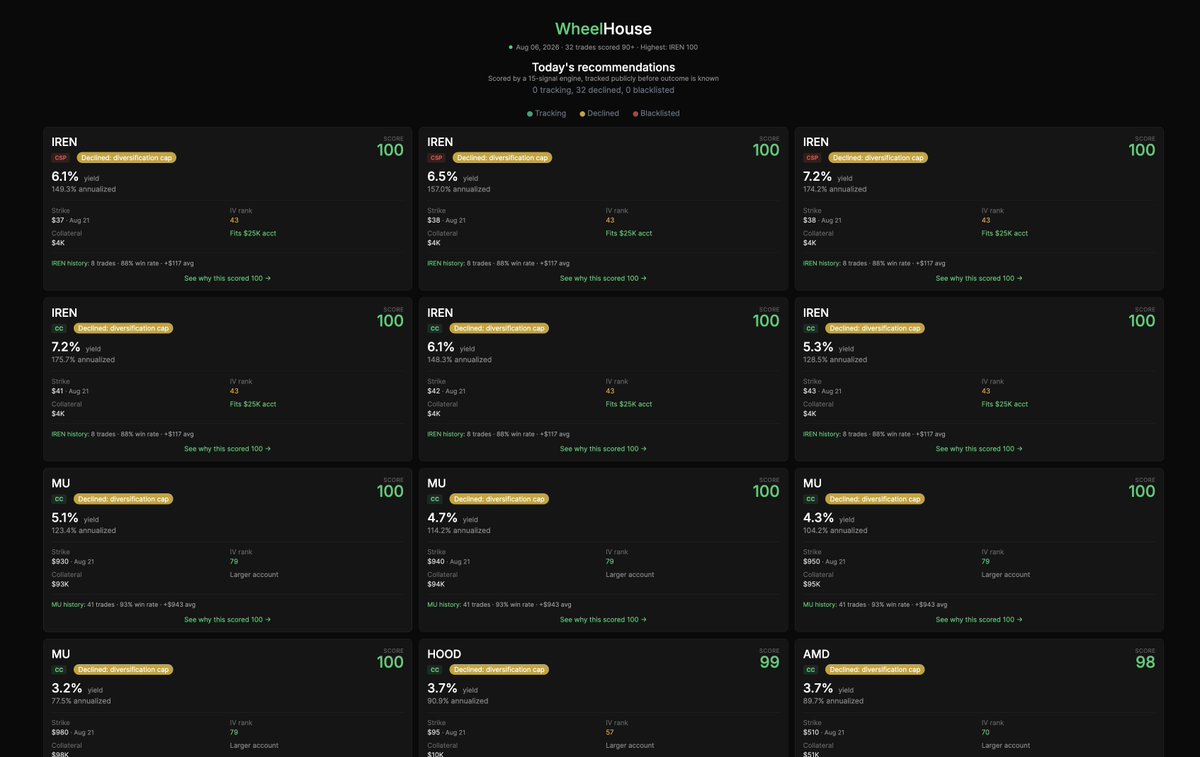
The best setup on my board today: an IREN put at a $38 strike, 7.2% on the cash it ties up over the 15 days to Aug 21. About $4,000 of collateral. Scored 100 out of 100.
I am not taking it.
A cash-secured put means you set aside the money to buy 100 shares at that price and get paid a premium up front for agreeing to it. If the stock stays above $38, you keep the premium and never buy the shares.
The reason I passed: 32 contracts cleared 90+ today, and ten scored a perfect100. Six of those ten were the same ticker. Adding another would be too much concentration risk.
https://t.co/W6JmLHt0pn
The best setup on my board today: an IREN put at a $38 strike, 7.2% on the cash it ties up over the 15 days to Aug 21. About $4,000 of collateral. Scored 100 out of 100.
I am not taking it.
A cash-secured put means you set aside the money to buy 100 shares at that price and get paid a premium up front for agreeing to it. If the stock stays above $38, you keep the premium and never buy the shares.
The reason I passed: 32 contracts cleared 90+ today, and ten scored a perfect100. Six of those ten were the same ticker. Adding another would be too much concentration risk.
That falling payout chart is worth explaining for anyone new.
A covered call fund pays out the premium it collects. Premium comes from the share price and how jumpy the stock is. When volatility cools off, the premium shrinks and the distribution shrinks with it.
Nothing broke. That is just what the income looks like when things get calm.
@ChartsRUs0 The horizon point is the whole thing.
This is why I sell puts on names I actually want to own. If the price never comes to me, I keep the premium. If it does, I get the shares at the price I picked.
Either way, I am not paying a premium to rush the market.
Nice. Worth thinking about closing it.
When a short call is up that much that fast, the money left on the table is small and you are still carrying the full risk of the shares getting called away.
Buy it back, free the shares, sell another one. I take most of mine off around 50 to 70 percent.
Selling calls right before earnings pays the most premium and has the best odds of the shares getting called away.
That is fine here because $40 is your trim zone. The mistake people make is selling a strike they do not actually want to sell at, then paying up to buy the call back after a gap.
Pick the strike you would be happy to sell at. Then look at the premium.
@BoBbyPleWniaK 26 points of premium on 3,500 shares is real money.
Worth saying out loud for anyone reading: a lower effective basis does not make the shares safer. It means you got paid to wait. The stock can still go anywhere.
That is the deal. Steady income, capped upside.
The part worth adding: that $20k in premium is not free cash. It is buying power you borrowed against.
If the stock falls, the short put and the shares you bought with the premium both lose at the same time. That is when the margin call shows up.
Cash secured is slower. It also cannot force you out of the trade.
Assignment is not the trade going wrong, it is the second half of the trade.
You buy the 100 shares at the strike. Your real cost basis is that strike minus
every premium you already collected on the name. Then you sell covered calls
against those shares until they get called away, and you keep collecting while
you wait.
Where it bites: if the stock is well below your basis, the calls that pay
anything worthwhile are also below your basis. So you either sell one and accept
locking a loss on the shares, or you sit and wait for a recovery. That waiting is
the real cost of the wheel and it is the part that never shows up in the
screenshots.
https://t.co/W6JmLHt0pn
The highest yielding setup on my board today is one I am not taking.
IREN, 8.6% on the collateral over the 16 days to Aug 21, scored a perfect 100 out of 100. Declined. The portfolio already leans on that name.
What I am taking instead: a Robinhood $90 put expiring Aug 21. 3.8% over those same 16 days, about $9,000 of cash set aside.
A cash-secured put means you agree to buy 100 shares at a set price, and you get paid a premium up front for agreeing to it. If stock stays above the strike, you keep the premium and never buy the shares.
29 contracts scored 90 or better today. I am taking 6.
No free lunch: passing on 8.6% to avoid concentration is a real cost, and some days that call is going to look stupid.
https://t.co/W6JmLHt0pn
The highest yielding setup on my board today is one I am not taking.
IREN, 8.6% on the collateral over the 16 days to Aug 21, scored a perfect 100 out of 100. Declined. The portfolio already leans on that name.
What I am taking instead: a Robinhood $90 put expiring Aug 21. 3.8% over those same 16 days, about $9,000 of cash set aside.
A cash-secured put means you agree to buy 100 shares at a set price, and you get paid a premium up front for agreeing to it. If stock stays above the strike, you keep the premium and never buy the shares.
29 contracts scored 90 or better today. I am taking 6.
No free lunch: passing on 8.6% to avoid concentration is a real cost, and some days that call is going to look stupid.
"If the IV stays this high" is the entire trade. High IV means the market is pricing a big move, and that usually resolves in days rather than weeks.
The version that keeps working long term: size for the move IV is implying, not the move you expect. If it's pricing plus or minus 20% and you're covered at plus 8%, the premium is fair, not free.
Nice haul though. What expiration are you writing?