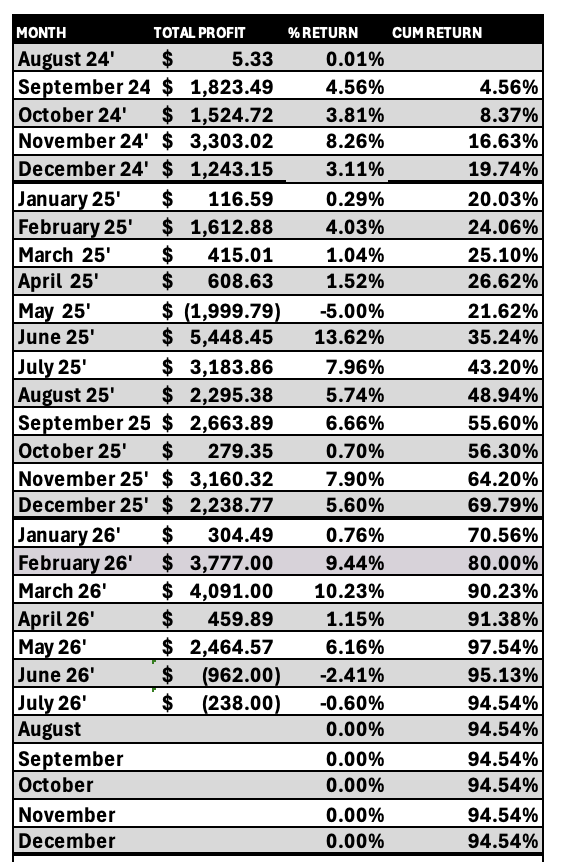
Update for June/July : Got on a little bit of a hot streak earlier this year so saw this coming honestly. Could've been worse, made a lot and lost a lot more but was mostly just because I had to roll further out on a lot of puts I sold. the biggest loss was rolling an ASTS put for -2500. Gains came from $SOFI covered calls, $HIMS covered calls, $ASTS/ $ASTX covered calls. Overall have ~7000 in outstanding premium through November so still not worried.
That brings us to $37,820 / $100,000
📈 Market Close | July 27
📊 Performance
SPY: -0.02%
QQQ: -0.35%
Russell 2000: +0.62%
VIX: 18.67 (+0.48%)
Today’s Overview
Markets finished mixed as investors rotated out of large-cap technology and into smaller, more defensive areas of the market ahead of this week’s Federal Reserve meeting and several major earnings reports. Falling oil prices helped reduce inflation concerns, but continued weakness in semiconductors kept pressure on the Nasdaq. Overall, today’s action reflected cautious positioning rather than broad risk-off selling.
Three Market Movers
Crude fell after geopolitical tensions in the Middle East eased, reducing immediate concerns about supply disruptions. Lower oil prices also helped pull Treasury yields lower and improved the inflation outlook.
Nvidia and several chipmakers declined as investors continued taking profits ahead of a busy earnings week. The AI trade remains intact, but expectations are extremely high heading into results from several mega-cap technology companies.
The Federal Reserve announces its interest-rate decision Wednesday, followed by earnings from Microsoft, Meta, Apple and Amazon later in the week. With so many major catalysts ahead, many investors chose to reduce risk rather than establish new positions.
Under the Hood
• Russell 2000 outperformed while the Nasdaq lagged.
• Consumer Staples and Healthcare were among the strongest sectors.
• Technology and Semiconductors were the weakest areas of the market.
• The 10-year Treasury yield declined as oil prices fell.
• The VIX remained near 19, signaling investors are still paying for downside protection ahead of this week’s events.
What to Watch
• Federal Reserve interest-rate decision on Wednesday.
• Microsoft and Meta earnings on Wednesday.
• Apple and Amazon earnings on Thursday.
• GDP and PCE inflation data later this week.
• Whether Treasury yields continue moving lower.
• Whether semiconductor weakness spreads to the broader market.
📈 Market Close | July 23
📊 Performance
• SPY: -1.20%
• QQQ: -1.88%
• Russell 2000: -0.61%
• VIX: 19.24 (+15.63%)
Today’s Overview
Stocks posted their sharpest decline in roughly a month as two major headwinds hit simultaneously. Investors questioned whether Big Tech’s accelerating AI spending will generate adequate near term returns, while Brent crude surged above $100 per barrel, pushing Treasury yields higher and reviving inflation concerns. The Nasdaq absorbed the bulk of the selling as Alphabet and Tesla challenged the market’s assumptions around AI profitability. Small caps held up relatively better, but overall risk appetite deteriorated as higher energy prices complicated the Federal Reserve’s path toward easier monetary policy.
Three Market Movers
Big Tech earnings forced investors to reassess AI spending. Alphabet fell sharply despite strong Cloud growth after increasing its 2026 capital expenditure outlook to as much as $205 billion. Tesla suffered an even steeper decline after reporting negative free cash flow as spending on AI, robotics and manufacturing accelerated.
Oil above $100 reignited inflation fears.
Brent crude briefly traded above $102 following renewed attacks on shipping routes in the Red Sea and escalating tensions involving Iran-backed Houthi forces. Higher oil prices immediately raise concerns about transportation costs, consumer inflation and corporate margins, increasing the likelihood that interest rates remain elevated for longer than markets had anticipated.
Strong labor data reinforced the higher-for-longer narrative. Initial jobless claims fell to their lowest level in decades, underscoring that the labor market remains exceptionally resilient. While that is positive for economic growth, combined with rising oil prices it also increases the risk that inflation remains sticky, reducing confidence that the Federal Reserve will be able to ease policy in the near future.
Under the Hood
Communication Services, Consumer Discretionary and Information Technology led the decline as Alphabet and Tesla weighed heavily on the major indexes. The Magnificent Seven collectively erased hundreds of billions of dollars in market capitalization, demonstrating that today’s weakness was concentrated in the market’s largest leadership group.
Market breadth was negative throughout the session, although the Russell 2000 outperformed both the S&P 500 and Nasdaq. That relative strength suggests investors were reducing exposure to expensive mega-cap growth rather than indiscriminately selling equities across every sector.
Airlines were among the day’s weakest performers as higher fuel costs pressured the group, while Energy stocks benefited from the sharp move higher in crude prices. Defensive sectors also outperformed as investors rotated toward lower-volatility areas of the market.
The 10-year Treasury yield climbed toward 4.70%, increasing the discount rate applied to long-duration growth assets and adding another headwind for technology valuations.
What to Watch
• Whether Brent crude remains above $100 or geopolitical tensions begin to ease
• The 10-year Treasury yield and whether it remains above 4.70%
• Intel’s earnings reaction and what it signals about AI infrastructure demand
• Whether selling pressure expands beyond mega-cap technology into the broader market
• Additional developments involving Iran, the Houthis and global shipping routes
• Upcoming earnings guidance, particularly around AI capital expenditures and free cash flow
• The Federal Reserve’s policy outlook as inflation risks re-emerge
@mikealfred Can you explain your open thesis. I see you keep buying but what has even changed. Why buy millions in a real estate company with rate hikes coming and nobody can even afford a home
📈 Market Close | July 22
📊 Performance
• SPY: -0.07%
• QQQ: -0.53%
• Russell 2000: -0.88%
• VIX: 16.64 (-2.40%)
Today's Overview
Stocks finished mixed as investors balanced selective strength in AI hardware against another rise in oil prices and Treasury yields. The S&P 500 finished nearly unchanged, but the Nasdaq and small caps declined as investors reduced risk ahead of Alphabet and Tesla earnings.
Three Market Movers
Oil and Treasury yields tightened financial conditions.
Brent crude climbed above $94 per barrel as continued U.S.-Iran tensions, tanker diversions and shipping concerns in the Strait of Hormuz and Red Sea kept supply fears elevated. At the same time, the 10-year Treasury yield moved toward 4.66%, forcing investors to reconsider whether higher energy prices could slow the disinflation trend and delay Federal Reserve rate cuts. That combination weighed most heavily on smaller companies and long-duration growth stocks.
The semiconductor index advanced roughly 1%, with Nvidia and AMD leading gains, while software and IT services underperformed. Super Micro Computer surged after announcing more than $60 billion in new orders, reinforcing confidence that AI infrastructure spending remains robust. The market continues rewarding companies directly tied to AI hardware while becoming increasingly selective elsewhere across technology.
AT&T gained after exceeding earnings expectations and reaffirming its full-year outlook. Meanwhile, GE Vernova declined despite record backlog and higher revenue guidance as investors focused on margin pressure and tariffs. With valuations elevated, the market continues demanding strong forward guidance rather than simply rewarding companies for beating quarterly estimates.
Under the Hood
Utilities and materials led the S&P 500, while consumer discretionary was the weakest major sector. Although the headline indexes appeared relatively calm, market participation remained mixed. The Russell 2000 underperformed, suggesting investors still preferred large, profitable companies over smaller, more rate-sensitive businesses.
Super Micro Computer was the session's standout winner, while Nvidia also finished higher. Alphabet and Tesla traded cautiously ahead of earnings, reflecting investor reluctance to add exposure before two of the most important reports of the quarter.
The VIX declined despite weaker equity performance, suggesting investors were not expecting an immediate volatility event. However, implied volatility remains elevated relative to earlier this month, reflecting continued uncertainty surrounding earnings, oil prices and geopolitical developments.
Cross asset markets painted a more cautious picture than the major indexes. Oil, Treasury yields and gold all moved higher simultaneously, indicating investors continued pricing geopolitical risk and inflation pressure rather than a deterioration in economic growth.
What to Watch
• Alphabet earnings reaction, particularly Cloud growth, AI monetization and capital expenditures
• Tesla earnings reaction, including margins, AI investment and vehicle demand
• Initial jobless claims on Thursday
• The 10-year Treasury yield and whether it remains above 4.60%
• Intel earnings and semiconductor commentary later this week
• Oil prices and further developments in the Middle East
• Whether AI leadership broadens beyond hardware into software and the rest of technology
• Market breadth following this week's major earnings releases
📈 Market Close | July 21
📊 Performance
• SPY: +0.84%
• QQQ: +1.83%
• Russell 2000: +1.42%
• VIX: 17.05 (-8.58%)
Today’s Overview
Stocks rebounded as investors returned to semiconductors and other AI linked names ahead of major technology earnings. The rally broadened beyond mega cap technology, with small caps participating and volatility declining. However, the macro environment remained restrictive: oil reached a five week high and the 10-year Treasury yield climbed above 4.63%. The session reflected renewed earnings optimism rather than an easing of inflation or geopolitical risk.
Three Market Movers
Semiconductors drove the market’s recovery. The Philadelphia Semiconductor Index gained more than 5%, although it remained over 20% below its late June high. Micron rose roughly 12%, SanDisk gained about 14%, and Nvidia advanced as investors rebuilt exposure to the AI trade following the sector’s recent correction. Strength across memory, storage and chipmakers made the move broader than a single stock rebound, although part of the rally likely reflected short covering and tactical dip-buying.
Earnings rewarded execution and punished weak guidance.
General Motors, 3M and Hasbro rallied after reporting stronger than expected results, reinforcing confidence that corporate earnings remain resilient outside the technology sector. Danaher fell sharply after lowering its outlook, while several housing related companies struggled despite reporting headline beats. The market continued to prioritize forward visibility and guidance rather than simply rewarding companies for exceeding backward looking estimates.
Oil and Treasury yields remained the primary macro constraint.
WTI crude rose 2.3% to $85.16 and Brent gained 2.1% to $91.08 after Saudi tankers reversed course in the Red Sea following Houthi threats. The 10-year Treasury yield reached approximately 4.64%, its highest level since May, as higher energy prices renewed inflation concerns. Equities absorbed that pressure during today’s session, but sustained increases in oil and yields would raise the valuation hurdle for both growth stocks and the broader market.
Under the Hood
Small caps outperformed the S&P 500, showing that participation extended beyond mega cap technology. The Russell 2000 rose approximately 1.4%, while QQQ gained nearly 1.8%. That breadth was constructive after several sessions in which market leadership had become increasingly narrow.
The rebound did not fully repair the market’s internal damage. Recent measures of Nasdaq new highs versus new lows have deteriorated, indicating that fewer stocks have participated in the index’s longer term advance. Today’s rally improved sentiment, but sustained breadth across multiple sessions will be necessary to confirm that the recent correction has stabilized.
The VIX fell back toward 17 as demand for immediate downside protection eased. Volatility nevertheless remained above the lower levels seen earlier this month, reflecting continued uncertainty surrounding major technology earnings, elevated Treasury yields and unresolved geopolitical risk.
The cross asset picture remained important. Oil traded above $90 per barrel, Treasury yields stayed near recent highs and the dollar remained firm. Those conditions suggest that inflation and financial conditions remain potential constraints even as investors return to risk assets.
What to Watch
• Alphabet earnings and AI-capex guidance
• Tesla earnings, margins and vehicle-demand commentary
• GE Vernova results
• The 20-year Treasury bond auction
• Whether the 10-year yield holds above 4.60%
• Whether semiconductor strength survives major earnings
• Oil prices and Red Sea shipping disruptions
• Intel earnings and the broader semiconductor outlook
• Whether improving market breadth continues beyond one session
Market Close | July 17
📊 Performance
• SPY: -0.98%
• QQQ: -1.49%
• Russell 2000: -0.54%
• VIX: 18.41 (+10.04%)
Today’s Overview
Stocks ended sharply lower as the semiconductor correction broadened into a wider risk-off move. The underlying economy remained resilient, but investors continued unwinding crowded AI exposure while escalating U.S.-Iran hostilities pushed oil higher and revived inflation concerns. Falling Treasury yields provided little support because Friday’s pressure came primarily from valuation compression and positioning rather than a deterioration in growth expectations.
📌 Three Market Movers
1.) The semiconductor correction became a confirmed bear market.
The Philadelphia Semiconductor Index closed more than 20% below its June record and posted its worst weekly decline in over a year. The selloff has moved beyond a routine pullback: investors are reassessing whether nearly $1 trillion of projected AI infrastructure spending can continue supporting elevated hardware valuations. The emergence of a competitive Chinese AI model added pressure, but crowded positioning and profit-taking appear to be the deeper causes.
2.) Weak guidance reinforced the shift from growth stories to execution. With expectations already elevated, investors punished any sign that revenue growth or operating leverage may fall short. Early earnings results remain broadly strong, but the market is no longer rewarding headline beats without convincing forward guidance.
3.) Escalating Middle East conflict pushed energy higher and complicated the inflation outlook. Oil rose as the United States and Iran expanded attacks on regional infrastructure. Energy was the only positive S&P 500 sector, while higher crude prices threatened to reverse part of the disinflation relief delivered by this week’s CPI and PPI reports. The geopolitical escalation did not initiate the equity selloff, but it broadened risk reduction and increased demand for downside protection.
🔍 Under the Hood
Communication services and consumer discretionary were the weakest major sectors, while energy was the only sector to finish higher. All Magnificent Seven stocks except Apple declined, with Meta and Alphabet among the largest losers.
Market breadth confirmed that the weakness had spread beyond semiconductors. Decliners outnumbered advancers by approximately 1.94-to-1 on the NYSE and 1.76-to-1 on the Nasdaq. The Nasdaq recorded 190 new lows against 75 new highs, another sign that internal momentum deteriorated materially.
The two-year Treasury yield fell to approximately 4.14%, while the 10-year declined toward 4.53% as investors moved into government bonds. The rally in Treasuries suggests defensive positioning rather than a major downgrade to the economic outlook: housing starts rose strongly, consumer sentiment reached a five-month high and industrial production increased modestly.
U.S. crude rose toward $81 per barrel, Brent gained approximately 4.6%, gold advanced and the dollar was nearly unchanged. Oil—not the dollar or rates—was the primary macro transmission channel from the Middle East conflict into U.S. markets.
What to Watch
• U.S. leading economic indicators — Monday at 10:00 a.m. ET
• Alphabet earnings and AI-capex guidance
• Preliminary U.S. manufacturing and services PMIs — Friday
• June new-home sales — Friday
• The 20-year Treasury auction on Wednesday
• The 10-year TIPS auction on Thursday
• Whether the semiconductor index stabilizes after entering a bear market
• Whether VIX holds above 18 or retreats after weekend hedges expire
• Oil prices, the Strait of Hormuz and further U.S.-Iran escalation
@Invest_Brandon what happens if we see a market pullback. For example using 50% margin and sell puts on individual stocks, but then market pullsback 10-20% and your stock pulls back 40%. You kinda get double smacked. do you get margin called, close early, or roll further? genuinely asking.