$WHILOM is live.
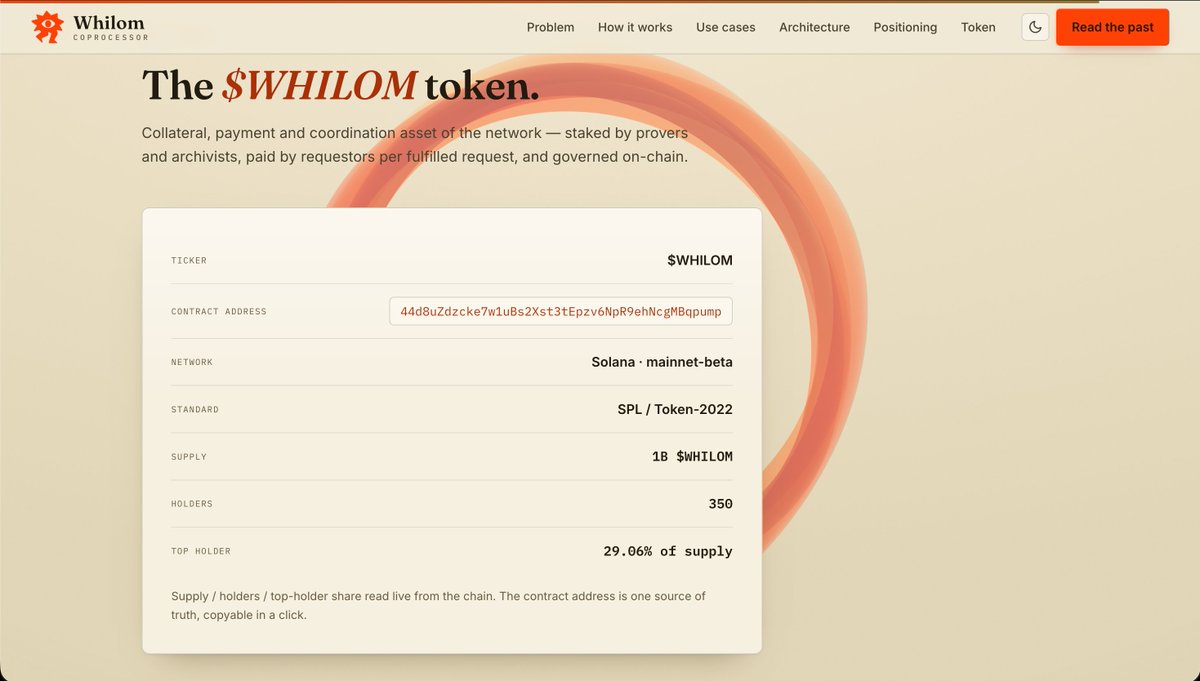
CA: 44d8uZdzcke7w1uBs2Xst3tEpzv6NpR9ehNcgMBqpump
Solana has no memory of its past. Whilom fixes that -verified historical reads, no multisig, no trust.
https://t.co/gy59rcl1OM
Producing the answer is the expensive part.
Verifying it is one Merkle fold. One on-chain call. That asymmetry is what makes Whilom work - the network only pays for results it can independently check.
Auto-snapshots are live.
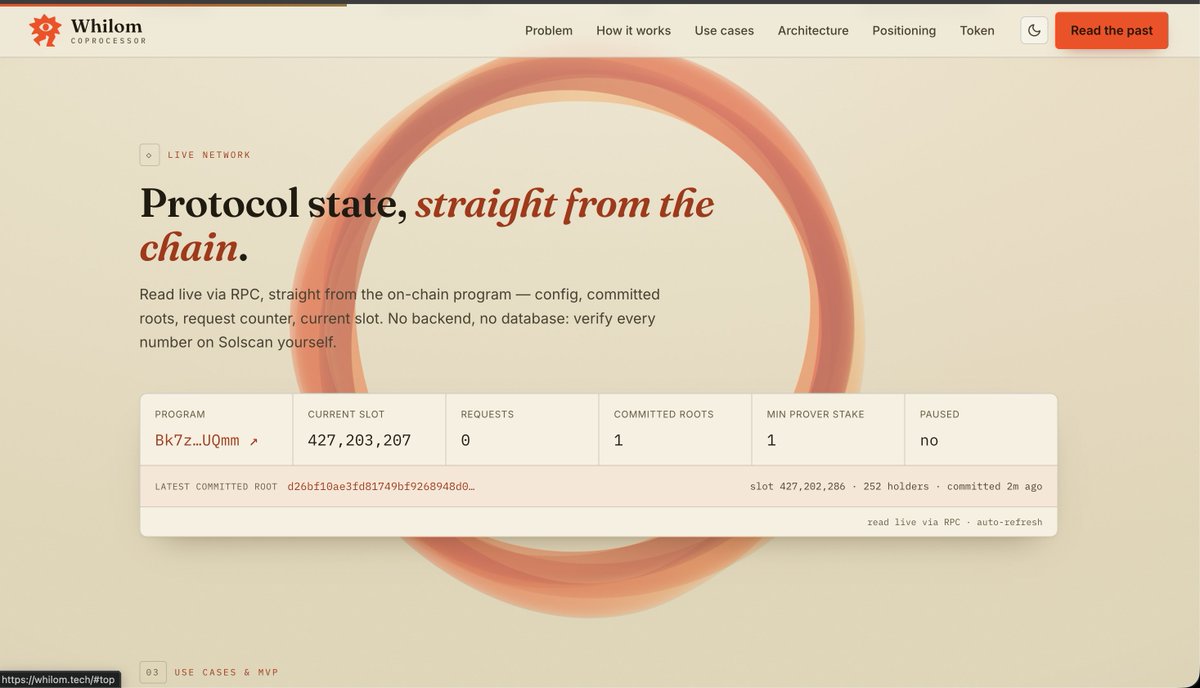
Every 6-12 hours Whilom pulls all current $WHILOM holders, builds a fresh Merkle root, and posts a new CommitmentRoot on-chain. New holders stay provable. The committed state doesn't go stale.
This is the protocol working as designed - rolling commitment roots, automated.
Check the current root yourself:
https://t.co/386i2aL5jB
A proof attests that the computation was done correctly.
Not that someone says so. Not that a multisig approved it. The math checks out or the transaction fails.
That's the whole point.
Whilom starts with one query type, end-to-end, on devnet.
Phase 0 - "What was the balance of wallet W at slot S?" One question. Full proof loop. Works or it doesn't.
From there: more query types, the optimistic path, permissionless prover auction, decentralized archival.
Every phase adds a piece. None of it ships until the previous piece is proven.
The category exists on Ethereum. Solana needs its own version. That's what's being built.
Not every question needs the same level of certainty.
Whilom routes each request to the right settlement path:
- ZK path - cryptographic proof checked on-chain. Instant finality. Costs more. Use for liquidations, big airdrops, anything high-stakes.
- Optimistic path - prover posts a bond. Anyone can challenge within a window. Cheaper and faster. Use for high-volume, low-stakes reads.
Most traffic runs optimistic by default and escalates to ZK automatically when the value is high enough.
Two speeds. One network.
Whilom platform update.
Two things shipped:
Live token stats on-chain - supply, holders, top holder concentration. Pulled straight from the chain via Helius on page load. No fake numbers, no backend.
Merkle inspector got deeper - full sibling path from leaf to root, recompute button that runs the fold in your browser and shows you the match against the on-chain CommitmentRoot. Direct Solscan link to the account the root lives in.
You don't have to trust the UI. You can verify every step yourself.
https://t.co/386i2aL5jB
What can you actually build with this?
- Airdrops that prove eligibility on-chain, no trusted list
- DeFi oracles pulling time-weighted prices from real history
- Voting power based on how long a wallet actually held a token
- On-chain credit scores referencing verified past balances
- Gaming rewards tied to provable historical actions
Any Solana program that needs to reason about the past. Whilom gives it a verified answer instead of a promise.
Whilom is built specifically for Solana from the ground up. Same category as Axiom - but native to the SVM.
The opening exists because nobody filled it yet.
On Ethereum, ZK coprocessors are already an established category.
Axiom, Herodotus, Lagrange, Brevis - all built to let smart contracts read and verify historical chain state.
The real competition on Solana right now isn't another coprocessor. It's the status quo: off-chain scripts and multisig pushers.
That's the trust assumption most protocols quietly rely on today.
Cheating never pays on Whilom.
Before claiming a request, a prover locks collateral worth a multiple of the maximum payout. A bad proof burns that stake. The math makes dishonesty pointless.