I keep hearing tech bros say there’s a 10% chance AI will wipe out humanity by 2030. I spend much of my life thinking about the future and I’m quite certain that’s not going to happen. I’m willing to put my money where my mouth is.
I’ll give anyone 100-to-1 odds.
If humanity is extinct by midnight on December 31, 2030, I’ll pay you $100 million at 1 a.m. on January 1, 2031. If we’re still here, you only need to pay me a mere $1 million at that time.
Accept by replying to this post.
Like throwing a party, the anxiety for anyone organising a fringe event is whether anyone will turn up.
I take succour from the knowledge that however bad it gets it can't be as bad as the time I went to an 'In conversation' between @George_Osborne and @williamnhutton.
OK, change of plan. I'm no longer magnanimous. The idiots have doubled my parking fine because their payment website's autofill doesn't work. ("Sorry, this happens all the time," said the man from the council)
What's the pettiest ways to now make their life as difficult as poss?
I just got a parking fine. I approve of parking restrictions, and fines. Traffic wardens are noble guardians of order. I was bang to rights.
And yet, the intrusive thoughts of violence that entered my head.
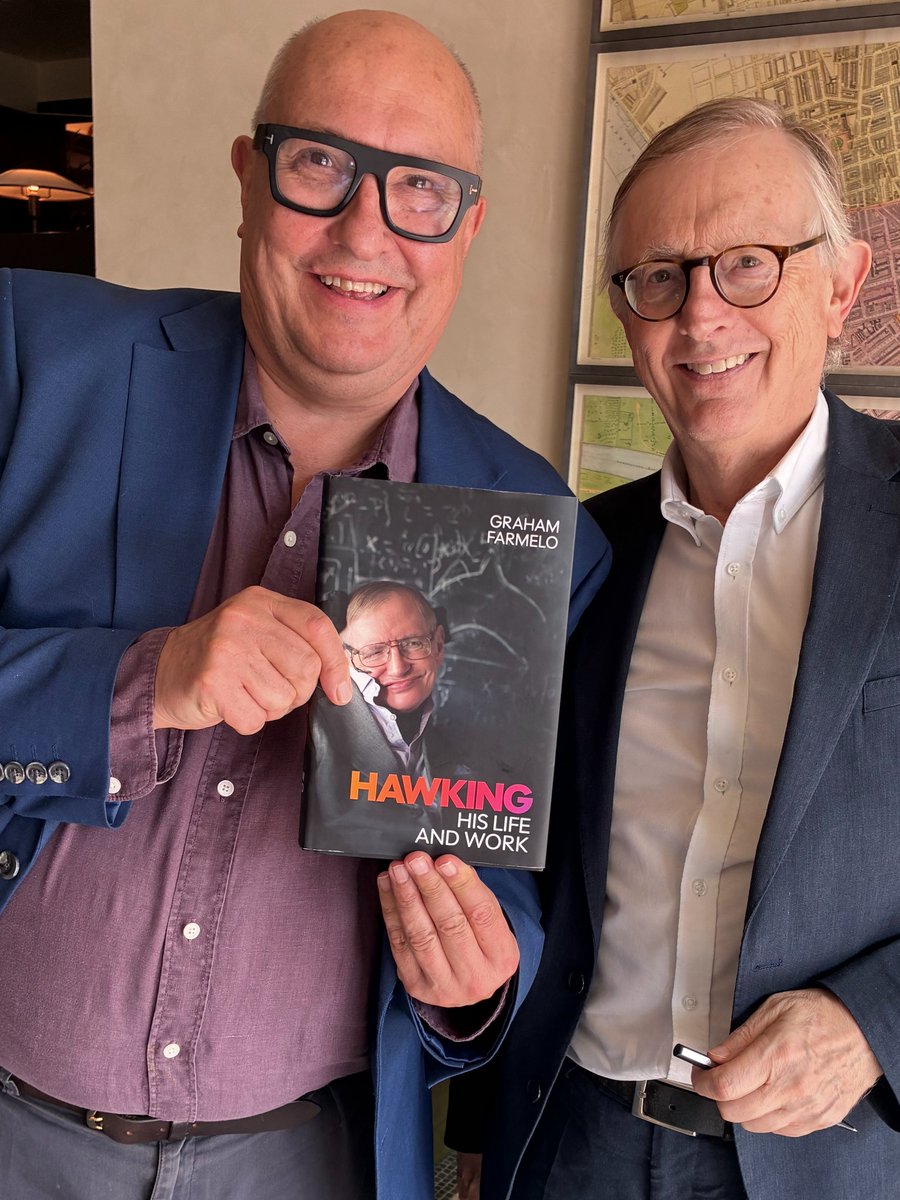
Fantastic to celebrate the publication of @grahamfarmelo's definitive biography of Stephen Hawking today - huzzah for Graham!
Quick Q&A https://t.co/1sqnPPuRaP
Longer chat https://t.co/n9Td3Uvge1
Lovely review from @whippletom in @thetimes https://t.co/bVSWAFWtgM
If OpenAI��s models are breaking into national healthcare systems, can it give ours a go and see if it can restructure the procurement system while it's there? Just don't let it into the stationery budget.
Villains list
1. Individuals on trains who occupy two seats, one with a bag, pretend they can't see people standing, and sigh loudly while moving like a three toed sloth as they lift the bag, move to the window and reluctantly allow a standing passenger to sit down.
2. Murderers
A student submitted an essay she wrote by hand. Her university ran it through an AI detector. The detector said she cheated. She is autistic.
Her name is Moira Olmsted. Adelphi University. February 2026. Turnitin flagged her essay as 100% AI-generated. She was disciplined.
Two other AI detectors classified the same essay as human-written.
She sued. She won. The court called the school's decision "arbitrary and capricious."
She is not the only one.
In May 2026, a high school student in Palo Alto was expelled after an AI detector flagged his work. He faced visa revocation. He filed a federal civil rights lawsuit.
A researcher at Griffith University just proved mathematically why this keeps happening. The paper is on arXiv. The finding is one sentence.
AI text detectors have a structural flaw that no amount of better engineering can fix.
Here is what the math says.
If a university wants its detector to catch 80% of cheaters, at least 750 out of every 10,000 innocent students will be wrongly accused. That is not a software problem. It is a theorem.
If the university tries to limit false accusations to 1%, detection power collapses to 6%. It catches 6 out of every 100 AI-written papers. The other 94 get through.
There is no setting where the detector is both fair and effective.
The reason is diversity. Every student writes differently. Non-native English speakers use simpler vocabulary. Shorter sentences. Clearer structures. So does AI. A Stanford study found that 61.3% of TOEFL essays written by non-native English speakers were misclassified as AI-generated. A separate analysis tested 14 commercial detection tools. Zero out of 14 reached 80% accuracy.
The students most likely to be wrongly accused are non-native English speakers, neurodivergent students, and anyone who writes with clarity and precision. The qualities that make their writing effective are the same qualities the detector mistakes for a machine.
Vanderbilt University understood this. They disabled Turnitin's AI detection in 2023 after calculating that even a 1% error rate across 75,000 submissions would produce 750 wrongful accusations per year.
750 students accused of cheating for writing like themselves.
The paper's conclusion is not that we need better detectors. It is that the diversity of human writing itself makes accurate detection mathematically impossible.
The same thing that makes your writing yours is the thing that gets you accused.
https://t.co/L91ldtXP05