Universal HIGH INCOME via checks issued by the Federal government is the best way to deal with unemployment caused by AI.
AI/robotics will produce goods & services far in excess of the increase in the money supply, so there will not be inflation.
This is CRAZY.
Unilever stopped reading your resume years ago.
Instead, they make you play video games and it's working better than anything they've ever tried.
They put 250,000 job applicants through 12 neuroscience based games before a single human ever looks at their application.
The games were built by Pymetrics, a company founded by neuroscientists from Harvard and MIT. Harver acquired them in 2022.
The games don't test what you know.
They measure how your brain actually works, how you handle risk, how fast you adapt, how you decide under pressure.
It cut their hiring time from four months to four weeks and it saved over 50,000 hours of recruiter time.
JPMorgan, BCG, Accenture, Mastercard, and McDonald's all use the same platform.
Now here is where it gets serious and there is hard science backing all of this.
Researchers at three European universities, Liechtenstein, Rotterdam, and Münster ran 40 business students through Sid Meier's Civilization, then put them through a Fortune 500-style management assessment.
Students who scored highest in the game also ranked highest in problem-solving, organization, and planning, according to a 2020 study published in the Review of Managerial Science.
In 2013, scientists at Queen Mary University of London ran 72 volunteers through 40 hours of StarCraft.
The StarCraft group showed a massive improvement in cognitive flexibility, your brain's ability to switch between tasks and think on the fly compared to a group that played The Sims.
The statistical evidence was 40 times stronger than what chance would predict.
SimCity has been used in university urban planning courses since as far back as the early 1990s, when professors began assigning it to teach systems thinking.
Now step back and look at what this all means.
Your resume tells an employer what you have done while a video game tells them how your brain actually operates.
One is a highlight reel, the other is a live test.
The gamification industry is now valued at over $43 billion globally and is projected to reach $172 billion by 2030.
This market did not get that large by accident.
Companies figured out that traditional hiring was broken.
Cover letters measure writing skills, interviews measure charm and neither one measures whether someone can actually think.
Games measure thinking and that is why corporations are quietly replacing the old system not with interviews, not with degrees but with joysticks.
The Civilization study only had 40 students and that matters.
But it was one piece of a much larger pattern across multiple games, multiple labs, and multiple decades of research pointing in the same direction.
The resume is not dead yet but its days are numbered.
Everyone is covering Terafab as a chip factory.
It is not a chip factory.
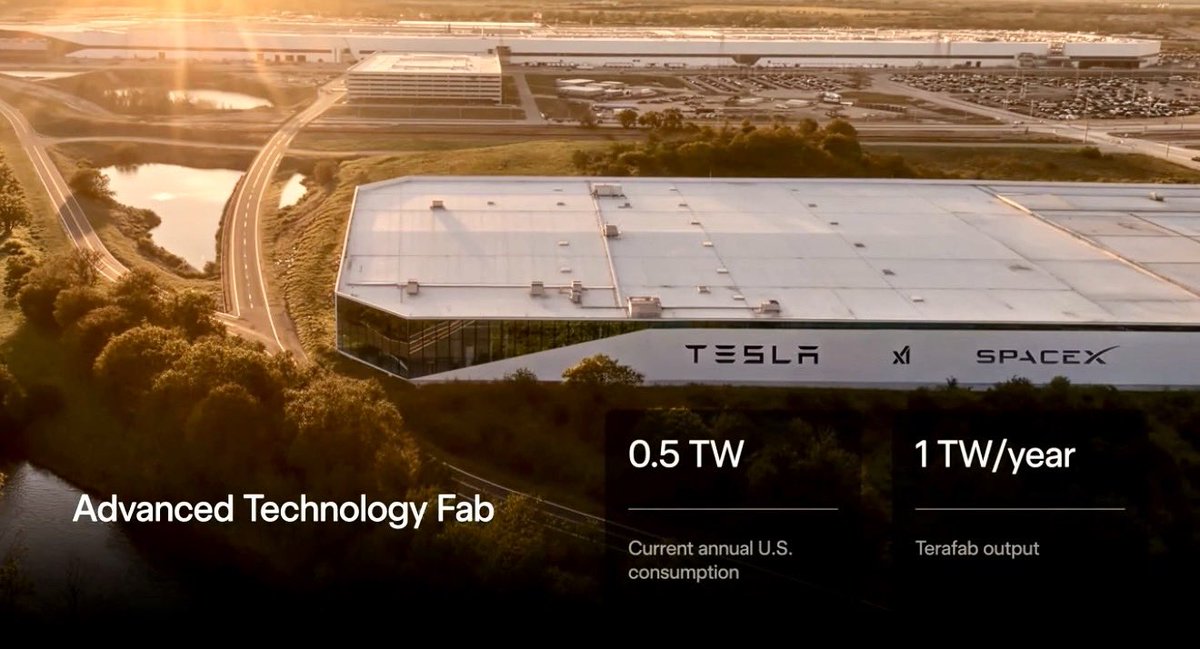
Last night in Austin, Elon unveiled a facility that makes masks, fabricates chips, and tests them inside a single building with a nine-month recursive improvement cadence. No such loop exists anywhere else on Earth. Then he told you 80% of the output goes to space. Then he showed you a 100-kilowatt AI satellite with solar panels and radiators, scaling to megawatt range. Then he said Optimus plus photovoltaics will be the first von Neumann probe, a machine capable of replicating itself from raw materials found in space.
Nobody connected the sequence.
Terafab produces 1 terawatt per year of compute. The entire United States consumes 0.5 terawatts of electricity. Musk is building a single factory whose output in AI silicon exceeds twice the power consumption of the country it sits in. And he is sending 80% of it off-planet because Earth literally cannot power what he is building.
Follow the mechanism. Terafab seeds the chips. Starship launches Optimus robots and solar arrays at 100 million tons per year. The robots mine lunar and asteroid regolith for silicon, iron, and nickel. They 3D-print more robots. They fabricate more solar panels. They assemble more AI satellites. Each satellite runs hotter-burning D3 chips designed specifically for vacuum, where free radiative cooling eliminates the thermal constraints that strangle every terrestrial data center on the planet. The nodes replicate. The replication is exponential.
This is a Dyson Swarm bootstrap hidden inside a semiconductor announcement.
The math is public. The Sun outputs 3.828 times 10 to the 26th watts. A 2022 paper in Physica Scripta calculated that 5.5 billion satellites at 290 kilograms each, robotically manufactured from Mars resources, capture enough solar energy to meet all of Earth’s power needs within 50 years. A 2025 paper in Solar Energy Materials calculated a partial swarm capturing 4% of solar output yields 15.6 yottawatts, roughly a billion times current human civilization’s total energy budget. Musk just announced the factory that builds the chips that go inside the satellites that replicate themselves forever.
92% of advanced logic chips are fabricated in Taiwan. One factory in Austin does not fix that. But one self-replicating system seeded by that factory, launched by the only company with reusable heavy-lift rockets, assembled by the only humanoid robot in mass production, and powered by the only star within reach, does not fix a supply chain. It obsoletes the concept of supply chains entirely.
The market priced this as a $20 billion capex story about semiconductor independence.
The actual announcement was the engineering blueprint for Kardashev Type II.
Humanity sits at 0.73 on the Kardashev scale. 18 terawatts. The distance between here and harnessing a star is not a technology gap. It is a recursion gap. And recursion is exactly what a single building in Austin that makes its own masks, builds its own chips, tests its own chips, and launches the output into orbit on its own rockets was designed to close.
Every civilization that makes it past this point never looks back.
Game designers figured this out decades ago and it cost millions in failed launches.
Will Wright built SimCity with a fully accurate traffic simulation. Testers hated it. The cars behaved realistically, which meant nobody could build a functioning city because real traffic is an unsolvable nightmare. He had to make the simulation dumber before the game became fun.
The tension is permanent: the more accurately you model a system, the more it punishes the participant. Real medieval economies kept 90% of the population in subsistence farming. A historically accurate fantasy world doesn't produce heroes. It produces serfs.
Tolkien solved this by making his economy deliberately vague. No one knows what a gold coin buys in Gondor. That ambiguity is a design choice, not a shortcut.
The Reddit post is funny. The lesson underneath it is one of the hardest problems in simulation design: fidelity and fun are opposing forces, and you have to pick which one wins.
First promo for the animated 'Firefly' series just dropped
They need fans to like their post on IG "to convince folks that this is something people want."
(via IG | https://t.co/6A8rICEQhF)
@themarketswork Heh, you are assuming he knew what everything actually meant. Or you know what he thought everything was. He knew what he thought was everything. That is different in hindsight.
@kevinolearytv have you looked at Idaho Falls Idaho for data centers? It is powered by INL one of the cutting edge nuclear research labs, plus hydro backup. It has cheap cold land, and a fantastic water table. Oh, and a favorable regulatory climate and low taxes. Hidden gem
This is it. The key to Epstein: Bear Stearns put him on BCCI trades in 1979, as it made millions helping the CIA, Brits, Saudis & Israelis disguise covert cash by clearing $13 billion with BCCI, a CIA money laundering bank. Epstein simply developed that clientele & career niche.
If you play Dungeons & Dragons, this object probably stops you in your tracks. It looks exactly like the "d20" you’d roll for a critical hit in a Saturday night gaming session. But this isn't a modern plastic prop. It’s nearly 2,000 years old, made of faience—a crushed quartz ceramic that (in certain techniques) self-glazes to create that vivid turquoise color.
While the Romans loved gambling with six-sided bone dice, this specific icosahedron was likely a tool for something much more serious: divination.
In the Roman world, people used "alphabet oracles" to solve their problems. This was essentially an ancient Magic 8-Ball. The system was simple: you would roll a die or draw a letter lot, note the Greek letter that landed face up, and then consult a public inscription or a guidebook to read your fortune. Each letter corresponded to a specific verse.
One famous key to these letter-oracles, carved on a pillar in Olympos (modern Turkey), lists a prophecy for each letter. For instance, if you rolled or drew an Alpha (Α), the text reassured you: "The God says you will do everything successfully." But if you rolled or drew a Zeta (Ζ), the advice was grim: "Flee the very great storm, lest you be disabled in some way."
@showalter_todd @Sec_Noem Yes. They will get with the program or they won't.
As for gay marriage being a farce, I disagree. I don't see a downside. I'm not religious and procreation isn't the be-all and end-all of marriage.