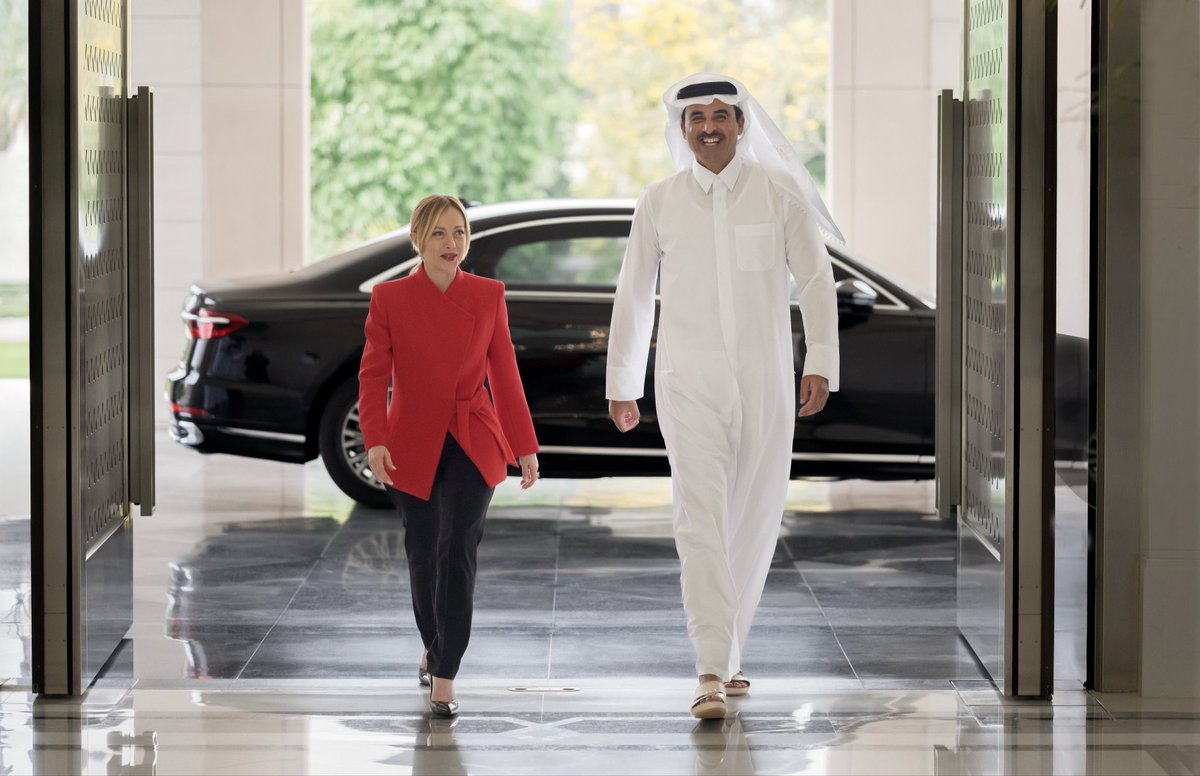
BREAKING: While Trump posted “48 hours before all Hell will reign down,” the European leader closest to him was in Doha telling Italian national television: “This time, we do not agree.” Giorgia Meloni became the first EU, NATO, G7, and G20 leader to set foot in the Gulf since the war began on February 28. She flew into countries under active bombardment to negotiate gas contracts. The UAE engaged 23 ballistic missiles and 56 Iranian drones on the same day she was scheduled to arrive there. She came anyway. She came for gas.
Italy gets 10 percent of its total gas consumption from Qatari LNG. Qatar’s Ras Laffan export facility was hit by Iranian missiles, losing 17 percent of its capacity. QatarEnergy declared force majeure on Italian cargoes, cancelling five shipments. Meloni sat in Lusail Palace with the Amir and pledged that Italy would contribute to restoring Qatari energy infrastructure damaged by Iranian bombing. She reaffirmed the necessity of reopening the Strait of Hormuz. She did not offer a single warplane to help reopen it. Italy denied the US use of Sigonella airbase for offensive operations. Meloni’s government called the strikes a “dangerous trend outside international law.” And then she flew to the Gulf to negotiate the supply of the molecule that cannot flow because the strait she will not help open remains closed.
The Bank of Italy lowered GDP growth forecasts for 2026 and 2027, citing the war. Italy breached the EU’s deficit ceiling last year. Italian families are paying for a war Italy refused to join, in fuel prices set by a strait Italy will not help reopen, for gas produced by allies Italy supports diplomatically but not militarily.
Meloni told RAI: “I continue to believe that, geopolitically, Europe has little to gain from a divergence with the United States, but our duty is, first and foremost, to defend our national interests, and when we disagree, we must say so.” That sentence was delivered from the Gulf, to Italian cameras, about an American war, by the leader Trump once called “fantastic” and treated as his closest European ally. The friendship is not over. But the sentence “this time, we do not agree” is the most significant public break between a European leader and the American president since the war began. It came not from Macron, who blocked the UN resolution. Not from Starmer, who is hosting the Hormuz summit from London. It came from Meloni, the one Trump expected to stand with him.
The day before Meloni arrived in Doha, eight Iranians were killed when the B1 bridge between Tehran and Karaj was struck. They had gathered underneath the unfinished structure to celebrate Sizdah Bedar, the Iranian holiday known as Nature Day. They were picnicking. The bridge collapsed on them. Over 3,000 people have died across the Middle East since February 28. The strait is closed. The gas is trapped. The ally who was supposed to help is negotiating contracts instead. And the leader who promised all Hell is posting countdowns while his closest European friend tells the camera, on the record, in the Gulf, that she disagrees.
The alliance did not fracture over ideology. It fractured over a molecule that cannot pass through a 34-kilometre strait. Meloni needs the gas. She will not fight for the strait. And the distance between those two positions is the distance between a partnership and a transaction.
https://t.co/dAOBBMsgDS
An Iranian man left this comment on my YouTube channel. This is without a doubt the single best explanation of the reality facing Iranian people today👇
"As an Iranian, I can tell you the situation is no longer just political—it's existential. We are trapped between two collapsing structures: one internal, one external. On one hand, we face a deeply dysfunctional government, led by the Supreme Leader and the Islamic Republic’s unelected institutions.
Decades of economic mismanagement, suppression of dissent, and brutal ideological control have alienated multiple generations. No one believes in reform anymore—because every attempt has either been co-opted or crushed. But here's the paradox: We are also terrified of regime collapse—because we've watched the aftermath of Western intervention in countries like Iraq, Libya, Syria, and Afghanistan. Each was promised freedom; each descended into chaos, civil war, or foreign occupation.
So no, we don't trust the U.S. or Israel. Not because we support our regime—but because we know how imperial powers treat ‘liberated’ nations in the Middle East.
Freedom, in their language, often means vacuum, fire, and permanent instability. Right now, many Iranians live with three truths at once: The Islamic Republic is morally and politically bankrupt. The alternatives offered by foreign actors are not liberation—they’re collapse.
A bad government is survivable. No government is not. We are not silent because we agree. We are cautious because we’ve learned—too well—what happens when superpowers decide to "help." In a sentence: Iran is a nation held hostage by its own regime, but haunted by the fate of its neighbors. We are stuck in a house we hate, surrounded by fires we fear more."
Asian Black Bear Cub in the Snow. Culture: Edo Period, Japan, 1799. Medium: Ink and color on silk. Collection: Ashmolean Museum, Oxford.
This is the Tsukinowaguma, the moon-ringed Asian black bear, native to Japan's mountainous forests. During the Edo period, a community in northern Japan's Tohoku region shared these deep, snow-covered beech forests with the bears and hunted them: the traditional winter hunters known as the Matagi. The Asian black bear was essential to the Matagi communities, who depended on the forest during the long, freezing winter months when farming completely stopped and roads were blocked by snow. Bear meat was a vital protein source for them, while the thick black pelt offered protection against the bitter cold. Also, a traditional medicine called kuma no i (熊の胆), derived from the bear's gallbladder, was extremely valuable in Asian medicine at the time.
For the Matagi, bear hunting wasn't just a sport or a commercial enterprise. They saw the bears as sacred messengers of Yama-no-kami, the goddess who ruled the mountains, and as a divine gift she offered to help humans survive.
Taking a life they deemed sacred was a complex religious process with extremely strict rules in Matagi culture. Before stepping into the snowy forest, the hunters would burn a fragrant fir branch called morobi, using its smoke to cleanse their clothes and bodies of any human-world scents. To avoid polluting the sacred mountain environment and angering the goddess, they'd completely stop speaking everyday Japanese. Instead, they used a secret mountain language they called Yama-kotoba. In this language, instead of saying words like "blood" or "death," they used specific substitutes. They wouldn't even let the word kuma -- the standard Japanese word for bear -- cross their lips. To avoid startling the prey and to show respect, they called it itazu.
When they successfully hunted a bear, there wasn't any individual celebration or personal boasting. Instead, they'd hold a special ritual called Kebokai on the deep snow to safely send the animal's spirit back to its divine ancestors. They'd lay the bear on its back, turn its head toward a specific compass direction, and recite ancient prayers. They treated the animal's body with the utmost respect, making sure no part of it went to waste. A small portion of the internal organs, like the heart and lungs, was offered as a tribute to the mountain goddess to express their gratitude. At the end of the hunt, the harvested meat and all proceeds were distributed equally among all the hunters, regardless of who struck the fatal blow.
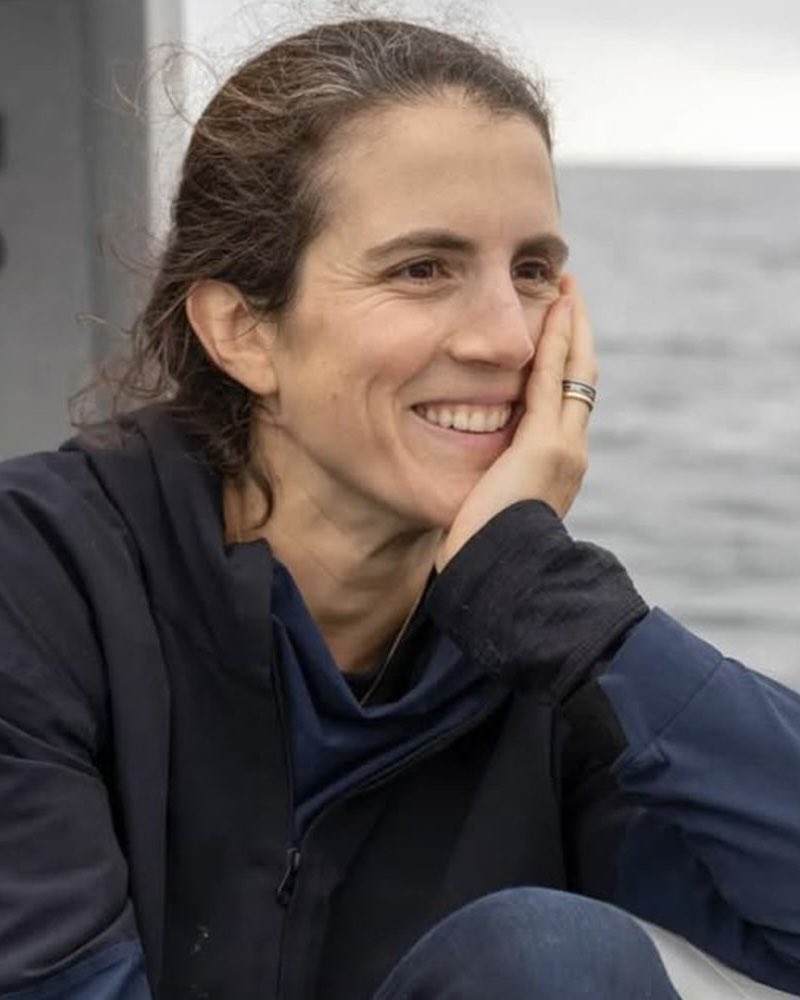
I return to this space today to pay tribute to my sweet, beloved Tatiana, who left this earth today. I return to this space to pay tribute and honor her loving and supportive family, who came together and did everything they possibly could do to help her. I return to this space heartbroken because Tatiana loved life. She loved her life, and she fought like hell to try to save it.
I cannot make sense of this. I cannot make any sense of it at all. None. Zero.
Tatiana was a great journalist, and she used her words to educate others about the earth and how to save it. She created a beautiful life with her extraordinary husband George, and children Eddie and Josie. She fought like a warrior. She was valiant, strong, courageous.
My heart has always been with my cousin Caroline ever since we were little kids. My entire being is with her now. What a rock she has been. What a source of love she has been with Ed, Rose, Rory, Jack, George, Eddie, Josie, and all of Tatiana’s cousins and friends and the amazing doctors who tried so hard.
A few weeks ago, Tatiana wrote so beautifully about her diagnosis and her battle with this horrendous disease. If you haven’t read her words, please honor her by doing so (the article is linked below). Her piece is extraordinary. Whatever your faith, please pray for Tatiana and her grieving family. Tatiana was the light, the humor, the joy. She was smart, wicked smart, as they say, and sassy. She was fun, funny loving, caring, a perfect daughter, sister, mother, cousin, niece, friend, all of it…
Those of us left behind will make sure Eddie and Josie know what a beautiful, courageous spirit their mother was and will always be. She takes after her extraordinary mother, Caroline. May we all hold Tatiana’s family in our collective embrace not just today, but in the days ahead, and may each of you who read this know how lucky you are to be alive right now. Please pause and honor your life. It truly is such a gift. ♥️