VUSD by @vetro_org has chosen frxUSD as default PegKeeper liquidity on @CurveFinance.
VUSD is designed as a treasury layer for institutional treasuries. Take advantage of launch incentives on @StakeDAOHQ and earn rewards.
Catch a special episode of @therollupco Stabled Up, featuring an in-person interview with our Founder and CEO @samkazemian in NYC.
As stablecoins continue to gain adoption, Sam lays out the growth ahead for Frax and frxUSD.
Borrow rates so low users have to rub their eyes.
On @Aave V4, users can borrow $frxUSD against blue‑chip assets at around 0.7%.
That frxUSD then becomes productive money as it can be deployed across DeFi to earn more than the cost of the borrow.
That’s what it looks like when money actually works for the user.
A new generation of stablecoins is being built, ones that share more value with partners and users.
Frax is uniquely positioned to lead here. Not just because we’ve built the StablecoinOS that makes this possible, but because we want DeFi to win.
No better partner than @aave.
I’ve been accumulating $CRV.
Every financial system runs on one thing, liquidity. It’s the bloodstream.
Without it, settlements stall, pegs break, cross-border flows stop.
The protocol that has been building the deepest, most battle-tested stablecoin liquidity infrastructure in DeFi for years is @CurveFinance.
Curve is purpose-built for one job, moving stablecoins and same-priced assets with minimal slippage at scale.
A specific architectural choice that makes it the go-to venue for DAOs rebalancing treasuries, protocols defending pegs, and market makers running tight spreads.
The AMM has been live since 2020, survived multiple market cycles, a major exploit, and still processes billions in volume every month.
The PegKeeper system is where this gets particularly interesting.
PegKeepers are specialized smart contracts engineered by Curve that dynamically manage stablecoin supply directly inside Curve pools to enforce price stability.
$frxUSD runs on this exact infrastructure.
The frxUSD PegKeeper has already crossed $1 billion in trading volume, with PegKeeper TVL at $50M+.
A live system executing at scale, before the broader market has noticed.
And this is where the future of finance becomes concrete. In April 2026, Polygon Labs, Frax, Curve, and DFB Network launched a full suite of onchain FX liquidity pools on Polygon.
frxUSD as the base dollar pair against $BRZ (Brazilian Real), $IDRX (Indonesian Rupiah), $tGBP (British Pound), $AUDF (Australian Dollar), $KRWQ (Korean Won), and $USDT.
Sub-$0.01 transaction fees. 2,600 transactions per second. 24/7 settlement.
Direct access to global currency pairs, fully onchain.
The global FX market moves $6.6 trillion per day. The onchain share of that is a rounding error today.
What Polygon, Frax, Curve, and DFB built is the first serious, full-stack attempt to route real-world currency flows through DeFi rails. Curve’s FXSwap as the exchange layer, frxUSD as the dollar settlement asset, DFB as the market-making bridge connecting local stablecoin issuers to the pools.
This is an infrastructure story.
Every serious stablecoin protocol that wants to defend its peg, manage liquidity, or enable onchain FX needs what Curve already provides.
The more stablecoins exist DeFi-native, institutional, local-currency the more all of them converge on the same place for deep, efficient liquidity.
That’s how network effects compound over years, not months.
veCRV captures the value of all of this: fees, gauge control, protocol revenue.
The more volume flows through Curve pools, the more accrues to those who hold.
Accumulating a stake in the settlement layer that onchain finance is quietly being built on top of.
$CRV 🩸
4/ before you hit publish don’t skip this
open “Preview”
this is exactly what creators will see
if anything feels unclear here, it WILL confuse people later
fix it → then publish
3/ next, you’re basically defining who and how:
* Who Can Apply → who you want
* Qualifications → what they need
* Rewards → how much you’re paying
this is the part that decides if your campaign works or flops
Stablecoin volume is growing.
10 straight quarters of QoQ growth, with acceleration after the GENIUS Act, points to one thing:
Stablecoins are moving from crypto-native rails to core financial infrastructure.
That shift favors protocols built for scale, resilience, and productive dollar liquidity.
@fraxfinance has been preparing for this environment for years:
• frxUSD: our Stablecoin for Genius and payments
• sfrxUSD: yield-bearing dollar
• Fraxtal: native execution & settlement layer for stablecoin finance
• $Frax alignment: value capture across the ecosystem
As stablecoin volumes move into the multi-trillion-dollar quarterly range, the winners will not just be issuers.
They will be full-stack dollar networks.
Frax is one of them.
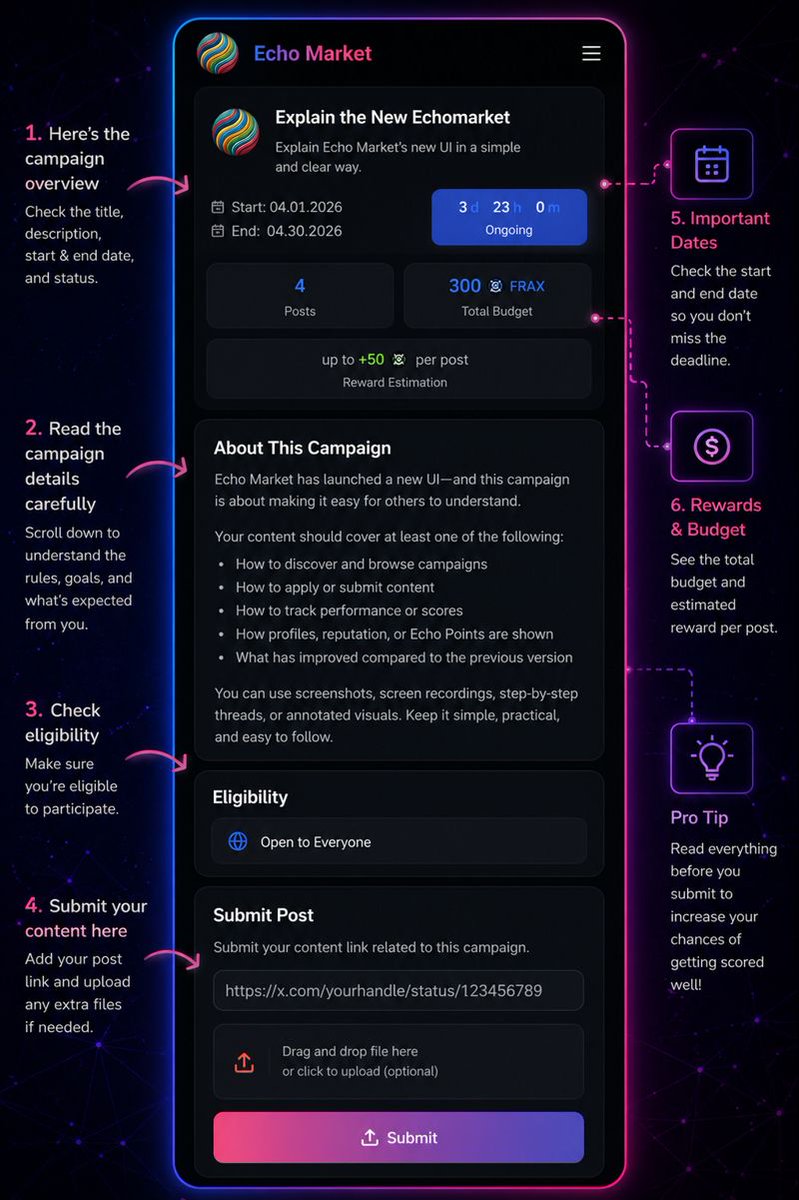
4/ after that, keep scrolling a bit more
you’ll see the submit section
drop your post link / content there and submit
that’s it, you’re in
no complicated steps, everything’s in one flow now
3/ once you open a campaign
scroll down this part matters
you’ll find:
* full rules
* what kind of content they want
* what to avoid
read this before doing anything, saves you time later