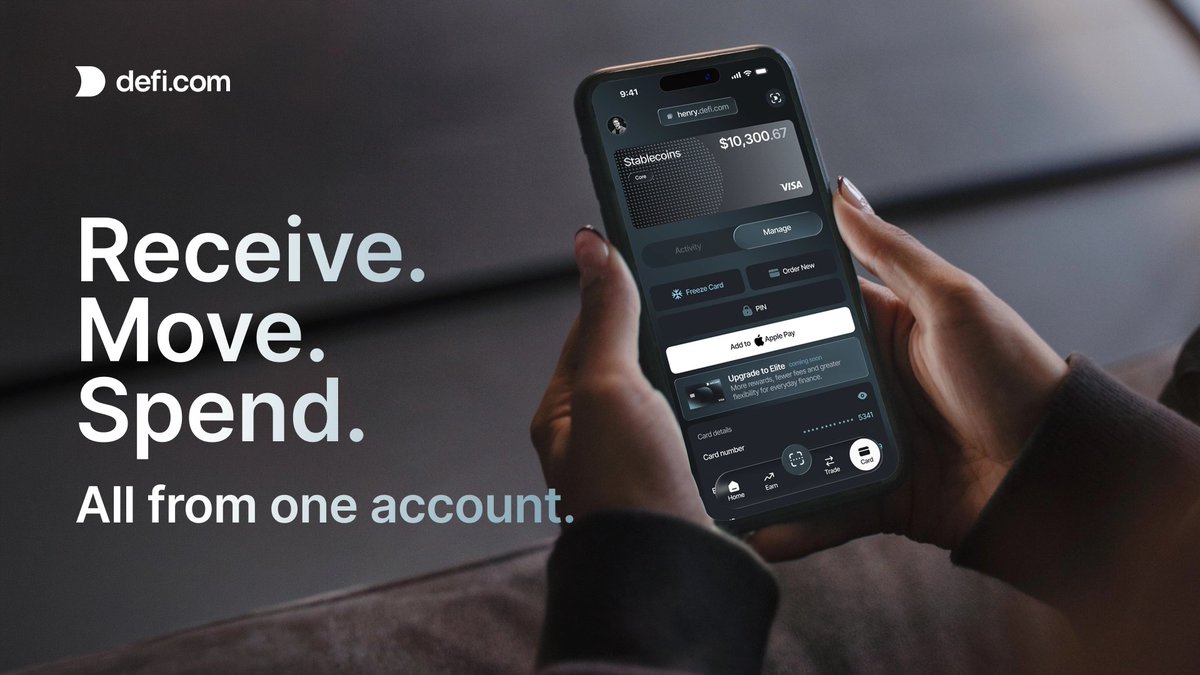
Imagine getting paid in USDC on Friday and using it to buy your coffee the same day. ☕👀
That's the convenience I'm interested in with the @deficom Spend Card.
It's a digital Visa card that spends USDC directly from your own https://t.co/w9s1k3l7jf account whenever you pay.
No moving funds through an exchange or waiting for a bank transfer.
Your funds stay in your account until you spend them.
Simple, practical and connected.
Would you use your stablecoins for everyday purchases?
Get Early Access: https://t.co/C0UatcZFma
When an app holds your funds, it decides when they move.
https://t.co/Jgat1j6NLJ is non-custodial, so your stablecoins stay in your own account and move when you say so.
Break the ice.
here are facts you need to know about Mountain 👇
@cashmerelabs
First , every barn starts with one open stall. If you want to expand, you’ll need to buy Stall Permits to unlock additional stalls
Each Permit unlocks one additional stall, with a maximum of 10 stalls per Barn.
Receiving crypto is one thing, but being able to convert it into money you can use locally is just as important.
That is where @moovexyz Off-Ramp comes in.
Moove Off-ramping allows you to convert your cryptocurrency into traditional money, such as Nigerian naira (NGN).
With Moove, eligible Nigerian users can sell supported cryptocurrencies and receive naira through a bank transfer.
This provides a convenient way to move from digital assets back to local currency when needed.
𝗪𝗮𝘁𝗰𝗵 𝘁𝗵𝗲 𝗳𝘂𝗹𝗹 𝘁𝘂𝘁𝗼𝗿𝗶𝗮𝗹 𝘃𝗶𝗱𝗲𝗼 𝗯𝗲𝗹𝗼𝘄 𝗮𝘀 𝗜 𝘄𝗮𝗹𝗸 𝘆𝗼𝘂 𝘁𝗵𝗿𝗼𝘂𝗴𝗵 𝘁𝗵𝗲 𝗽𝗿𝗼𝗰𝗲𝘀𝘀 𝗼𝗳 𝗰𝗼𝗻𝘃𝗲𝗿𝘁𝗶𝗻𝗴 𝗰𝗿𝘆𝗽𝘁𝗼 𝗶𝗻𝘁𝗼 𝗹𝗼𝗰𝗮𝗹 𝗰𝘂𝗿𝗿𝗲𝗻𝗰𝘆 𝘂𝘀𝗶𝗻𝗴 𝗡𝗶𝗴𝗲𝗿𝗶𝗮𝗻 𝗻𝗮𝗶𝗿𝗮 (𝗡𝗚𝗡).
𝗟𝗲𝘁'𝘀 𝗴𝗲𝘁 𝘀𝘁𝗮𝗿𝘁𝗲𝗱! 👇👇👇👇
HAVING A SOCIAL MEDIA ACCOUNT DOESN'T MEAN YOUR IDENTITY IS VERIFIED.
Think about it.
Anyone can create an account, choose a username, upload a picture and start following people.
Someone can even use another person's picture to create a fake account.
So, how do you know the person you're interacting with online is who they claim to be?
This is where SOEI comes in.
SOEI is building a network where every account belongs to a real, verified person.
It's about making sure there's an actual person behind the account, not just a profile on your screen.
That's what SOEI is working towards.
@heysoei $SOEI
𝗪𝗛𝗔𝗧 𝗛𝗔𝗣𝗣𝗘𝗡𝗦 𝗪𝗛𝗘𝗡 𝗬𝗢𝗨 𝗦𝗘𝗟𝗟 𝗔𝗡 𝗡𝗙𝗧 𝗧𝗛𝗔𝗧 𝗛𝗢𝗟𝗗𝗦 𝗠𝗢𝗥𝗘 𝗧𝗛𝗔𝗡 𝗝𝗨𝗦𝗧 𝗔𝗥𝗧?
With @meetmotes, this question becomes particularly interesting.
Imagine an NFT connected to a smart account holding funds or managing active positions. What exactly happens to those assets when ownership changes?
It’s not as simple as transferring a digital collectible.
Motes’ documentation recognises this and highlights the need for a clear settlement policy when a funded NFT is transferred.
That’s an important detail because transferring ownership of an NFT and deciding what happens to the assets connected to it are two different things.
If you were buying an NFT connected to a funded smart account, what would you want clarified before accepting the transfer?@meetmotes
Rarelist Season 1 is an opportunity to turn research and creativity into meaningful contributions.
With @rarelistio, creators can publish original project insights, earn RARS, and climb the leaderboard. The RARS earned will later convert into $RARE.
My focus is simple: less recycled hype, more thoughtful content that adds value to the Web3 conversation.
Ready to make every post count.
Join here: https://t.co/uA9VWdxnqt
Rarelist Web3
I keep coming back to one question about institutional crypto.
Not speed. Not fees. Exposure.
On a public chain, every balance and position is visible. I can't see a serious fund running a strategy that rivals can read live.
That's why @primus_labs caught my attention.
How I understand it:
- zkTLS proves data came from a real source without exposing credentials
- zkFHE lets you compute on encrypted data
From its own materials, Confidential Vault is live on BNB Chain, and Proof-of-Reserves covers onchain and offchain reserves.
My honest take: smart idea, early infrastructure. Adoption decides everything.
What stuck with me: confidentiality isn't anonymity. Hide positions, keep claims provable.
Would you use this? DYOR.
Explore Primus: https://t.co/j3FzW2NJSB
Join the campaign: https://t.co/SyHeU8MG5C
WHAT IF THE BIGGEST PROBLEM WITH AI IS NO LONGER WHAT IT CAN DO, BUT HOW MUCH WORK WE STILL HAVE TO DO TO MAKE IT ALL WORK TOGETHER?
Think about this for a moment.
AI can help you research an idea, write an article, analyze information, develop software, organize a business strategy, and generate solutions to everyday problems.
Yet, despite all this progress, using AI effectively can still feel like managing several employees who don’t share an office.
You open one chatbot for research. Another tool for writing. A coding assistant for development. Something else for planning and organization.
Then comes the part nobody really advertises:
You have to carry information between them, explain the same objective repeatedly, connect different outputs, correct inconsistencies, and make sure everything contributes to the same result.
The tools are powerful, but the coordination is still largely your responsibility.
And I think that’s an important problem worth discussing.
Imagine a small business owner who wants to launch a new product.
They need market research, competitor analysis, a marketing strategy, content, customer support preparation, and a plan for reaching potential customers.
These aren’t six unrelated activities. They’re different parts of one business objective.
But when AI tools operate in separate conversations, the owner becomes the project manager, information carrier, workflow designer, and final coordinator.
At some point, the time spent managing the tools starts competing with the time spent actually building the business.
We have made AI increasingly capable, but have we made working with AI sufficiently connected?
This is the gap that makes @annaos_ai interesting.
Anna is being built around a different approach: instead of asking people to manage multiple agents, models, and workflows themselves, give them one conversational environment where humans and AI colleagues can work together.
And that changes the question from:
“Which AI tool should I open next?”
To:
“Here’s what I need to accomplish. How can we get it done?”
That distinction might sound simple, but it points towards a much bigger shift in how people could interact with artificial intelligence.
Let’s look at what that actually means. 👇