Welcome to Why Stocks Move 📈
• I trade for a living
• Manage my own capital
• Trade Indian stocks with strong earnings growth
I love sharing what I've learned & have NO paid services.
On this FREE WhatsApp channel, I share:
• My personal trades
• Market observations
• Feedback from the market
https://t.co/YWMuwClmBn
A few important points:
• I am NOT SEBI registered
• This is NOT a tips channel
• This is NOT investment advice
Please do your own research or consult your financial advisor BEFORE making any investment decisions.
Ten Important Filings that you should know, for week ended 24th July 🌯
All data via https://t.co/bZqTmFZFru
1. HFCL to expand Data Centre Connectivity capacity by nearly 5x
HFCL will invest ₹215 crore to add capacity for 270,000 MMC and SNMT assemblies annually, with commissioning expected by September 2027
The capex represents a significant scale up while also shifting HFCL toward higher value connectivity products used inside AI and hyperscale data centers
https://t.co/CZ1c1bFmr1
2. Paras Defence has signed a MoU to set up advanced packaging OSAT facility at cost of 6200cr
Advanced packaging is one of the crucial bottlenecks in AI supply chain today. TSMC overflow is already benefiting companies like ASE Tech and Amkor
Paras wants to set up latest 2.5D/3D advanced packaging line
This is just a MoU at this stage and no funding and terms have been finalized
https://t.co/Gjr4kEAUEh
3. SPEL Semiconductor plans major expansion and fundraising of up to ₹1,000 crore
SPEL has approved raising up to ₹500 crore through a Rights Issue/QIP and another ₹500 crore through overseas instruments including FDI or FCCBs
SPEL currently operates a semiconductor packaging and testing facility, it does not manufacture chips or wafers
It packages fabricated semiconductor dies into finished ICs and performs electrical and reliability testing
The funds will be used to modernize and expand its packaging, testing, automation and manufacturing infrastructure
The company also plans to apply for Central and State semiconductor incentives
https://t.co/owpYtrtc5t
4. ICE Make enters into a joint venture with Japanese company Galilei to foray into HoReCa segment
Galilei will also invest 180cr in ICE Make via preference shares
Food Processing & Hospitality already contributes 15-20% of ICE Make’s revenue, while commercial freezers account for only 2%, leaving significant headroom to build a larger standardized HoReCa equipment business
Galilei brings established Japanese product technology and has around 30% share of Japan’s domestic commercial-refrigerator production
https://t.co/lcfQBFnKbj
5. Apollo Micro Systems receives Indian Navy approval to develop an Autonomous Underwater Surveillance System
Apollo Micro Systems has received a Make-II Prototype Sanction Order to develop SAVIOR-ASW, an unmanned semi-submersible vessel that can operate for extended periods and use acoustic sensors and AI/ML to detect and classify submarines and other underwater threats
The system would represent a first-of-its-kind indigenous capability in India and marks Apollo’s formal entry into autonomous maritime and underwater warfare systems
https://t.co/ebZ3n7DEIn
6. Marine Electricals wins orders worth 376cr including a major order from Siemens for power distribution system that will be used in a Hyperscaler data center
https://t.co/dIkYGmGtZW
7. Gabriel India enters ADAS and automotive electronics through JV with Korea-based HL Klemove
Gabriel India will acquire a 30% stake in HL Klemove India for around ₹935 crore, while the Korean parent will retain the remaining 70% stake
HL Klemove India manufactures ADAS radars, front cameras, autonomous-driving control units and software, along with automotive electronics such as braking and steering ECUs
https://t.co/LgPAYp8b1e
8. Sona Comstar enters into a partnership with Japanese firm Densco Corporation
Sona Comstar and DENSO will establish two India based joint ventures to develop and manufacture traction motors, inverters, generators and eAxles for electric and hybrid vehicles
The first JV will focus on high voltage liquid cooled powertrain systems for passenger and commercial vehicles, with DENSO holding 51% and Sona Comstar holding 49%. This gives Sona access to DENSO’s inverter and hybrid technology and expands it beyond individual EV components into integrated powertrain systems.
In the second JV, Sona will transfer its existing two-wheeler and three-wheeler electric motor and controller business into a subsidiary. DENSO will acquire a 49% stake at an enterprise valuation of ₹1,750 crore, while Sona retains 51% and management control.
https://t.co/Gp0ElKJlXy
9. Indo Tech Transformers enters the 400 kV transformer segment for BESS projects
Indo Tech has received NTPC approval to manufacture 400 kV class transformers for BESS projects, expanding its product portfolio beyond the existing 220 kV range
It has also secured an initial order for two 90 MVA, 400 kV transformers through an EPC contractor
Large grid scale BESS projects require high voltage transformers to connect battery systems to 220 kV and 400 kV transmission networks
NTPC’s recent renewable and BESS tenders include 400/33 kV tie transformers and 400 kV pooling substations
The approval moves Indo Tech into a more technically demanding and higher-value transformer segment and positions it to participate in NTPC’s growing BESS and renewable power evacuation pipeline
https://t.co/6uvcPP3RWv
10. Azad Engineering delivers India’s first indigenous 350 kg thrust class expendable turbojet engine
Azad has manufactured and assembled a 350 kg thrust class turbojet engine designed by DRDO’s Gas Turbine Research Establishment, and delivered the first unit to DRDO
This is not a fighter aircraft engine, it is built for a one time use defence platform, such as a missile or unmanned system, rather than a reusable aircraft
The development is significant because Azad is moving beyond manufacturing individual aerospace components to the complete assembly of an indigenous jet engine, establishing system level manufacturing capabilities in a technology mastered by only a few countries
https://t.co/39VYfNq620
_______________
The above is public-market information drawn from selected filings featured in the weekly #TheWrap🌯 report
None of the above constitutes a recommendation to buy or sell any security
Check out #TheWrap🌯 for in-depth coverage of the week’s most important corporate filings
https://t.co/5YZmbdLhdE
📝 What I learnt today - July 26
Buybacks DON’T always make shareholders richer.
Most investors believe:
“Buyback announced = Bullish.”
NOT always.
A buyback creates value only when a company buys its own shares for LESS than they’re worth. ⭐️
Otherwise, it can destroy shareholder wealth.
Here’s why ↓
Imagine a company is worth ₹1,000 crore.
It also has ₹200 crore of excess cash.
Now consider two situations.
> Scenario 1: A smart buyback ✅
The market panics.
The stock falls well below its intrinsic value.
Management knows the business is healthy.
Instead of wasting cash on unnecessary acquisitions or projects, they buy back undervalued shares.
Result:
• Every remaining shareholder owns a bigger piece of the business.
• The company bought a valuable asset at a bargain.
• EPS also rises because fewer shares remain.
Everyone who continues holding benefits.
> Scenario 2: A poor buyback ❌
Now imagine the stock is expensive.
Intrinsic value: ₹10.
Market price: ₹18.
Management still announces a buyback.
Why?
• To boost EPS
• To support the share price
• To hit executive bonus targets
The company is paying ₹18 for something worth only ₹10.
- Who benefits?
The shareholders who sell into the buyback. ⭐️
- Who loses?
The shareholders who stay, because company cash was spent inefficiently.
It’s no different from buying an overpriced house.
•••
✱ The Warren Buffett’s test
A buyback makes sense only when:
- The company has excess cash AFTER funding attractive GROWTH opportunities.
- The shares trade BELOW intrinsic value.
Miss either condition, and the buyback may reduce shareholder wealth instead of increasing it. ⭐️
•••
✱ The takeaway:
A buyback is not automatically good or bad.
It’s simply another capital allocation decision.
Like building a factory.
Like acquiring another company.
What matters isn’t whether the company buys back shares.
What matters is the price it pays and whether the cash had a better use elsewhere. ⭐️
📝 What We Learn Today • July 27
High Gross Margin ≠ Great Business
We naturally think:
“This company has an 80% gross margin.
It MUST be an amazing business.”
NOT ALWAYS.
Gross margin tells you only how much money is left after producing the product or service.
It does NOT tell you how expensive it is to RUN the business. ⭐️
Think of gross margin as just the first checkpoint, NOT the final score.
•••
✱ First, what is gross margin?
Imagine you sell online courses.
You sell one course for $100.
- Creating and delivering that course costs you $20.
- You keep $80.
> Your gross margin is 80%.
Sounds fantastic!
But now look at what happens next.
•••
✱ The hidden costs:
To sell that course, you spend:
- $20 paying your employees
- $50 on Google and Facebook ads
- $15 on office expenses, software and administration
Total operating expenses = $85
But you only had $80 left after production.
> So despite having an 80% gross margin, you actually LOST $5.
The business isn’t as attractive as the gross margin suggested. ⭐️
Now compare it with a supermarket!
Suppose a supermarket sells groceries worth $100.
- Buying those groceries from suppliers costs $75.
> Gross margin is only 25%.
At first glance, that seems terrible.
But the supermarket:
- Attracts customers without massive advertising
- Sells products very quickly
- Earns from thousands of daily transactions
- Keeps operating costs under control
> After paying all expenses, it earns $8 profit.
Despite the much lower gross margin, it is actually more profitable than the online course business in our example. ⭐️
•••
✱ Why does this happen?
Because businesses spend money on very different things AFTER production.
For example:
A software company may spend enormous amounts on:
- Marketing
- Sales teams
- Customer acquisition
- Research & development
A retailer may spend on:
- Rent
- Logistics
- Employees
A luxury brand may spend heavily on:
- Advertising
- Premium stores
- Celebrity endorsements
These expenses don’t appear in gross margin.
They come later.
•••
✱ What should investors look at instead?
Gross margin is useful.
Higher gross margins often indicate:
- Pricing power
- Strong products
- Efficient production
- Differentiated offerings
But it should never be analyzed in isolation. ⭐️
Also look at:
> Operating margin - How much profit remains after running the business.
> Net profit margin - How much the company keeps after all expenses, including interest and taxes.
> Return on Capital Employed (ROCE) - How efficiently management generates profits from the capital invested.
> Free Cash Flow - Does the business actually generate cash?
These metrics provide a complete picture.
•••
✱ A real-world example:
Many Software-as-a-Service (SaaS) companies have gross margins above 70–85%.
Yet some remain unprofitable for years because they spend aggressively on customer acquisition and expansion.
On the other hand,
retailers like Costco operate with gross margins of only around 10–15%,
but have historically built highly successful businesses through enormous sales volumes, efficient operations, and disciplined cost control.
The lesson is clear:
A high gross margin alone doesn’t determine whether a business is great.
•••
✱ The key takeaway:
Think of gross margin as the amount of fuel left after buying the raw materials.
The journey has only just begun.
The company still has to pay for:
• Rent
• Research
• Marketing
• Employees
• Technology
• Administration
• Interest
• Taxes
Only AFTER all those costs do you discover how much value the business truly creates. ⭐️
High gross margins can be a competitive advantage.
But they are not, by themselves, proof of a great business.
@shome_rajarshi Can you explain the logic behind your 2035 statement?
Do you expect ALL businesses to be ONE PERSON businesses by 2035
or ALL workers replaced by machines & robots by 2035?
@PRATIKBULANI555 At least the Supertrend indicator has turned 🟢 on the weekly timeframe.
+ Jewellery sector is gaining momentum.
The stock needs to clear 400 for any meaningful upmove.
📝 What I learnt today - July 25
3 Demerger Myths Investors Believe (And Why They’re Wrong)
A demerger does NOT make you richer overnight.
Many investors see a demerger announcement and assume the stock will go up.
That’s a mistake. ⚠️
Here are 3 concepts every investor should understand ↓
1. A demerger does NOT create value by itself.
Imagine you own a pizza worth ₹1,000.
You cut it into 8 slices.
Did your wealth become ₹8,000?
Of course NOT.
You still own a ₹1,000 pizza.
A demerger works the same way.
If a ₹10,000 crore company splits into:
- Company A worth ₹6,000 crore
- Company B worth ₹4,000 crore
You still own businesses worth ₹10,000 crore.
Nothing magical happened.
Value is created only if both businesses perform better separately than they did together. ⭐️
•••
2. Then WHY do companies demerge?
Because different businesses deserve different valuations.
Imagine one company has:
- A mature cement business growing at 8%
- A renewable energy business growing at 40%
As one company, investors may value both businesses like a slow-growing cement company.
After the demerger:
- The cement business gets valued like a cement company.
- The renewable business gets valued like a clean energy company.
If investors assign a higher multiple to the faster-growing business, the combined value can increase.
This is called value unlocking. ⭐️
Not because the business changed overnight.
Because the market can finally value each business correctly.
•••
3. You’re NOT getting “free shares.”
This is one of the biggest misconceptions.
Suppose you own:
100 shares of Company A.
After the demerger, you receive:
- 100 shares of Company A (remaining business)
- 25 shares of Company B (new business)
Many investors think they received “free” shares.
They did NOT. ❌
Part of the value simply moved from the old company into the new one.
That’s why, on the ex-demerger date, the price of the original company usually falls to reflect the value transferred. ⭐️
Immediately after the demerger, your total wealth should be roughly the same (ignoring market movements).
•••
So the next time a company announces a demerger, DON’T ASK:
“Will I get free shares?”
ASK these 3 questions instead:
> WHY is the company demerging?
> Will each business perform BETTER independently?
> Will the market assign a HIGHER VALUATION to the separate businesses? ⭐️
📝 What I learnt today - July 26
Buybacks DON’T always make shareholders richer.
Most investors believe:
“Buyback announced = Bullish.”
NOT always.
A buyback creates value only when a company buys its own shares for LESS than they’re worth. ⭐️
Otherwise, it can destroy shareholder wealth.
Here’s why ↓
Imagine a company is worth ₹1,000 crore.
It also has ₹200 crore of excess cash.
Now consider two situations.
> Scenario 1: A smart buyback ✅
The market panics.
The stock falls well below its intrinsic value.
Management knows the business is healthy.
Instead of wasting cash on unnecessary acquisitions or projects, they buy back undervalued shares.
Result:
• Every remaining shareholder owns a bigger piece of the business.
• The company bought a valuable asset at a bargain.
• EPS also rises because fewer shares remain.
Everyone who continues holding benefits.
> Scenario 2: A poor buyback ❌
Now imagine the stock is expensive.
Intrinsic value: ₹10.
Market price: ₹18.
Management still announces a buyback.
Why?
• To boost EPS
• To support the share price
• To hit executive bonus targets
The company is paying ₹18 for something worth only ₹10.
- Who benefits?
The shareholders who sell into the buyback. ⭐️
- Who loses?
The shareholders who stay, because company cash was spent inefficiently.
It’s no different from buying an overpriced house.
•••
✱ The Warren Buffett’s test
A buyback makes sense only when:
- The company has excess cash AFTER funding attractive GROWTH opportunities.
- The shares trade BELOW intrinsic value.
Miss either condition, and the buyback may reduce shareholder wealth instead of increasing it. ⭐️
•••
✱ The takeaway:
A buyback is not automatically good or bad.
It’s simply another capital allocation decision.
Like building a factory.
Like acquiring another company.
What matters isn’t whether the company buys back shares.
What matters is the price it pays and whether the cash had a better use elsewhere. ⭐️
Strong Sectors in the Indian Market 📈
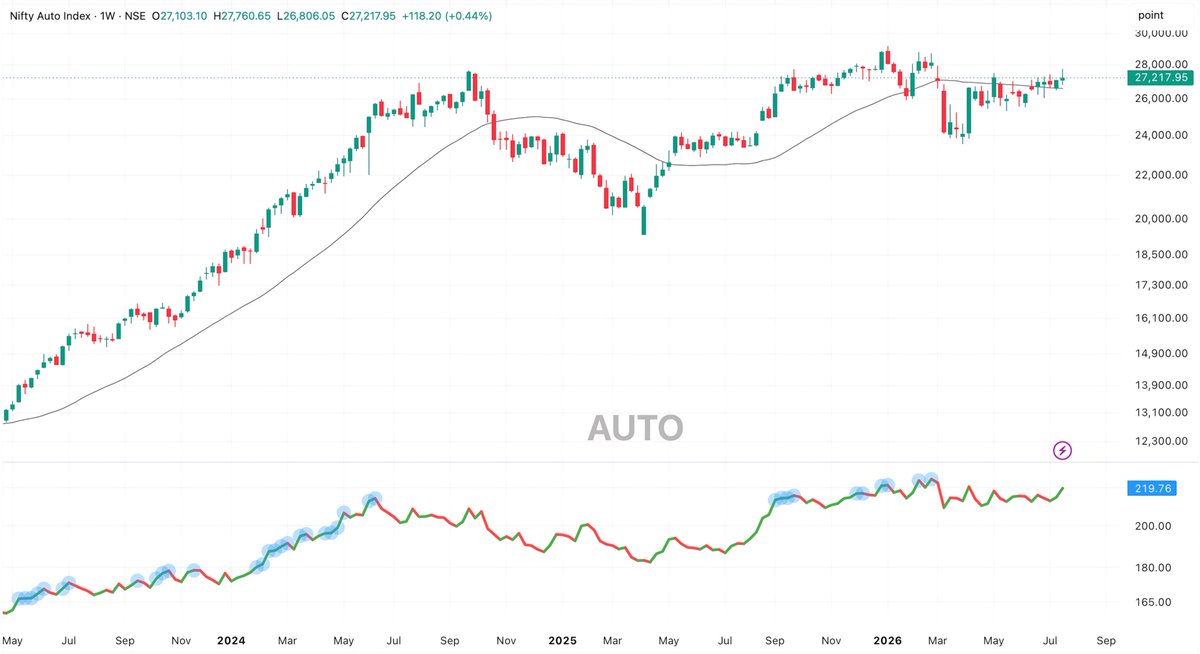
Week ended: Friday, July 24
Method:
- Weekly chart
- 30 week EMA
- Relative strength vs Nifty 500
🧵
1/11 - Nifty Auto Index
I feel the opposite.
If you study the winners’ charts during their major up moves, you can easily spot technical patterns.
Simple example: ALL major up moves happen ABOVE 50 DMA.
So if you identify stock XYZ & your analysis says it’s going to be a multibagger, you can be a part of its journey during ALL “above 50 DMA” phases.
The main issue I observe is people don’t hit the sell button enough.
That's the sector strength snapshot for this week.
The next step is finding fundamentally strong companies within these sectors.
See you next weekend with the next update.
Follow @WhyStocksMove if you enjoy simple stock market education!
Strong Sectors in the Indian Market 📈
Week ended: Friday, July 24
Method:
- Weekly chart
- 30 week EMA
- Relative strength vs Nifty 500
🧵
1/11 - Nifty Auto Index