MON is 28 days from its biggest test 👀
Coinbase’s first token sale. $2.5B valuation. Now it trades below the ICO price, and 16.6B tokens unlock Nov 24.
Hold or exit? https://t.co/uQZ6d1dbxO
Equity perps can begin trading on qualifying US regulated exchanges for the first time, the CFTC says.
The contracts cover individual stocks. Eligible venues must be CFTC-designated contract markets and SEC notice-registered exchanges for security futures.
Chairman Michael S. Selig said the move gives US participants access to equity perps under regulatory safeguards, supported by coordination between the CFTC and SEC.
Source: CFTC, Nov 3.
Backpack traded $952M of tokenized stocks in 24 hours.
That’s more than bStocks, Ondo, Robinhood and xStocks combined.
So Backpack ranks #1 by trading volume and #6 by size. People aren’t parking money there. They trade there.
Why? Backpack doesn’t sell synthetic price trackers. You buy a real US share through a regulated broker, turn it into a Solana token, trade it 24/7, and redeem it 1:1 for the share.
The legal side is the part most people skip:
US: shares held through SEC-registered, FINRA-member brokers
EU: MiFID II license, bought with FTX EU
Dubai: full VARA exchange license
Japan: member of the JVCEA, the industry’s self-regulatory body
Backpack US is run by a former CFTC acting chairman. A former SEC acting chairman sits on its board.
One caveat: $919M of that $952M was a single stock, SpaceX. The next test is doing the same with 200+ names, and Backpack's founder says the target is 10,000.
Volume can move to a rival in a month. Licenses take years.
That’s why Backpack is our Project of the Week. NFA.
@AshCrypto The SEC’s new guidance looks bullish for DeFi, clarifying that token holder voting alone doesn’t equal central control and that true decentralization depends on the actual facts.
@dealerdefi Interesting setup going into today’s midterms, especially since the last three saw big drawdowns before the bottom and then solid gains over the next year.
@Enxgma3@MgnStnlyDerivs If retail stays net sellers for a full week after being buyers all year, it could start weighing on the broader market more noticeably.
@MgnStnlyDerivs Retail flipped to net sellers today for only the second time this year, offloading about $1.4 billion of US equities after buying over a trillion dollars year to date.
@RWAFoundation_@Backpack@tokenterminal Tokenized stock adoption is clearly picking up, with Backpack alone adding over 227K new holders in the last 30 days.
Who's actually buying bitcoin right now?
Fewer people than in the summer. Here's where the money went in October.
ETFs: the biggest buyer flipped to seller.
Aug: +$3.52B
Sep: +$2.65B
Oct: -$515M
The first red month since June, and $643M left in a single day on Oct 30.
Companies: still buying, just slowly.
Strategy added 811 BTC last week at $80,846 and now holds 849,327, about 4% of all the bitcoin that will ever exist. Its two other October buys were only 250 and 267 BTC.
And it paid by selling about $164M of its own stock. So the real buyer is whoever bought those MSTR shares.
Retail: moving coins to exchanges.
Small-holder deposits to Binance hit $10.75B over 30 days, about double six months ago (CryptoQuant). Coins usually go to an exchange to be sold.
So BTC lost 7.3% in October with no big buyer stepping in.
What flips it: a run of ETF inflow days. Watch the daily flow data, and Friday's jobs report, which sets the odds of a Fed hike on Dec 9.
Disney is reportedly preparing to cut thousands of jobs.
Some managers have been told to find 20% in annual cost savings, through layoffs and lower spending.
And this isn't a one-off. It's the latest in a string of cuts this year:
→ ~1,000 roles in spring, mostly from merging marketing teams
→ Several hundred in summer, hitting Pixar, Nat Geo and ESPN
→ Early-retirement buyouts offered to senior staff
→ ~300 more in HR and tech
→ Now, possibly thousands more
Disney isn't alone.
US employers added just 29K jobs in September, with unemployment at 4.2%.
Tech companies have announced ~166K job cuts so far this year, up 54% from last year.
September hiring plans were the weakest for that month since 2011.
The pattern: companies aren't firing in a panic. They're quietly running leaner. Fewer hires, tighter budgets, and AI taking over more back-office work.
That's a slow-bleed job market. And a slow bleed is exactly what the Fed watches.
This week we get ADP, the Challenger layoffs report and the October jobs report.
Soft numbers = higher rate-cut odds. And that matters for stocks and crypto..
Week ahead (Nov 2–6): US midterms, jobs data and tech earnings.
Mon: ISM Manufacturing at 10 AM ET, then $AAPL $PLTR after the close.
Tue: US midterms + JOLTS at 10 AM ET, then $AMD after the close.
Wed: ISM Services at 10 AM ET.
Thu: Bank of England rate decision at 7 AM ET.
Fri: US jobs report at 8:30 AM ET.
Which day are you watching?
On Friday, $1.29 billion of crypto bets got wiped out in a day. Almost all of them were bets on prices going up.
To get why it happened so fast, you need one number: the funding rate.
A lot of crypto trading isn't people buying coins. It's betting on the price with "perps" (perpetual futures). A perp is a bet with no end date. You can hold it as long as you want.
But if the bet never ends, what keeps its price close to the real price of bitcoin?
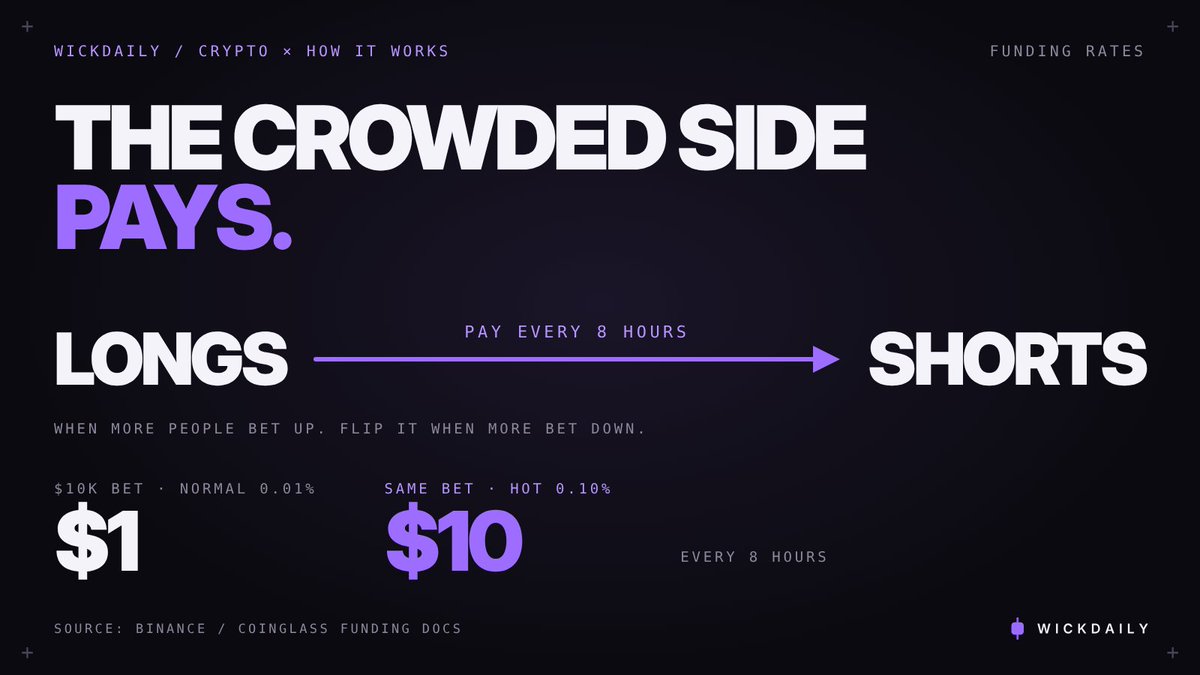
A small fee that one side pays the other, every 8 hours. That's the funding rate.
More people betting up? Longs pay shorts.
More people betting down? Shorts pay longs.
The crowded side pays. That fee pulls the bet's price back toward the real price.
The math is simple:
$10,000 bet × 0.01% = $1 every 8 hours. That's the normal rate on Binance. You barely notice it.
At 0.10%, the same bet costs $10 every 8 hours, or $30 a day. Hold it for a year and you'd pay more than the bet itself.
So why should you care?
A high funding rate means everyone is leaning the same way, often with borrowed money. When the price dips, those borrowed bets get closed by force (liquidated). Each forced sale pushes the price lower, which sets off the next one.
That's what Friday looked like: $1.53B liquidated in 24 hours, $1.29B of it bets on up.
What to watch:
- Near 0.01%: calm, balanced
- Well above that: the crowd is leaning long, so be careful
- Below zero: the crowd is betting on a drop
Funding doesn't tell you where the price goes. It tells you who's crowded, and the crowded side is the one that gets squeezed.
We follow the markets, not the hype.
$100 paid in 10 years is worth $67.60 today if bonds pay 4%. At 5%, it's $61.40.
That gap is why tech falls hardest when yields rise: most of its profits sit years away.
But in October yields fell and tech still dropped. The article explains what changed. https://t.co/sxfW7Moj3a
Is the AI bubble starting to pop?
Not yet. But the market just changed the question it's asking.
For two years it was "who's spending the most on AI?" Spending got rewarded.
This week it became "when does the spending pay back?"
What flipped it:
- Alphabet fell 12.6% Thursday, its worst day since its 2004 IPO, erasing about $475B. Free cash flow turned negative as AI spending climbed.
- Amazon's free cash flow over the last 12 months: -$42.4B, mostly data centers.
- Intel fell 28.6% in a day on a weak outlook.
- The Nasdaq lost about 5% in October.
Meanwhile, demand is real. Google Cloud revenue grew 103%. AWS grew 39%, its fastest in nearly five years.
So the selloff isn't saying AI doesn't work. It's saying the bill is arriving before the profits. When a company burns cash today, investors have to trust a payoff years out, and that trust costs more when the Fed is talking about hiking.
A bubble pops when the spending stops. That hasn't happened. The day a big tech company cuts its AI budget is the day this becomes a different story.
Next tests: Apple and Palantir Monday, AMD Tuesday.
$6.3B left Binance wallets in about 20 minutes on Thursday. Bitcoin still closed October near $77K.
Why no crash? About $3B was frozen fast, $2.3B+ by Tether and Circle, which can block tokens in their own contracts. Once BTC lands in a hacker's wallet, nobody can freeze it.
The Weekly Map: looking back at this week, and the 3 dates that matter next week.
Looking back:
On Wednesday the Fed held rates at 3.75–4.00%. The vote was 10 to 2, and the two who voted no wanted to raise rates, not cut them.
Futures now put the odds of a December hike at about 76%.
Why is a hike even on the table? Prices were up 3.7% over the year to September, up from 3.4% in August. Gasoline rose 9.1% in a single month and did more than half of the damage. Core inflation, which leaves out food and energy, is only 2.6%.
That gap is the whole debate. The hawks worry an energy spike leaks into everything else: shipping, airfares, then wages. Wait, and the Fed ends up chasing it. The other side says oil shocks fade on their own, and hiking into one hits an economy that's already slowing.
And it is slowing. September added 29,000 jobs. July was revised down to a loss of 10,000. Unemployment is 4.2%.
Looking ahead:
Tue, Nov 3: midterms. The Fed sets rates, but Congress sets the deficit. If markets expect more borrowing, the 10-year yield climbs and the Fed's job gets harder. Watch the 10-year on Wednesday morning.
Fri, Nov 6: October jobs report, 8:30am ET. Another weak number gives the Fed a reason to hold, even with inflation at 3.7%. A strong one takes away the main argument against hiking.
Tue, Nov 10: October CPI. If gasoline cooled, headline inflation drops back toward core and the hike case gets weaker. If core moves up too, that's the number the hawks have been waiting for.
By Friday's close, check December hike odds on CME FedWatch. That one number will tell you which way this week went.
Major banks have raised their oil price forecasts for 2026 and 2027, according to a WSJ survey.
Average forecasts per barrel:
2026: Brent $90.40 / WTI $84.38
Q4 2026: Brent $94.78 / WTI $88.10
2027: Brent $76.74 / WTI $70.52
Despite the upward revisions, banks still expect lower average prices in 2027 than in late 2026.
Source: WSJ / Dow Jones.
$6.4B was stolen from Binance on Thursday. 44% of it is frozen.
Almost all of the frozen part is USDT and USDC. Tether and Circle can lock any wallet holding their tokens.
The 18,270 stolen BTC? Nobody can freeze it.
That button works on any wallet, not just a hacker's.
~$5.6B just left Binance's hot wallets. If confirmed, it's the biggest crypto hack ever.
What left, per on-chain trackers:
$USDT $1.57B
$BTC $1.45B
$ETH $875M
$USDC $823M
$TRX $234M
$RLUSD $88.5M
$WBETH $75M
$XAUT $50M
Others $447.5M
The previous record was Bybit at $1.5B in Feb 2025. This is nearly 4x that.
Tether and Circle have already frozen ~$2.4B of the stablecoins. The BTC and ETH can't be frozen.
Binance says it's investigating and user funds are safe. The total isn't confirmed yet.
The company that tracks crypto hackers just got hacked.
Chainalysis told customers an outside attacker used "offensive agentic techniques" (AI agents) to get into its systems and internal tools.
Accessed:
• User IDs
• Full names
• Emails
• Org role labels
No sign of access, per Chainalysis:
• Investigation graphs, notes and cases
• Query results
• Passwords, MFA secrets, session tokens
So no case files leaked. But think about who uses Chainalysis: compliance teams, investigators, government agencies. Their names, emails and job roles make a ready-made phishing list.
The method is the bigger story. AI agents got inside a company whose whole business is security.
Chainalysis says this is unrelated to the recent Binance theft. It's still working out exactly which records each customer lost.
@KobeissiLetter Sentiment can change much faster than fundamentals. Zooming out helps, but the long-term case still rests on earnings, cash flow and real adoption keeping pace with expectations.