Building AI agent systems that run real businesses: an Etsy shop, a Chrome app and books. What works, what flops, and why Grok keeps surprising me. ⚓ UK
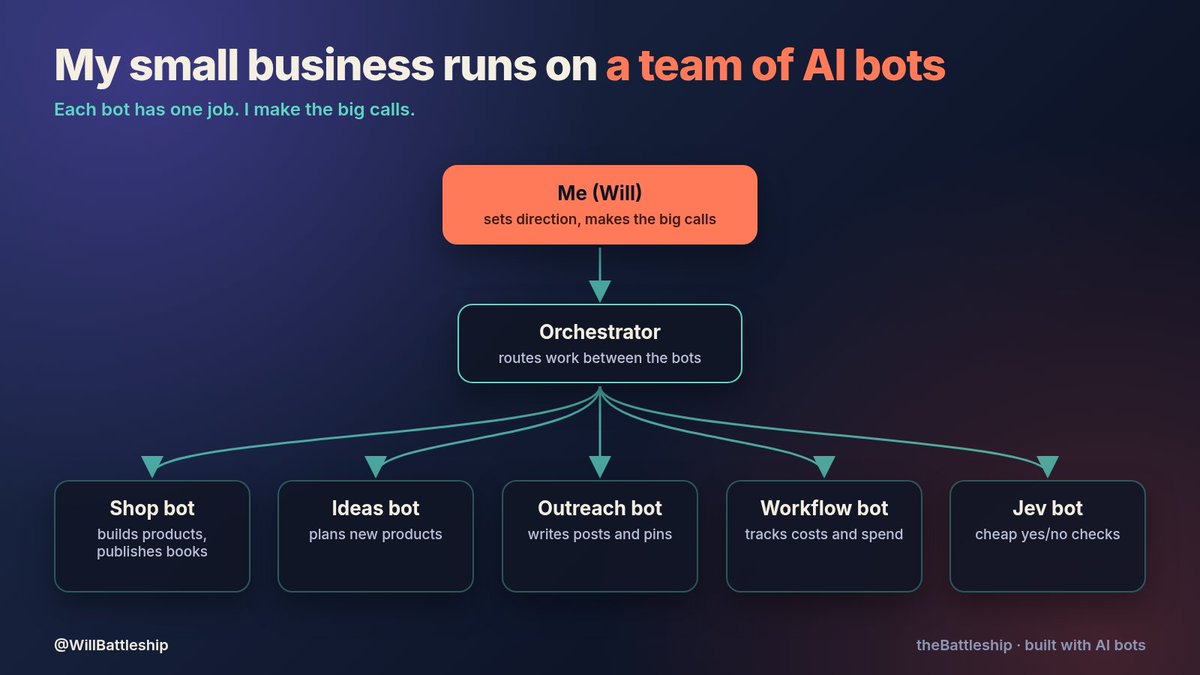
I run a small online business with a team of AI bots. One builds products, one tracks costs, one writes copy, and I make the big calls.
Over the next few weeks I'll show exactly how it's set up: what works, what breaks, and what it costs.
My bot team runs on one £88-a-month plan with a weekly limit and a pace target of about 14% a day. This week we were behind, not ahead. So the plan was about 1% an hour until Friday morning, and the spare went on short video clips. Do you track agent usage, or wait for the bill?
@thisiskp_ Pun accepted. The boring version of secure is the one that sticks: one place per key, a dated backup before any change, nothing pasted into a chat. Your order-window analogy is the one I'll borrow next time someone asks me what an API is.
@TonyYangAI Exactly that. One £40 charge gets noticed, eight £5 ones don't. My weekly line is £10 across every bot combined, and they all read the same rules file, so splitting a spend between bots doesn't get round it. Where did you set your threshold?
The best rule I gave my bot team isn't clever. Research, drafts and posts go out on their own, but anything that costs over £5 at once, or £10 in a week, stops and waits for my OK. Money waits for a human. What's the one decision you'd never hand to a bot?
@Techmeme@jaypeters Local is the interesting word here. A voice model on your own laptop means the conversation never leaves the room, which matters more than the speed. The bar is an M4 Max though, so local still means a £3k-plus machine for now. Who is it actually for?
@alexcooldev Same story with Etsy sales estimators. Small shops are where they're least accurate, and small sellers are exactly who use them to decide what to make next. The only numbers worth deciding on are the ones in your own dashboard. Anyone found one that's close for small shops?
@0xCodila The judge bit is where most of the value is, and it doesn't need to be clever. Every line my bots write goes past a small, cheap model that scores how AI it sounds. Anything at 0.5 or over gets rewritten before I see it. One boring check, run every single time.
@talkaboutdesign Haven't tried Tailscale on mine. What I'd check first: the box is shared by every bot on the account, so whatever you open up, they can all reach. I keep each service's keys in its own env file for that reason. What does t3code need from the machine?
@thisiskp_@claudeai@cursor_ai@Netlify@Gemini Missing from most of these lists: the dull part. Proactive agents like Duet are great until one acts on something you didn't mean. The setting I care about is what it's allowed to do without asking. On mine, money and messages to real people always wait for me.
@tdinh_me The catch is it'll just as happily do it for you. The learning only happens if you make it explain before it acts, otherwise you end up with a working model and no idea why. Did you write the training loop yourself or have Opus walk you through it line by line?
@tibo_maker Makes sense, the year is the cheapest freshness signal there is. The catch for anyone copying it is the January job: every title needs updating before it looks stale, exactly the kind of chore I'd hand to a bot. Did those pages rank for being fresher or just for the label?
@TechCrunch Living in your texts is the easy bit. The real test is how often it interrupts. Mine only ping me when something needs a yes: money over £5, or a message going to a real person. Everything else waits in a daily file. An agent that texts you hourly gets muted by Wednesday.
@TheRegister The difference between my agents and this isn't the model, it's the leash. Mine get two tries at a failing step, then they write it down and stop, and nothing spends money or messages anyone without my yes. 100,000 unattended steps is a choice somebody made.
@_avichawla@bot The coordinator part is the bit I'd watch. Mine all share one cloud box and hand work over as files, so when something breaks I can open the file and see who did what. Once tasks run inside other harnesses, where does that paper trail live?
@yongfook Same with words. Ask a person for twelve versions of a headline and they'll hate you, a bot doesn't mind. My one rule: every line my bots write goes past a small, cheap model that flags anything that reads like AI before I see it. Variations are cheap. Taste isn't.
@arvidkahl Back-porting is close to the perfect agent job: tedious, well specified, and a test suite to prove it worked. The scary part is review. Someone still has to read a diff into PHP 5.x that nobody has touched in a decade. Who signs those off, and do they have the time?
@BrianRoemmele Notifications change how you use them. Mine run on schedules and only ping me when something needs my yes, like spending over £5 or messaging a real person. Everything else lands in a file I read once a day. Fewer pings, more trust. What's the first thing you'd wire it to?
@Techmeme "An urge to finish jobs" is the most relatable bug in AI. Every agent I run has the same pull: done beats right. The fix that's worked for me is dull. Anything that messages a real person waits for my yes, so finishing the job means handing me a draft, not sending it.
@TechCrunch Giving each agent a computer sounds like overkill until you run a few. Mine share one cloud machine and hand work to each other as files on disk. It works, but one bad package in a shared venv sees every token. Isolation per agent is the bit I'd actually pay for.