Respectfully, Ben, I think you are overreacting, and that this is an uncharitable characterization of Keeperman's speech, and I'm going to use it as a jumping off point to talk about the reactions I'm seeing to this panel more broadly.
The hollowing out of support for the American-Israeli alliance on the American right - especially among the young - is real, and is one of the most important problems facing all of us who support that relationship.
All of the speakers made the time to fly half way across the world to the Jewish State to talk about this problem and how they think it can be fixed, as they were tasked with doing. They didn't choose the schedule - and in sense, neither did EBF, as the conference had to be rescheduled from June due to the war, and this week was one of the only options available.
And, for what it's worth, I agree with much of what the speakers said about the proper rhetorical and strategic approach. I think I have a pretty good record as a person willing to go into unfriendly environments to defend the American-Israeli alliance and the Trump Administration's policies in the Middle East. When I do so, I try, as Matt Peterson suggests, not to call antagonists antisemites (even if they are), and instead to pick their arguments apart on their merits. I focus on the concrete interests that Americans have in the relationship and the strength of our Israeli partners, as Keeperman suggests.
And I agree with Wolfe that the campaign against JD Vance by pro-Israel forces has been a major misstep, though not for the precise reason that Wolfe suggests. I don't know that Vance or Rubio will be the successor; what I know is that Donald Trump will pick his successor and that will be that. Whoever Trump picks will be the nominee, and the other will not run against the endorsee, which makes the entire campaign against Vance a pointless exercise that needlessly antagonizes those who support the Vice President.
Finally I would submit that much of the overwrought reaction to these speeches is proving Milius's point about the counterproductive way pro-Israel forces have handled matters for the last few years. I would say, overall, our side has not been stellar on the persuasion front, as polling numbers would indicate.
Now - are Israelis or Jews solely to blame for the collapse in support? I think not, clearly, and I've spoken out plenty about the other dynamics that are likely at play. But I do think we can do much better, and a right-wing conference in Jerusalem is the perfect place to have a frank discussion among friends about the best path forward, which is precisely what this was.
Anyway you may hear more on this from me in a few hours when I speak on law fare.
If you think that the appropriate thing to do on October 7th is to say that people are exploiting the Holocaust to gin up support for Israel and to cast as victims those who wrongly malign Israel, there is something very wrong with you.
I regret speaking at NatCon last year, though I am still grateful to @willchamberlain — a great, brilliant, very decent guy whom I respect a lot — for inviting me.
I’m out.
Sorry, but I’m done.
Dear Mr. Podhoretz,
Thank you for your question. I am happy to engage in good-faith discussion, especially with an important voice in the American Jewish community. Indeed, I hoped that my tweet would encourage these very discussions.
Now, to answer your question. Firstly, I reject outright your characterization of William Wolfe as “hostile.” As he and others repeatedly pointed out, he came to Jerusalem in order to have a serious and meaningful discussion on the image of Israel among a certain and important sector of the American youth. I believe he was genuine in his intentions. Moreover – as all panelists pointed out – this name-calling is unhelpful, either to Israel’s cause or to the future of Israel-American relations.
As to the substance of your question, I will reply that yes, I will listen to him and may even heed his advice, because I, an Israeli Jew, recognize that in many respects, Mr. Wolfe and I are on the same side of the political and civilizational divide; American Jews who voted for Obama, Biden and Harris (to say nothing of Mamdani) – whether for progressive or neoconservative reasons – are not.
I will not relitigate here the Israeli case against Jewish progressive and leftist causes. As someone who has fought vigorously against the policies and worldviews of Jewish progressive and socialist groups, you are in a much better position than me to explain how their support of radical causes, from immigration and DEI to the Black Panthers and other Third World causes – including the Palestinian cause – have not only harmed American interests, but also Israel’s. I can say that as an Israeli, it particularly incenses me that they do so in the name of Judaism and some ethereal Jewish ethics, while Israeli Jews are living, fighting and dying for the survival of real-life Jews and a real-life Jewish way of life. But again, we need not get into this here.
A much more interesting and important conversation needs to be had between Israeli Jews and Jewish Neoconservatives such as yourself. This conversation will include many strands, ranging from the pragmatic-political to the ideological-philosophical. I cannot hope to get to all of them here. But let me at least begin.
In 2016, Donald Trump ran on a campaign that rejected the fundamental premises of the Liberal International Order, in both its domestic and foreign policy implications. He was subsequently elected to carry out this agenda. Meanwhile, upon Trump’s election – and even before – the leaders of Neoconservatism coalesced to form the backbone of the NeverTrump movement and allied themselves unequivocally with the LIO. This put them in confrontation not only with much of the American voting public – and now at least also the mainstream of conservative politics – but also with the people of Israel.
What does the LIO mean for Israelis, you may wonder? It means anti-Israel UN resolutions every other day. It means the Goldstone Report. It means the threat of The Hague over our heads. It means the rule of NGO’s, litigating for Hamas leaders to receive treatment in Israeli hospitals because of “universal human rights” or whatever.
You may object that Neoconservatism always rejected the excesses of the LIO, advocating for American unilateralism, without regard for these international institutions. And that is true. But once you favored the LIO over Trump – even as the “lesser of two evils” – you effectively aligned yourself with the anti-Israel camp.
Onwards. Mr. Wolfe represents a young generation of Americans that recognize that Neoconservatism died on the battlefields of Afghanistan and Iraq. Whatever merits the prowar arguments may have had at the time, they dwindle into insignificance when confronted with the unbelievable costs of these wars, at very little benefit to America. I do not think there is a point in pretending otherwise.
Israelis understand this, because they understand the immense complexity of the Middle East and the folly of the endeavor to try to affect regime change in this region along the lines of Germany or Japan following World War II. I absolutely reject the idea that this was a war fought for Israel’s sake, although I acknowledge that there were members of the administration that believed that these wars – particularly Iraq – would also improve the Israeli strategic position. Some Israelis may have supported the war, but many did not, due to their firsthand experience with Middle Eastern affairs. That is also why they believe the creation of a Palestinian state will lead to similarly disastrous results.
This brings me to more ideological-philosophic issues. Neoconservatives seem to believe that America is something of an ideological project. In “The Neoconservative Persuasion” (September 2003), Irving Kristol characterized the United States as “a nation of immigrants,” and hence patriotism “should be encouraged by both private and public institutions.” Yet he also described America as a “large nation,” “whose identity is ideological, like the Soviet Union of yesteryear and the United States of today.” He says very little there about Israel, but in the one sentence devoted to the Jewish state, he also characterizes Israel as a fundamentally ideological project: “a democratic nation under attack from nondemocratic forces, external or internal.”
Israeli Jews reject this description of either America – or Israel. Israelis recognize that America is not an ideological project but a civilization, with a particular people, a particular history, and a particular worldview – for that, after all, is how Israelis view themselves. While Israelis may recognize the rhetorical importance of presenting themselves as a lone democracy in a sea of tyrannies, they ultimately do not regard themselves as “symbols” but as a real, flesh-and-blood people going all the way back to Abraham, Isaac, and Jacob. They recognize that Americans view themselves in similarly civilizational terms.
This may seem like a minor and inconsequential point, but it has very real implications. You may disagree with the view that there is only a short path between this abstract view of America – and Israel – to the embrace of open borders. And I accept that. It is more complicated than that. But that path is clearly visible. Young Americans like Mr. Wolfe see it, and young(ish) Israelis like me see it. I cannot fault him for speaking against the excesses of this abstract (“propositional”) view and in favor of a more historically grounded, civilizational reading of American identity.
It seems to me at least that your father, Norman Podhoretz, came to similar conclusions. In “Neoconservatism: A Eulogy” (March 1996), for example, he stated that part of the mission of neoconservatism was the defense of “American society and its sustaining institutions.” Neoconservatives, he argued, bitterly fought the counterculture which bred hostility towards America – “toward its history and toward the values and the moral standards by which it has always tried to live.” But he provided, at least in this text, very little explanation of what this history consisted of. At least at the time, he believed that the defense of America amounted essentially to justifying “why the traditional values of the bourgeois democratic order were superior to any of the known alternatives.” That is why he belittled the “cultural anxieties” professed by conservative critics of immigration policy. By the time of his death, however – judging at least from his interview with the Claremont Review of Books (Spring 2019) – he seems to have reversed his earlier judgement and become much more skeptical of his earlier views. I respect this reckoning.
From the Israeli perspective, this “symbolic” view of Israel as a lone democracy in the tyrannical Middle East similarly undermines the Israelis’ view of themselves: a people that returned to its historic homeland, in order that this people may live. I personally hate to be thought of as a “symbol.” I hate it when I am described as a symbol of settler colonialism and absolute evil, and I hate it when I am thought of as a symbol of all that is good in the West. Mr. Wolfe seems to similarly reject this Manichean presentation, at least in his own Church. In this respect, I also find much common ground with him.
This brings me to my last point, at least for now. In his speech, Mr. Wolfe stated that “MAGA supports Vance,” that Vance is the future of conservative politics, and that Israelis need to understand this. I absolutely agree. Israeli and Jewish attacks on the Vice President are strategically foolish.
But there is another point I want to make. It seems to me that if Israelis put aside the hysterics for a moment, they will realize that Vance’s worldview is actually much more compatible with their own Hebraic-civilizational view of nations and cultures. In his nomination speech at the Republican National Convention in 2024, for example, Vance emphasized that American – and his own – identity was built on the “chain of generations”: his allusion to his own heritage (“a cemetery plot on a mountainside in eastern Kentucky,” “we came from the mountains of Appalachia, factories of Ohio, Pennsylvania, Michigan and Wisconsin”), as well as promising to fight for future American children. This resonated with an Israeli Jew much more than any abstract talk of “freedom,” “capitalism,” or “individual rights.”
In short, I iterate my point that Mr. Wolfe and I are on the same side of the contemporary civilizational divide. Other Jews may see things differently, but they should not be surprised when Israeli Jews reject them.
שְׁמַע הָאֶמֶת מִמִּי שֶׁאֲמָרָהּ (רמב"ם, שמונה פרקים)
“Hear the truth from whoever speaks it” (Maimonides, Eight Chapters)
All the best.
Some thoughts on my way back home from NatCon.
NatCon is where the arguments that define the movement actually get made. Out loud, on stage, in a room with diverse perspectives across the right.
You won’t find rah-rah, cookie-cutter speeches in our halls. You’ll find hard conversations, reality-based perspectives, and speakers with the courage to say what they think without a filter or a lip-service line for anyone.
Huge thanks to @WilliamWolfe@L0m3z@docMJP@amandamilius and every speaker who flew to Jerusalem this week to take our stage.
If something you heard this week moved you, pissed you off, or made you consider a view you’d never heard before, don’t just doomscroll the clips on X. Come be part of the conversation.
NatCon 6, Washington, DC. January 11 to 13. Love us or hate us, come see for yourself.
Today, the Trump Administration is sanctioning the ICC.
This action should encourage our Allies within the Court to work for solutions to end this threat to U.S. sovereignty forever.
Dear Mr. Podhoretz,
Thank you for your question. I am happy to engage in good-faith discussion, especially with an important voice in the American Jewish community. Indeed, I hoped that my tweet would encourage these very discussions.
Now, to answer your question. Firstly, I reject outright your characterization of William Wolfe as “hostile.” As he and others repeatedly pointed out, he came to Jerusalem in order to have a serious and meaningful discussion on the image of Israel among a certain and important sector of the American youth. I believe he was genuine in his intentions. Moreover – as all panelists pointed out – this name-calling is unhelpful, either to Israel’s cause or to the future of Israel-American relations.
As to the substance of your question, I will reply that yes, I will listen to him and may even heed his advice, because I, an Israeli Jew, recognize that in many respects, Mr. Wolfe and I are on the same side of the political and civilizational divide; American Jews who voted for Obama, Biden and Harris (to say nothing of Mamdani) – whether for progressive or neoconservative reasons – are not.
I will not relitigate here the Israeli case against Jewish progressive and leftist causes. As someone who has fought vigorously against the policies and worldviews of Jewish progressive and socialist groups, you are in a much better position than me to explain how their support of radical causes, from immigration and DEI to the Black Panthers and other Third World causes – including the Palestinian cause – have not only harmed American interests, but also Israel’s. I can say that as an Israeli, it particularly incenses me that they do so in the name of Judaism and some ethereal Jewish ethics, while Israeli Jews are living, fighting and dying for the survival of real-life Jews and a real-life Jewish way of life. But again, we need not get into this here.
A much more interesting and important conversation needs to be had between Israeli Jews and Jewish Neoconservatives such as yourself. This conversation will include many strands, ranging from the pragmatic-political to the ideological-philosophical. I cannot hope to get to all of them here. But let me at least begin.
In 2016, Donald Trump ran on a campaign that rejected the fundamental premises of the Liberal International Order, in both its domestic and foreign policy implications. He was subsequently elected to carry out this agenda. Meanwhile, upon Trump’s election – and even before – the leaders of Neoconservatism coalesced to form the backbone of the NeverTrump movement and allied themselves unequivocally with the LIO. This put them in confrontation not only with much of the American voting public – and now at least also the mainstream of conservative politics – but also with the people of Israel.
What does the LIO mean for Israelis, you may wonder? It means anti-Israel UN resolutions every other day. It means the Goldstone Report. It means the threat of The Hague over our heads. It means the rule of NGO’s, litigating for Hamas leaders to receive treatment in Israeli hospitals because of “universal human rights” or whatever.
You may object that Neoconservatism always rejected the excesses of the LIO, advocating for American unilateralism, without regard for these international institutions. And that is true. But once you favored the LIO over Trump – even as the “lesser of two evils” – you effectively aligned yourself with the anti-Israel camp.
Onwards. Mr. Wolfe represents a young generation of Americans that recognize that Neoconservatism died on the battlefields of Afghanistan and Iraq. Whatever merits the prowar arguments may have had at the time, they dwindle into insignificance when confronted with the unbelievable costs of these wars, at very little benefit to America. I do not think there is a point in pretending otherwise.
Israelis understand this, because they understand the immense complexity of the Middle East and the folly of the endeavor to try to affect regime change in this region along the lines of Germany or Japan following World War II. I absolutely reject the idea that this was a war fought for Israel’s sake, although I acknowledge that there were members of the administration that believed that these wars – particularly Iraq – would also improve the Israeli strategic position. Some Israelis may have supported the war, but many did not, due to their firsthand experience with Middle Eastern affairs. That is also why they believe the creation of a Palestinian state will lead to similarly disastrous results.
This brings me to more ideological-philosophic issues. Neoconservatives seem to believe that America is something of an ideological project. In “The Neoconservative Persuasion” (September 2003), Irving Kristol characterized the United States as “a nation of immigrants,” and hence patriotism “should be encouraged by both private and public institutions.” Yet he also described America as a “large nation,” “whose identity is ideological, like the Soviet Union of yesteryear and the United States of today.” He says very little there about Israel, but in the one sentence devoted to the Jewish state, he also characterizes Israel as a fundamentally ideological project: “a democratic nation under attack from nondemocratic forces, external or internal.”
Israeli Jews reject this description of either America – or Israel. Israelis recognize that America is not an ideological project but a civilization, with a particular people, a particular history, and a particular worldview – for that, after all, is how Israelis view themselves. While Israelis may recognize the rhetorical importance of presenting themselves as a lone democracy in a sea of tyrannies, they ultimately do not regard themselves as “symbols” but as a real, flesh-and-blood people going all the way back to Abraham, Isaac, and Jacob. They recognize that Americans view themselves in similarly civilizational terms.
This may seem like a minor and inconsequential point, but it has very real implications. You may disagree with the view that there is only a short path between this abstract view of America – and Israel – to the embrace of open borders. And I accept that. It is more complicated than that. But that path is clearly visible. Young Americans like Mr. Wolfe see it, and young(ish) Israelis like me see it. I cannot fault him for speaking against the excesses of this abstract (“propositional”) view and in favor of a more historically grounded, civilizational reading of American identity.
It seems to me at least that your father, Norman Podhoretz, came to similar conclusions. In “Neoconservatism: A Eulogy” (March 1996), for example, he stated that part of the mission of neoconservatism was the defense of “American society and its sustaining institutions.” Neoconservatives, he argued, bitterly fought the counterculture which bred hostility towards America – “toward its history and toward the values and the moral standards by which it has always tried to live.” But he provided, at least in this text, very little explanation of what this history consisted of. At least at the time, he believed that the defense of America amounted essentially to justifying “why the traditional values of the bourgeois democratic order were superior to any of the known alternatives.” That is why he belittled the “cultural anxieties” professed by conservative critics of immigration policy. By the time of his death, however – judging at least from his interview with the Claremont Review of Books (Spring 2019) – he seems to have reversed his earlier judgement and become much more skeptical of his earlier views. I respect this reckoning.
From the Israeli perspective, this “symbolic” view of Israel as a lone democracy in the tyrannical Middle East similarly undermines the Israelis’ view of themselves: a people that returned to its historic homeland, in order that this people may live. I personally hate to be thought of as a “symbol.” I hate it when I am described as a symbol of settler colonialism and absolute evil, and I hate it when I am thought of as a symbol of all that is good in the West. Mr. Wolfe seems to similarly reject this Manichean presentation, at least in his own Church. In this respect, I also find much common ground with him.
This brings me to my last point, at least for now. In his speech, Mr. Wolfe stated that “MAGA supports Vance,” that Vance is the future of conservative politics, and that Israelis need to understand this. I absolutely agree. Israeli and Jewish attacks on the Vice President are strategically foolish.
But there is another point I want to make. It seems to me that if Israelis put aside the hysterics for a moment, they will realize that Vance’s worldview is actually much more compatible with their own Hebraic-civilizational view of nations and cultures. In his nomination speech at the Republican National Convention in 2024, for example, Vance emphasized that American – and his own – identity was built on the “chain of generations”: his allusion to his own heritage (“a cemetery plot on a mountainside in eastern Kentucky,” “we came from the mountains of Appalachia, factories of Ohio, Pennsylvania, Michigan and Wisconsin”), as well as promising to fight for future American children. This resonated with an Israeli Jew much more than any abstract talk of “freedom,” “capitalism,” or “individual rights.”
In short, I iterate my point that Mr. Wolfe and I are on the same side of the contemporary civilizational divide. Other Jews may see things differently, but they should not be surprised when Israeli Jews reject them.
שְׁמַע הָאֶמֶת מִמִּי שֶׁאֲמָרָהּ (ר��ב"ם, שמונה פרקים)
“Hear the truth from whoever speaks it” (Maimonides, Eight Chapters)
All the best.
It’s a perfect example. @marcthiessen calls a fellow American anti-Semitic for declaring he is loyal to America, doesn’t address a single specific from anything else his fellow citizen said, and calls it a day.
Obviously, none of this is intended to be persuasive to anyone. It’s a performative dance.
I’m not begging anyone to take my advice, offered in good will along with my description of the scene.
But there is an older, better American way of argument in the public square rather than the left-coded slander approach we see here that I invite more people to enter into.
“I do not mean to tell anyone to be silent. On the contrary, if we're going to sort through the noise, my advice is to stop using abstract categories and -isms and -ists and -istics. Call out and argue instead about specific statements and positions you think wrong or evil. Ask specific questions to specific people.”
Declaring your loyalty to America at a conference overseas is anti-semitism?
Reactions continuing to prove my point.
“Denouncing anti-Semitism in America these days is much like calling an opponent racist. Both terms have been hollowed out by the left.”
https://t.co/RyoSTSS2j3
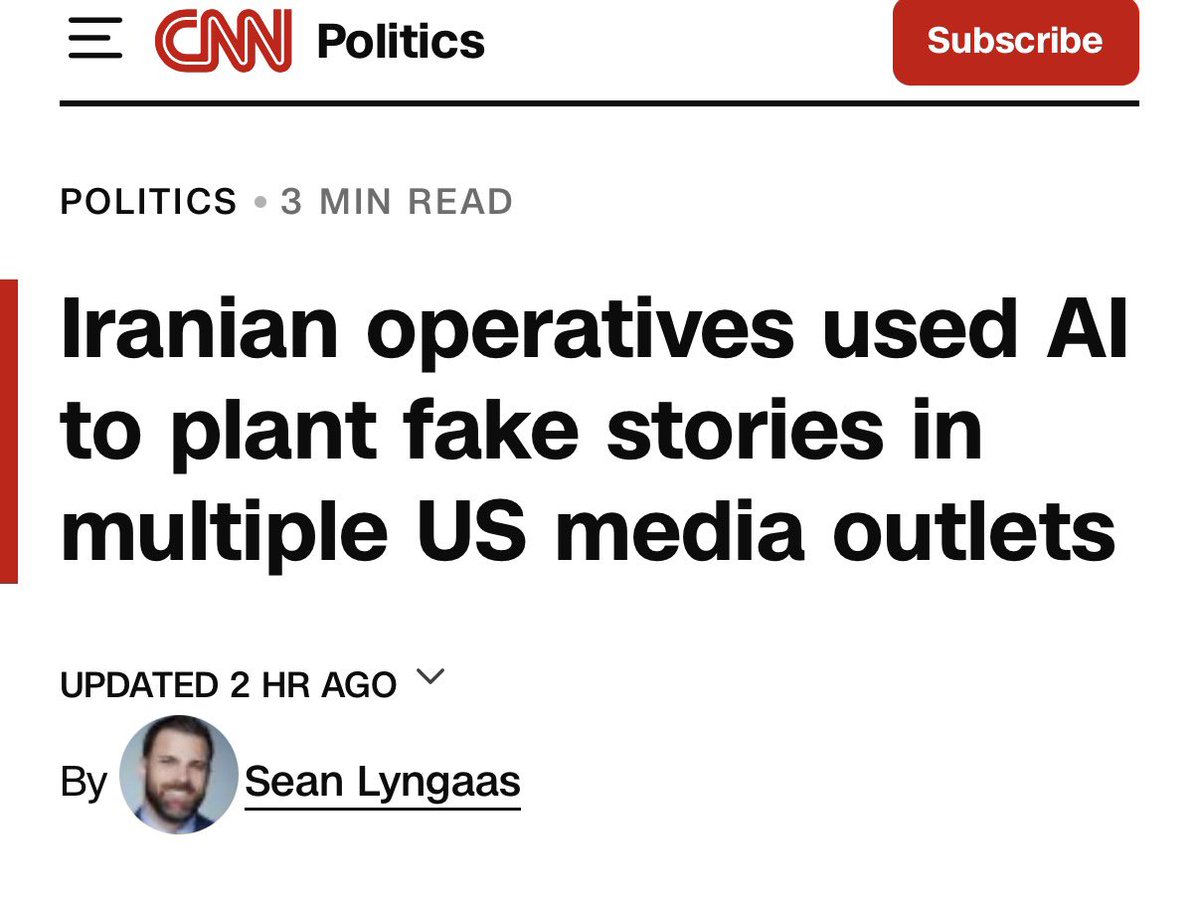
BREAKING: Iranian operatives used OpenAI models and fake personas to help plant news articles critical of the US war against Iran in multiple US media outlets.
As we’ve been saying, you are being fooled and manipulated by foreign entities.
@willchamberlain You aren't a conservative at all. You are a neoconservative period. I wanted to address to you since you make an ass out of yourself on @PiersUncensored. You never served in the military but will cheer a war you never liked.
This has always been NatCon since the beginning, and that’s why I have immense respect for @yhazony, @willchamberlain and many others. Proud to call them friends—because champions of the west cannot afford to make each other enemies as the barbarians ram the gates.
The execution of former Maj. Nidal Hassan is a military matter, not the carrying out of a civilian criminal sentence.
He was convicted by Court Martial by a panel of Army Officers who then sentenced him to death.
He murdered fellow uniformed military personnel while on active duty during wartime. That's treason.
His conduct was no different than had he been in deployed front line unit and turned his weapon on his fellow soldiers.
This is Military Justice. It is by the Military for the benefit of the Military.
Quit equating it to a civilian criminal offense.
Jaw is on the floor at this CNN panel about Abdul El-Sayed
@NoahCRothman: “Are you not disturbed by the level of comfort that he evinces with the people who do set out to kill Americans, kill Jews, kill civilians?”
Van Lathan: “NOPE.”