@_amirbar This is half correct.
Incorrect - Robot training data is specific to the hardware - motors, joint types, gearing, mass distribution, joint lengths, +10 more variables that undermine sharing data between different hardware.
Correct - OpenAI can't be trusted by robot companies
The most common mistake in robotics is rushing design. 99% of robots failed in design, but that won’t be apparent and inescapable until reality reveals the failures.
AI and Robotics are not synonymous.
If someone conflates the two, it really shows that they understand neither.
If someone brags about a robot’s AI is, then they are likely distracting from a crappy, unsafe, useless, and/or overpriced robot.
“Personality” in a robot is what its maker boasts when the robot can’t do anything useful.
If you want personality, get a dog.
Better yet, get one from a shelter - THAT’S personality.
ps. adding a layer of clothing on a 15-pound aluminum arm robot is akin to adding a sock onto an aluminum baseball bat.
Calling that 'robot safety' is indefensible bulljunk.
Robotic Perspective:
1) Swinging an aluminum baseball bat and hitting someone in the face is obviously dangerous. The bat weighs ~2 pounds.
2) An aluminum robot arm weighs 13-15 pounds. (F~1/2mv^2)
130-pound metal robots with metal arms are not safe and shouldn't be in homes.
@tlbtlbtlb Not 'every' - just the ones you know about ;)
I'll respectfully defer to your investment experience. The companies building today tho can't be eventual winners when their mech tech is a dead end.
Robotic design 101: its easier to start from scratch than improve a fatal design.
@JimRosenthal4 Overcoming filter R is different for large/small designs.
For large designs, its easy to raise A to drop R (larger surface area filters, pleating, etc) for higher Q
For small designs, A is tight and increasing Q is costly (R~Q^2). So, to increase Q, add a 2nd fan for better P/Q
@brosseau_lisa Healthcare orgs blaming HCW infections on community exposure is like blaming a massive spike in firefighter deaths on backyard BBQs.
Reality: Healthcare orgs gave them surgical masks, which were known to not work. Don't send firefighters into forest fires wearing hockey pants.
@cleanairkits@CleanAirStars@sri_srikrishna@JimRosenthal4@robwiss Depends on the application. Total audible noise depends on how many fans a design uses. You use 6-10 fans in parallel to get through a MERV filter (high R). I use one fan and a better filter (lower R), which is quieter than 6-10 fans at 30dB. More portable, lower power, etc.
@kprather88 He’s 100% wrong. I was in Toronto when the Precautionary Principle was used for the first time. It’s why HCWs in 2003 Toronto had full PPE to defend all three modes of transmission.
@sri_srikrishna Healthcare worker PPE
The Crisis Strategies just let hospitals buy the cheapest options which we know does not protect HCWs.
https://t.co/pxUrByBDnh
A thread and timeline on how a cascade of CDC errors destroyed American PPE standards for Health Care Workers, and how this has contributed to a looming national crisis.
(An expansion of this earlier point.)
1/
https://t.co/UZi4GeDdFG
@angievassallo@AbraarKaran Well said.
ICUs though are special places that turn any virus (regardless of main mode) into all three modes.
The danger in characterizing as one mode: what if one gets the mode wrong? (cough, surgical masks for covid)
Side note: single-mode stockpiling is inherently gnarly.
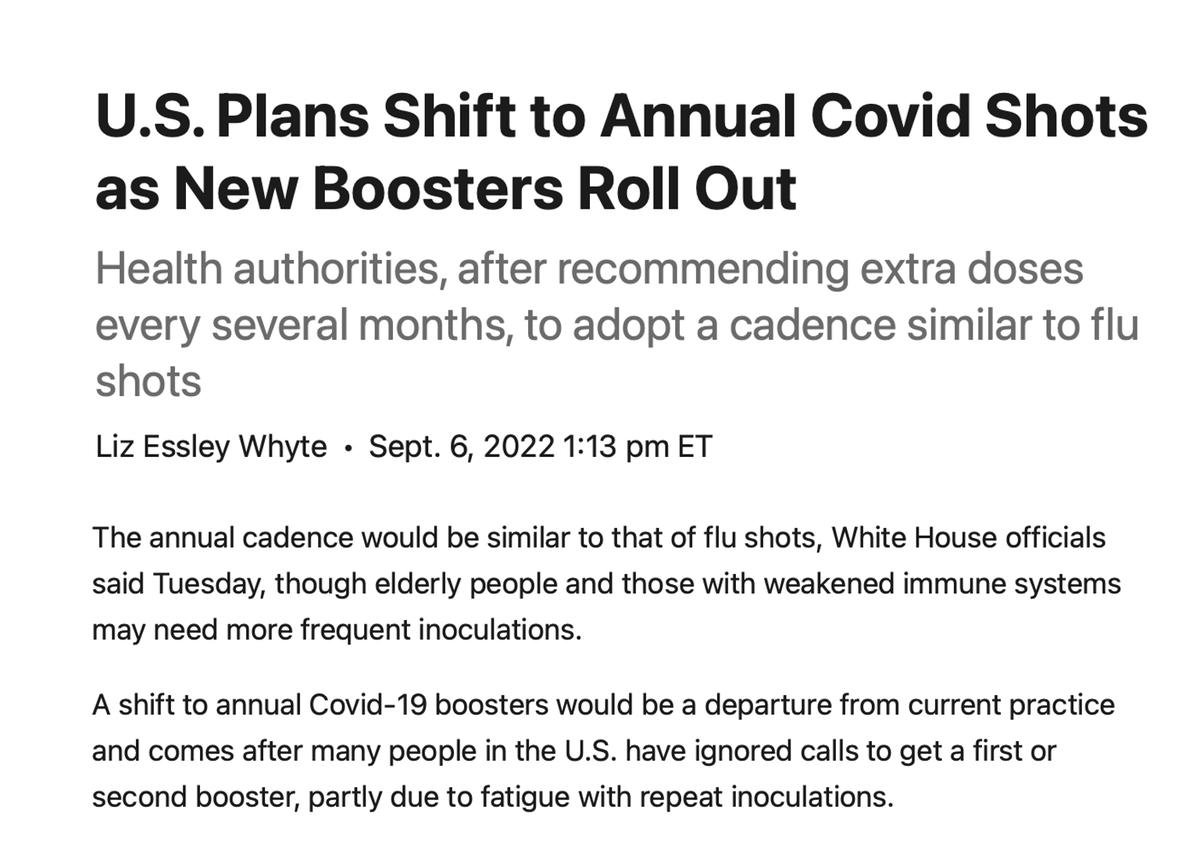
I don't see any evidence for how an annual Covid shot will provide durable protection (current ones wane after 4-6 months) without better vaccines, such as variant-proof, improved nanoparticles, and nasal
https://t.co/uytgskKKN9