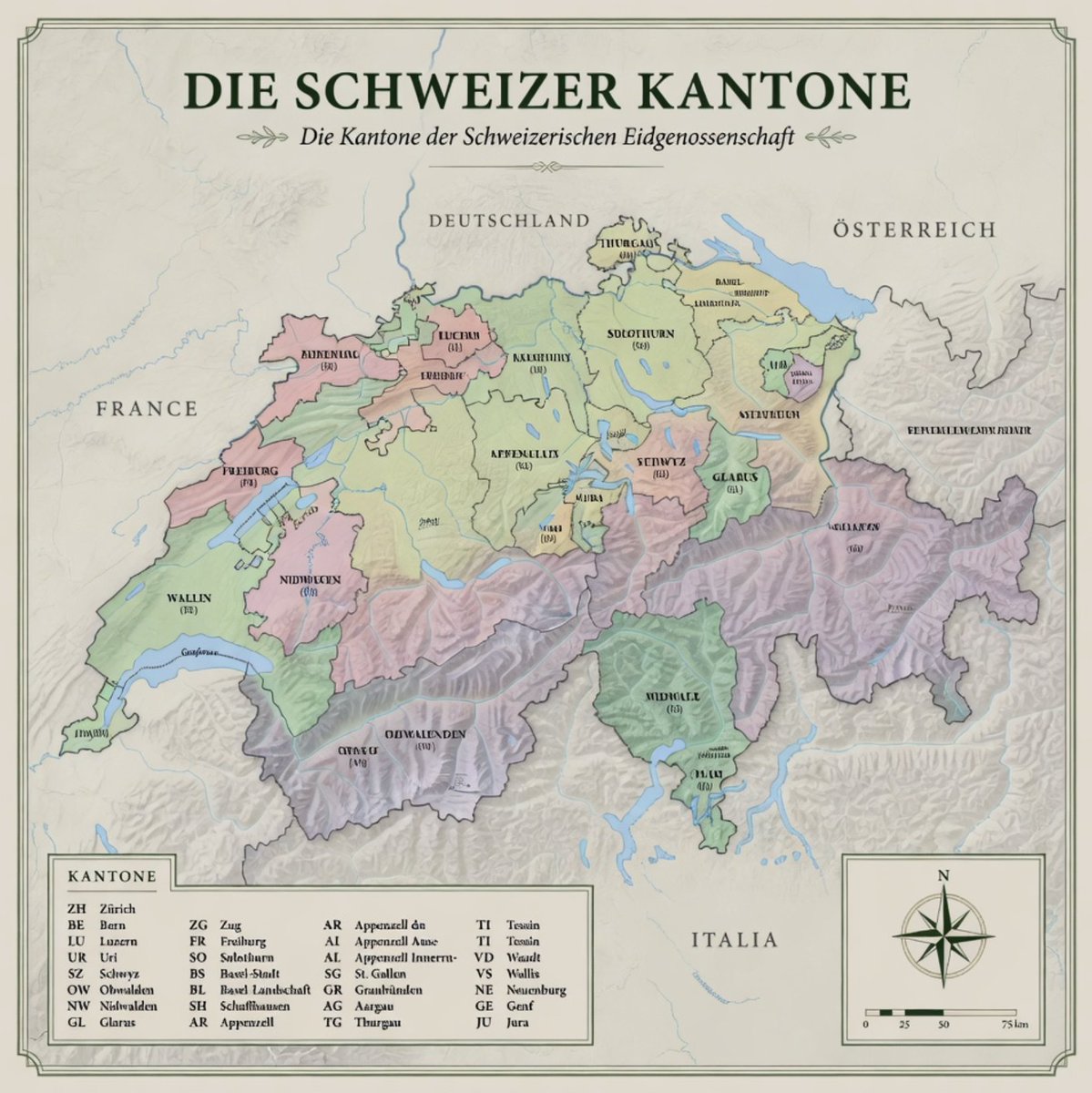
Switzerland has 26 cantons, each with its own constitution, tax rates, and laws, and the result is one of the wealthiest, most stable countries on earth. That is not a coincidence.
You want to understand why Swiss GDP per capita sits around $92,000 while the EU average hovers near $37,000? Start here. Cantons compete for residents and businesses the same way firms compete for customers. Zug kept its corporate tax rate at roughly 11.9%, attracted commodity traders and crypto firms, and watched its population and tax revenues grow. Cantons that taxed aggressively lost mobile capital and productive citizens to neighbors with lighter burdens. This is Tiebout competition working in real life, not a textbook diagram.
The federal government in Bern handles defense, monetary policy, and some foreign affairs. Everything else defaults downward. Cantons set income taxes. Communes set property levies. Citizens in Appenzell Innerrhoden voted on local laws by a show of hands in the Landsgemeinde, an open-air assembly, until 1990 for most matters. The feedback loop between decision-makers and the people paying for those decisions stays tight. That tightness disciplines spending in ways no central auditor ever will.
Free market thinkers have stressed this for generations: political units must be small enough that exit is credible. When the cost of leaving a bad jurisdiction drops, politicians face real consequences for bad policy. Switzerland kept that cost low by design. A business or family in Basel-Stadt dissatisfied with cantonal policy drives forty minutes to Baselland. No visa. No language barrier. No bureaucratic labyrinth. Just a move.
The EU spent decades building the opposite architecture, consolidating regulatory power in Brussels and eliminating the jurisdictional diversity that forces governments to stay honest. Switzerland refused to join. Its per-capita wealth, its low public debt, and its functional civil society arrived because the Swiss preserved the one institutional feature every centralized state destroys first: the credible right to leave.
I went to the Tour de France last week and it feels like a perfect microcosm of how Capitalism and Socialism differ (and why America is diverging economically and stagnating socially).
As an American I couldn't believe how poorly they monetized the event. You have millions of people watching and 99% of them watch for free.
The result - the median rider in the event is earning $250K a year, but the public has an event that is loved and accessible by all. The broader result is you don't get the private (and public) investment that coincides with such events in the USA because it's not being monetized well. That is, the teams earn less, the riders earn less and municipalities hosting earn less. So the aggregate result is everyone is poorer, on average, in the long-run because they don't capture the economic value of the event well.
BUT, the Europeans love their bikes. Boy do they love their bikes. And you see the happiness and social value of making this a public good instead of a private profit maximizing endeavor. So there's social value in NOT monetizing the event that **arguably** makes it a better overall social value than the Capitalist model.
In short, the American model creates a wealthier, more capitalized industry, while the European model sacrifices financial maximization to generate a widely distributed, unpriced public good. Which is better? Most certainly a mix. The hard part is getting the balance right.
someone once told me “emotional intelligence is the discipline of sitting with a feeling long enough to understand it before you hand it to someone else” and that honestly changed how i move.
Did you know that South Africa’s deposit insurance scheme, the Corporation for Deposit Insurance (CODI), fully protects 9 out of 10 qualifying depositors with accounts in qualifying products? A qualifying depositor will have access to up to R100 000 per deposit per bank should a bank fail.
Deputy Governor Mampho Modise explains more:
Visit 👉 https://t.co/JMbpSekNBd and ask your bank about CODI’s coverage.
#CorporationForDepositInsurance #CODI #AskYourBank #CODIWorks
Work these days means:
1. Tell Claude what to do;
2. While Claude is thinking, tell Gemini what to do;
3. While they're both thinking, scroll through twitter.
“If you haven't read hundreds of books, you are functionally illiterate, and you will be incompetent, because your personal experiences alone aren't broad enough to sustain you.”
— James N. Mattis
National Treasury has proposed giving itself the power to expropriate people's crypto assets should they hold more than a certain amount. https://t.co/e2atcWV1iN
Javier Milei: “No tengo nada en contra de los artistas. Yo mismo tuve una banda de rock. Mi problema es que si necesitas una subvención del gobierno para hacer arte, ya no eres un artista, eres un empleado público.”
Milei es un número uno.
https://t.co/SQeY55YZjZ
The biggest idiots work as advisors/consultants/brokers/agents.
Yet all of them convinced their clients they are geniuses.
@nntaleb’s IYI (Intellectual Yet Idiot) run rampant in these professions.