Rules the NBA had to change specifically because of Wilt Chamberlain’s dominance:
1. Offensive goaltending:
"He used to jump up, catch his teammates shots and dunk them."
2. In-bounds plays:
"Players are no longer allowed to throw a pass on the baseline over the backboard. Wilt used to jump up and dunk those, too."
3. Free throws:
"When fouled, players no longer are allowed to take a running start from behind the foul line. Wilt used to dunk his free throws in that fashion as if it were a long-jump competition."
4. Rebounding positions:
"In free-throw situations, the two inside rebounding positions were divided one to the offense, one to the defense. That was changed to both defensive positions because Wilt's coaches ordered his teammates to miss so Wilt could get the rebound and score two points instead of one."
5. Widened key:
"The key area was widened to 16 feet to keep Chamberlain away from the basket."
In November 2006, three games back from knee surgery, Kobe Bryant was playing on a knee still so weak the rim blocked one of his dunks against Seattle.
No brace, no protecting his reputation — 21 assists in his first three games, and laughing at himself:
"Yeah, man, that stunk, but sometimes you just have to laugh at yourself. My teammates are still giving me grief about that one."
"I don't need a brace, and I don't need to make people think I'm in pain. I just need to play."
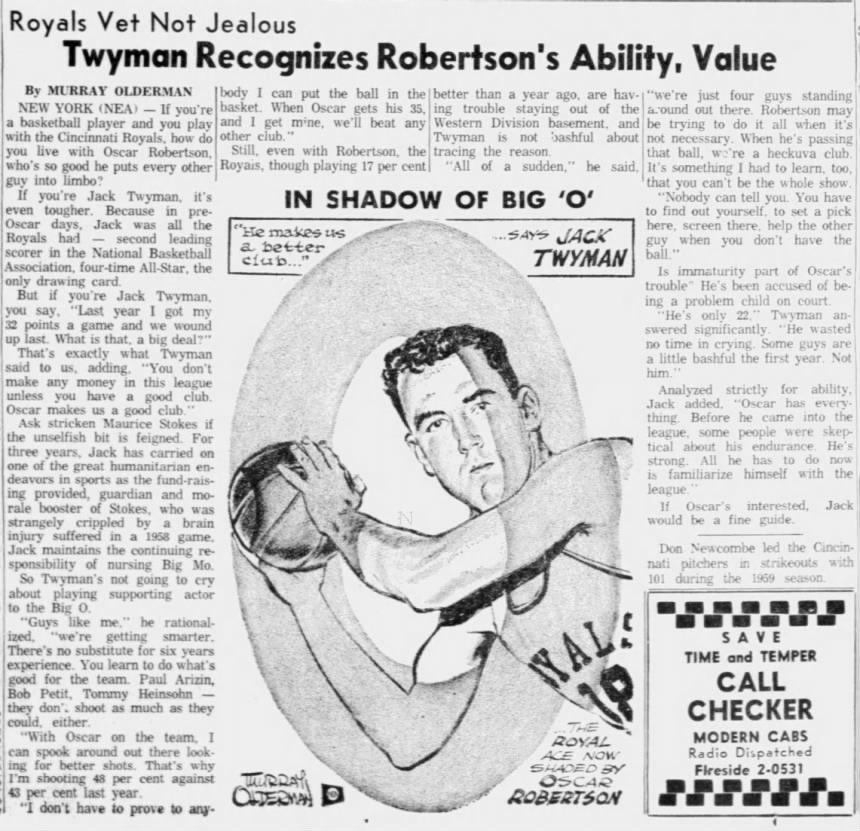
Jack Twyman on what happened to his numbers when Oscar Robertson joined the Royals in 1960:
"Last year I got my 32 points a game and we wound up last. What is that, a big deal?"
Instead of being jealous, Twyman embraced the spacing:
"With Oscar on the team, I can spook around out there. That's why I'm shooting 48 percent against 43 percent last year. I don't have to prove to anybody I can put the ball in the basket. When Oscar gets his 35, and I get mine, we'll beat any other club."
During a Warriors game at the Garden in 1962, the announcer told the crowd Wilt Chamberlain had broken the record for most shots taken in one period — 19.
Warriors coach Frank McGuire burned:
"He was trying to ridicule Chamberlain. It was like announcing a fellow setting a record for striking out."
Wilt on criticism that he hogged the shooting:
"If I don't score, we don't win."
Rockets coach Rudy Tomjanovich after Tim Duncan sank a game-winner to beat Houston in January 2003:
"I've been watching him a lot lately, and it's just sickening what he's doing.
Just sickening."
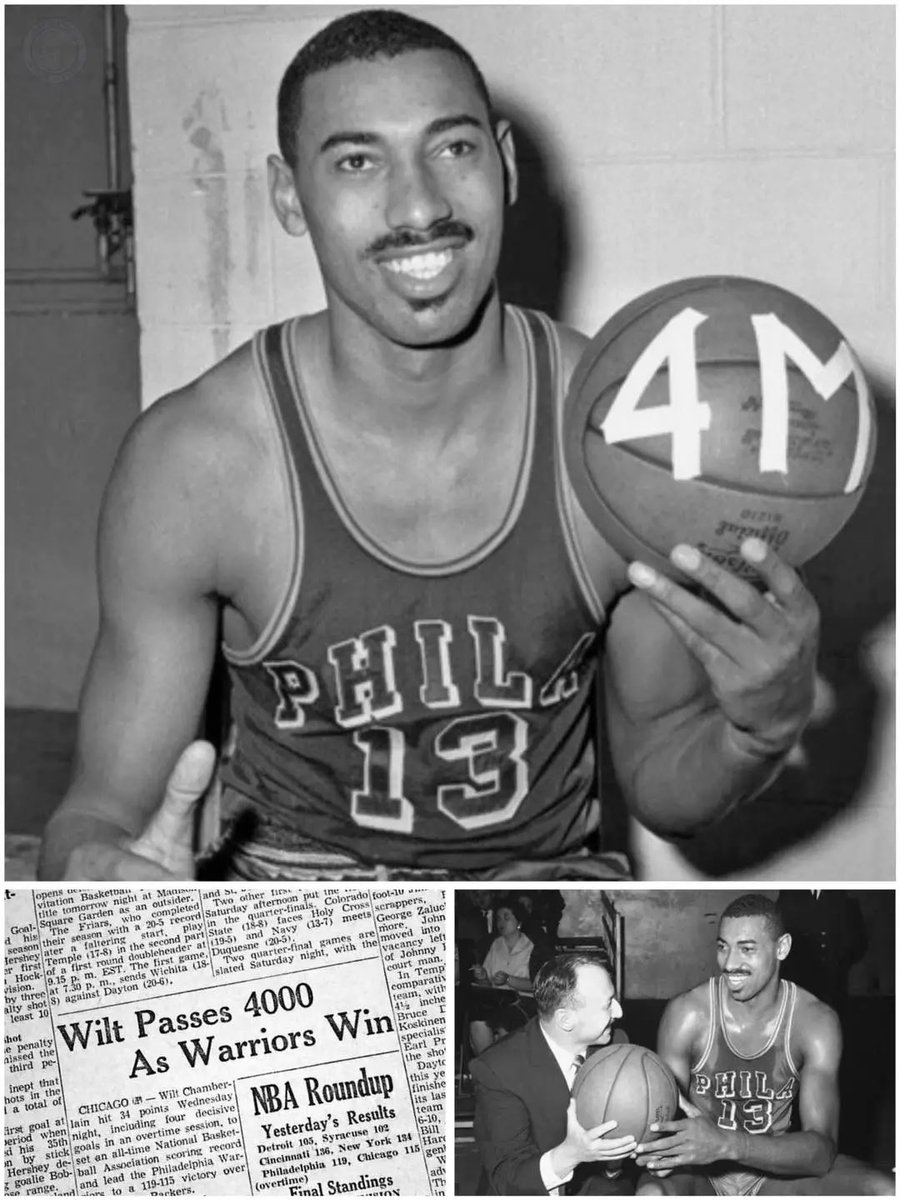
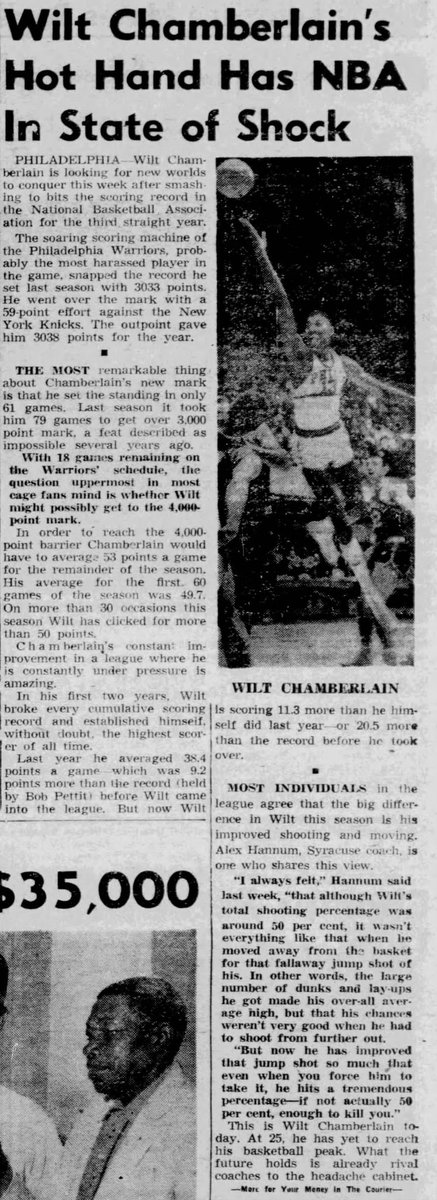
In February 1962, the papers wondered if Wilt Chamberlain could reach 4,000 points in a season. He needed to average 53 a night the rest of the way.
Syracuse coach Alex Hannum on what made him unstoppable:
"He has improved that jump shot so much that even when you force him to take it, he hits a tremendous percentage — if not actually 50 percent, enough to kill you."
Wilt finished with 4,029 points. It's still the only 4,000-point season in NBA history.
Less than three weeks after this story ran, he scored 100 in a game.
On the morning of Game 6 of the 2003 NBA Finals, Jason Kidd was one loss from the end of his time in New Jersey.
He'd put up 29 points, 7 assists, and 7 rebounds in Game 5 — possibly his last home game as a Net. Asked if it was, he said:
"We'll see."
The team about to close him out, San Antonio, was the one waiting to sign him that summer.
Wake Forest coach Dave Odom, who recruited Tim Duncan, in 1999:
"His mind works different from most basketball players. When I visited his home in St. Croix to recruit Tim, my pitch didn't seem to be making a dent. I figured he wasn't hearing a word. But when I decided to quiz Tim, he had retained everything in great detail. A natural psychologist."
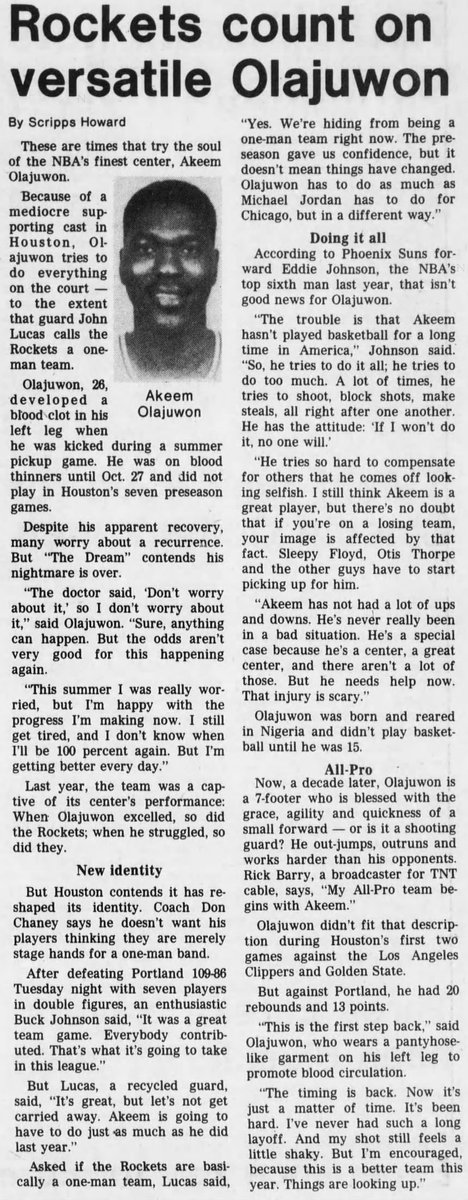
In November 1989, Rockets guard John Lucas on Houston's reliance on Hakeem Olajuwon:
"Yes. We're hiding from being a one-man team right now… Olajuwon has to do as much as Michael Jordan has to do for Chicago, but in a different way."
Suns forward Eddie Johnson on the burden:
"A lot of times, he tries to shoot, block shots, make steals, all right after one another. He has the attitude: 'If I won't do it, no one will.'"
"He tries so hard to compensate for others that he comes off looking selfish. I still think Akeem is a great player, but there's no doubt that if you're on a losing team, your image is affected by that fact."
Darius Acuff Jr. has 288 points through his first 11 games — fifth-most ever by a rookie, one behind Michael Jordan.
1. Wilt Chamberlain — 395 (1959-60)
2. Walt Bellamy — 322 (1961-62)
3. Kareem Abdul-Jabbar — 295 (1969-70)
4. Michael Jordan — 289 (1984-85)
5. Darius Acuff Jr. — 288 (2026-27)
6. Elvin Hayes — 286 (1968-69)
7. Bernard King — 282 (1977-78)
8. Brandon Jennings — 278 (2009-10)
9. Terry Dischinger — 273 (1962-63)
10. Oscar Robertson — 272 (1960-61)
Tim Duncan in April 2002 on Jason Kidd, his main competition for MVP:
"He's my favorite player in the whole league. Every year he plays he should be a candidate for MVP."
@arhooptalk He's not in a stance. He’s reaching across his body instead of sliding, and his hips are pushed back while his chest leans forward. One change of direction beats him clean.
What else would you say, Andy?
5 games in 5 days.
44 shots a game. 25 rebounds a game.
And an unrecorded mountain of blocks.
Wilt led the Warriors to a 4–1 record over that absurd stretch.
Wilt Chamberlain's 1961-62 schedule:
39 back-to-backs
Eight 3-in-3s
Two 4-in-4s
One 5-in-5 — Jan. 17–21, with overtime games on both ends
63 of his 80 games came inside a consecutive-day stretch.
Across all of it, he averaged 50.4 points a night — and missed eight minutes the entire season: the end of one game, after an ejection.
Phil Jackson says Michael Jordan would be so worn down after a game that he needed teammates to help him get to his room, and says Jordan would still want to play the next night because it might be the fans’ only opportunity to ever see him play
“We got out on the road, we were winning games. Michael played a great game in Sacramento and literally had to be kind of carried, not physically carried, but his arm around the shoulders of two of his teammates to get to his room. Oh, he’ll be back, he’ll play tomorrow. There’s no way he’s going to stop playing.”
“He’ll want to play just because this is the only chance the fans out here in Golden State or Portland, or wherever he was, are going to see him. And he knows that, and he wants to perform and play the best he can in front of them. That was a remarkable part about the effort he gave. And we have effort now from NBA players where they literally take time off.”
“‘I don’t think I can play two games in three nights.’ As basketball players, we used to play. One of our finishes to a road trip, we played Golden State, Portland, and Seattle, three games in three nights. And now, with literally back-to-back games, a lot of players take off because they can’t play back-to-back games.”
“And that’s a remarkable thing about the performance level of the game that became like Michael Jordan’s muse, was that I need to perform to show these people why I’m the best player in this game, or to have my impact on the game itself that we’re playing. One time, we were at the end, before the All-Star break, and we had a game in Seattle, a double-overtime game. Michael bumped a referee, and he was suspended for one game, the last game of this road trip in Phoenix. And the hue and cry from people that had bought tickets from all around the Arizona area just so they could go watch Michael Jordan.”
“Our only time he played in Phoenix, you know, it left the league a little bit embarrassed about the suspension because it was a minor event, a minor thing, accidental as a matter of fact. So that was perhaps one of the most remarkable things about the effort that Michael put in.”
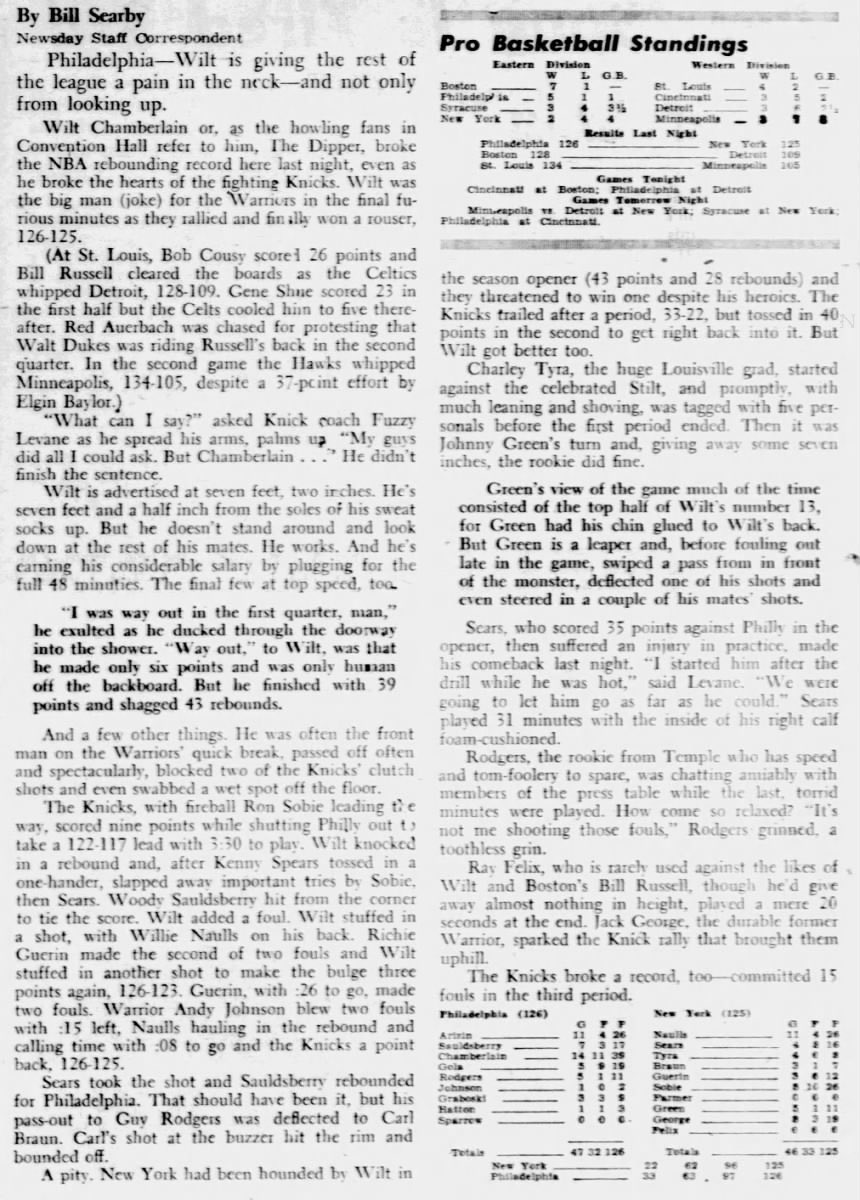
67 years ago today, in his sixth NBA game, Wilt Chamberlain scored 39 points and grabbed 43 rebounds against the Knicks.
Knicks coach Fuzzy Levane spread his arms, palms up:
"What can I say? My guys did all I could ask. But Chamberlain…"
He didn't finish the sentence.
37 years ago today, Larry Bird scored 50 points against Atlanta.
19-of-25 shooting, 13 rebounds, 7 assists — the fourth and final 50-point game of his career, in his first season back from double heel surgery that had cost him all but six games the year before.
Atlanta coach Mike Fratello:
"He is truly one of the all-time great players to play this game."
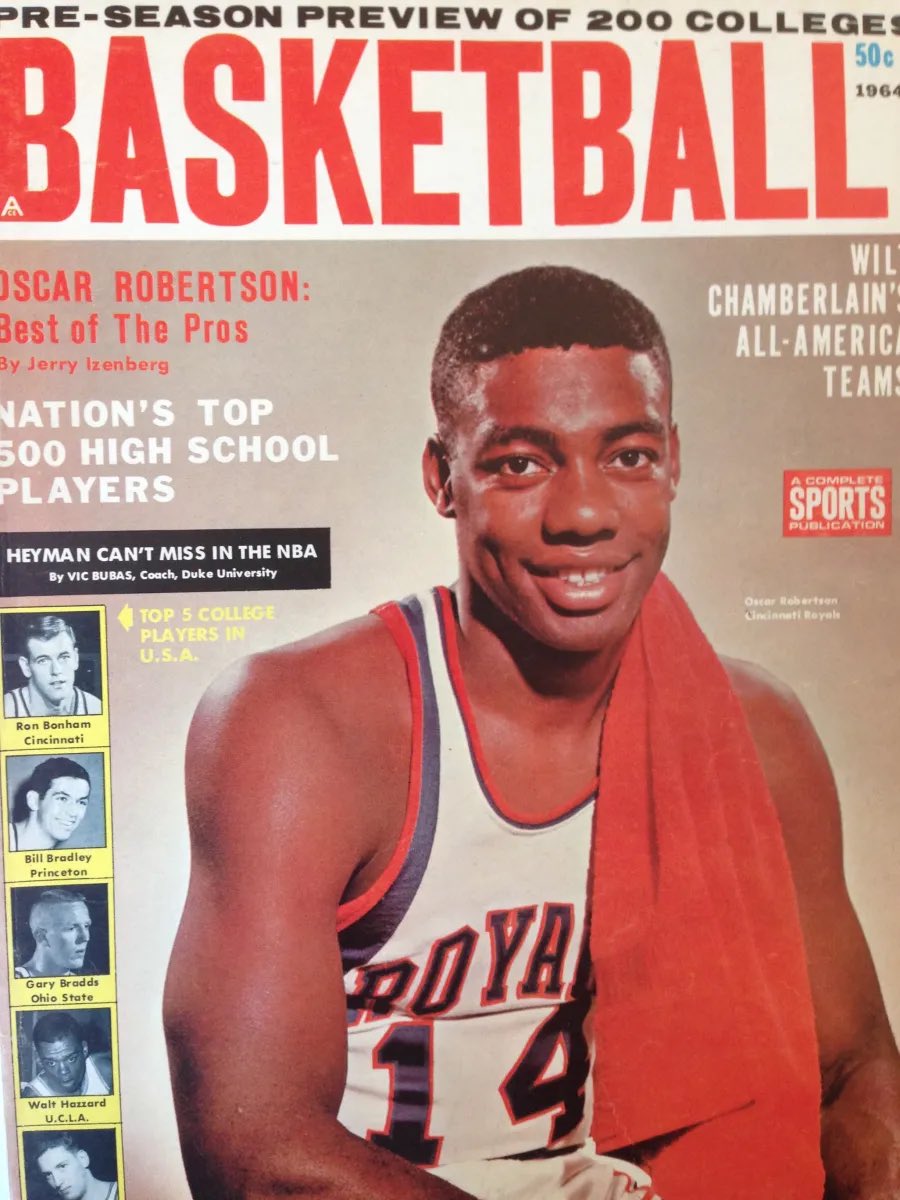
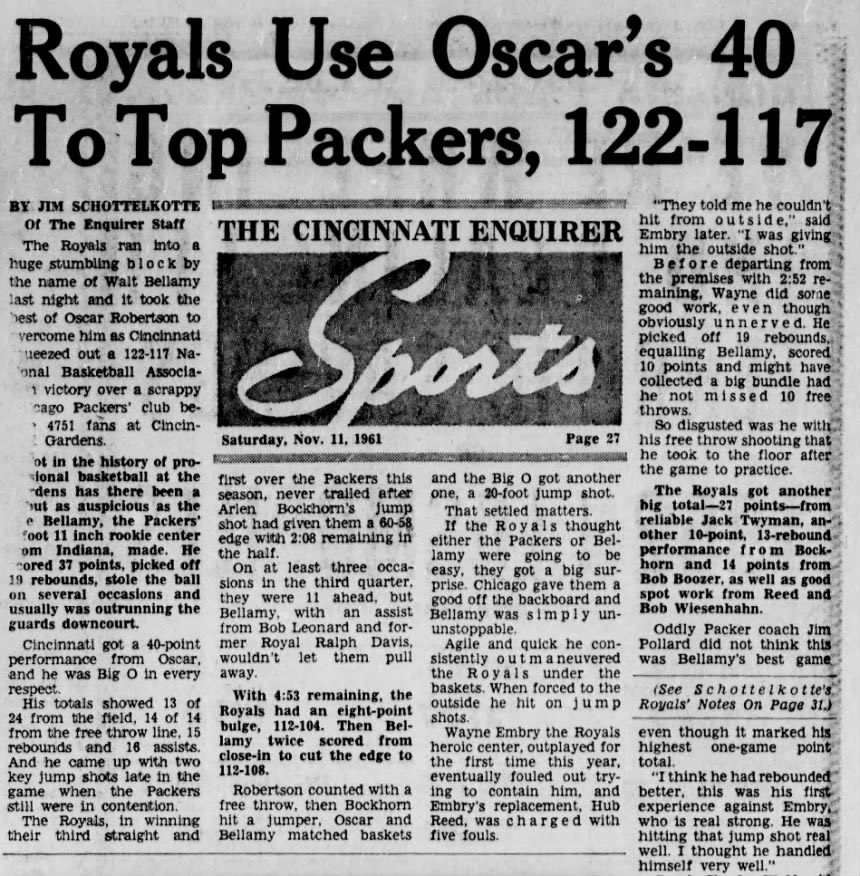
65 years ago today, Oscar Robertson put up the first 40/15/15 game in NBA history:
40 points, 15 rebounds, 16 assists against Chicago — 13-of-24 from the field, 14-of-14 from the line.
Only four more have happened since: Oscar again, Harden once, and Jokic twice.
Cincinnati needed every bit of it, too. Rookie Walt Bellamy had 37 points and 19 rebounds, and the Royals escaped 122-117.
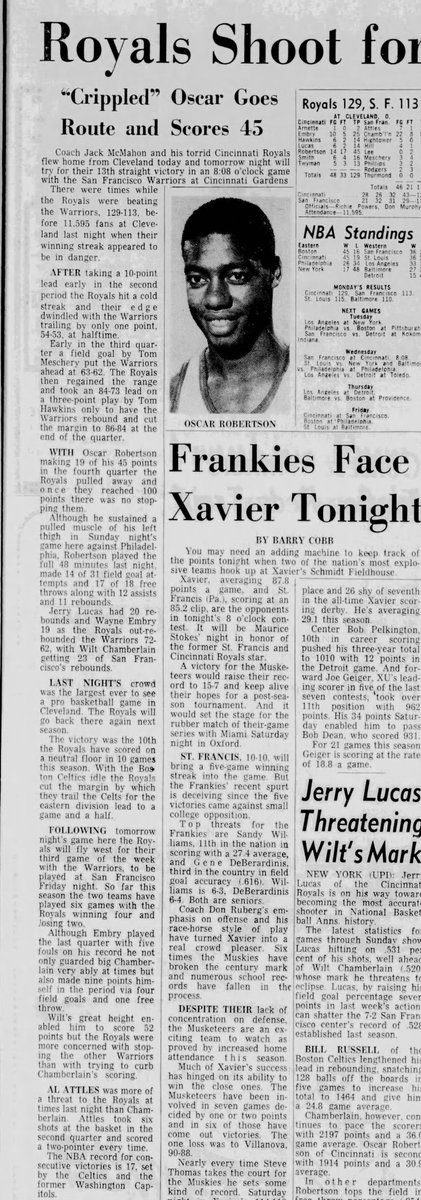
"'Crippled' Oscar Goes Route and Scores 45"
On Feb. 17, 1964, playing on a pulled thigh muscle, Oscar Robertson went all 48 minutes against Wilt Chamberlain's Warriors:
45 points, 12 assists, 11 rebounds — 19 of them in the 4th quarter.
Wilt had 52 and 23 rebounds. Cincinnati won its 12th straight, 129-113.