Windward expands into Maritime Visual Intelligence with acquisition of Azimut AI.
The newly added sensing layer identifies and fingerprints vessels in real time at maritime chokepoints and ports, enabling the visibility of vessels even when they go dark to evade detection.
Read the full press release: https://t.co/1yegbnLy5R
Happy 251st Birthday to the @USMC.
Since November 10, 1775, Marines have carried out missions from the sea to the shore. Today we honor the Marines who serve, the veterans who served, and the families who stand behind them.
Semper Fidelis.
#USMC#MarineCorpsBirthday#SemperFi
One of two tankers assessed with high confidence to be sailing to the U.S. with Russian diesel has turned around. If the second keeps going, its cargo is likely not diesel, meaning no Russian diesel will have reached the U.S. despite General License 135.
70% of the new Arab “Dark Fleet” has had a dark period in the past three months, averaging 12 days.
@Michellewb_ on what she says is probably the biggest shift in how oil companies have managed their supply chains since the 1980s tanker war.
https://t.co/13rbTnpChS
Join Windward at the @PotomacOfficers 2026 Homeland Security Summit tomorrow!
DHS leaders and industry innovators will discuss how the government can use data and advanced technologies to protect the nation’s borders and critical infrastructure.
Visit our booth to see how Windward’s all-source maritime intelligence turns fragmented data into one clear operational picture, helping agencies uncover illicit activity, suspicious vessels and threats to U.S. ports.
You’ll also get a first look at how our Maritime Visual Intelligence (MVI), a new proprietary camera-based data layer, recognizes every vessel by its hull to catch the boats that never transmit and the ships that lie about who they are.
https://t.co/axijEd5fx3
#POCHomeland2026 #MaritimeIntelligence
Drug trafficking vessels leave a signature. A flag of convenience, a recent MMSI change, a vessel size and type that recur across seizures, and a voyage that doesn’t match any legitimate trade. Learn to read it, and to build the queries and alerts that catch the next one.
On Thursday, November 12, Windward is running a live operational masterclass on identifying the behavioral patterns of drug trafficking vessels. Manuel M.B. Assis Teixeira, MIOC Maritime Counter-Narcotics Intelligence Analyst, covers how trafficking routes, methods, and vessel types have shifted and where interdiction teams are seeing new activity. John S., Customer Success Manager and former DEA, walks through cases he worked.
No theory. Real world examples. Real world techniques.
https://t.co/7TSLLRgSCh
Windward's API runs inside Gulf Marine's inquiry workflow, screening every vessel against its own policy. Six months in, 100% coverage, nearly triple the volume, and analysts focused on real risk. https://t.co/W1ZW29l4xC
A Chinese survey vessel spent 53 hours running survey-style patterns over two cables in the northern South China Sea, including Telstra’s EAC-C2C, which lands in Taiwan.
It sailed ~226 nm at a steady 5 knots, went dark for approximately 4 hours mid-loiter and had loitered near two other cable routes days earlier.
Full analysis: https://t.co/mEHCBqz21H
A second convoy of three Russian cargo vessels known to be involved in shipping weapons and military goods sailed from Baltiysk, Kaliningrad on November 5. Maia-1 (IMO 9358010), Lady R (IMO 9161003) and Lady D (IMO 9349289), all Russia-flagged, appear to be following Anastasiia (IMO 9349291) and Ascalon (IMO 9198226), which sailed through the English Channel on November 4.
All of the ships have long histories supplying weapons, military equipment and dual use goods to and from Russian Baltic ports. All five are sanctioned by the U.S., UK or EU, or a combination of them. In the past 180 days, vessel tracking shows the three ships made port calls in China, in addition to extended dark periods that likely masked port calls in Iran and Syria.
Analysis from Windward’s Maritime Intelligence Operations Center. https://t.co/ORefKKgrVN
A vessel moving narcotics and a vessel moving sanctioned crude share the challenge of moving cargo without being identified. Both go dark, transfer at sea, and change flag, name, and MMSI.
Find out how agencies can apply the same tools to surface sanctions evasion and transnational smuggling networks. https://t.co/CK5CeUYIUe
Attacks on ships near the Strait of Hormuz, which once mostly hit tankers, are now hitting container ships and moving further north.
Matthew Mueller (@MMueller1098), MIOC U.S. Team Lead at Windward, says this shows Iran is willing to extend pressure across the Gulf, and why that’s so difficult to counter. Air defenses would have to cover a much larger area, a resource challenge for any military.
Watch the full on-demand executive briefing on how Q3’s top maritime risks are shaping Q4. https://t.co/5DNtCCGpZI
Drug trafficking vessels leave a signature. A flag of convenience, a recent MMSI change, a vessel size and type that recur across seizures, and a voyage that doesn’t match any legitimate trade. Learn to read it, and to build the queries and alerts that catch the next one.
On Thursday, November 12, Windward is running a live operational masterclass on identifying the behavioral patterns of drug trafficking vessels. Manuel M.B. Assis Teixeira, MIOC Maritime Counter-Narcotics Intelligence Analyst, covers how trafficking routes, methods, and vessel types have shifted and where interdiction teams are seeing new activity. John S., Customer Success Manager and former DEA, walks through cases he worked.
No theory. Real world examples. Real world techniques.
10:00 AM ET | 3:00 PM GMT. Virtual.
Register: https://t.co/HALXdgebzw
Location is just the start. James Hughes, VP Solution Engineering, explains how Windward adds where a vessel is going, who owns it and what it’s up to. See it in a live demo and speak to our experts at Booth J128, Hall 6 today. #EURONAVAL2026
Final day at #EURONAVAL2026. Meet the team behind Booth J128 to talk maritime domain awareness, uncovering illicit activity and decision superiority.
Get a first-hand look at how trusted, all-source maritime intelligence delivers one clear picture that decision makers can act on.
PRC research vessels nearly doubled their survey time within 300 NM of Taiwan: 7,411 hours in January–September 2026, up from 3,862 in 2025. Total fleet working time stayed roughly flat, meaning more of the fleet’s effort went to the waters around Taiwan.
Spring 2027 should show whether this is a seasonal program or a lasting shift. For anyone monitoring the area, a vessel breaking from its own pattern says more than research vessel presence alone.
Get the full breakdown: https://t.co/swDeKVFkbR
Two sanctioned Russian cargo vessels with a long history of shipping weapons and military equipment are now transiting the English Channel.
Anastasiia (IMO 9349291), a Russia-flagged general cargo vessel, and Ascalon (IMO 9198226), a Russia-flagged ro-ro vessel, were sanctioned by the U.S. Office of Foreign Assets Control in May 2022. Neither is directly designated by the EU or UK, although both vessels’ beneficial owners are.
AIS-visible transits fell 83% from the pre-conflict baseline during the 2026 Iran war.
When ships go dark, a satellite pass gives only a momentary, overhead view. A camera on the horizon sees them continuously, down to name, flag, and hull condition.
Windward is acquiring https://t.co/2dZ4z3LDUM to combine that continuous view natively with our data, risk models, and agents. Our CEO @AmiDaniel1 explains why this is the future of maritime domain awareness. https://t.co/2z4aOMJhJS
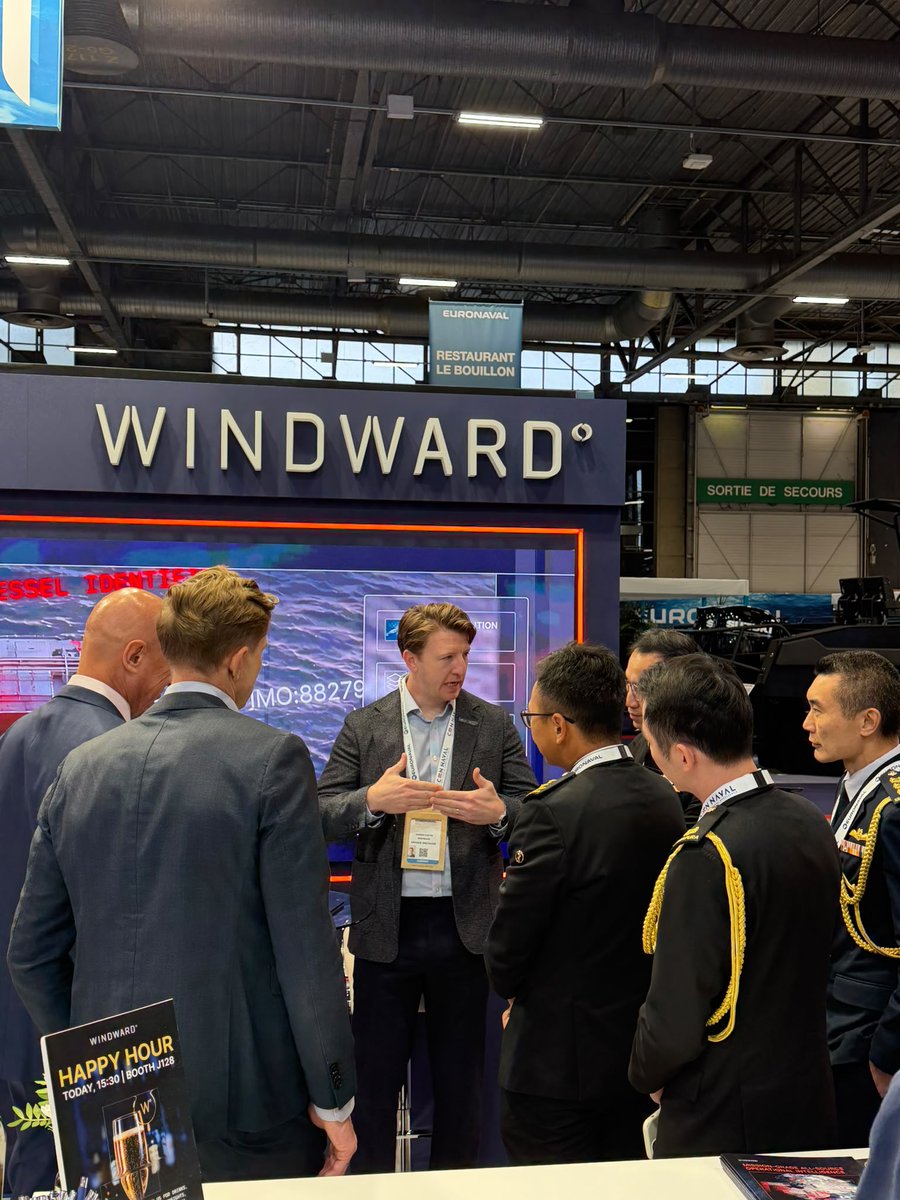
Tell us your mission, and we’ll show you how we support it. Great to be sharing insights with naval delegations at Booth J128 today on dark vessel identification, illicit activity detection and real-time operational intelligence. #EURONAVAL2026#NavalDefense
From global view to vessel-level detail. Live demos of our all-source approach and remote-sensing operational intelligence at Booth J128. #EURONAVAL2026
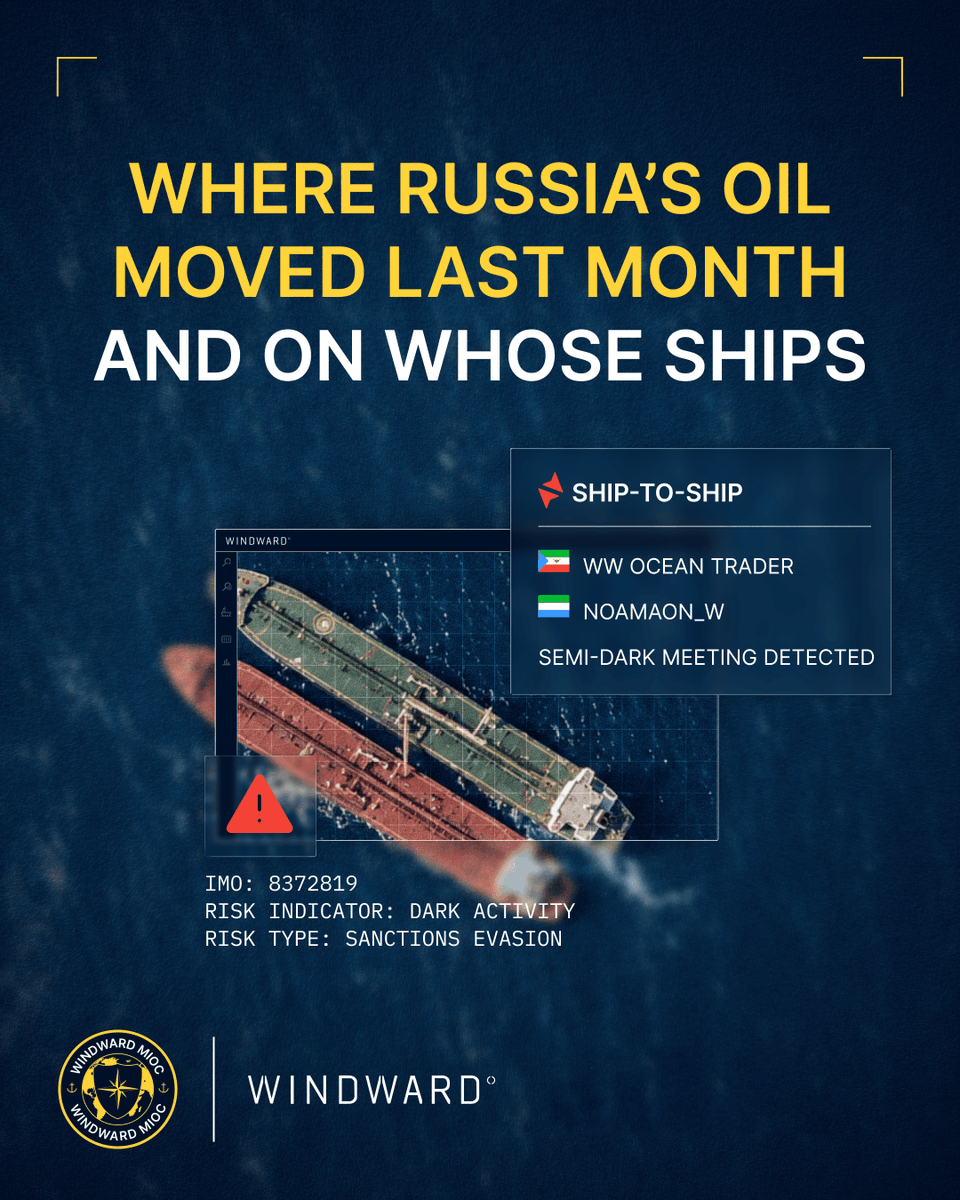
Russia’s oil moves on three kinds of tonnage: sanctioned tankers, EU-owned ships trading under the price cap, and shadow fleet vessels nobody has sanctioned yet. The split shifted sharply. The report shows where.
Get the report: https://t.co/61voNkUio2