"HMS Foudroyant (80) – Nelson’s Former Flagship" ⚓📸Photographs of Foudroyant (80), once Nelson’s flagship, laid down in 1789 and lost off Blackpool in 1897. These historic images are currently on display at the Liverpool Maritime Museum.
#NavalHistory#HMSFoudroyant#Nelson #MaritimeHeritage
@reportingLibya@HiddenHistoryYT Hood was designed to carry armour protection equivalent to the Queen Elizabeths, which nobody can accuse of being fragile. Her destruction was a factor of extreme bad luck, rather than a design issue. A diving shell can bypass even a battleship’s belt, such as HMS Prince of Wales
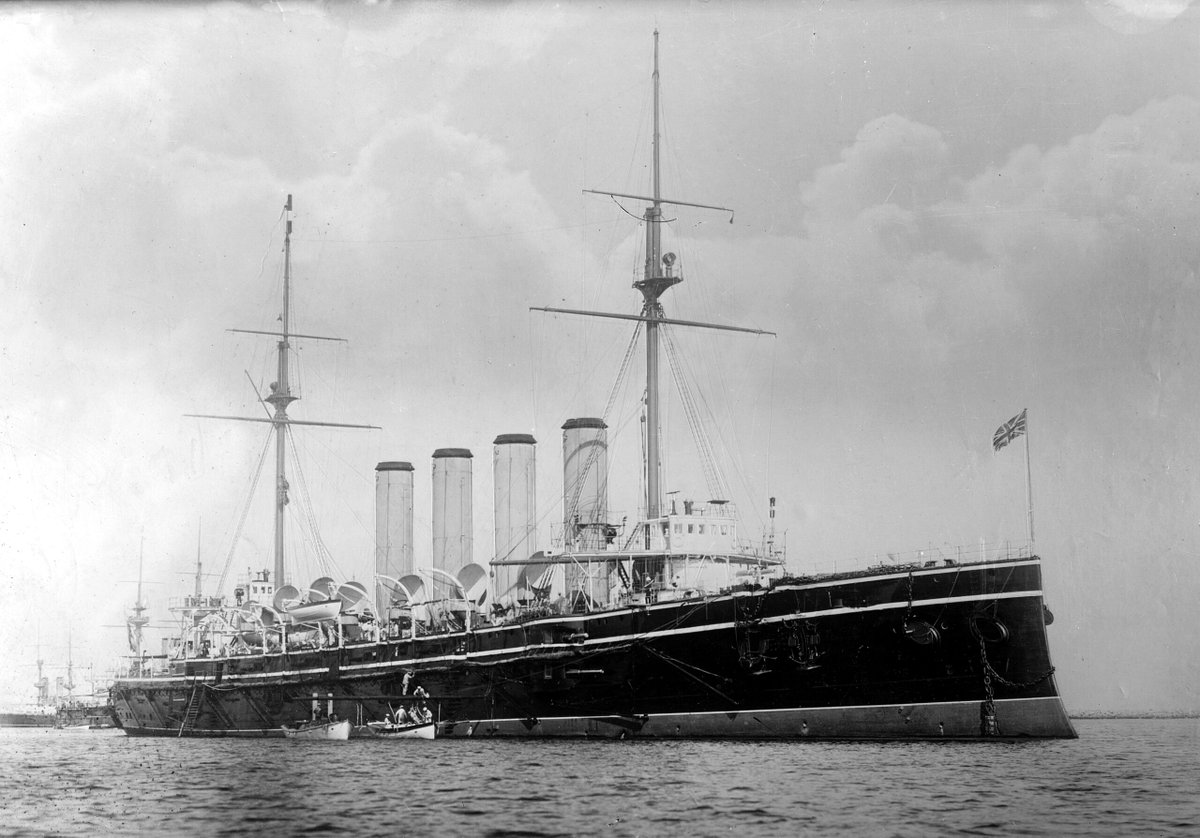
The beautiful Diadem-class protected cruiser and Boer War veteran HMCS Niobe, c. 1910. She was the second vessel to be commissioned into the Naval Service of Canada, i.e. the Royal Canadian Navy. Her career for the Dominion almost started disastrously, with her running aground in a fog off Cape Sable Island, Nova Scotia, in July 1911. Sound damage control saved the ship, however. She was repaired, put back into service, and patrolled American waters during the opening months of the First World War. She was demoted to a depot ship at Halifax in July 1915, never to see active service again. She became damaged again in the cataclysmic 1917 Halifax Explosion, the largest human-made explosion at the time (2.9 kilotons of TNT), which claimed the lives of over 1,700 people in Halifax and Dartmouth. She was sold for scrap in 1922.
Library of Congress (ID: ggbain.08665)
For an interesting video containing eyewitness accounts of the Halifax Explosion: https://t.co/Mf4EXPRbUz
The 10-Engine Flying PALACE:
Britain's Lost Luxury Airliner.
Restored and colorized this video shows rare historical footage of the Saunders-Roe SR.45 Princess, the largest all-metal flying boat ever constructed.
This British airliner is a "flying hotel" designed for transatlantic luxury that was ultimately made obsolete before it ever carried a single passenger.
On this day in naval history, 1908: the Royal Navy’s last pre-dreadnought, HMS Lord Nelson, was commissioned. Clearly visible in the photograph are her five port-side BL 9.2-inch guns—four mounted in two twin turrets and one in a single turret—together with her two aft 12-inch guns. Within her superstructure, protected behind steel parapets and railings, stand her QF 12-pounder guns. This mixed-calibre main armament distinguished her from her dreadnought successors, whose uniform battery of a single calibre represented a major leap forward. Earlier arrangements, such as Lord Nelson’s, complicated fire-control efforts due to the differing ballistic characteristics of each gun type. Another significant difference from the later dreadnought leviathans was propulsion: the new generation adopted steam turbines, which greatly improved speed and overall performance (top speed: Lord Nelson 18 knots versus HMS Dreadnought 21 knots), while ships like Lord Nelson still relied on older triple-expansion reciprocating engines.
The ship was serving as flagship of the Channel Fleet when the First World War broke out in 1914. In early 1915, Lord Nelson was redeployed to the Mediterranean to take part in the Dardanelles Campaign. She remained in those waters thereafter, becoming flagship of the Eastern Mediterranean Squadron, later redesignated the Aegean Squadron. Following the Ottoman capitulation in 1918, the vessel proceeded to the Black Sea, where she continued to serve as flagship until her return to the United Kingdom in May 1919. Upon arrival, she was placed in reserve and, in June 1920, sold for scrap.
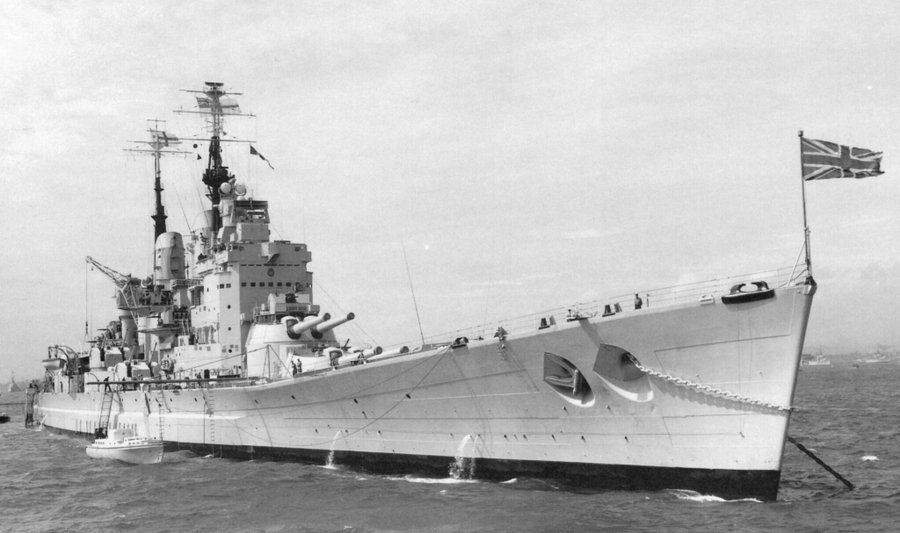
#OnThisDay in 1944 the last and largest @RoyalNavy
Battleship and the last Battleship in the world to be launched, HMS VANGUARD was launched in #Clydebank by the then Princess Elizabeth. She was over 50,000 Tonnes at full load and capable of over 30 Knots. The end of an era.
On this day in naval history, 1909: HMS Lion was laid down at HM Dockyard, Devonport. She was the lead ship of a class of three ships, nicknamed "the Splendid Cats", her sisters being Princess Royal and Queen Mary (although some consider Queen Mary a separate class on her own).
The Lion signaled a radical change in battlecruiser design, spurred on by the sudden emergence of Germany as the Royal Navy's fiercest competitor on the high seas. The dramatic increase of the Kaiser's fleet of dreadnoughts and battlecruisers alarmed the British, who subsequently refrained from cutting naval spending, as had been previously agreed in Parliament in early 1908, and convinced Parliament to increase their dreadnought and battlecruiser fleet even more.
The latest battlecruisers of the Lion-class saw a significant increase in length, weight, firepower and armour in comparison with the previous Indefatigable-class. To put this in figures: Lion was 32 m/105 ft longer and displaced about 7,550 more tons; she carried much more powerful 13.5-inch guns (four twin turrets, of which two, A and B, in superfiring configuration) as opposed to the Indefatigable's 12-inch guns. Despite this dramatic increase in size, the Lion managed to reach a top speed of 28 knots, 3 knots faster than HMS Indefatigable. Such incredible velocity was enabled by the installation of a staggering number of 42 boilers (Orion-class battleship: 18; Indefatigable-class: 31). This made the Lion easily the fastest capital ship in the world at that time.
Lion was concurrently the first battlecruiser to outsize the latest generation of dreadnoughts (3,850 tons heavier than HMS Orion). The purpose of the "Splendid Cats" was clear: to provide Germany's battleships and battlecruisers with a formidable opponent, while not sacrificing the battlecruiser's essential characteristic of superior speed. Britain did pay a heavy price to procure such incredible vessels: £2,086,458 for HMS Lion, compared to the £1,520,591 of HMS Indefatigable. The Lion-class still proved vulnerable to the battlecruisers of the Hochseeflotte, with HMS Queen Mary blowing up at Jutland on 31 May 1916.
This is why I started watermarking the videos I post. Albeit a seemingly simple video in the public domain, it takes a while to edit and research the details. The date of June 15, 1944 isn’t given on NARA. It takes hours of cross checking to arrive at June 15, 1944.
For the longest time I had this video dated June 13, 1944. Many took the video and posted it, unknowingly pushing incorrect info. A double edge sword.
HMS Victory firing a salute as warships of the United States Navy arrive at Portsmouth on 13 July 1903. The print was taken from the predreadnought USS Kearsarge (BB-5) which was the flagship of the American squadron.
The signature belongs to Prince George, later King George V, who visited the ships and dined aboard Kearsarge.
Today, my book Infantry in Battle, 1733-1783, released.
Why should you care?
It changes the story of 18th century battles by telling the experiences of enlisted and NCOs, not just the officers. Battle looks different when you are enlisted.
A thread for the infantrymen. 1/20
The Last fight of the Revenge by Charles Dixon
The Revenge was a mainstay in the Elizabethan Navy, she saw action in both Ireland and Cadiz before being captained by Drake during the action of the Spanish Armada.
She was also part of later expeditions including the English Counter Armada and an expedition led by Martin Frobisher.
In 1591 she was eventually captured by the Spanish whilst under the command of Sir Richard Grenville, but she never made it to Spain and sunk to the depths just days later.
Both Grenville and Revenge never saw England again.
HMS Renown (foreground) and HMS Hood with other capital ships during an exercise in the English Channel. This must have taken place sometime before 1936, as Renown still has her pre-reconstruction appearance.
Source: Reddit (user: Tony_Tanna78)
On this day in naval history, 1759: the Royal Navy achieved one of its most remarkable and important victories, as Admiral Hawke (HMS Royal George) chased and defeated the Comte de Conflans’ (Soleil Royal) fleet amid the razor-sharp rocks of a gale-stricken Quiberon Bay. The French admiral initially believed the British would abstain from such folly as entering uncharted waters in heavy weather. He was wrong: “Where there is a passage for the enemy, there is a passage for me!” Admiral Hawke later famously replied to his ship’s master as he pointed out the dangers: “You have done your duty in showing me the danger! You are now to comply with my orders and lay me alongside the Soleil Royal.”
The French lost seven ships, while the rest were scattered or became trapped inside the Vilaine River. King Louis XV was now effectively barred from sending reinforcements to his troops across the Atlantic, where the British were in the process of conquering the whole of French Canada. By the end of the Seven Years’ War, British domination of North America was secured, and the Battle of Quiberon Bay was crucial in bringing this about.
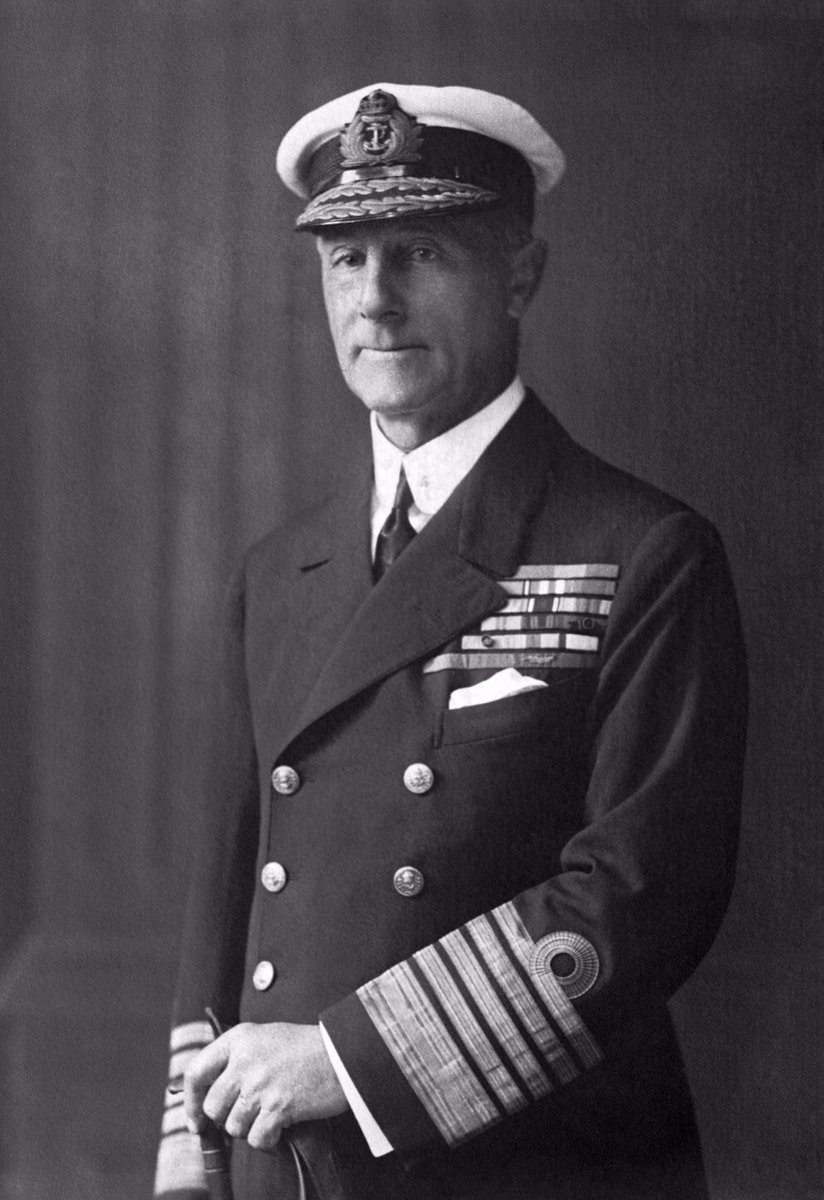
#OnThisDay 90 yrs ago in 1935, Admiral of the Fleet John Jellicoe died. Commander in Chief of the @RoyalNavy Grand Fleet at Jutland and First Sea Lord until 1917. He was the controlling mind of the greatest assembly of sea power the world has ever seen.
HMS Benbow leading the line of battle. She was the third unit of the four Iron Duke-class battleships, the Royal Navy’s most modern dreadnoughts at the outbreak of the First World War. They represented an improvement over their predecessors in both armour and armament, featuring more powerful 6-inch guns as secondary armament instead of the earlier 4-inch guns, mounted in casemates. Three of the sisters took part in the Battle of Jutland in 1916, while HMS Emperor of India was in dock undergoing a periodic refit. As for their primary armament, they retained the 13.5-inch guns of the preceding King George V class.
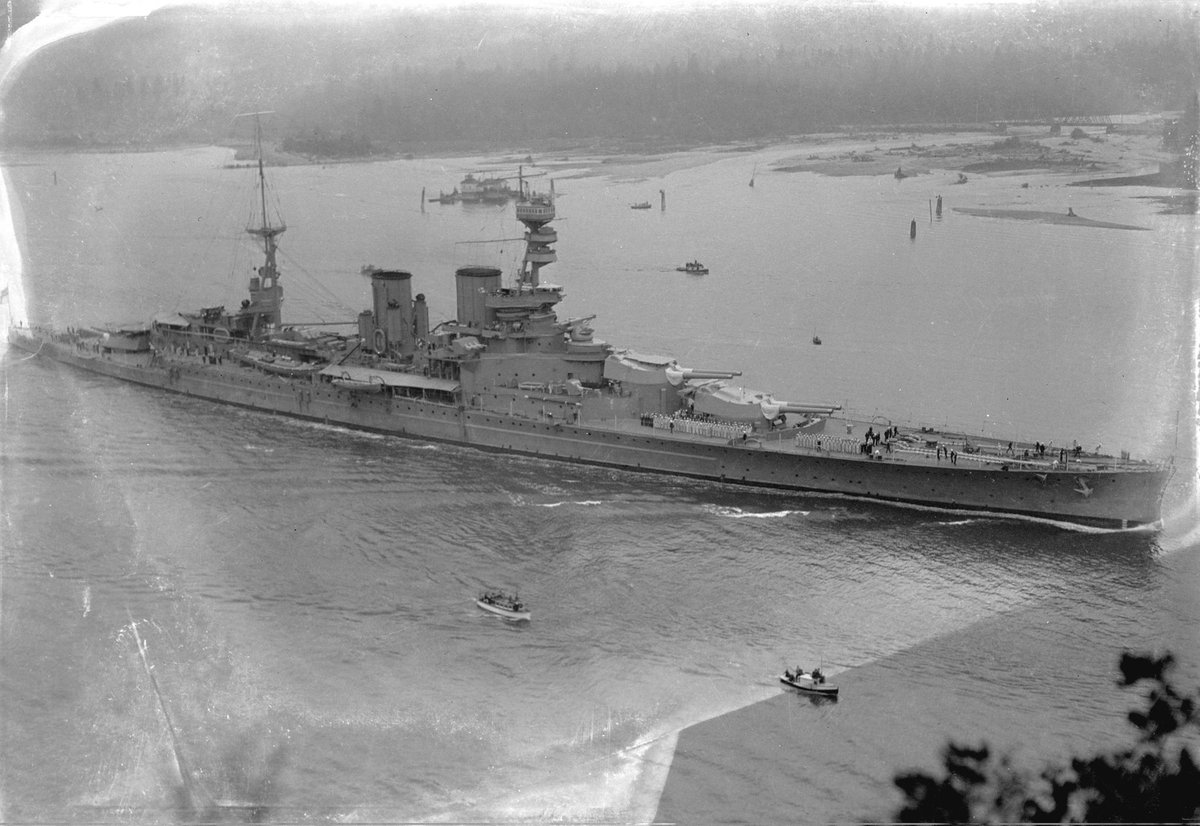
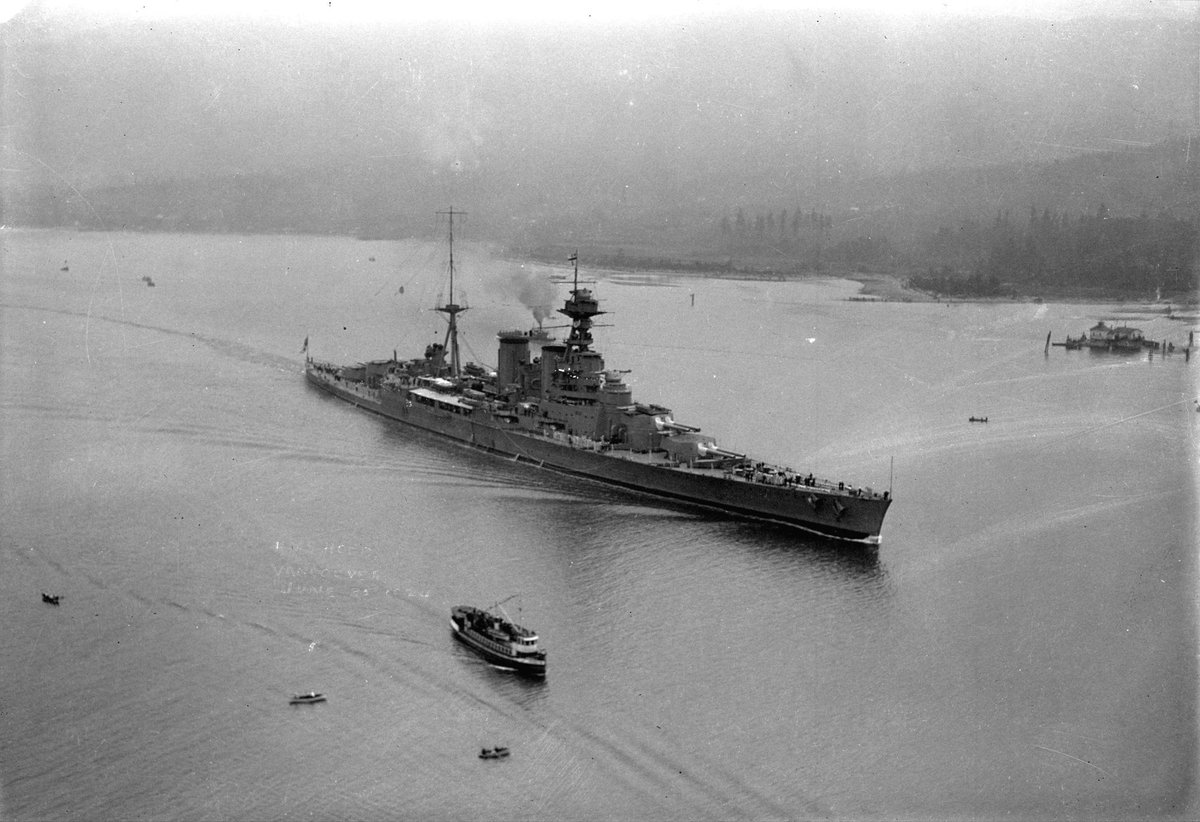
The Special Service Squadron arrives at the Harbor of Vancouver, Canada on 25 June 1924 during the World Cruise.
The first photo shows HMS Hood while the second photo shows HMS Repulse.