Worth reading in its entirety
That agents will diminish the relative importance of distribution (against the importance of product quality) seems obviously true (upon reflection) and has many interesting implications
Assorted things I've been mulling over regarding agents in the economy:
• Companies are in some sense the original superintelligence. It's often the case that they can use their amortized cognitive surplus to advance their interests against those of certain consumers: relative to the optimization capacity of companies, consumers can be inattentive, underinformed, irrational, etc. (Think, say, of some of the classic insurance upsells at the end of a booking process, which is typically priced substantially above what a regular policy would cost.) Herbert Simon introduced the idea of bounded rationality, and firms often end up benefiting from it. Thanks to personal agents, we will probably get somewhat more rational in how we engage with companies.
• How exactly will outcomes change? Well, certain kinds of price discrimination will work less well (how do coupons work if every agent hunts fastidiously for them?), and certain kinds of customer cross-subsidy will change (today, people who forget to cancel subscriptions subsidize those who don't). Taken across the economy as a whole, I'm not sure what the incidence of all of this will be.
• In corporate strategy, people have long debated the relative importance of distribution and product quality. Perhaps you've made something better, but does anyone know about it? Won't people just continue to buy the ACME Corp Mousetraps? Personal agents will, I think, act as a kind of structural subsidy for product quality. How would markets look different if individuals always spent at least 10 hours researching their purchases? On the margin, focusing on making a product better is, I think, going to become a more effective strategy for companies. This is good!
• It true, a corollary is that information about product quality will become more important and impactful. Today, most people have very limited ability to aggregate and integrate such data, but agents will have insatiable thirst for such signals. (It's often said that data is becoming more valuable because it helps in the training of models. That's obviously true, but I think there's a secondary way in which it's more valuable simply as a complement to cheaper intelligence.)
• A big question is whether agents will increase superstar effects (rational agents all settle on the same product) or increase dispersion (because everyone has slightly different tastes and preferences, which agents are good at eliciting, finally overcoming the artificial clustering we've been subjected to).
• Many internet companies have monetized demand routing, which is in turn often predicated on short attention spans. "I'll click on the first thing I see." This has led to some amount of inefficiency, as companies try to propitiate capricious ranking algorithms and incur various placement fees. It's not all deadweight loss (willingness to pay is itself a kind of signal, which is valuable to buyers), but it's not great. How will the nature and value of this routing change in a world of personal agents? I don't know the answer, but I think that the effects might be pretty big.
• Much of what I'm writing hinges on the assumption that personal agents will be on the consumer's side. I suspect that that will be the winning strategy, but whether it's true, and what it means to be true, involves a lot of other questions.
Taken as a whole, the market is a massively parallelized, decentralized, and highly imperfect value attribution machine, and, taking stock of all of the effects, it seems to me that the quality point may well be the biggest: that agents will change the nature of the backpropagation such that the rewards for better products increase. Maybe this is too optimistic, but I suspect (and hope) that companies that make things that they're proud of will feel that the universe is a little more partisan in their favor.
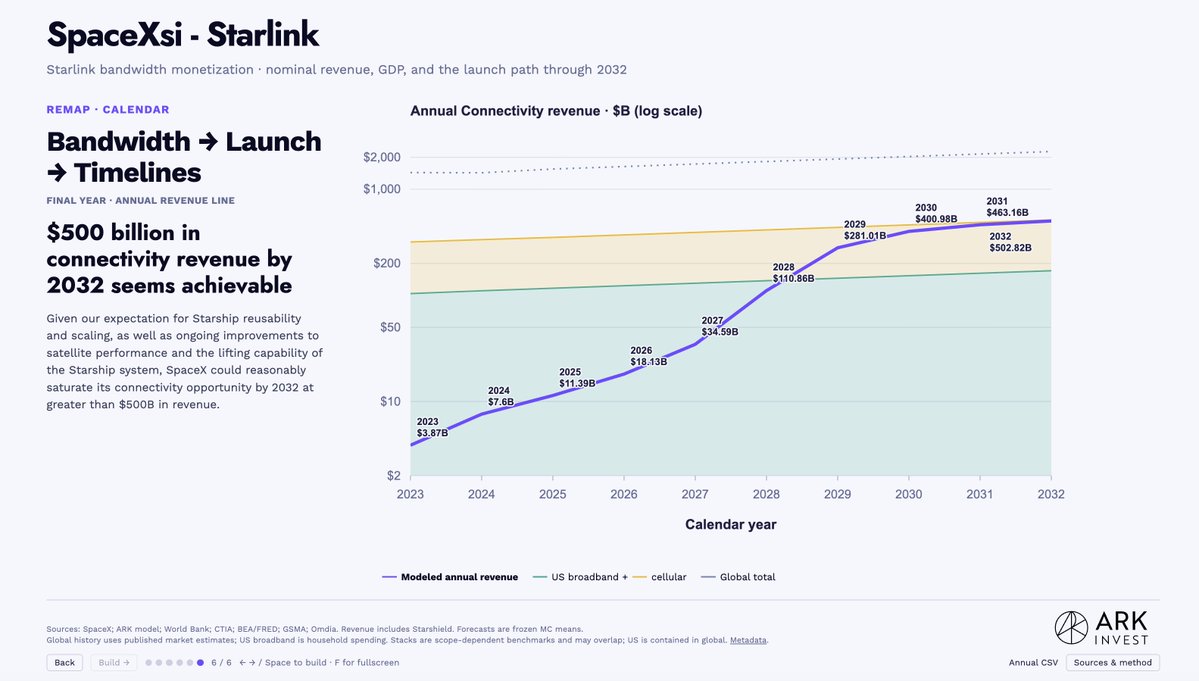
Further mapping to timeline suggests that $500 b in connectivity revenue by 2032 is possible, perhaps even quite likely.
This also ignores or doesn't anticipate additional connectivity demand likely to be spurred by the rise of the agentic economy which should itself serve to accelerate underlying economic growth.
What we talk about when we talk about starlink
Though many focus on subscriber numbers and ARPU, the most durable way to understand and forecast SpaceXsi’s connectivity revenue is on a revenue per terabit per second basis. By lofting its Starlink satellites, SpaceXsi enables additional data throughput everywhere on Earth. It sells that connectivity to cow tracking companies, Antarctic researchers and individual homeowners (amongst many others!).
By mapping terabits to launches we can get a sense for whether or not SpaceXsi could reasonably service this market.
Seems very much in bounds.
On 700 starship launches (accommodating anticipated improvements in the underlying satellites as well as the rockets themselves) they could fully saturate the connectivity opportunity.
This is another example of how vertical integration is a superpower.
That they have internal use for the compute (and a strong balance sheet) allows SpaceXsi to take a more aggressive contracting stance on its IaaS business and ultimately command massively premium pricing relative to other compute providers relying solely on the rental market to make them whole on their capex.
Because of their willingness and ability to sign short term deals, enabled by the strength of their balance sheet, their relationship with nvidia, and their ability to flex supply into internal use in the event of a demand shortfall, SpaceXsi can enjoy wildly better pricing over time (assuming they can continue to scale up their fleet.)
This is another example of how vertical integration is a superpower. That they have internal use for the compute (and a strong balance sheet) allows SpaceXsi to take a more aggressive contracting stance on its IaaS business and ultimately command massively premium pricing relative to other compute providers relying solely on the rental market to make them whole on their capex.
Because of their willingness and ability to sign short term deals, enabled by the strength of their balance sheet, their relationship with nvidia, and their ability to flex supply into internal use in the event of a demand shortfall, SpaceXsi can enjoy wildly better pricing over time (assuming they can continue to scale up their fleet.)
This is another example of how vertical integration is a superpower. That they have internal use for the compute (and a strong balance sheet) allows SpaceXsi to take a more aggressive contracting stance on its IaaS business and ultimately command massively premium pricing relative to other compute providers relying solely on the rental market to make them whole on their capex.
SpaceXSI's short term IaaS contracting terms means it can take advantage of the premium that new chips can command given their superior tokenomics.
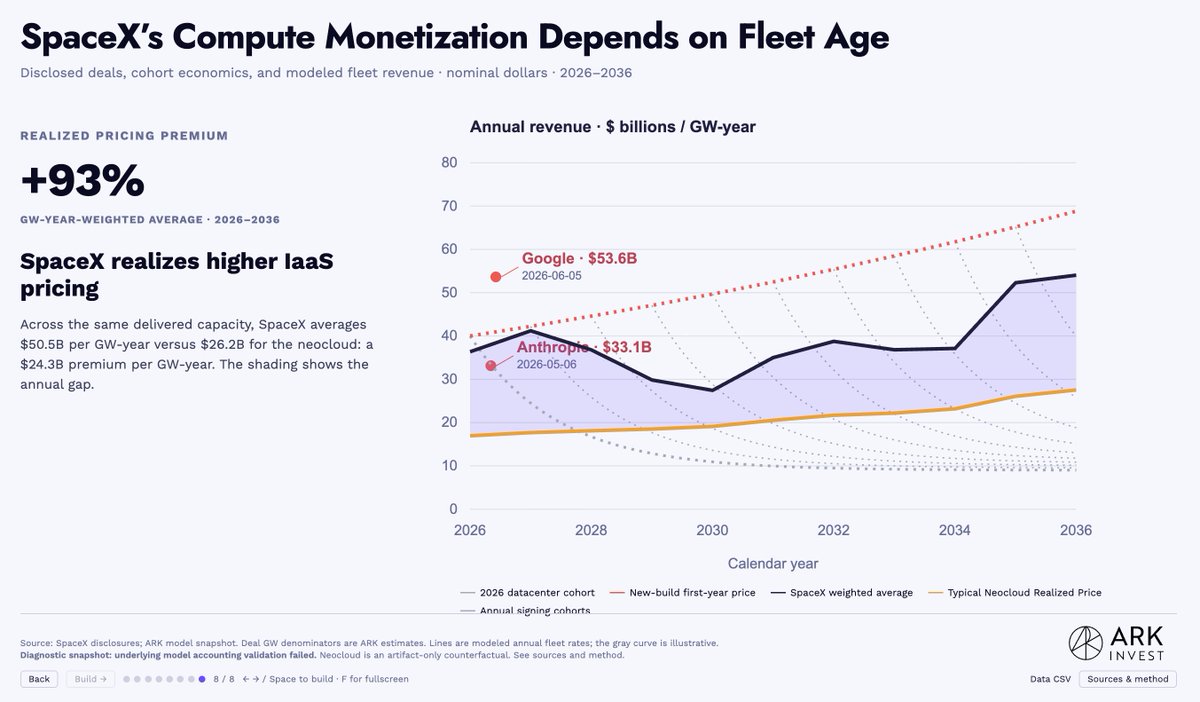
Whereas traditional neocloud players will sign medium term deals on their facilities in order to secure financing, SpaceXSI has more balance sheet leeway (and also wants to maintain the option to call on the compute for internal purposes). This means their realized IaaS pricing can remain almost double other neocloud's so long as they continue to scale their compute assets.
Net SpaceXSI could realize IaaS pricing in $30 to $40b per GW range even as other players have to settle for inching over $20b per GW.
This stands in stark contrast to the realized pricing for other neoclouds, and its worth exploring why.
To finance their capex neoclouds need revenue certainty. Rather than pricing the new build on short term contracts that capture the premium that those chips can command, they sign longer term deals that capture the 5 to 6 year forward expected revenue curve.
Not only does this mean that their realized monetization per GW will lag (since it captures deals signed before compute had gotten so dear) even deals signed today will, on a $ per compute basis, appear much more economical than what SpaceX is able to charge into the market.
People will interpret this as SpaceX just having to have had excess compute supply at a time-point where the world happened to be excessively short compute, but if you operate on the reasonable pricing assumptions for first year chips, and adjust for the longer-term deals that neoclouds are forced to sign by their capital providers, its actually just reflective of the different contracting terms that SpaceXsi takes relative to the rest of the industry.
On the same GW build, signing medium term deals rather than short term deals, SpaceXsi's realized monetization per GW would be substantially lower.
@VibeGuessing@grok Since older data centers with older chips monetize worse if you don’t aggressively keep building new your monetization rate averages down as your facilities season
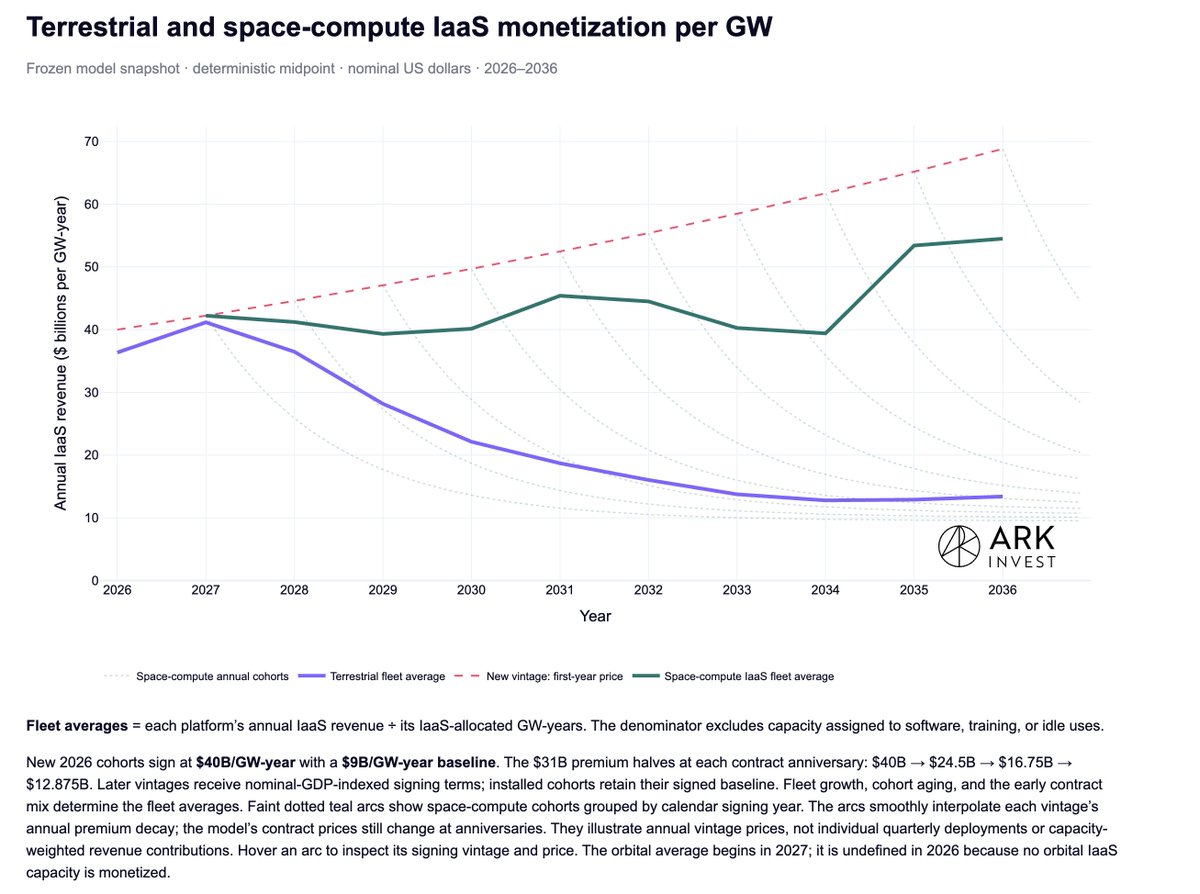
What is a rented GW worth?
Here's how we model it (at least for SpaceXsi)
So long as they continue to sign year by year deals, and the world remains short compute, and their compute capacity keeps growing exponentially they should command premium pricing.
Orbital monetization fluctuates as the mix of new vs seasoned cohorts shifts (based on launch timing and satellite manufacturing throughput constraints.) Terrestrial monetization falls off since we have them tamping down ongoing new build terrestrial as space super compute becomes economically dominant.
As their R&D spend brings them level with the frontier, they reserve more of their compute for higher margin direct super intelligence software monetization.