We used a 35-second shot clock today at the WBY Tourney in Marshfield. It was very well received and actually easy to operate. The clocks did come into play at some point(s) in almost every game.
Former #wisbb Star and State Champion from @pewaukeehoops to play at Kentucky! The Basket Under Review Newsletter - June 2, 2026 https://t.co/GKFPEgjr0s
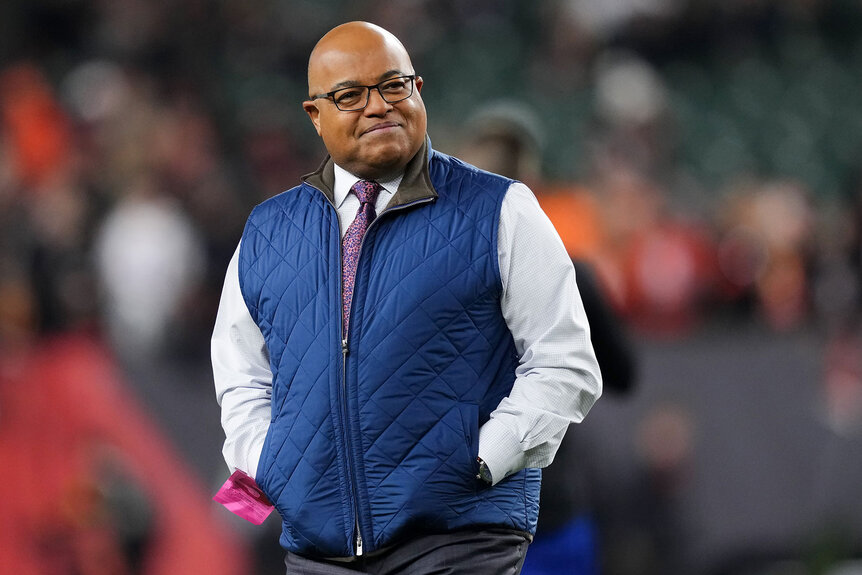
Mike Tirico told me his secret.
It wasn't talent.
It wasn't luck.
It was what he does on every flight home.
A few years ago, I met him at a restaurant bar in Indianapolis during the Big Ten tournament. One of the biggest voices in sports.
He didn't lead with his résumé. He introduced himself. He asked questions. He cared about every person in the room before anyone cared about him.
Eventually, I asked him what made him great.
He said after every game he calls, on the flight home, he pulls up the broadcast and watches it back.
Listens to his own voice. Hunts for the misses. The dead air. The calls he wishes he could have over.
Every game. Twenty-plus years in.
He wasn't born world-class. He worked his way there one flight at a time.
The best in any room are usually the ones still grading themselves the hardest.
World-class isn't a personality.
It's a habit.
"There shouldn't be a classroom in America from kindergarten to PhD where you're allowed to use your personal devices," says @ArthurBrooks. "We're rewiring their brains to become lonely and depressed." https://t.co/LvW5c05S54
May 10, 1984: Milwaukee’s Sidney Moncrief drives for a lefty slam against New Jersey in Game 6 of the ECSF.
Moncrief had 16 PTS/7 AST/7 REB and Marques Johnson had a team-high 25 PTS/13 REB in the Bucks’ 98-97 series-clinching win. Darryl Dawkins scored 29 PTS for the Nets.
We’re embarking on a project to find Wisconsin’s best high school athletes of all time. And we need your help. Vote in our poll. https://t.co/xotd1S3DGE
@CoachAdragna I’m in WA w/clock. I avoid the argument on possession impact. We have rules for fighting, hanging on the rim, running out of bounds, and flopping. None of these impact even 10% of possessions. That said, a SC impacts every possession and how many exceeded :35 is irrelevant.
I've been pretty quiet on the shot clock being voted down in Indiana because I know it's a delicate topic with a lot of moving parts.
But I was one of the 68% of coaches who voted FOR the shot clock.
To me, that's important.
The people with the closest pulse on the game, the people in gyms every single day teaching players, building programs, studying film, and understanding what today's players actually need, overwhelmingly said yes. Yet somehow, 17 of the 18 administrators voted against it.
The implementation costs are not lost on me. I understand smaller schools have concerns. But I also think the "$10,000 per school" number being floated around is pretty inflated. I could go online right now and buy large digital countdown clocks for around $100. Are they perfect? No. But from a problem-solving standpoint, there are absolutely ways to make this more affordable than people are making it out to be.
So why did I vote yes?
Because I think a shot clock forces better basketball habits.
It forces coaches to teach decision-making, advantage basketball, reading defenses, pace, timing, and offensive organization. It reduces some of the over-controlling "joystick coaching" where every possession is dictated from the sideline for 90 seconds.
All of that matters for player development and basketball IQ.
I know the argument always gets brought up that only a tiny percentage of high school players will play college basketball, and even fewer will play professionally. That's true.
But how many WANT to play at the next level?
I think that's the more important question.
Are we helping prepare players for what modern basketball actually looks like? That shouldn't be the only factor in the decision, but I do think it should matter.
The IHSAA noted that there are very few possessions lasting over 35 seconds in Indiana high school basketball.
I only have anecdotal evidence from my own season, but I would argue 25-30% of possessions in our games lasted longer than that. And once you get into end-of-quarter and end-of-game situations, that number skyrockets.
If the clock gets under a minute, teams hold for the last shot. Mine included.
Ends of games become foul-fests trying to extend possessions, and I honestly think it creates a worse product a lot of the time.
Meanwhile, much of the rest of the basketball world is using a shot clock, starting as young as 12 years old, because they understand it accelerates skill development, spacing, decision-making, and the feel for the game.
And if we're being honest, the rest of the world is catching up to the United States in basketball skill. There are a lot of reasons for that, but their emphasis on skill development is absolutely part of it.
I fully understand there are challenges with implementation.
But 33 other states have figured it out.
At some point, I think the conversation has to shift from finding reasons to say no toward trying to solve for yes.
I’ve been watching live period film all spring and I haven’t seen one defensive highlight worth talking about — and that tells me everything. Everybody can score.
College coaches see hundreds of scorers every weekend. The player who can score AND defend is the one they remember when they get back to the office.
Low effort and energy at the college level will not fly.