अमेरिका और MasterCard की साजिश? कांग्रेस से आए WhatsApp का सीधा फॉरवर्ड मार दिया क्या? 🤣
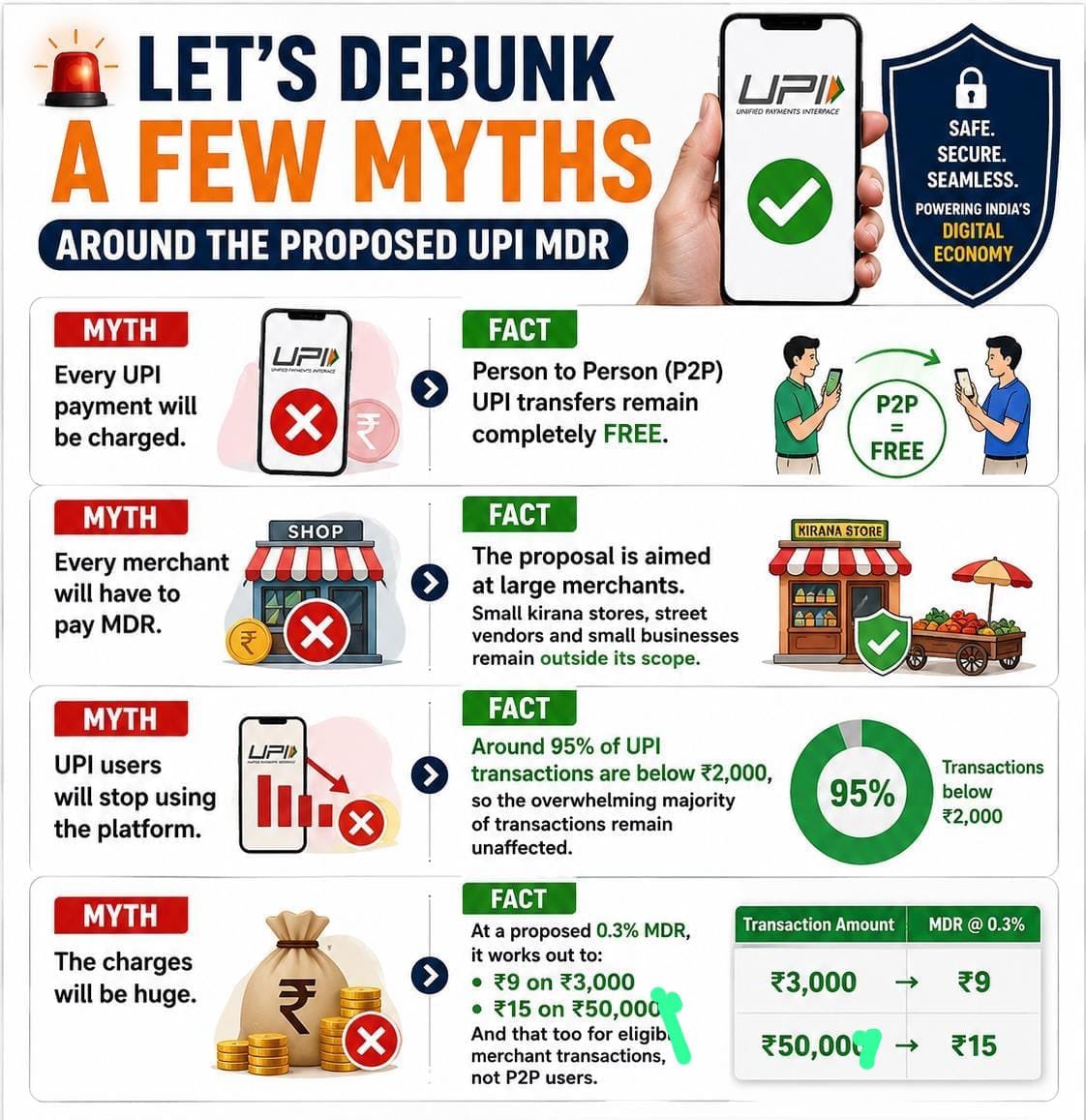
0.3% प्रोसेसिंग फीस वो भी सिर्फ करोड़ों का टर्नओवर वाले गिने-चुने बड़े व्यापारियों पर... इससे अमेरिका का क्या लेना-देना?
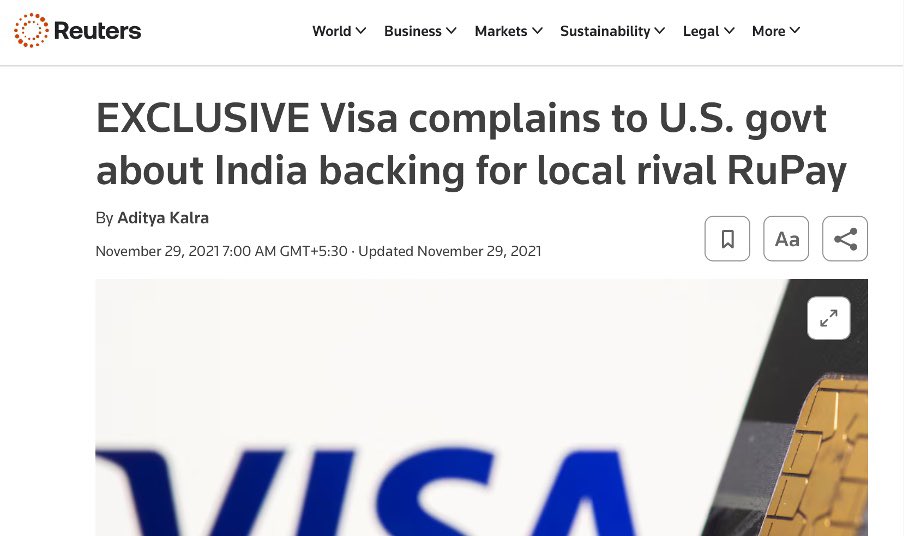
तुम्हारी जानकारी के लिए बता दूं अमेरिका ने यह रिपोर्ट कई बार भेजी है और भारत ने इगनोर किया है।
फैक्चुअल बात करना कब शुरू करोगे?
“We build the economy, we pay taxes” and then blaming the Union Finance Minister for an expenditure made by a state government.
Brilliant economics, professor.
The Centre's UPI incentive scheme was specifically designed to keep eligible low value P2M transactions at zero MDR and support the digital payments ecosystem.
Maybe read the policy before declaring taxpayers “jokers.”
@Netajinonsense1 FM said UPI charges, if applicable, would be on the merchant side, not a charge imposed on consumers for making UPI payments. You somehow turned that into “merchants will charge customers 1.5%” and then found an AI image to support it.
What a shameless person you are!
@AshwiniUpadhyay@narendramodi@nsitharaman ₹1 लाख महीना कमाने वाले पर टैक्स का रोना रोने से पहले ₹12 लाख की tax-free limit भी पढ़ लेते। 😄
Salaried लोगों के लिए ₹12.75 लाख तक effectively zero tax है, जबकि ऊँची आय पर 30% तक टैक्स + surcharge।
Headline पढ़कर expert बनना आसान है, Tax Slabs पढ़ना थोड़ा मुश्किल।
@storyoftaxpayer@FI_InvestIndia@nsitharaman@narendramodi Income tax rates have been rationalised. Income up to 12.75 lakh is tax free.
GST rates have been cut across numerous essential and mass consumption items.
Pretending that nothing has changed for tax payers is simply dishonest.
@FI_InvestIndia Income tax rates have been rationalised. Income up to 12.75 lakh is tax free.
GST rates have been cut across numerous essential and mass consumption items.
Pretending that nothing has changed for tax payers is simply dishonest.
If your GST analogy were correct, every merchant paying card MDR would have to separately charge customers for it.
That clearly does not happen. Major retailers routinely absorb card payment costs while offering customers discounts, cashback and EMI benefits.
MDR being paid by the merchant does not magically become a customer charge.
Calling someone “dumb” while making this comparison is quite the self own.
Even if IRCTC passes a gateway charge on, one merchant proves it can happen, not that it “inevitably” happens everywhere.
Amazon, Flipkart, Croma and Vijay Sales accept cards carrying far higher processing costs, maintain common prices, and even run card discounts and no-cost EMI offers. Why? Because merchants absorb or co-fund payment costs when higher sales and ticket sizes justify them. There is no economic law compelling a separate surcharge.
“Government spends on freebies” is another red herring. It does not make servers, settlement, fraud prevention and cybersecurity free or justify permanently subsidising high-value payments to large merchants.
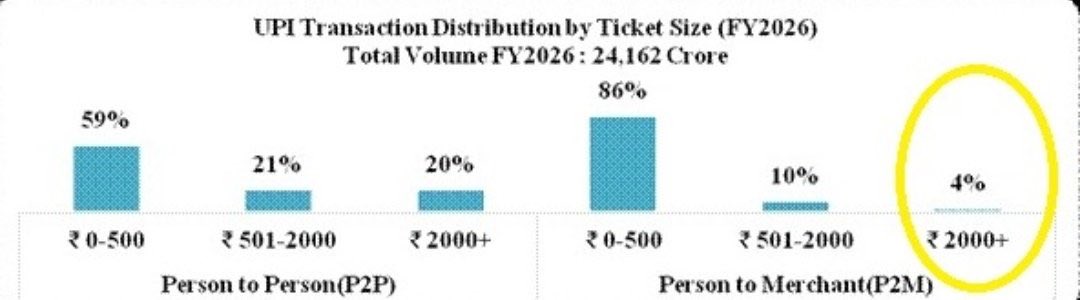
The leading proposal covers payments above ₹2,000 to large merchants barely 4% of merchant-payment volume and nothing has been finalised.
You found a gateway menu, called it evidence of a UPI charge, and replaced economics with “IT cell” abuse.
The irony is that you have written nine paragraphs defending UPI while attacking a proposal that is specifically designed to keep the user experience free.
If large merchants can absorb card MDR as a business cost, why is a modest merchant side charge on digital payments suddenly being portrayed as the death of UPI?
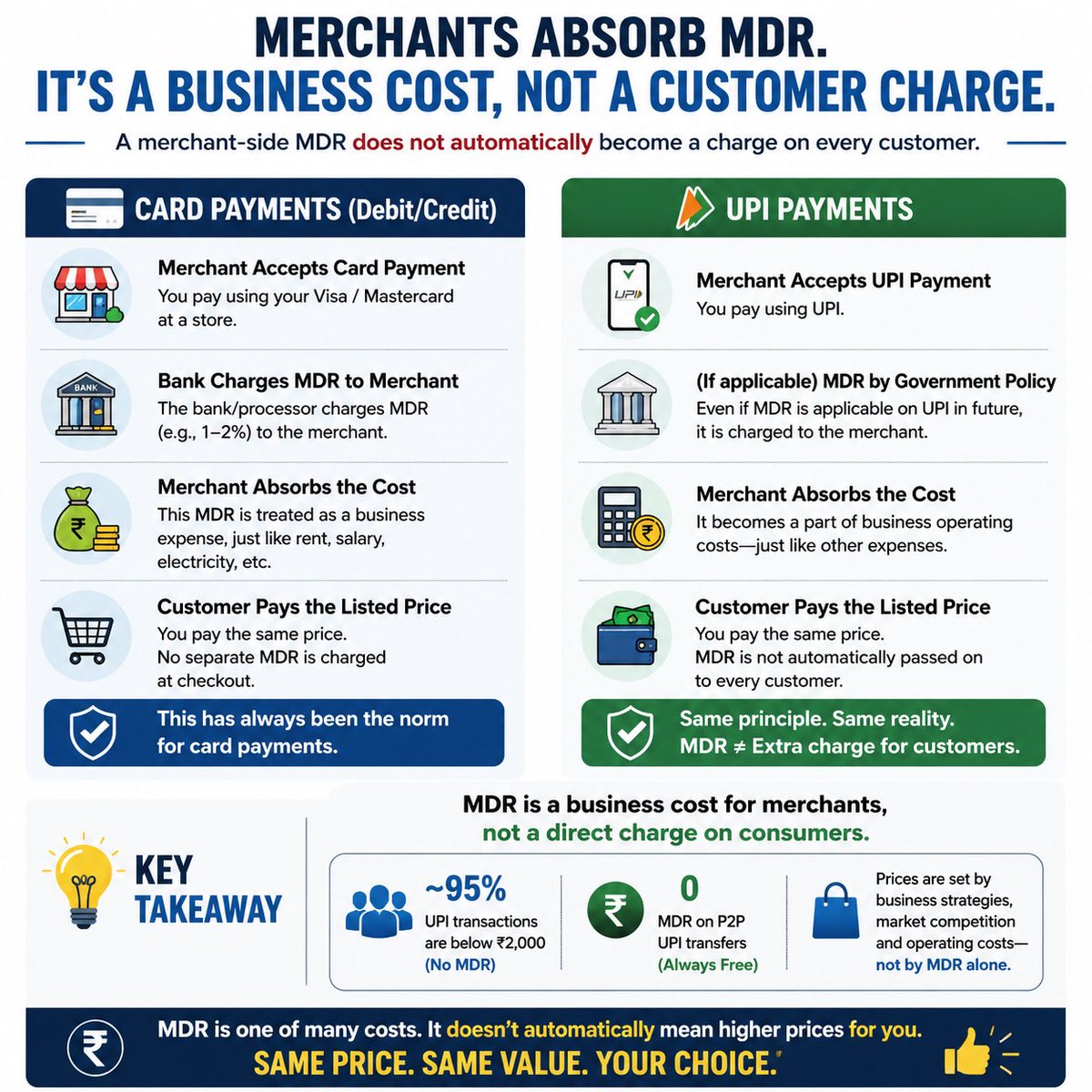
Customers are not the ones being charged. Merchants are.
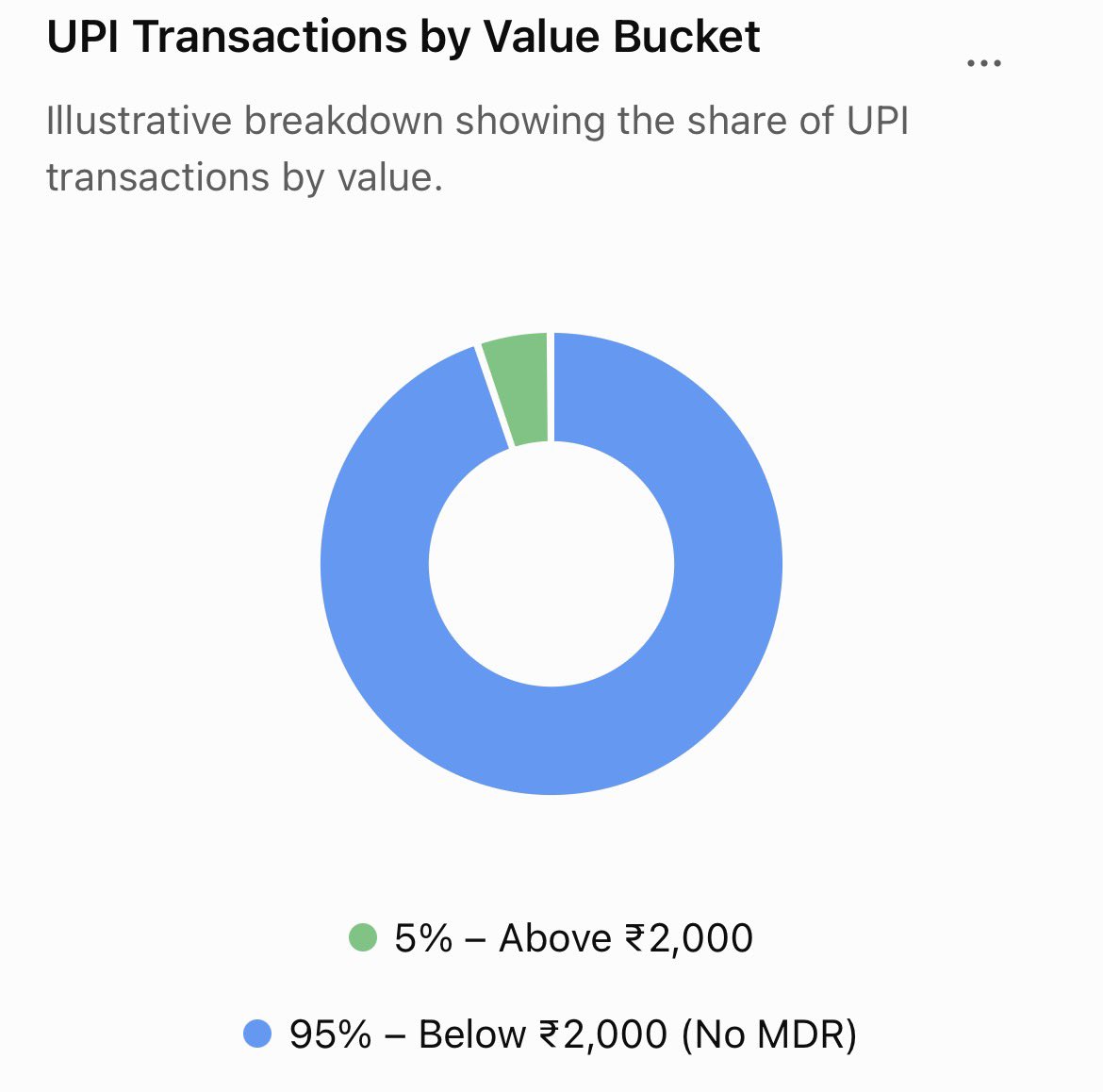
96 % of transactions anyway will remain free as they are of less than 2000 rupees.
Don't create Outrage.
In the regulation, govt will not permit the surcharge. So electronics should not happen for the reasons as follows-
- Today, the electronics (all major ones) do not pass back the cost of MDR even at 2% to the customers for credit cards, rather encourage to buy on CC due to offers from the issuer bank.
- The reason is over 70% electronics is today bought on EMI, and technically UPI is the least used option there due to no incentives/or discounts, since no EMI/offered by the issuer bank currently.
-Once some earning comes in UPI, even the EMI on UPI will start.
However, those merchant categories who charge the convenience fee for even credit cards and debit cards will continue to do - some examples are movie tickets, airline and education. Also one more point to note is, for the large value transactions categories like education, fertilisers, insurance, mutual funds and govt payments (taxes etc), irrespective of the value have kept Rs. 5 as Interchange so MDR should be around Rs. 7 - so on avarge ticket size of 20,000 the MDR is less than 1 basis point cost.
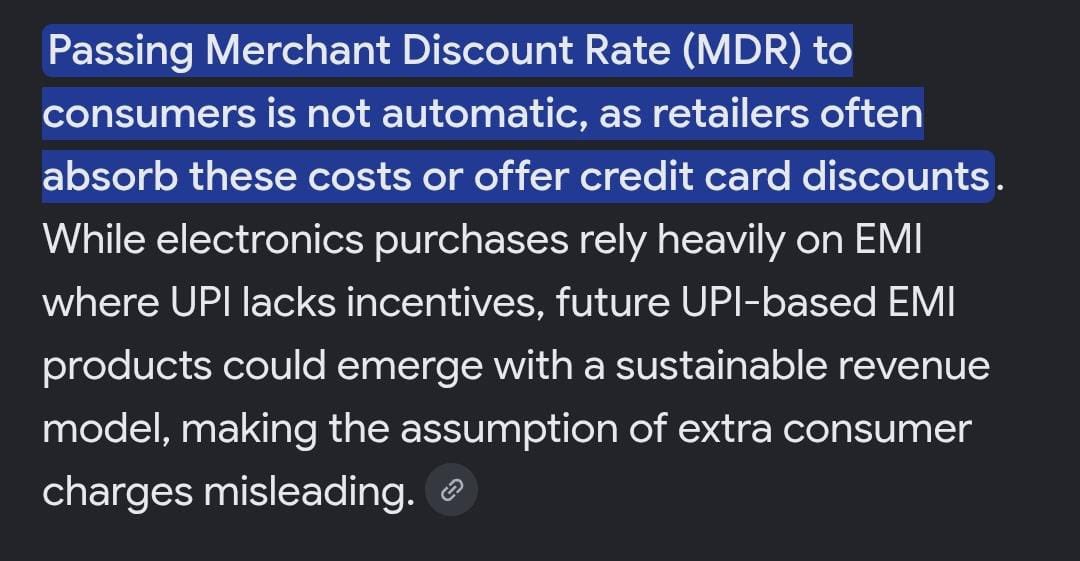
If MDR automatically had to be passed on to customers, credit card payments would look very different today.
Major electronics retailers routinely absorb card MDR and still offer customers discounts on credit card purchases.
More than 70% of electronics purchases happen through EMI, where UPI currently has far fewer incentives.
A sustainable UPI revenue model could actually enable UPI based EMI products in the future.
The assumption that consumers will simply be charged extra is therefore misleading.
@GuruShareMarket Merchants have always absorbed card MDR as a cost of doing business. That never meant every customer paid a separate fee at checkout.
A merchant-side MDR doesn't automatically become a consumer charge it is simply one of many operating costs businesses factor into pricing.
Pawan Khera’s degree in “Entire Hyperbole” is clearly working overtime.
UPI was launched in 2016 and scaled under the Modi Government from 2 crore transactions in FY2016-17 to 24,162 crore in FY2025-26—a 12,000-fold increase. It now accounts for around 85% of India’s digital transactions.
The Government that turned UPI into the world’s largest retail fast-payment system apparently wants to “burn it down”. Absurd.
There is not even a final MDR decision. The leading proposal concerns only payments above ₹2,000 to large merchants—barely 4% of merchant-payment volume. Customers, small merchants and the remaining 96% stay outside its scope.
Providing revenue for banks, cybersecurity and payment infrastructure does not bulldoze UPI. Forcing the ecosystem to process ever-growing commercial transactions indefinitely without revenue is what threatens sustainability.
When facts are unavailable, Congress supplies fire metaphors, personal insults and manufactured panic.
Peda for a reason
@TARUNspeakss One crucial fact being ignored: around 95% of UPI transactions are below ₹2,000, where no MDR applies.
The debate concerns only a small segment of high-value merchant payments not everyday UPI transfers.
Stop spreading panic by misrepresenting the facts
That is an extraordinarily long confession that facts stop mattering when you dislike the Government.
You admit taking “creative liberties” at the cost of economic rigour -which is precisely the intellectual dishonesty you accuse others of.
You then claim rupee depreciation and economic health are “uncorrelated”, immediately followed by saying India’s worst economic periods coincided with sharp depreciation. That is literally a claim of correlation.
Your GST grievance may be genuine, but it has absolutely nothing to do with whether MDR is charged to merchants or whether 96% of merchant transactions remain outside the proposal.
You have rebutted none of the facts. “I am on Twitter” is not an exemption from basic honesty.
TL;DR: You concede the facts, admit the smear and justify it with personal anger. Case closed.
@tehseenp Merchants have always absorbed card MDR as a cost of doing business. That never meant every customer paid a separate fee at checkout.
A merchant-side MDR doesn't automatically become a consumer charge it is simply one of many operating costs businesses factor into pricing.
@AishwaryakiRai That is the point this is only for big merchants for small merchant no charge (threshold 2 crore) even at big merchant no charge till 2000 rupees