Elliott Wave student | Simplernation member | Student of LeadingTrader | I/O Fund member | 42 Macro member| Dark Pool Watcher| Student of the 4rth Turning| CIMA
Today is the last day of HD Awareness month. I have a request to all @uniQure_NV $QURE $NVS $PTCT $WVE and other HD focused investors. If you have been fortunate enough to have the means, consider making a donation to HD Buzz so they can continue their great work. Link to donation page below.
https://t.co/UwkBg2XRq3
There are many great HD charities out there to help the HD Community, don't limit your donations just to this if you are in a position to do so. The need is constant. Thank you for considering this on a very important day for the community.
It could have happened.
1. It was Huntington’s Awareness Month, so there’s a chance the meeting already took place.
2. Someone has been loading up on June and July calls as if they know something. Just look at the open interest — it’s insane.
3. We saw some very large dark pool prints near the lows a few months ago.
4. A lot of the people who were standing in the way are no longer in the picture.
I’m not saying this is what happened, but it’s definitely within the realm of possibility. They may simply be waiting to announce something closer to when the finalized meeting minutes are available.
$qure The recent FDA action showing a willingness to revisit a prior decision is actually pretty encouraging for $QURE.
What makes uniQure’s situation unique is that by the end of June they will have the complete 4-year dataset in hand. That is a lot more information than what was available during previous discussions with the FDA.
I continue to believe there is a reasonable middle-ground solution here. Something along the lines of accelerated approval while additional long-term data continue to mature. Patients could gain access to the therapy while the company provides certified 4-year data, then 5-year data, and continues to follow both existing and newly treated patients. If the long-term data fail to hold up, the FDA always has the authority to revisit its decision.
To me, that seems like a practical path given the severity of Huntington’s disease, the lack of effective treatment options, and the FDA’s stated willingness to be flexible in serious rare diseases with high unmet need.
Another factor that I don’t think gets discussed enough is the change in leadership. The previous FDA leadership was often criticized for taking a very rigid approach, especially on novel therapies and rare disease programs. History has shown that when leadership changes, priorities and interpretations can shift as well. Sometimes the pendulum swings in the opposite direction.
I’m not saying that guarantees a favorable outcome for $QURE. It doesn’t. But I also wouldn’t be surprised if the current or temporary leadership proves to be more flexible and pragmatic than many investors are currently assuming, particularly when reviewing a dataset that will soon include four years of follow-up.
My speculation is that the market is still viewing this as a simple FDA reversal story. I think it’s more nuanced than that. The FDA is going to have access to significantly more long-term data than it had before, and the range of potential outcomes may be broader than the market is currently pricing in.
Nothing is guaranteed and we still need to hear the outcome of the FDA interactions, but I believe the market may be underestimating the value of the upcoming 4-year data and the potential paths forward.
$clpt San Diego Alzheimer’s
Tuszynski is also running a new early-stage gene therapy trial which involves delivering another nerve growth factor called brain-derived neurotrophic factor (BDNF). Surgeons will use MRI-guidance to ensure the gene therapy gets to the right place.
NGF only protects the neurons that produce the chemical acetylcholine. “BDNF treated a more important cell type,” said Tuszynski, “neurons in the cortex of the brain” that handle memory and higher cognitive functions.
“We’ve treated nine of 12 patients so far, and we don’t have information yet on how it’s affecting memory,” said Tuszynski. But so far, brain imaging is promising: One sign of Alzheimer’s is slowed metabolism in the brain, and so far, the treatment looks like it’s reversing these changes.
“That doesn’t mean it will help memory or be effective for the disease,” he said, “but it’s a hopeful sign.”
The study will finish in 2027, and if the results show promise, it will lead to a larger trial.
https://t.co/08JdbDWAse
$qure $clpt Pure speculation on my part, but if I exclude the holidays and the final week of the quarter, I think the highest probability window for positive news from uniQure is between now and June 12.
If we don’t hear anything during that period, it doesn’t necessarily mean bad news — it may simply mean the update is coming later. But based on the timing, this feels like the window with the best odds for a favorable announcement.
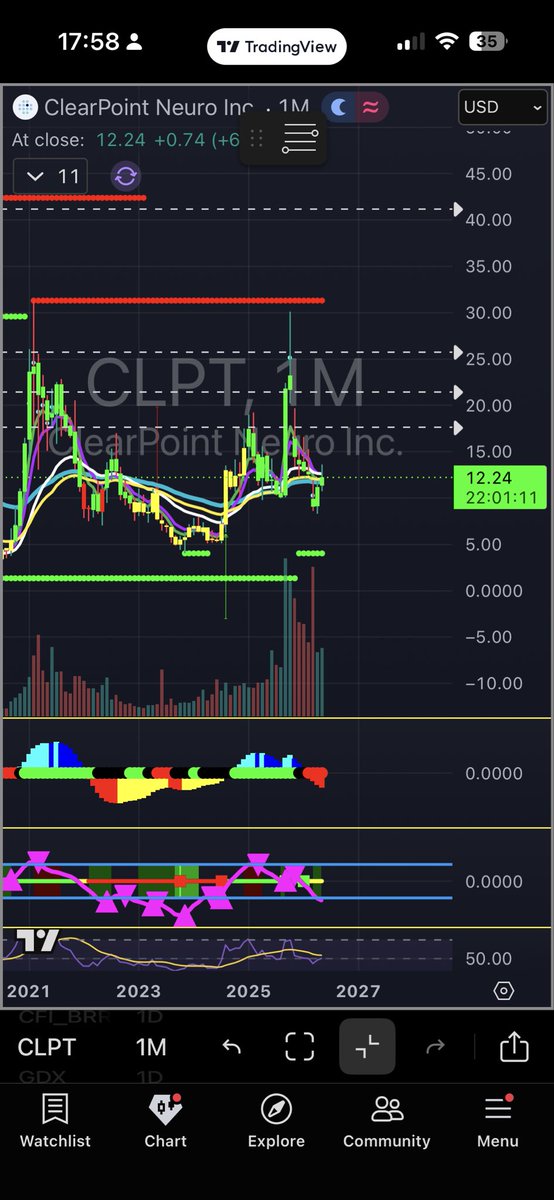
$CLPT is probably one of the most misunderstood asymmetric plays in my portfolio right now.
The market still values them mostly as a niche neuro navigation / tools company because none of the commercial drug programs tied to their ecosystem have fully crossed the finish line yet.
But I think the moment ONE major CNS therapy works commercially, the entire framework changes overnight.
Main catalyst I’m watching:
$QURE upcoming FDA Type B/B2 meeting for AMT-130.
If AMT-130 gets a favorable path forward, investors will suddenly have to recalculate the probability of success across the entire CNS delivery ecosystem.
And that’s where $CLPT gets interesting.
People forget CLPT already has:
• a huge network of biopharma partnerships
• years of workflow integration
• MRI-guided precision delivery moat
• exposure to gene therapy, biologics, focused ultrasound, and CNS drug delivery
Right now Wall Street basically assigns little to no value to most of these partnerships because none have fully commercialized yet.
But once one hits?
Everything changes.
Then the market starts asking:
“What’s the value of the infrastructure company already connected to all these programs?”
At that point you can’t just value CLPT off current revenue anymore. You have to probability-weight the entire pipeline ecosystem tied to them.
That’s why I think the current valuation disconnect exists. The market is waiting for proof. I’m looking at what happens if proof arrives.
My personal target:
$40 within 6 months if the regulatory + commercial dominoes start falling into place.
And if multiple CNS programs begin validating over the next year?
I genuinely think this has potential to become a 10 bagger type story.
LFG!
To further strengthen the conviction, the monthly technicals are starting to align with the fundamentals.
There is now a famous @johnfcarter Squeeze forming on the monthly chart — Bollinger Bands contracting, signaling a potentially massive move ahead. The overall structure also resembles a large cup & handle while simultaneously forming a messy inverse head & shoulders.
This setup honestly reminds me of $ONDS back when it was trading around $0.60 in May 2025 before the market fully understood the story.
The difference with $CLPT is the platform potential may be significantly larger if even one commercial drug-delivery partnership hits.
Would not be surprised to see a potential 10x move within the next 12–18 months.
IO Fund is expecting some kind of downturn within the next week or so — maybe just a pullback, maybe a deeper correction.
42Macro recently sold their BTC allocation and basically put everyone on notice not to be surprised if we see a correction.
Robert Minor from Dynamic Traders says we’re approaching cycle dates that could signal a weekly high. Could end up being a shallow pullback or something deeper.
Dark pool observations are also showing a lot of large prints hitting here.
My speculation:
I don’t think this is the start of some massive market collapse. More likely a pullback or digestion phase until some of these blockbuster IPOs get released. Mission Control probably doesn’t want to rock the liquidity boat before then.
I actually expect the larger correction to happen after the SpaceX and/or OpenAI IPOs and potentially carry into the midterm election cycle.
Pure speculation of course — but for now, a lot of the wizards and operators I follow seem to be signaling at least a near-term pullback.
#ClearPoint Neuro Enters into 10-year Focused Ultrasound Development Partnership with Sungkyunkwan University, South Korea, Further Expanding Our Drug Delivery Ecosystem and Global Footprint - Read More Here: https://t.co/ubbC5bFV6m
#CLPT
https://t.co/GYVi1i9KPF
Def worth a watch! Both of them are legendary imo. Milton’s retail service is only $10 a month. https://t.co/ayLPYe3pw2
@BergMilton
$BTCUSD looks like it’s about to puke. If it does, this may be the final leg down of the cycle. 2–3 months imo.
US10Y monthly honestly looks like it’s about to rip. Huge bull flag. 🤷♂️
A lot of my clients in import/export are doing average to below average right now. What’s interesting is even clients in the service sector are slowing down too. Usually the specialized service businesses I work with — even stuff like dog groomers/stylists — are always busy. Some of them are saying this is the first real slowdown they’ve felt in 15 years.
Maybe it’s nothing, but something just feels a little off to me lately. Not outright bearish… just uneasy.
@turkishpowell@lzwaaron 🤷♂️ but these trades are coming in close to ATH; you have to ask yourself why would someone buy now or sell now? IMHO usually we see slightly higher prices the following week and then it dumps the next.
What’s the point here exactly? A guy researches rare diseases, advocates for patients, studies companies in the space, and then invests in the ones he believes are undervalued or promising… and somehow that’s supposed to be hypocrisy?
That’s called capitalism. And honestly, at least he’s putting his money where his mouth is. Maybe he invests because he actually believes in the science and wants these companies to succeed.
Trying to shame everyone involved in biotech investing as morally compromised while acting intellectually superior doesn’t really help patients either.
@mike98572986
Katy, I appreciate your loyalty to Dr. Makary and I truly believe he wanted to reform a broken system. But as someone from the Huntington’s disease community, I need people to understand why so many families were deeply hurt by how we were characterized.
We were not “Big Pharma.” We were not paid lobbyists. We were families drowning in generational trauma because our loved ones are dying from one of the cruelest neurodegenerative diseases on earth.
And the hardest part? While many Huntington’s families, caregivers, and at-risk individuals were literally on Capitol Hill during Rare Disease Week meeting with lawmakers after paying our own way there, Dr. Makary was simultaneously speaking to reporters about “moneyed interests” and outside pressure surrounding AMT-130.
There were no corporate-funded advocacy campaigns behind us. Just families carrying decades of trauma, grief, and fear into congressional offices because we are terrified of running out of time. Nearly 50,000 signatures were gathered from HD families, grassroots advocates, caregivers, and supporters demanding urgency for AMT-130, and those petitions were hand-delivered directly to the FDA by members of the Huntington’s community themselves. Over 10,000 emails were also sent to FDA and members of Congress. Nobody paid us to do that. Fear did. Love did. Desperation did.
At the 2024 EL-PFDD meeting in Maryland, FDA sat across from more than 100 HD families and listened as we described watching parents, grandparents, siblings, and children slowly lose movement, speech, cognition, personality, and independence. People in those rooms cried with us. We were told urgency mattered.
Soon after we learned FDA aligned with uniQure on an accelerated pathway, many of us finally felt hope for the first time in our lives.
So yes, families became loud. Because this disease does not wait.
What also deeply damaged trust was watching Dr. Vinay Prasad speak anonymously to reporters about an active therapy. If someone cannot publicly face the people they serve during moments of crisis and scrutiny, they should not be leading CBER.
Leadership requires courage, transparency, and accountability. This is especially true in rare disease communities where every delay carries irreversible consequences.
Many of us respected Dr. Prasad intellectually. We respected his focus on scientific rigor. But from the patient/family side, much of what we experienced felt dismissive, detached, and at times unnecessarily combative toward a dying community simply asking to be heard.
And Dr. Makary protected that approach far too long.
The Huntington’s community is not asking for reckless science. FDA itself asked our community what level of risk we would accept, and nearly three-quarters of respondents said they would accept treatment risks for even a chance at 5 years without progression.
Because this disease does not wait for “perfect data.”
For families living with Huntington’s, every year means more neurons lost, more memories erased, more independence gone, and more people disappearing in front of us. AMT-130 showed the possibility of dramatically slowing that decline over three years. That is time with children. That is dignity. That is life itself.
We are not a lobbying machine. We are human beings trying to stop generations of suffering from continuing.
💙💜
#Huntingtonsdisease
@mike98572986 There was another person who claims they had it as well and it still on redddit but talked ill about it. He then deleted his profile but his posts are still there. 🤷♂️