You are a Web3 OG and you are not part of what @0G_labs is building.
Commot for here jhooor!!!
What is 0G Labs building?
0G Labs is building a decentralized AI operating system and modular blockchain for scalable, secure, on-chain AI applications.
With 0G Labs speed of 50000GB/s you get access to data in real-time, super fast 100x better that other centralized AI operating systems.
0G labs are not just chasing hype with the name, they are building something solid!
Pivot to @0G_labs !!!
gm
𝘀𝗲𝗰𝘂𝗿𝗶𝘁𝘆 𝗰𝗮𝗻𝗻𝗼𝘁 𝗱𝗲𝗽𝗲𝗻𝗱 𝗼𝗻 𝘁𝗿𝘂𝘀𝘁𝗶𝗻𝗴 𝗼𝗻𝗲 𝗮𝘁𝘁𝗲𝘀𝘁𝗼𝗿
a zkTLS proof can be cryptographically valid and still leave an important question unanswered:
what happens if the attestor generating that proof is dishonest?
this is one of the security problems @primus_labs is addressing with its alphanet architecture.
think about a lending protocol that uses zkTLS to verify someone's offchain financial data. the protocol may rely on that proof before granting credit.
but what if an attestor deliberately signs false information? or rejects a valid request because it wants to manipulate the outcome?
the cryptography alone does not automatically prevent a malicious attestor from abusing its position.
primus approaches this problem by adding multiple security layers rather than relying on a single point of trust.
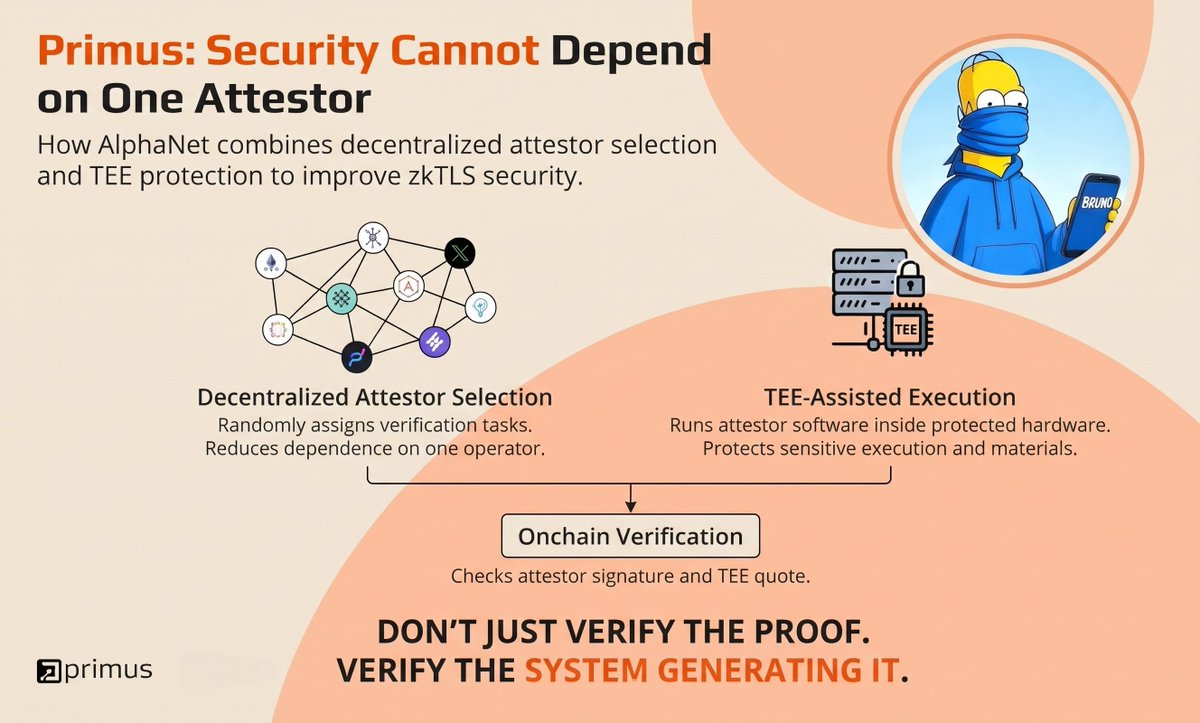
𝗳𝗶𝗿𝘀𝘁, 𝗿𝗲𝗱𝘂𝗰𝗶𝗻𝗴 𝗱𝗲𝗽𝗲𝗻𝗱𝗲𝗻𝗰𝗲 𝗼𝗻 𝗼𝗻𝗲 𝗮𝘁𝘁𝗲𝘀𝘁𝗼𝗿
in alphanet, smart contracts deployed on base handle the attestor selection process.
instead of allowing one operator to handle every verification task, the network uses a secure rotation algorithm to randomly select an attestor for each task.
this changes the trust model.
a developer does not have to depend on one fixed intermediary for every request. tasks are distributed across an attestor set, making it harder for one operator to control the entire verification process.
alphanet currently starts with attestors operated by primus and its partners. the longer-term direction is a fully permissionless decentralized network.
𝗻𝗲𝘅𝘁, 𝗽𝗿𝗼𝘁𝗲𝗰𝘁𝗶𝗻𝗴 𝘁𝗵𝗲 𝗮𝘁𝘁𝗲𝘀𝘁𝗼𝗿 𝗶𝘁𝘀𝗲𝗹𝗳
random selection helps reduce dependence on individual operators, but it does not automatically stop an operator from interfering with the software running on its machine.
this is where trusted execution environments (tees) come in.
primus integrates Phala Network's dstack technology to run attestor software inside a protected hardware environment.
a tee isolates sensitive code and data from the rest of the system. even if the machine's main operating system is compromised, the protected execution environment is designed to keep its critical operations and assets isolated.
this also helps protect sensitive node materials, including attestor keys.
𝗵𝗼𝘄 𝗱𝗼𝗲𝘀 𝘁𝗵𝗲 𝘃𝗲𝗿𝗶𝗳𝗶𝗰𝗮𝘁𝗶𝗼𝗻 𝗵𝗮𝗽𝗽𝗲𝗻?
the process goes beyond simply running software inside a tee.
- the attestor executes the zkTLS process within the protected environment.
- after execution, the tee generates a quote containing a cryptographic signature.
- the smart contract checks the attestor's signature and the tee quote.
this gives the network a way to verify that the attestor is operating through the expected protected environment, rather than blindly trusting the service provider's claims.
it does not make every possible hardware or implementation risk disappear, but it adds another layer of accountability to the verification process.
𝗯𝘂𝗶𝗹𝗱𝗶𝗻𝗴 𝗼𝗻 𝗮𝗹𝗽𝗵𝗮𝗻𝗲𝘁
developers can still build zkTLS applications using the primus network sdk.
the main workflow remains familiar: create a verification task, connect with the corresponding attestor node and generate an attestation. only minor changes are needed to the zkTLS-related apis.
the interesting part here is how primus is treating security as part of the network architecture, not something developers should have to solve on their own.
decentralized attestor selection reduces reliance on individual operators, while tee-assisted execution adds protection and verifiability at the node level.
both layers address different risks, and that distinction matters when zkTLS is used in applications involving financial decisions and private data.
a proof should not only show that information was verified. the system generating that proof also needs to be accountable.
@fermah_xyz@7wealthh@vanishree_rao As zero-knowledge applications mature, failure handling will become part of the infrastructure advantage. The strongest networks will not simply execute workloads when conditions are perfect. They will manage uncertainty without making every failure a costly setback.
A completed workload is easy to celebrate, but dependable infrastructure is tested by what happens when execution does not go as planned.
Distributed proving systems must account for failed jobs, unavailable resources and unexpected interruptions.
A zero-knowledge proof can be mathematically valid and still be difficult to integrate into another application.
The challenge is not always generating the proof, but ensuring the receiving system understands what it represents.
@fermah_xyz@7wealthh@vanishree_rao For a proof marketplace like Fermah Froben, reliability involves more than matching requests with available machines. Resource selection, execution outcomes and recovery all influence whether applications receive the proofs they need.
@primus_labs The future of automation should not depend on making agents sound more convincing.
It should depend on making their inputs, computations and outcomes easier to verify. That is how autonomy can become more accountable.
The hardest part of building trustworthy digital systems is not always producing an answer. It is making sure the answer can be traced back to evidence and checked independently.
Without that, automation still depends on blind acceptance.
The hardest part of building trustworthy digital systems is not always producing an answer. It is making sure the answer can be traced back to evidence and checked independently.
Without that, automation still depends on blind acceptance.
@primus_labs Through its work on zkTLS and verifiable computation, @primus_labs is exploring ways to connect external data with cryptographic guarantees.
That direction becomes increasingly relevant as applications delegate more decisions to automated systems.
@primus_labs The future of automation should not depend on making agents sound more convincing.
It should depend on making their inputs, computations and outcomes easier to verify. That is how autonomy can become more accountable.
The hardest part of building trustworthy digital systems is not always producing an answer. It is making sure the answer can be traced back to evidence and checked independently.
Without that, automation still depends on blind acceptance.
An application rarely makes a decision from one isolated fact. It combines identity, eligibility, transaction data and rules from different systems.
The challenge is ensuring each input can be checked without exposing everything behind it.
Through its work on zkTLS and verifiable computation, @primus_labs is exploring ways to connect external data with cryptographic guarantees.
That direction becomes increasingly relevant as applications delegate more decisions to automated systems.