Excited to host @FrontiersIn Water research topic w @DrinkMic @HozalskiRay@irishmhw & T Bartrand connecting microbial risks, environ research & policy. Check out the topic: https://t.co/Y7xLjDUjRS to submit or stay up-to-date! Please RT #DrinkingWater#RiskAssessment#Policy
@DrinkMic …We reached to these hyperactive researchers for comment, but they were far too busy to answer our inquiry…or eat, sleep, or use the toilet. Luckily, due to their productivity, their funding is is automatically renewed…
Our new paper on @WaterRes_J talks about phosphate and anode materials interfere with Cu antimicrobial effects towards L. pneumophila (this strain has high copper tolerance as well). @waterARGome@WjRhoads strainhttps://www.sciencedirect.com/science/article/pii/S0043135423006140
@DrinkMic Why don’t mainstream info sources for legio include amoeba? Science/research and practitioners seem on opposite ends: mic community v dead end/residuals. Both are important-need to understand AND COMMUNICATE both. Few do it.
@watermicrobe How do you deal with exposure to family when you return while you wait to see if you got it? Just looking for examples as we try to navigate this too…
New case study with @celine_marg and @DrinkMic in @Micro_MDPI all about Legionella during periods of low water demand associated with COVID stay-at-home and winter holidays…and flushing as a “preventative” measure https://t.co/ebaaHgBndX (1/5)
Also, some speculation about future use pipe surface temperature probes as a useful (non-invasive) diagnostic and monitoring approach. Check it out and let us know what you think! (5/5)
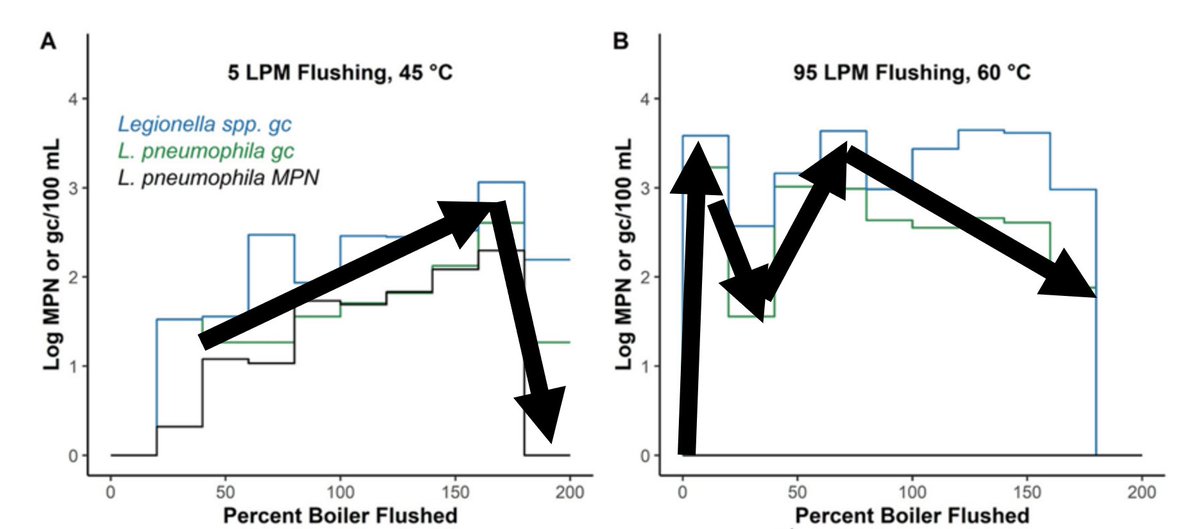
Boiler turnover resulted in Legionella being resuspended from the bottom of the boiler and/or (when RAPIDLY flushed) sloughing off biofilm in the pipes. (4/4)