Injecting an immunotherapy drug into the tumor puts far less of it in the blood than an IV does.
In the NIVIPIT melanoma trial, published in Nature this year, ipilimumab injected into the tumor at one tenth of the IV dose reached peak blood levels of 2.2 µg/mL, compared with 42.2 µg/mL by IV.
Treatment-related side effects occurred in 22.6% of the injected group and 57.1% of patients who got both drugs by IV.
Williams Cancer Institute has injected immunotherapy directly into tumors since 2014.
Headlines say AI will help cure cancer.
The doctors explain what AI is actually doing today, from reading mammograms and CT scans to speeding up drug discovery to matching patients with treatment. Join them this Friday on Beyond the Standard.
Watch live on X and our other channels.
Williams Cancer Institute treats pancreatic cancer with techniques it has been refining since 2008.
We destroy the tumor with pulsed electric field ablation, a needle technique that can reach tumors wrapped around major blood vessels.
Through the same needle, we inject immunotherapy into the tumor to teach the immune system to recognize the cancer.
If you have been told surgery is not an option, you can apply for a free review of your case and imaging at https://t.co/0g7wTz9ZIb
Gastritis that doesn't go away deserves a test for H. pylori, a stomach bacterium that can slowly push the stomach lining toward cancer.
H. pylori can live in the stomach for years and keep its lining inflamed.
Doctors can treat the infection with medication and then confirm it is gone.
Treating H. pylori before the stomach lining changes can lower the risk of stomach cancer.
Read more about gastritis and stomach cancer on our blog at https://t.co/iYsSAwIxRK
At Williams Cancer Institute, we turn tumors into personalized cancer vaccines.
I’m Dr. Jason Williams, founder of @WmsCInstitute. We break the tumor down with pulsed electric field ablation or cryoablation, then inject immune-activating drugs into that same spot. Our team also treats cancer with intra-arterial immunotherapy, intratumoral chemotherapy, microbiome therapy, and targeted radiation combined with immunotherapy.
I believe that cancer and aging run on the same biology. Cancer cells and old cells both send signals that tell the immune system to leave them alone. This means if we as a society are able to cure cancer, then we can cure aging, too. A younger body has a stronger immune system, and a stronger immune system stops cancer before it starts.
My new mini-book with @drgoodyear, The Longevity Primer, explains how the same treatments that fight cancer keep you younger, our thoughts on Ozempic, and more. The Longevity Primer is out now on Amazon Kindle.
https://t.co/7APnfLhesD
If you want to know which treatment fits your cancer, you can book a free consultation at https://t.co/kDNnrev27I
E-cigarettes cut exposure to many of the cancer-causing chemicals in cigarette smoke while still delivering nicotine.
Experimental studies show nicotine can help tumor cells survive, multiply and grow the blood vessels that feed them.
Nicotine is not a classic carcinogen, though researchers think it may help cancers progress.
For anyone with a history of cancer, switching to vaping lowers some risks and leaves the nicotine risk in place.
Our blog post on e-cigarettes is at https://t.co/Z21WS1WtpX
Williams Cancer Institute treats advanced prostate cancer with techniques it has been refining since 2008.
The treatment is designed for prostate cancer that has outlasted hormone therapy and other treatments.
Because prostate tumors tend to keep immune cells out, we inject several immune drugs directly into the tumor after cryoablation or pulsed electric field ablation.
We coordinate with your oncology and urology teams.
You can request a free evaluation for advanced prostate cancer at https://t.co/2693QbxXXW
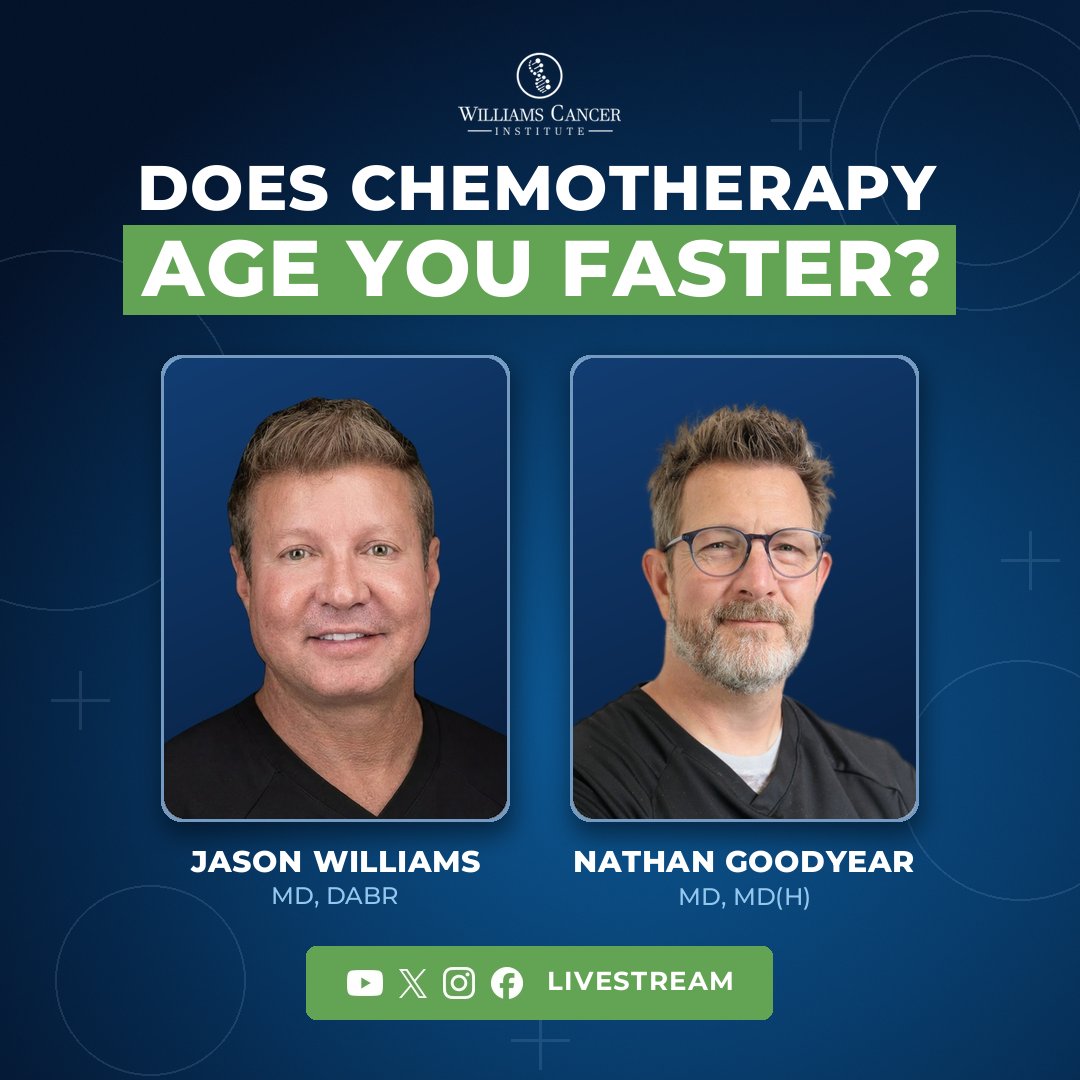
Tune in to our livestream today at 1PM PST / 4PM EST with @jasonwilliamsmd and @drgoodyear to hear more on the relationship between chemotherapy and aging.
Chemotherapy can save a breast cancer patient's life and may still take years off of it.
A modeling study published in @JAMANetworkOpen estimates that survivors treated with anthracycline chemotherapy lose a median of 9.4 years of life to accelerated biological aging. The doctors break down the study this Friday on Beyond the Standard.
Watch live on X and our other channels
Antibiotics taken within 60 days of starting checkpoint immunotherapy are consistently linked to poorer outcomes, according to a meta-analysis cited by Elkrief and colleagues in 2025.
Antibiotics can wipe out the gut bacteria that help the immune system respond to treatment.
If you are about to start immunotherapy, tell your oncologist about any antibiotics you have taken in the last two months.
Stage IV lung cancer patients treated with pulsed electric field ablation had 74.3% one-year survival, compared with 33% in a control group, in a 41-patient study from NYU, Weill Cornell and Duke.
All 41 had already received immunotherapy, chemotherapy or both without benefit.
The study was small and retrospective, and its authors describe it as limited.
Williams Cancer Institute uses pulsed electric field ablation for lung cancer, paired with immunotherapy injected into the tumor.
Lung cancer patients can request a free evaluation at https://t.co/rnkUuJRkAX
Can diet and fasting fight cancer?
@jasonwilliamsmd and @drgoodyear weigh in this Friday on Beyond the Standard, starting from a recent review of fasting and metabolic diets in oncology. The episode also covers the FDA's approval of dostarlimab, the immunotherapy that let most patients in its rectal cancer trial avoid surgery, chemo, and radiation.
Watch live on X and our other channels.
Colorectal cancer patients who drank at least two cups of coffee a day had a lower risk of the cancer coming back, in a Dutch study of 1,719 people.
Death rates were lowest at three to five cups a day, with no added benefit above five.
The study, published in the International Journal of Cancer, found an association and cannot prove coffee prevents recurrence.
The full article on coffee and colorectal cancer is at https://t.co/33ixyqWLPI
Williams Cancer Institute treats lung cancer with techniques it has been refining since 2008.
We treat lung cancer that cannot be operated on, has spread, or has stopped responding to treatment.
We use pulsed electric field ablation to destroy the tumor and then inject immunotherapy into it.
The National Comprehensive Cancer Network's guidelines already include ablation for stage I non-small cell lung cancer in patients who cannot have surgery.
To ask whether your lung cancer case is a fit, request a free evaluation at https://t.co/rnkUuJRkAX
Even light drinking was linked to more prostate cancer in a European Journal of Cancer study of 82,570 Finnish men published this year.
Light drinkers had about an 18% higher rate than non-drinkers, moderate drinkers a 20% higher rate and heavy drinkers a 32% higher rate.
The study cannot prove alcohol causes prostate cancer, but the rate rose with every level of drinking.
The full article on alcohol and prostate cancer is at https://t.co/ur8NwhFGF7
Williams Cancer Institute treats liver cancer with techniques it has been refining since 2008.
We treat both primary liver cancer and cancers that have spread to the liver from other organs.
Because the liver has its own artery, we can deliver immunotherapy through that artery and concentrate the drug where the tumors are.
Most patients complete treatment in about a week.
Liver cancer patients can book a free evaluation at https://t.co/SyFTuYVPBo