Starlink's first million subscribers took 26 months. The most recent million took 53 days.
The service launched in beta in October 2020. By December 2022 it had 1 million paying customers, then doubled to 2 million by September 2023. After that, the pace accelerated. Two more million arrived in the following 12 months. By late 2025, Starlink was adding roughly a million new subscribers every 4 to 8 weeks. Three straight years of exactly doubling: 2.3 million at the end of 2023, 4.6 million at the end of 2024, 9.2 million at the end of 2025.
That cadence runs on rocket launches. SpaceX has already flown 68 Falcon 9 missions in 2026, with more than 80 percent carrying Starlink satellites. Today's 29 satellites pushed the total fleet past 10,500 in low Earth orbit, about 550 km up, where signals travel with very little delay. About 65 percent of every working satellite in orbit belongs to Starlink.
Subscriber growth and revenue growth ran in opposite directions. Even as customers doubled in the first quarter of 2026, operating profit rose from $1.03 billion to only $1.19 billion. SpaceX's IPO filing explains it. Average revenue per subscriber was $99 per month in 2023. By early 2026 it had fallen to $66, a 33 percent drop. SpaceX expanded into Africa, Southeast Asia, and Latin America, charging less than US prices to win those markets. That trade got Starlink to 10 million subscribers before any competitor was close. Amazon only began launching operational satellites in April 2025. Viasat and SES operate from much higher orbits using older technology.
Today is also SpaceX's first day as a public company, having raised $75 billion at a $1.75 trillion valuation, the largest IPO in history. Saudi Aramco's 2019 debut held the previous record at $29 billion. That valuation rests almost entirely on Starlink, which generated $11.4 billion of SpaceX's $18.7 billion in 2025 revenue. In May 2026, SpaceX raised prices by up to $10 per month. Analysts at Payload Space project the subscriber count doubles again to 18 million by end of 2026.
I agree strongly.
You almost have to be delusional to achieve almost anything extraordinary.
Nobody sees the vision except you in the beginning. Nobody understands the goals, the standards or the future you’re working towards.
The people who end up doing remarkable things are usually the ones crazy enough to believe they can before they have any evidence to prove it.
I’ve had enough conversations with successful people to know that this mindset is more common than people think.
First it’s called delusion.
Then it becomes reality.
And suddenly everyone acts like they saw it coming.
The Dangote Refinery private placement closes today.
3 billion shares. $0.35 each (about ₦480 a share). This is the round the billionaires elbowed each other to get into. Otedola alone asked for $100 million worth of it.
The IPO everyone is waiting for comes in September. But this is the door that opens before that one.
And this time, the form wasn’t locked inside a boardroom. It was out in the open.
Last year, a seven-time world champion told reporters his own team should replace him. He was coming off the worst season of his career. On Sunday, that same man, Lewis Hamilton, finished second at Monaco, a race where overtaking is famously almost impossible.
Hamilton has won the championship, the season-long title, seven times. Last year he joined Ferrari, his dream team since childhood, and it went badly. His teammate, Charles Leclerc, beat him in qualifying, the Saturday laps that set the starting order, in nineteen of twenty-four weekends. He finished the year eighty-six points behind. For the first time in his whole career, he did not reach the top three of a single race all season.
A second place at Monaco means more than one almost anywhere else. The reason is the track. Monaco is raced on ordinary city streets, so narrow the cars can barely fit past each other. And the 2024 race produced a first in the sport's history: the top ten cars finished in the exact order they started. Nobody up front passed anybody all race. A circuit like China can produce fifty overtakes in an afternoon. Monaco averages about twelve. Your result is mostly settled before the race starts, by where you qualify, then by not making one mistake for two hours.
Sunday gave Hamilton plenty of chances to make one. At the start, the car ahead of him, Max Verstappen's, broke down and dropped out, moving Hamilton up to second. Then the officials gave him a five-second penalty for speeding in the pit lane, where teams change tyres. A crash then stopped the race for forty minutes. When it restarted, the cars lined up for an eight-lap dash to the finish. Hamilton held second the whole way.
The driver who won, Kimi Antonelli, is still a teenager, the boy Mercedes signed to replace Hamilton when he left. On Sunday he led from the front, beat Hamilton by six seconds, and became the youngest person ever to win at Monaco, his fifth win in a row. Hamilton shook his hand on the podium. A few hundred metres away, the other Ferrari sat wrecked against the barriers. Its driver, Charles Leclerc, is a Monaco local who had just crashed out of his home race.
None of this means Ferrari are winning again. They have not won a race since October 2024, and Antonelli drove away from both red cars whenever he wanted. It was a strong second, but the fastest car still belonged to Mercedes.
Hamilton has won at Monaco three times before, in 2008, 2016 and 2019. Those were full victories, earned at his peak. Late last year, his own boss at Ferrari told him to talk less and drive more. He has gone from that to second in the championship in about six months. Most drivers never get a comeback like this. Second place might mean more to him now than any of those three wins did.
Turn up the volume of your speakers:
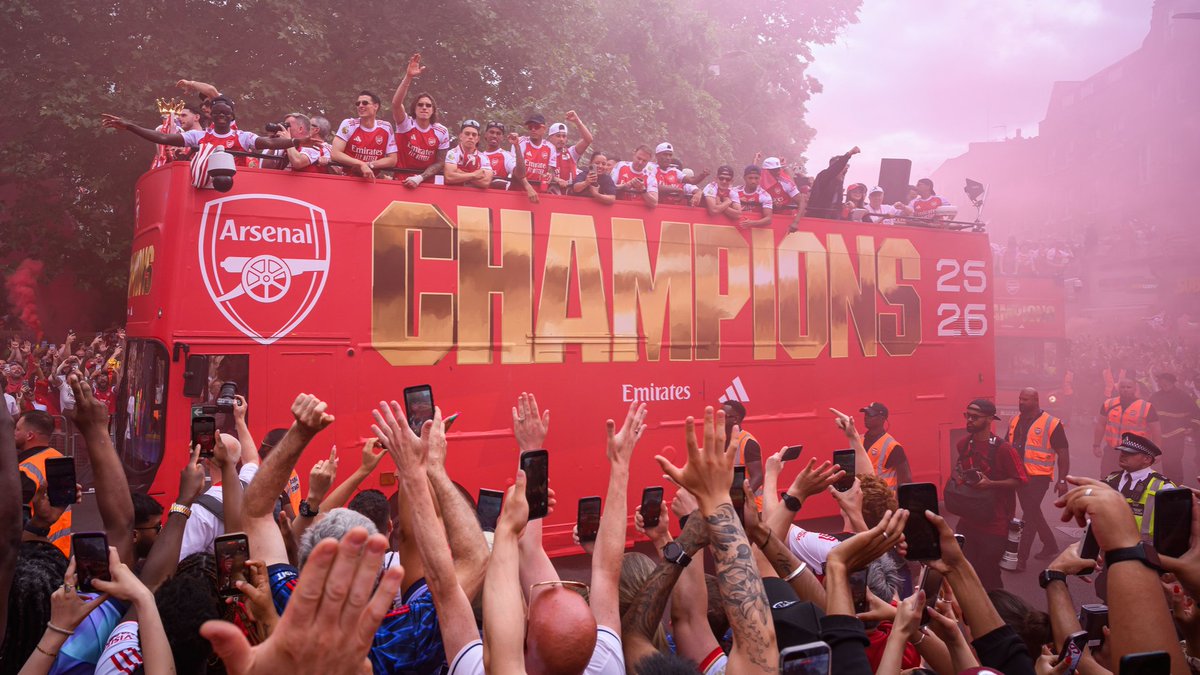
This is one of the most beautiful videos i have watched in YEARS! Lovely production.
There is no Arsenal fan/GUNNER that wouldn't feel touched or motivated by this video. Even haters would almost shed a tear.
LESSON: Never give up!