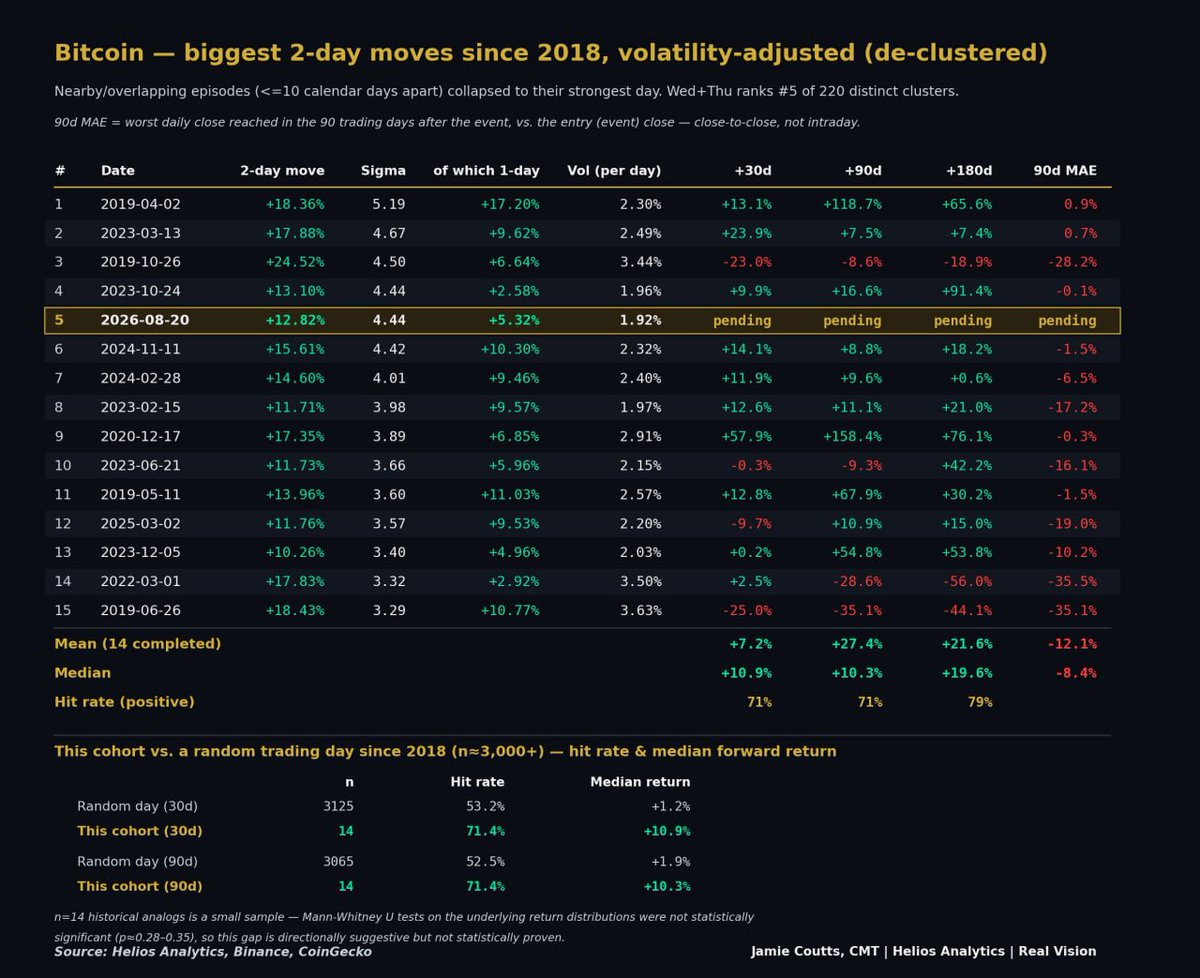
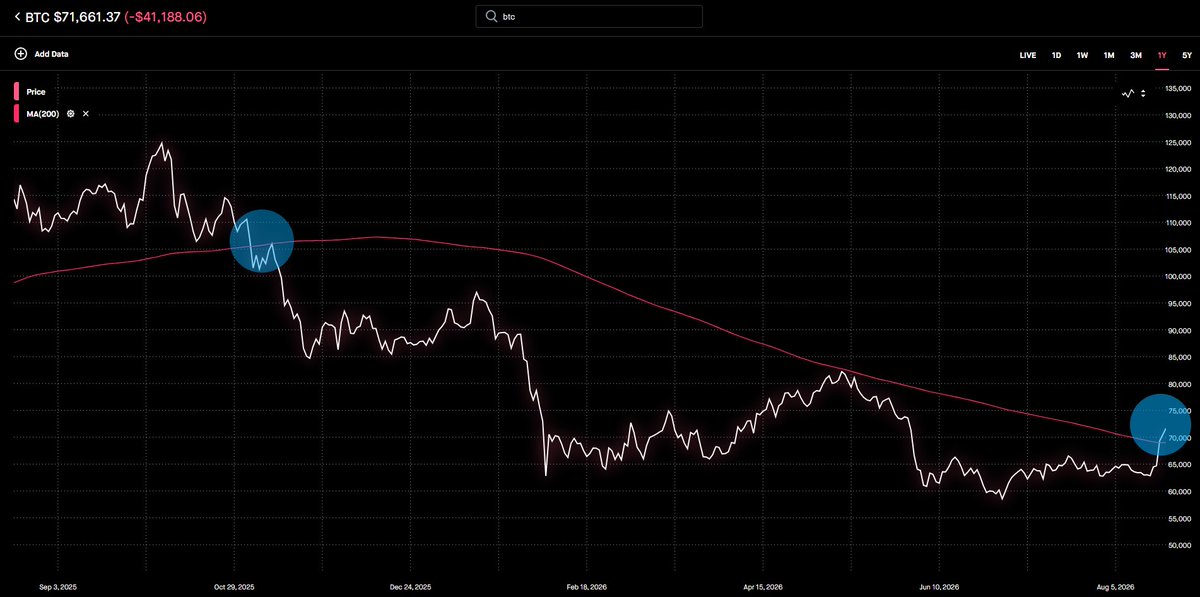
What is the medium- to long-term read on this week's $BTC rally? Firstly, anyone drawing a trend line will notice a break in the downtrend on the daily chart. But what does the magnitude of the move tell us? Once you volatility-adjust the move (Bitcoin has been in a structural volatility downtrend), this week's 2-day move is the fifth-largest since 2018 (a 4.4 sigma move).
It doesn't read as a normal countertrend rally. The 2018 & 2019 lows both had a volatility squeeze, followed by a big impulse move higher. Both were large in % terms but not as big as this one in volatility-adjusted terms.
So a cycle inflection, not a counter-trend bounce, and the forward statistics support that. Bitcoin has been higher >70% of the time 30/90/180 days after moves like this, compared to roughly a coin flip in a random study. Also, the median return is much higher than random. Fourteen prior instances is a small sample, so before the "n=" crowd start arking up, this is probabilistic tilt, not a certainty.
What makes the timing interesting is what's happening in the bond market. Long yields are creeping higher again after the Treasury's move this week.
Bitcoin's role as an early warning for a coming liquidity impulse is now firing. Since Q4 liquidity momentum had rolled over hard and was on the precipice of going negative leading into these 2 Treasury interventions. You simply can't have debt issuance exploding at the rate it is while the liquidity floor under it erodes. But nothing the Treasury has done changes the supply equation. They have affected the dollar and the curve, but it won't be enough.
That said, it doesn't mean Bitcoin will go vertical from here. There is a wall of overhead supply at the low $80k range it needs to work through. And while the liquidity backdrop is serious, maybe the Phony War
https://t.co/TueI8MDG7N
- will continue for a while longer. What's changed is that Bitcoin is starting to do its job again as the earliest tell for where liquidity must be heading because the market finally woke up to reality. And with each chapter of this modern fiat experiment, Bitcoin'sfunction as a non-sovereign hard asset becomes clearer to more and more people.
All signal no noise
Sec Bessent “Stablecoins reinforce USD supremacy”
Wall St is chasing parabolic charts in AI. They always buy high and sell low.
Wall St is not positioned for what’s coming next.
must watch 👇
In an unprecedented move, the US Treasury is buying back its own long term debt in order to stop the surge in yields
Calling it “liquidity support”
But there’s one big problem with this…
The government doesn’t run a surplus. So in order to buy back old debt, they have to borrow new debt
Since they can’t borrow long term debt (that would make the buyback useless because they would be selling the exact thing they are buying) they have to borrow with short term debt
What are the implications?
Anyone calling this QE doesn’t understand it. Zero net effect on liquidity in the financial system overall. The government is simply swapping long term debt for short term. Same total debt and number of dollars exist as before.
But the Treasury has blinked. Large treasury holders now know that if they need to get rid of a large volume of treasuries, they don’t need to worry about crashing the treasury market and losing value. The US will step in and buy what is necessary.
This is a dangerous game and is exactly what led to the collapse of the Mississippi Bubble by John Law 300 years ago.
It also means we are likely to see intervention from the Fed sooner rather than later. The Treasury can’t do this themselves forever because the treasury doesn’t print money.
Either the Fed steps in with real QE, or they deregulate the banks (eliminate the SLR) so banks can buy unlimited treasuries and do QE for them.
We’ll see.
What the government is doing now is the equivalent of holding a 30-year mortgage at a 3% interest rate and refinancing it into a 4% one-year adjustable-rate mortgage.
In other words, you are replacing longer-term, lower-cost debt with shorter-term, higher-cost debt.
Now apply that to trillions of US dollars.
That is effectively what the US Treasury is being forced to do as long-term yields surge.
Unfortunately, the Treasury is largely playing the hand it has been dealt.
The next phase of the US deficit spending crisis began today.
BREAKING: The US Treasury announces it will double the size long-term US government debt buybacks following the rapid surge in US Treasury yields.
Repurchases of $2 billion will now be increased to "at least" $4 billion, the US Treasury said.
The move is intended to provide "liquidity support" for bonds maturing in 10 to 30 years as total US debt nears $40 trillion.
There is the intervention we have been calling for.
💥THIS IS A **MASSIVE** SHIFT in how global financial plumbing will work, as this announcement means the @USTreasury--NOT the @federalreserve--controls whether tokenized eurodollars/euroyen/euroeuros, will be recognized as valid in the US. Bessent knows what he's doing & why.💡
⚡️Bitcoin is an attempt to create a promise with no promisor.
Almost every economic promise in history ultimately depends on someone remaining trustworthy.
A king guarantees the coin.
A bank guarantees the deposit.
A government guarantees the currency.
A company guarantees the bond.
A court guarantees the contract.
The weakness is always the same: the guarantor is mortal.
People die. Governments change. Institutions decay. Incentives reverse. Emergency arrives. The entity that promised yesterday discovers a reason to reinterpret the promise tomorrow.
Bitcoin tries to remove that point of betrayal.
The promise is very specific. It does not promise that one bitcoin will buy a house, a meal, or a particular number of dollars fifty years from now.
The promise is deeper:
The monetary rules governing your unit do not change merely because someone powerful wants them changed.
The issuance history remains auditable.
The ownership history remains verifiable.
The scarcity rule travels forward with the system.
And the people who originally created the arrangement are unnecessary to its continuation.
That last part is enormous.
Satoshi can disappear.
The original developers can die.
Today’s miners can disappear.
Today’s holders can disappear.
Today’s governments can disappear.
Yet the rule can continue being enforced by people who never met any of them.
That makes Bitcoin something close to an intergenerational economic covenant.
Imagine signing a contract with people who will be born a century after your death.
Normally impossible.
You cannot know them.
They cannot know you.
No shared government may exist.
No shared bank may exist.
Your language may barely survive.
Bitcoin’s answer is to make personal trust irrelevant to the continuation of the rule.
The future does not have to know who you were.
It only has to verify what happened.
That is the leap.
Human memory becomes protocol memory.
And now the sentence becomes heavier.
Civilizations have always struggled to make promises outlive the people who made them.
Constitutions attempt it.
Religions attempt it.
Property law attempts it.
Treaties attempt it.
Inheritance law attempts it.
Every one eventually encounters the same problem: living humans become interpreters of commitments made by dead humans.
Interpretation becomes power.
Power eventually finds exceptions.
Bitcoin takes one narrow category of human promise, monetary ownership and issuance, and tries to reduce the room for interpretation almost to zero.
That is why the 21 million ceiling matters far beyond the number.
It represents an attempt to tell people who do not yet exist:
You inherit the system, but you do not automatically inherit permission to dilute those who came before you.
That is historically strange.
The living have always possessed overwhelming power over the accumulated claims of the dead and the old.
Bitcoin tries to bind the living too.
A constitution for money whose authors cannot amend it from the grave, whose current rulers cannot casually amend it from the throne, and whose future rulers inherit constraint alongside power.
So the deepest thing Bitcoin is trying to accomplish has almost nothing to do with speed, payments, ETFs, or even price.
It is trying to answer an ancient human question:
Can a promise remain intact after everyone who originally believed in it is gone?
Bitcoin’s answer is:
Do not preserve the promise by preserving the people.
Preserve the rule.
And that is why Satoshi’s disappearance carries such mythic weight.
The creator vanished.
The creation kept remembering.
Bitcoin therefore contains one of the strangest propositions civilization has ever attempted:
Build the promise so well that eventually nobody has to remember who promised it.
⚡️A huge percentage of talented people lose because they are too embarrassed to be seen wanting something.
They want the reward without the exposure.
They want the upside without the cringe risk.
They want to be undeniable while still being approved by people who have never built anything.
That kills momentum.
The people who win usually have some abnormal relationship with embarrassment.
They can post more. Ask more. Sell more. Pitch more. Repeat more. Be misunderstood more. Take public swings. Survive mockery.
Keep moving after people laugh.
That looks “shameless” to people still trapped inside social permission.
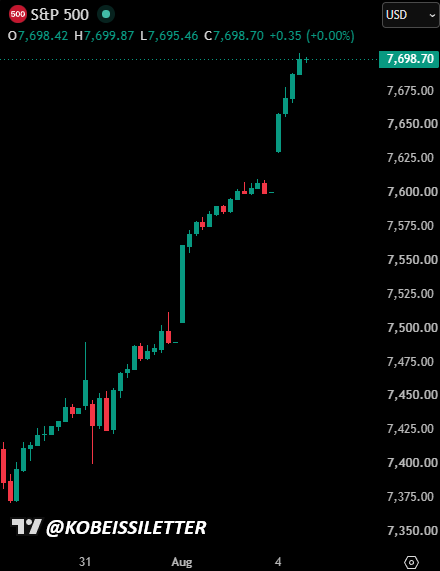
BREAKING: The S&P 500 surges above 7,700 for the first time in history.
This pushes the total market cap of the S&P 500 above $70 trillion for the first time ever.
⚡️The real mistake is treating technology as stronger than incentives.
Technology never exists in isolation.
It exists inside systems that fight to preserve themselves.
Bitcoin is no longer a research project.
It is a monetary network securing trillions of dollars in value, embedded in sovereign policy, public companies, ETFs, banks, payment infrastructure, and global capital markets.
That creates an evolutionary force far larger than any individual cryptographic algorithm.
Quantum eventually breaks today’s cryptography.
That part is almost irrelevant.
Today’s cryptography was never supposed to be eternal.
Every cryptographic standard in history has eventually been replaced.
DES disappeared.
SHA-1 disappeared.
RSA has been hardened repeatedly.
TLS evolved.
The internet did not die because its cryptography changed.
It evolved because the incentive to evolve exceeded the cost of staying still.
Bitcoin inherits the same dynamic.
The deeper misunderstanding is believing mathematics alone protects Bitcoin.
Economics protects Bitcoin.
The protocol survives because the people securing it have overwhelming financial incentive to migrate before failure.
Miners.
Exchanges.
Custodians.
ETFs.
Nation-states.
Treasury companies.
Developers.
Every one of them becomes poorer if Bitcoin dies.
Every one of them becomes richer if Bitcoin adapts.
That incentive field is the strongest defensive mechanism the network possesses.
Quantum therefore faces an adaptive organism, not frozen software.
The narrative also reveals something about human psychology.
People consistently overestimate discontinuity and underestimate adaptation.
Civilizations almost never collapse because one invention suddenly appears.
Civilizations reorganize around inventions.
Steam reorganized labor.
Electricity reorganized industry.
The internet reorganized communication.
AI is reorganizing cognition.
Quantum reorganizes computation.
The systems built on those foundations mutate in response.
Bitcoin will be one of them.
The deeper irony is that the same people claiming AI will recursively improve itself somehow assume Bitcoin developers, cryptographers, hardware manufacturers, nation-states, and every institution securing the network simply stop thinking while quantum advances.
That assumption violates every historical pattern.
The strongest systems become the fastest adapters because they have the most to lose.
The real existential threat to Bitcoin has never been quantum.
The real existential threat would be a loss of adaptive capacity.
A protocol that stopped evolving.
A community that became ideologically frozen.
An ecosystem that refused to upgrade.
Bitcoin has repeatedly demonstrated the opposite.
Every crisis has increased its institutional depth.
Every attack has expanded its engineering effort.
Every failure has produced stronger infrastructure.
Quantum is another evolutionary pressure.
The network either adapts or disappears.
The incentive structure overwhelmingly favors adaptation.
The fear comes from imagining a static protocol.
Reality contains a living monetary organism with millions of participants defending their own balance sheets.
That is a much harder target than a cryptographic paper.
The market keeps asking whether quantum can break Bitcoin.
The better question is whether quantum can outrun the combined adaptive intelligence of every actor whose wealth depends on Bitcoin continuing to exist.
That is a far higher bar than most people appreciate.
James Clear on taking the first step:
“Many situations in life are similar to going on a hike: the view changes once you start walking. You don't need all the answers right now. New paths will reveal themselves if you have the courage to get started.”
⚡️Bitcoin exploits a weakness in human cognition:
People overweight visible price and underweight invisible persistence.
A monetary network compounds through survival.
Every year without catastrophic failure adds credibility. Every attack endured becomes part of the security record. Every jurisdiction that fails to destroy it narrows the imaginable path to zero. Every new holder enters a network with more infrastructure and less existential uncertainty than the previous holder encountered.
Time itself becomes evidence.
This is also why most crypto assets cannot borrow Bitcoin’s holding doctrine. Their survival often depends on teams, emissions, narratives, incentives, or applications that can lose relevance. Time may expose their weakness rather than strengthen them.
Bitcoin’s core properties become more credible through continued operation:
Fixed issuance.
Permissionless possession.
Neutral settlement.
Distributed security.
Global liquidity.
Resistance to discretionary control.
The real bet is that those properties continue acquiring monetary value as the competing system creates more debt, more surveillance, more capital restrictions, and more political discretion over money.
In reality, the holder is not merely waiting for price appreciation.
The holder is taking the other side of civilization’s belief that monetary institutions can expand claims forever without increasing demand for an exit.
That is the true asymmetry.
If the existing system remains disciplined, Bitcoin’s monetary premium grows more slowly.
If the existing system continues producing fiscal dominance, debasement, coercive finance, and institutional distrust, Bitcoin’s purpose becomes progressively harder to dismiss.
The system attacking the asset keeps manufacturing its use case.
That is why boredom matters so much. Boredom arrives after spectacle disappears but before structural recognition becomes universal. The market looks dead precisely because the next layer of demand has not yet been forced to understand the problem.
The holder is paid for inhabiting that interval.
Bitcoin monetizes the distance between when a structure becomes true and when society becomes capable of admitting it.
Trading tries to predict every movement inside that distance.
Holding owns the distance itself.
⚡️In fiat systems, capital is fictionally priced.
Interest rates are manipulated.
Risk is hidden behind derivatives. Bailouts reward failure. Value is not earned, it is engineered. Fiat-based capital is floating on lies.
Bitcoin does not allow this.
It enforces thermodynamic truth.
Only real energy, real time, and real belief can produce value. Every sat in existence was mined with proof of work. Every transaction is settled with finality. Every supply schedule is locked by math, not men.
Capital that cannot lie becomes a benchmark for everything that does.