In “The Kishinev Massacre and the Jewish Question” (1903), Karl Kautsky writes about the class character of Western European anti-Semitism, defining its social basis as the petty bourgeoisie in decline and a part of the intelligentsia. (1/18)
The fixation of some Maoists toward defending their claimed ideology solely by referring to this or that current movement abroad speaks to a recent point made by @marxleninmao_ regarding the “economy of thought.”
Those that cling to the Anti-Maoist dogma of the “Universality” of People’s War appear to be indulging in a certain tactical fetishism, advocating unilaterally for “hard” tactics
https://t.co/gnhnc8WCPY
The quotations that make up the thread were introduced *in the first place* by Gonzaloites, who cited them as irrefutable proof of their position, relying on the fact that the quotations were in Chinese and inaccessible to English readers.
Upon re-reading the comprehensive thread by @marxleninmao_ that debunks the universality of PW as a strategy & tactics, it’s clear that the Gonzaloites are our modern-day “virtuosi of philistinism.” A 🧵
To that end, this is a really helpful study guide of the Marxist classics. These are texts that every comrade, every revolutionary, should know in all their details:
https://t.co/cBsrqsIZrF
Like our current identitarians, the Bund lived for petty squabbling. While our last thread dealt with a matter of principle (Marxist and anti-Marxist conceptions of anti-Semitism), the 1903 Bund-Iskra debate also provides several examples of quarrels of a lower sort.
The 1903 polemic on the nature of anti-Semitism, involving the Ekaterinoslav Committee of the RSDLP, the Foreign Committee of the Bund, and Lenin (and Kautsky via Lenin), is instructive for revolutionary Marxists today when scrapping verbally with our contemporary identitarians.
As this concludes, the present task of communists is to firmly grasp the basic principles of MLM. Bury the petty-bourgeois corpse that traded on empty slogans and catechism-like devotion to abstractions torn from their historic context in Peru or, infinitely more important, China
Re. the recent trend of “confessions” from ex-Tribune members: all the usual preoccupations (identity qualifications and interpersonal frictions) and some more unusual ones (physical violence, “war communism”). All in all, a less-than-edifying literature.
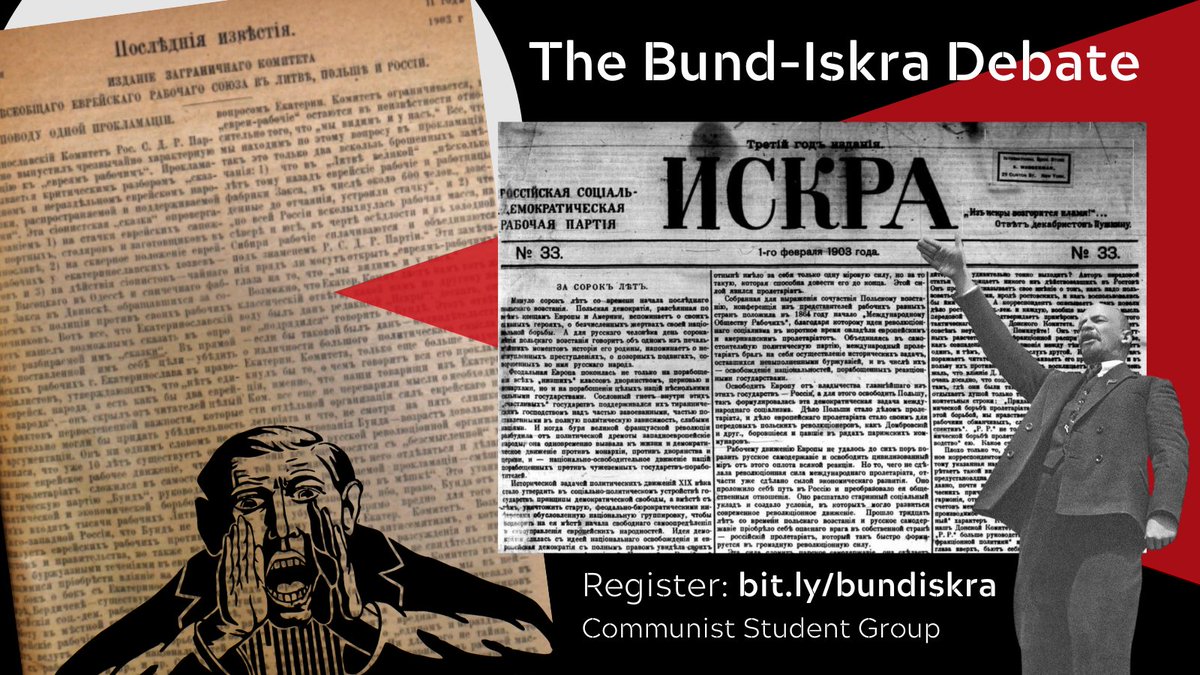
Join us for an IRL study circle on The Bund-Iskra Debate on the National Question and Party organization, taking place over two Sundays this month:
We will examine key texts from Jan/Feb 1903, including new translations of key texts by Lenin & material not available in English.
When working people learn that capitalism is not inevitable – when they can see a clear way to end their daily struggles – they will abandon reactionary prejudices against their fellow workers.
In pre-revolutionary Russia, there was an additional particularity in that the tsarist regime encouraged anti-Semitism among the masses in order to prevent popular unity against the autocracy:
Contrast Kautsky's 1903 analysis with that of the petty-bourgeois dupe Bakunin, so mystified by the historical development of society as to *buy into* the anti-Semitic conspiratorialism characteristic of the most reactionary section of his class.
In “The Kishinev Massacre and the Jewish Question” (1903), Karl Kautsky writes about the class character of Western European anti-Semitism, defining its social basis as the petty bourgeoisie in decline and a part of the intelligentsia. (1/18)
"But the stronger the socialist movement, the safer all Jewry is from the misguided rage of despairing masses of people being poured out into the ghetto instead of being turned against tsarism, the stronghold of all barbarism.” (17/18)