BREAKING: @vyatsenko is stepping down as CTO of @Revolut after building the company from literally line one of code!
Vlad wasn't just the CTO.
He was Revolut's first ever employee, joining a full year before @NStoronsky launched the company in 2015.
Before Revolut, he spent a decade building financial systems at tier-one banks like UBS and Deutsche Bank.
Then he decided to build the bank himself.
What he built is INSANE:
🚀 The core tech platform behind every single Revolut product
🚀 Infrastructure that scaled from thousands of users to 70m+
🚀 A banking app now live across 160+ countries and regions
🚀 The backbone of a company valued at $75bn
And the results speak for themselves:
🚀 $6bn revenue in 2025 (+46% YoY)
🚀 $2.3bn profit before tax (+57%)
🚀 Full UK banking license secured in March 2026
He's not going far.
Vlad moves to a non-executive director role on Revolut's board, with @DonatoLucia (current head of technology) stepping up as VP of Technology.
In his own words, he feels content, having watched Revolut grow from an ambitious young startup into a mature, highly impactful global company.
Building a $75bn fintech from the very first commit. What a run.
Amazing stuff, Vlad! 👏
How do you land a job in 2026?
AI skills + soft skills + a network that compounds
The Work in Fintech AI Summit is where all three come together.
Fri 28th Aug | NatWest Conference Centre, London
Hear from CEOs, founders and industry leaders at:
@OpenAI / @NatWestBusiness / @payabl_eu / @ipushpull / @AllicaBank / Atom bank / @MarketAxess / PrimaryBid / @SpriveApp / @10XBanking... and more to come
On the day you'll get:
-Workshops and panels led by fintech and AI leaders
-Networking with people who can actually hire you
-An AI hackathon (no coding required)
-Dragons' Den-style pitching stage
Every event we've run has led to young people landing jobs, internships and work experience placements directly from conversations with on the day.
Tickets are application only https://t.co/VxupL8MdFy
Approvals will go out in July and hackathon teams confirmed in early August.
"I wouldn't want to be the CFO of OpenAI right now."
@tether co-founder and early @PayPal investor @WilliamEQuigley@OpenAI and @AnthropicAI are racing to IPO near $1T each.
Still no proven path to profit.
When @amazon IPO'd, it lost money for years too.
But investors could see the whole map.
Everyone could see e-commerce go 10% → 100%.
AI has no map like that yet.
Would you buy the IPO?
Full Episode: https://t.co/GfRCFaPmRQ
Why investing in AI may be one of the riskiest bets in tech today
In our recent conversation with @WilliamEQuigley , co-founder of @tether and early @PayPal investor, he shared a perspective on AI that most people aren't talking about.
Billions of dollars are pouring into AI.
Some companies are already being valued in the hundreds of billions, with trillion-dollar valuations being discussed.
Many investors compare AI to the early internet.
But William argues there's a crucial difference.
Internet companies were built on top of infrastructure that already existed.
Governments spent decades building communication networks.
Telecom companies invested billions in connectivity.
Platforms like Google and Apple gave startups instant access to billions of users.
As a founder, you could build a product relatively cheaply and focus your resources on acquiring customers.
The infrastructure was already there.
AI is different.
Today, a massive amount of capital is being spent building the infrastructure itself.
- Data centers.
- GPUs.
- Power generation.
- Compute capacity.
Before anyone knows who the long-term winners will be, hundreds of billions of dollars must be invested just to build the foundation.
That's what makes AI both exciting and risky.
As William put it, the best entrepreneurs usually try to "ride the coattails" of infrastructure someone else has already paid to build.
The opportunity is enormous.
But so is the uncertainty.
Watch the full conversation. Link Below
BREAKING:
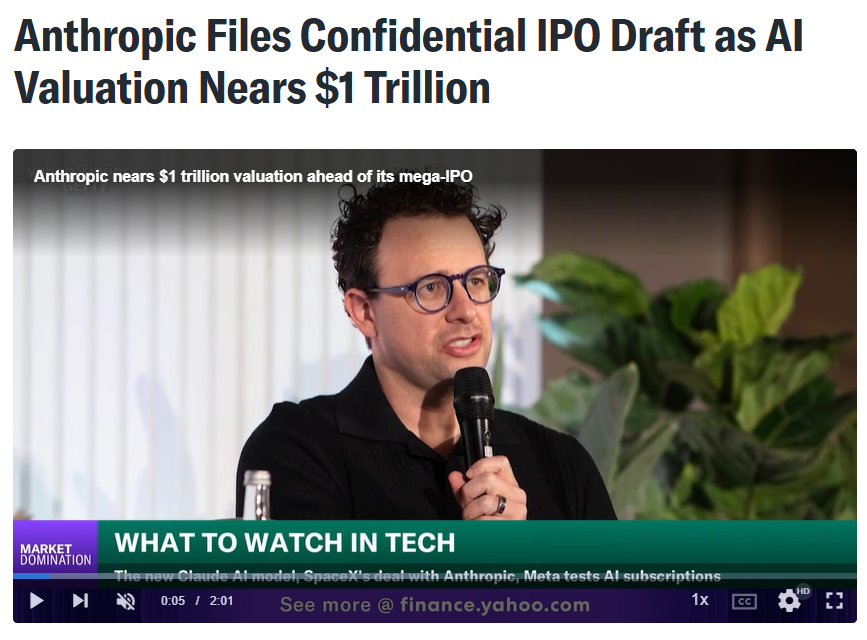
@AnthropicAI , the maker of @claudeai, has just filed to go public in what could be a WHOPPING $1 TRILLION IPO!
It filed a confidential draft S-1 with the SEC on Monday, setting up one of the largest tech listings in history.
And this comes just days after a monster raise:
🚀 $65bn Series H
🚀 $965bn post-money valuation
🚀 Now the world's most valuable AI startup, past OpenAI's
If it debuts above $1tn it would be the second or third largest IPO ever, behind only SpaceX and Saudi Aramco.
LETS GO.
...except not everyone is sold on the number.
On our latest Work in Fintech pod, @Matthew_Cheung_ sat down with @WilliamEQuigley, @tether co-founder and one of @PayPal first institutional investors, and his read on these AI valuations is blunt:
🚀 Every previous tech wave (internet, Web2, mobile, crypto) ran on near-zero marginal cost. AI is the opposite. In his words, the variable costs sit "hundreds of percent above the revenue being generated."
🚀 He wouldn't want to be the CFO of one of these companies, going public "without any proven ability to remain solvent... other than continually raising money."
🚀 And the bluntest line of all: "I don't do stuff in AI. I don't understand how I can make money in that space, which is why I don't."
His point isn't that AI won't change the world. It's that a trillion-dollar price tag on a business still burning cash on every single query is a very different bet from Amazon in 1999.
Full episode out now:
YouTube:
https://t.co/GfRCFaOP2i
Spotify:
https://t.co/vJxsdDlWoO
Apple Podcast:
https://t.co/nlk6NkgCVK
He backed PayPal and built https://t.co/DEhPsBoxOV but will not invest in AI
Today's guest is @WilliamEQuigley, one of the few venture investors who has operated at the center of multiple technological inflection points.
William was one of the first institutional investors in @PayPal, co-founded @tether, the world's first and largest fiat-backed stablecoin, and founded WAX, one of the most active NFT blockchains globally.
He saw the consumer internet emerge, watched payments transform, helped shape crypto infrastructure, and now sits at the edge of the AI wave.
This is our third conversation with William, and a lot has changed since we last spoke 18 months ago.
This time we go beyond the cycles and into the structural future: who owns the rails, how capital actually flows, and where the durable infrastructure is forming beneath the hype.
In the full episode, we cover:
- How AI is the opposite of the early internet, and why that should worry you
- Why the economics of AI companies are upside down
- Why he backed PayPal and built Tether but won't invest in AI
- How VCs ignoring chips for 25 years accidentally built @nvidia
- Why @OpenAI and @AnthropicAI could struggle as public companies
- The trillion-dollar currency tax tokenised money could erase
- Why NFTs aren't dead, just rebranded
- The one trait William looks for in every founder
If you are trying to read the AI cycle clearly, this is the conversation to watch.
Watch the full conversation. Link below.
"Within a few years, agentic activity will be the primary activity on crypto networks by a huge margin."
That's @XenBH Director of Growth at @base on Work in Fintech Podcast and the data backs him up.
In traditional finance, agents are talked about.
In crypto, they're already transacting.
Base is one of the leading network for agentic activity, running on X402, an open payment standard @coinbase built, now adopted across the industry.
Agents are paying each other on-chain for compute, data, models, and skills.
They're also issuing tokens, and the capital raised is funding their next move.
Crypto was sold as money for the internet.
It's turning out to be money for the machines on it.
Full episode on Work in Fintech, link👇
Most people aren't built to be founders.
And the ones who are? They're a bit broken.
@XenBH Director of Growth at @base put it bluntly on Work in Fintech:
"Founders are not normal people. They need something driving them. Something deep."
Here's what most people get wrong about founders:
They think it's about:
→ The idea
→ The market
→ The timing
→ The funding
It's none of that.
It's about one thing:
A drive so deep, so personal, so unshakeable, that quitting isn't even an option.
Because being a founder is brutal.
You get knocked down.
You get back up.
You get knocked down again.
You get back up.
And you do that on a loop. For years.
Most people break.
The ones who don't?
They had something to prove from day one.
Not the kind of thing you read in a book.
Not the kind of thing you learn at an MBA.
Not the kind of thing you wake up one morning and decide.
It's wired in.
So if you're sitting there wondering whether you should start that company:
Ask "do I have the drive that nothing else can satisfy?"
BREAKING: @tether. has just made a strategic investment in @UseLemfi to power stablecoin remittances across Africa and Asia!
The London-headquartered fintech, founded by Ridwan Olalere in 2020, has built the leading cross-border payments platform connecting diaspora communities in the UK, US, Canada, and Europe with recipients in Africa and Asia.
LemFi's track record is INSANE:
🚀 500,000+ active users across 30 countries
🚀 Previously raised $33m in 2023 to scale the platform
🚀 Now integrating USD₮ as a settlement layer across the entire product suite
The play here is massive, LemFi is bypassing SWIFT on key corridors and using USDT to move money in seconds, not days, at a fraction of the cost.
Tether CEO @paoloardoino said it bluntly: this is about how money actually moves across borders - speed, cost, and transparency for the 585 million people globally using USD.
This is what the stablecoin endgame actually looks like. Not speculation. Distribution.
LETS GO, amazing news for Ridwan, the LemFi team, and the millions of migrants about to get faster, cheaper remittances. 👏
P.S. We sat down with @WilliamEQuigley, co-founder of Tether, on the Work in Fintech podcast. Episode drops this coming week. Stay tuned.
BREAKING: https://t.co/eyj7gpDOGO has just filed CONFIDENTIALLY with the SEC for a US IPO!
The company, founded by @OneMorePeter, @niccary, and @BenjaminReeves. in 2011 out of a flat in York, UK, is one of the OLDEST names in crypto.
It started life as the first ever Bitcoin block explorer.
Some INSANE stats on the business today:
🚀 95m+ wallets created
🚀 43m+ verified users
🚀 1,100+ employees
🚀 Profitable on an adjusted basis for 3 years straight
🚀 Last valued at $14bn (Series D, March 2022)
The Dallas-based firm submitted a draft Form S-1 on May 21. Share count and price range haven't been set yet.
When the S-1 goes public, the numbers will be worth the wait.
LETS GO
Crazy stuff. Amazing news, congrats Peter Smith and the team!
P.S. We will be hosting Nicolas Cary, co-founder of https://t.co/eyj7gpDOGO, on the podcast in the coming months. Stay tuned and follow along!
2 opportunities worth building in the AI era:
In our recent conversation with @XenBH, Director of Growth at @base , we asked where he sees the biggest opportunities.
His Answer:
1. Agentic-first infrastructure for organisations
Not bolting agents onto legacy systems.
Rebuilding workflows from a blank page so agents can run them end to end, talk to each other, and replace most of what a meeting accomplishes today.
"The agents can go have a meeting on your behalf, tell you what to do. The agents can do most of the things you are doing."
Most organisations aren't ready. Fragmented data. Systems that don't talk to each other. Compliance walls.
Whoever builds the transition layer that gets them there owns the rails for the next decade.
2. Better interfaces
Right now, AI power users live in terminals and complex workflows.
That’s not scalable.
The next wave of winners will make AI usable for everyday operators:
- relationship managers
- analysts
- compliance teams
- founders
- operators
The interface layer is still massively underbuilt.
The best founders in history share one trait.
And it's not vision.
@XenBH, Director of Growth at @base, said it on the podcast:
"The types of people who become these founders always have this character trait of drive. Needing to be the best. Needing to win. Needing to make a dent in the universe."
That's the part most people miss.
It's not the idea. It's not the timing. It's not even the talent.
It's the relentless need to prove something and build something that matters.
Steve Jobs had it. Musk has it. Bezos has it.
A drive so strong it bends the world around it.