#WorldEBHCDay raises awareness of the need for better evidence to inform healthcare policy, practice & decision-making to improve health outcomes globally.
The #WorldEBHCDay 2026 wrap-up news story is here!
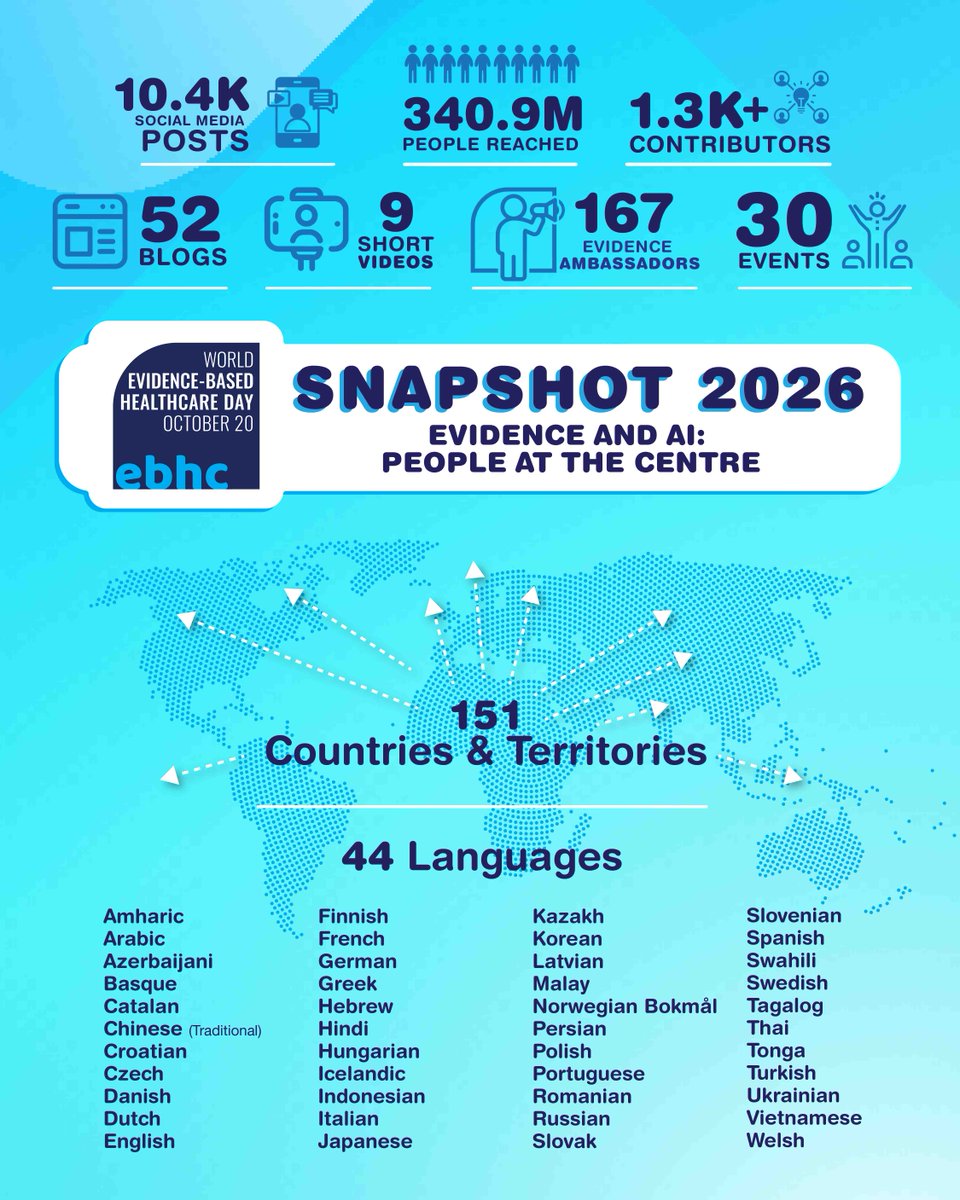
Explore how 167 individuals and organisations from 151 countries & territories, across 44 languages, came together to champion people-centred AI and evidence.
Thank you to everyone who contributed! 👏
🔗 https://t.co/Mqg6wGySk5
As conversations on AI and evidence continue, thank you to our global community for sharing your insights and making #WorldEBHCDay 2026 a success!
👉Explore the contributions: https://t.co/qR2wFBTQVP
📹Watch the wrap-up video: https://t.co/f6YLbTHQQB
@WorldEBHCDay 🌍 Celebrating #WorldEBHCDay2026 as an Evidence Ambassador!
Proud to share my contribution: “Making human/AI systems an object of evidence.”
AI alone isn't enough to evaluate. Human–AI interactions matter.
🔗 https://t.co/YpkTvRNqcR
#EvidenceAndAI#JBI30
On @WorldEBHCDay 2026, @KIHTech brought experts to discuss the future of AI in healthcare.
Featuring Prof. Dr. G. A. Rama Raju, the webinar highlighted that AI delivers its greatest value when guided by evidence, clinical expertise, ethics, and patient-centric care.
#KIHT #WorldEvidenceBasedHealthcareDay #EvidenceBasedHealthcare #AI #DigitalHealth #HealthcareInnovation #PatientCentredCare #JBl
Read #WorldEBHCDay blog by Prof Lisa Whitehead @EdithCowanUni, et al. As AI transforms healthcare, equity-focused governance, transparent evaluation & systematic evidence synthesis are essential to prevent bias, ensure fairness & reduce health disparities. https://t.co/5p1CJcj1B1
Visit our #WorldEBHCDay photo gallery & share photos of your celebrations! Together, let’s highlight the importance of keeping people at the centre of AI in healthcare. See how people around the world are celebrating in 2026: https://t.co/2LdUUApsyt
Voices from around the world have contributed insights and experiences to #WorldEBHCDay 2026!
Explore blogs sharing diverse perspectives on how AI can strengthen trust, equity and rigour while keeping people at the centre.
👉 https://t.co/HPCfdXG4x1
Thank you to our global #EvidenceAmbassadors for sharing valuable insights and amplifying the #WorldEBHCDay 2026 theme, ‘Evidence and AI: People at the Centre’. Explore their contributions and share what inspires you! 👏
👉 https://t.co/G6LKoYN8lA
🌍 #WorldEBHCDay thanks Ovid for its generous support as a sponsor of the 2026 campaign. Ovid is a leading medical research platform that brings together full-text journals, eBooks, databases & workflow tools in one integrated solution: https://t.co/OBIzJyhtgL @ovid_wkhealth
World EBHC Day extends its gratitude to the dedicated #WorldEBHCDay Steering Committee whose time & commitment have been instrumental in the conceptualisation, implementation & success of the 2026 campaign. Learn more 👇
https://t.co/oS7afR8BYD
🌍 #WorldEBHCDay thanks our peer reviewers for the time, expertise & care they bring to reviewing our 2026 campaign blogs. Your dedication helps ensure the quality of every blog we publish, and we’re grateful for your contribution! Explore the blogs: https://t.co/HPCfdXGCmz
#WorldEBHCDay thanks the organising partners for their work & dedication in bringing #WorldEBHCDay 2026 to you.
Learn more about our partners, here 👉https://t.co/pqkFblloL1
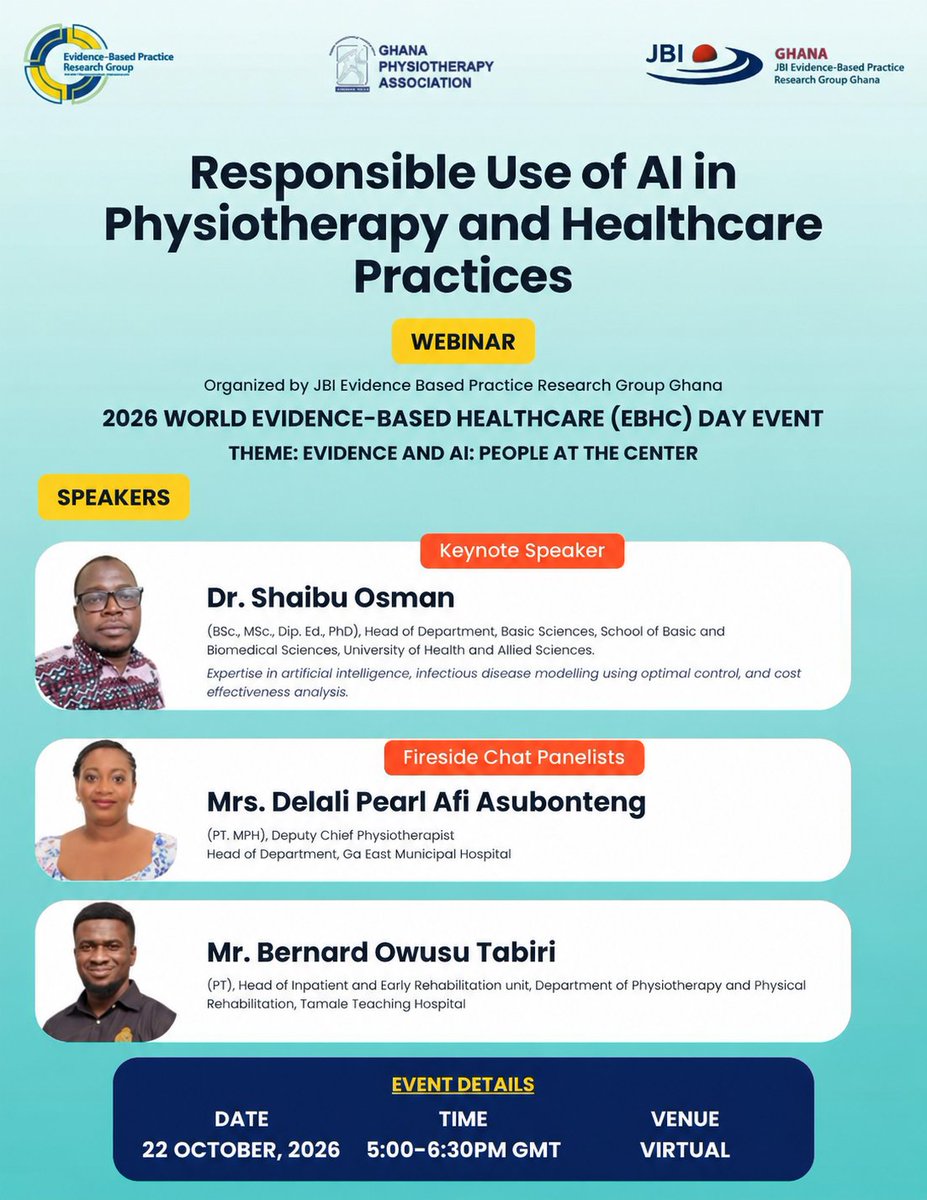
AI in healthcare: Learning from clinicians in Ghana 🇬🇭
How is AI shaping everyday clinical practice, and what does responsible use look like in African healthcare settings?
A @WorldEBHCDay blog shares the experiences of five physiotherapists practising in Ghana. Their accounts describe using AI to explore clinical possibilities, prepare patient information and support documentation, while raising concerns about inaccurate outputs, unreliable references, confidentiality and overreliance.
For #AENmembers, these reflections highlight the importance of checking information, understanding local contexts and developing the skills to question AI-generated responses. They also show how AI can influence patients’ expectations and the trust underpinning clinical conversations.
The authors call for practical training and locally relevant guidance, with clinicians remaining accountable for decisions made with AI support.
As Africa’s evidence community explores these tools, how can we support their responsible use while keeping people, reliable evidence and professional judgement at the centre?
🔗Read more: https://t.co/IE5cSndAeI
#AfricaLovesEvidence #EvidenceUse #ResponsibleAI #WorldEBHCDay
Het is World Evidence-Based Healthcare Day @WorldEBHCDay. Op deze dag wordt aandacht gevraagd voor het belang van 'evidence-based' onderzoek in de gezondheidszorg en - mede dankzij @Cochrane_FA - doet eerste hulp er ook echt toe in dit veld! #EHBO#EBHC@RodeKruis
On #WorldEBHCDay, we celebrate the power of research in healthcare decisions. ASHT is committed to supporting researchers, academics, clinicians and all who drive better care and outcomes worldwide. 🌍📚
@WorldEBHCDay@JBIEBHC
For #WorldEBHCDay, we at JBI share an editorial on AI’s benefits and pitfalls in publishing, emphasising trust and human oversight.
📸 Meet the team behind it (L–R): Tara Crandon, Mara Lambert, Melanie Dankel and Hien Ho.
https://t.co/4tphaX9wak