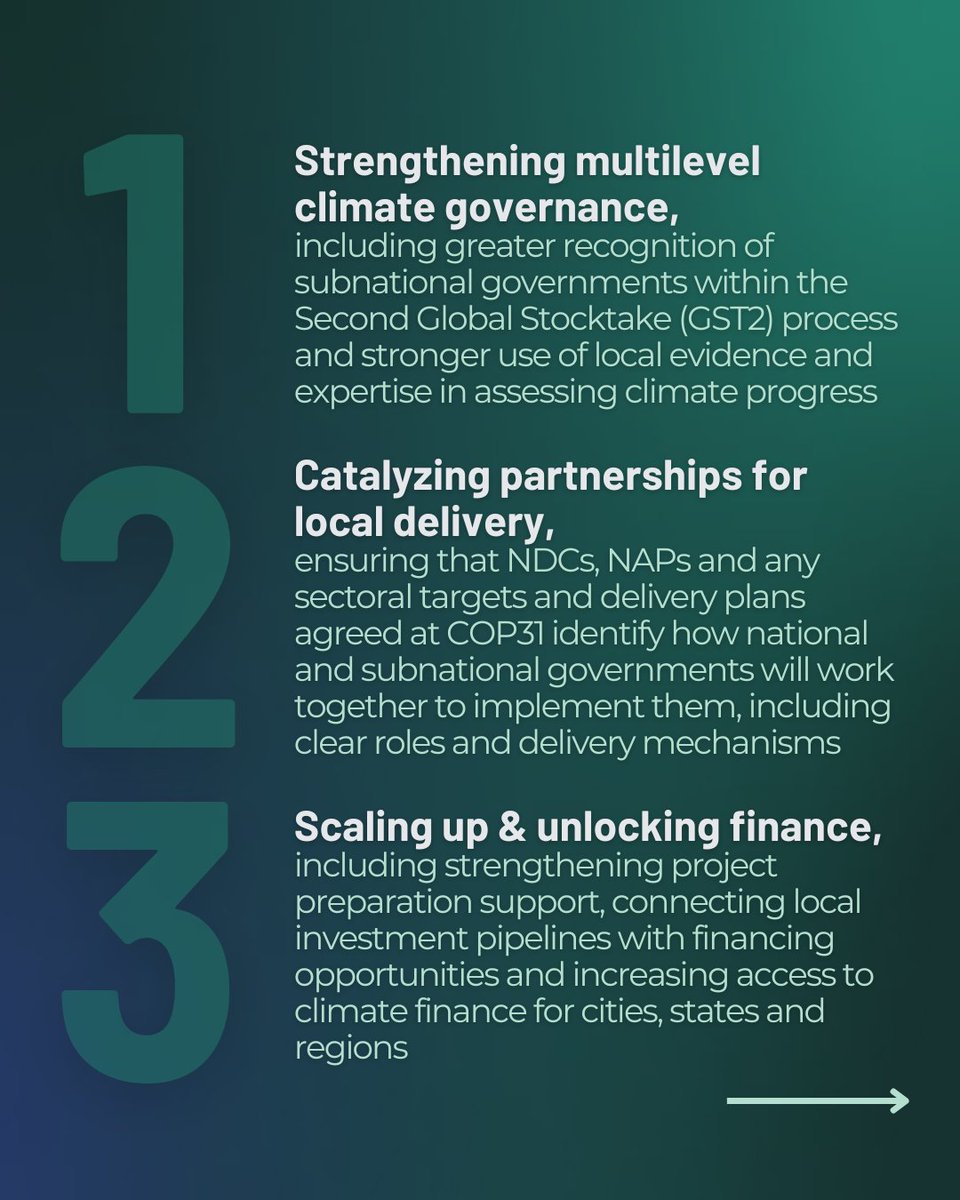
Increasingly, the challenge for climate action is not a lack of solutions, technologies or even available finance, but the gap between national ambition and local delivery.
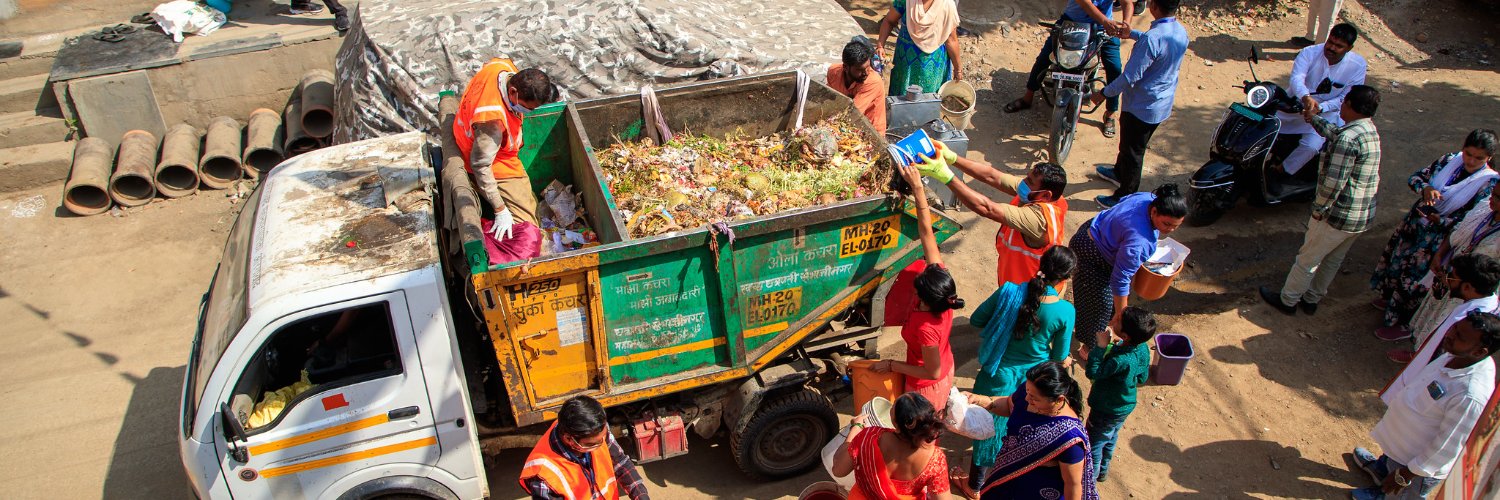
Cities, states and regions are where many climate actions are implemented, where infrastructure decisions are made and where people experience both the impacts of climate change and the solutions that make places healthier and more resilient.
Rogier van den Berg, Global Director, @WRIRossCities shares the latest developments for cities from COP31.
Dive deeper: https://t.co/5HgocKz3rx
While #cities, states & regions implement many climate solutions, they remain underrepresented in climate decision-making processes. This week at #COP31 in Antalya, 🇹🇷, #CHAMPclimate is changing that.
“Cities & regions are where climate action becomes real. The CHAMP COP31 Statement reflects a growing recognition that national climate ambition can only succeed when all levels of government are involved,” 💬 Chair of the CHAMP Subnational Advisory Council & former Mayor of Paris @Anne_Hidalgo.
Read more ➡️ https://t.co/Dar6fEPCtD
Yes, the Paris Agreement still matters.
The Paris Agreement remains central to global climate cooperation, but understanding what it can and cannot deliver will be key to advancing climate action in a changing geopolitical landscape.
Read WRI expert Nathan Cogswell's strong defense of the Paris Agreement and the UNFCCC👉 https://t.co/4na0sYeIyP
While acknowledging their real limitations, he surfaces three areas where the Paris Agreement can add the most value in the decade ahead:
1️⃣Provide a central global political platform for climate action
2️⃣Provide a vision for the future of climate action and support through collective ambitions
3️⃣Shape country-level implementation and spotlight national and collective climate progress
TAFFtastic (adj.): When a COP delivers real progress on the Transition Away From Fossil Fuels🌍
Brazil’s COP30 presidency formally presented the global Roadmap for Transitioning Away from Fossil Fuels to the UN Secretary-General and the UN Climate Change Secretariat. Bringing together the work advanced since Belém last year, the Roadmap introduces a diagnostic framework, the Belém Readiness Index and a set of actions through 2033 to enable governments to accelerate implementation according to their country needs.
Read the full statement from Nick Robins, Senior Director, Finance and Private Sector, World Resources Institute: https://t.co/bLtMlDox1r
COP31 in Antalya, Turkey aims to accelerate the shift to electrification, urging countries to adopt a pledge to supply 35% of global final energy consumption with electricity by 2035.
But how quickly the world moves toward electric products hinges on a key question: Will they actually lower rising energy bills?
Clem Perry, Global Lead, @WRIEnergy tells us what the next steps are.
Go deeper into how electrification can lower energy bills, if done right: https://t.co/MTCS00k1m7
Visit WRI's COP31 Resource Hub for all the latest updates: https://t.co/eSoodcPYyR
💰🏡Households need affordable heating, cooling, cooking and mobility.
Industry needs competitive, reliable power to invest, create jobs and replace fossil fuels. Governments need energy systems that support growth, expand access and strengthen energy security while delivering on climate commitments.
Dramatic falls in solar, wind and battery costs have created an extraordinary opportunity to meet those needs while also reducing emissions and exposure to volatile fossil-fuel prices. Yet an awkward question persists: If renewables are so cheap, why is electricity still expensive in so many places?
The answer is that cheaper technology is just one piece of the puzzle. Countries will need to build, operate, finance and price their electricity systems so that lower costs translate into affordable energy bills for people. If upfront costs put electric products out of reach — or promised savings fail to materialize — political ambition will struggle to sustain public backing, putting the entire shift to electrification in jeopardy.
#COP31 aims to accelerate the shift to electrification, urging countries to adopt a pledge to supply 35% of global final energy consumption with electricity by 2035. But how quickly the world moves toward electric products hinges on a key question: Will they actually lower rising energy bills?
5 priorities can help governments, regulators and industry turn electrification into savings➡️ https://t.co/MTCS00k1m7
#COP31 will be successful if it can advance three critical areas:
🔋Make clean electrification affordable, reliable and accessible.
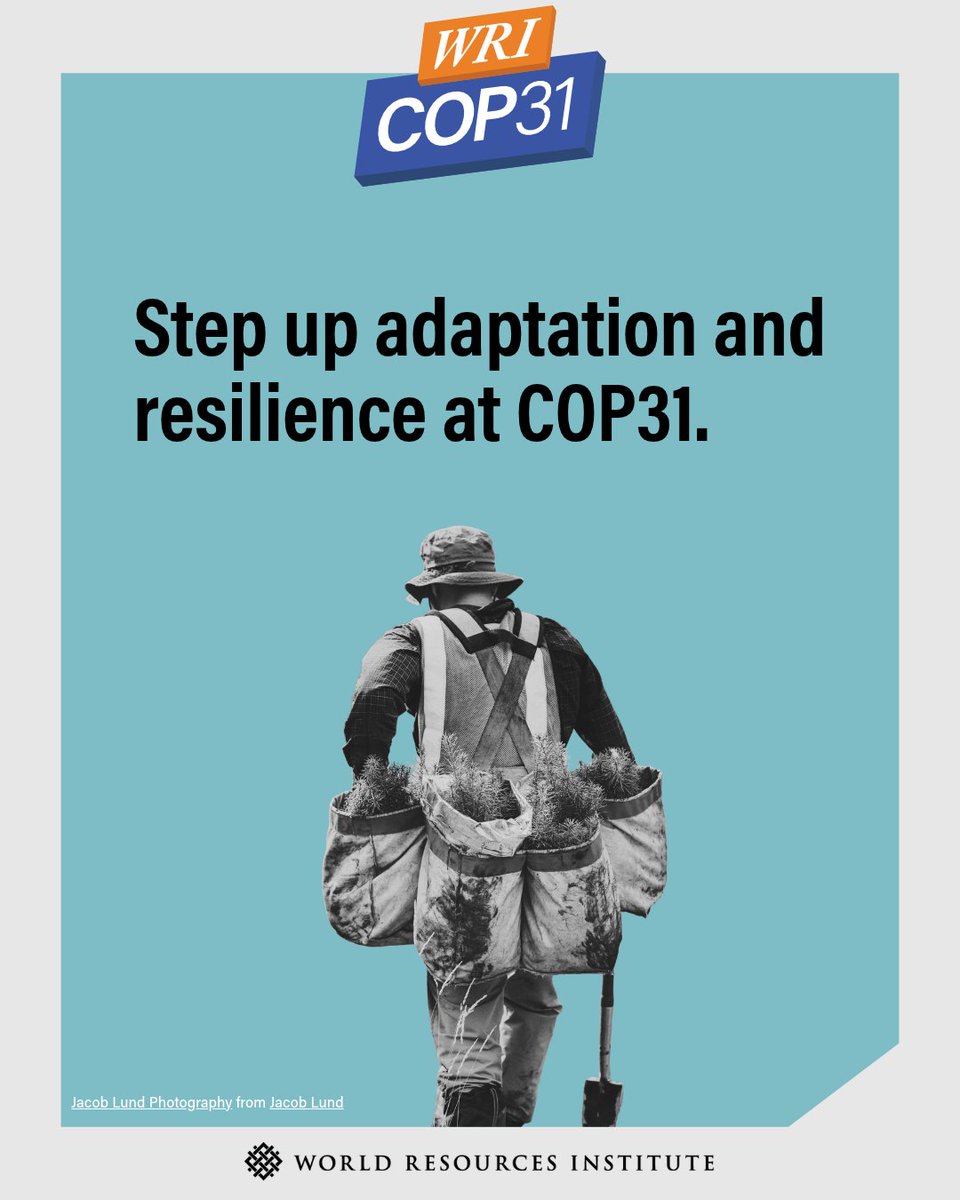
🌱Step up adaptation and resilience.
🌊Integrate ocean-based climate solutions into national and multilateral policy.
WRI experts are closely tracking the issues at stake. Visit this resource hub regularly for the latest commentary, analysis, events and more➡️ https://t.co/EmYLdbBykO
The 2026 UN climate conference (#COP31) shifts the focus from new pledges to practical action.
WRI experts pinpoint areas where countries can drive real progress🔽
Dive deeper➡️ https://t.co/pYwzwkRqw4
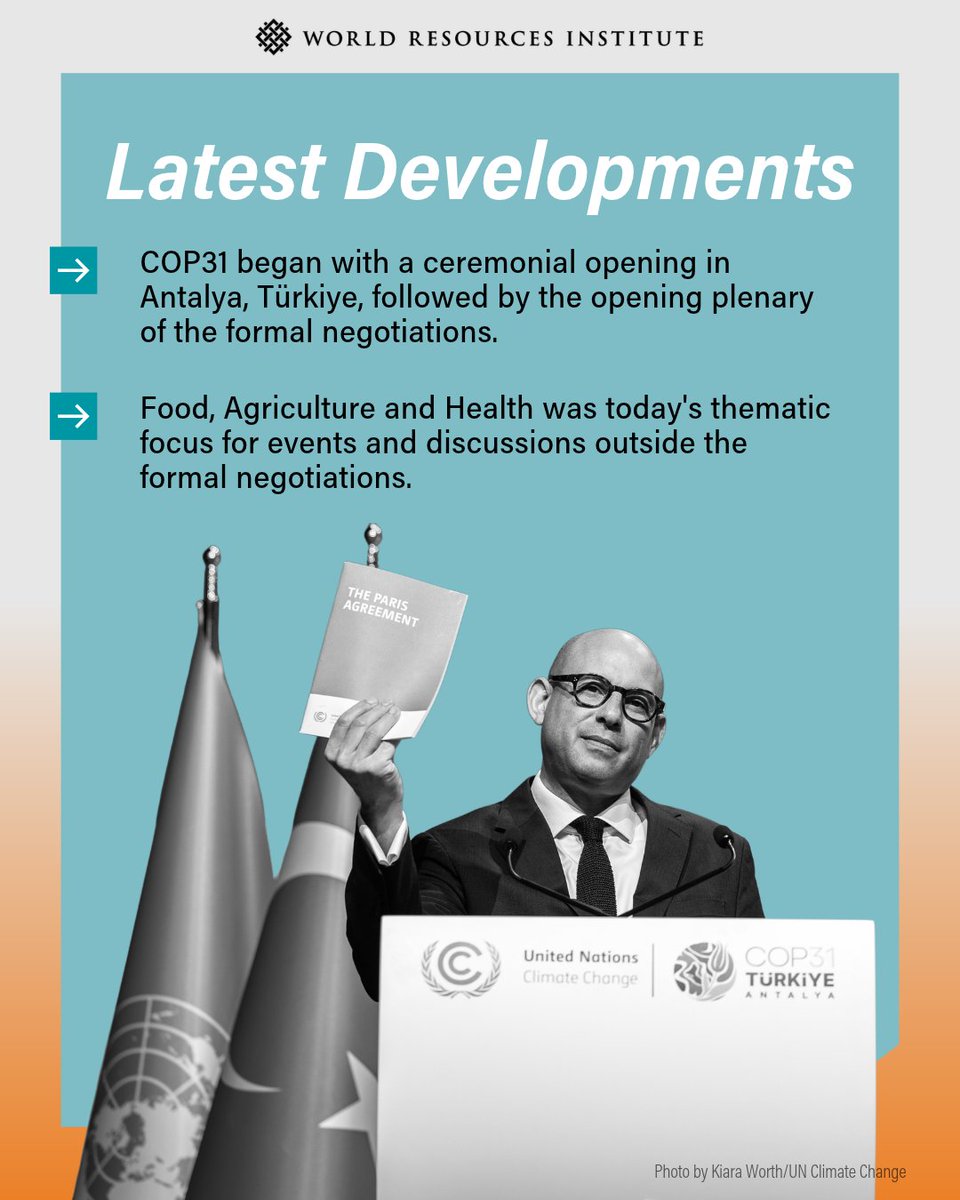
📚Day 1 at #COP31 is in the books! Find out the latest developments 🔽
Resources:
➡️ Reaching $1.3 Trillion Climate Finance Relies on Swift, Sweeping Actions: https://t.co/ObpQ14LBY0
➡️ COP30 Presidency’s Global Roadmap on Halting Deforestation: https://t.co/1FQam1dqBj
More updates and events here👉 https://t.co/eSoodcPYyR
The success of global climate goals hinges on local implementation.
#CHAMPclimate Chairs Hidalgo, Da Costa & Jaeckel share why national governments need to champion multilevel partnerships at #COP31 to reach their climate goals.
Join CHAMP at COP31 ➡️ https://t.co/yEb3WFMxGq
@WRIRossCities@Mayors4Climate #CHAMPconversations
Now is the time for decision-makers to focus on successful implementation of climate action plans — not just headline pledges — to secure a better future.
Progress at COP31 will require that governments move forward on their own national climate plans and strategies, as well as cooperate with other countries, cities and initiatives.
Learn more about the issues to watch at COP31: https://t.co/fhkbhzqWTO
#COP31Türkiye #COP31Antalya #COP31
The cost of diesel fuel rose nearly 33% from 2025 to 2026, with some countries experiencing even higher price spikes.
For many of the world’s rural farmers, processors and small businesses, solar-powered equipment offers an attractive alternative.
Learn more: https://t.co/KRChFCE9BU
🔋Countries can advance a number of actions at COP31 that, if acted on by governments, would help shift the world toward cleaner, more secure energy.
Success looks like:
➡️Electrification: The COP Presidency has proposed a global goal of increasing electrification’s share of final energy demand to 35% by 2035, up from 23% today. Countries should sign up to this target and commit to publish credible electrification and clean energy roadmaps.
➡️Implementation: Countries should announce priority grid and clean energy investment pipelines, as well as advance the policy and regulatory reforms needed to unlock them.
➡️Finance: Countries should address the rising cost of capital for low- and middle-income countries to build stronger grids, clean power and greater energy efficiency.
➡️Transition away from fossil fuels: More countries should advance planning processes to transition away from fossil fuels, while supporting workers and communities. Negotiators could also agree to create a new technical support hub to facilitate just and equitable transitions in countries.
Dive deeper into issues to watch at #COP31: https://t.co/fhkbhzqWTO
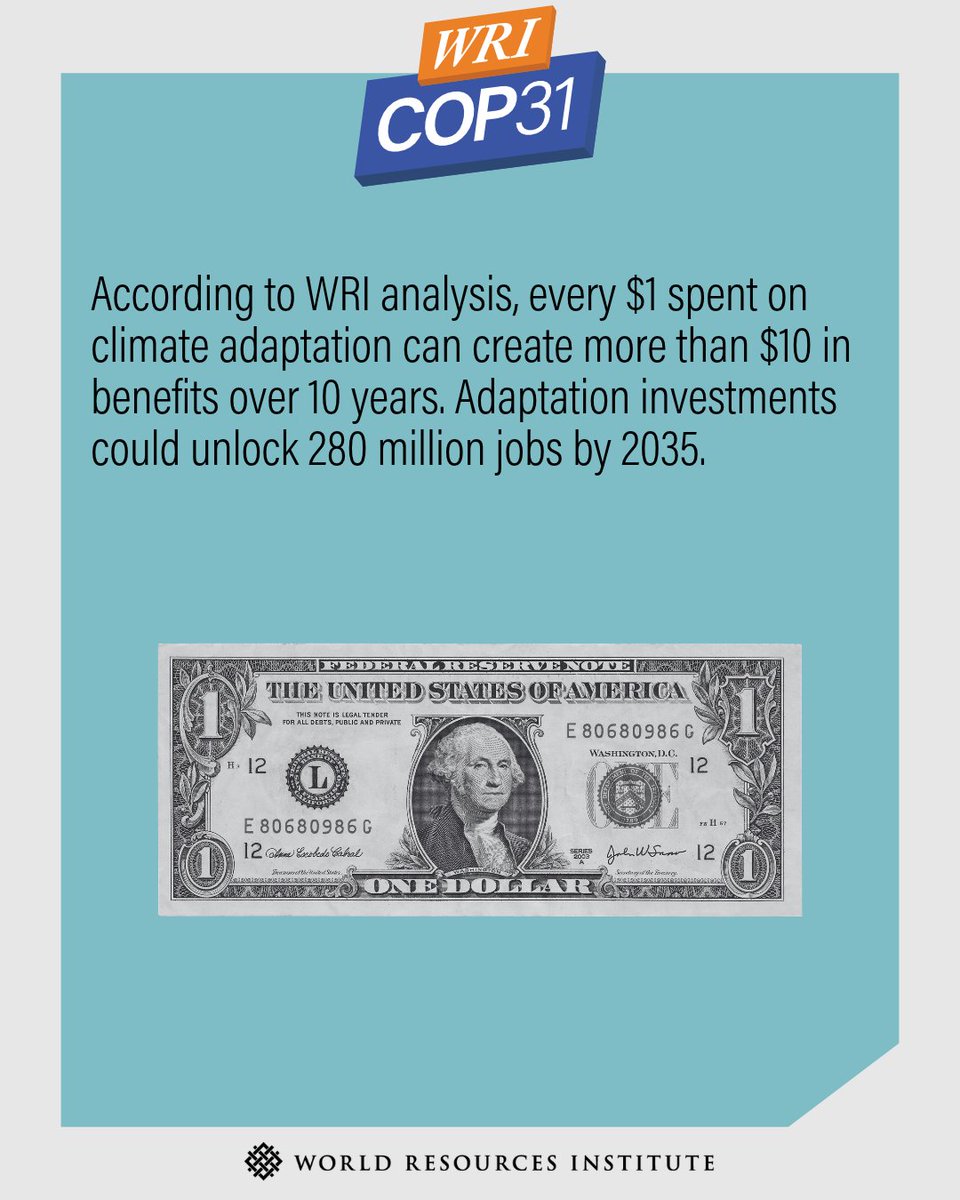
COP31 can make progress on adaptation through:
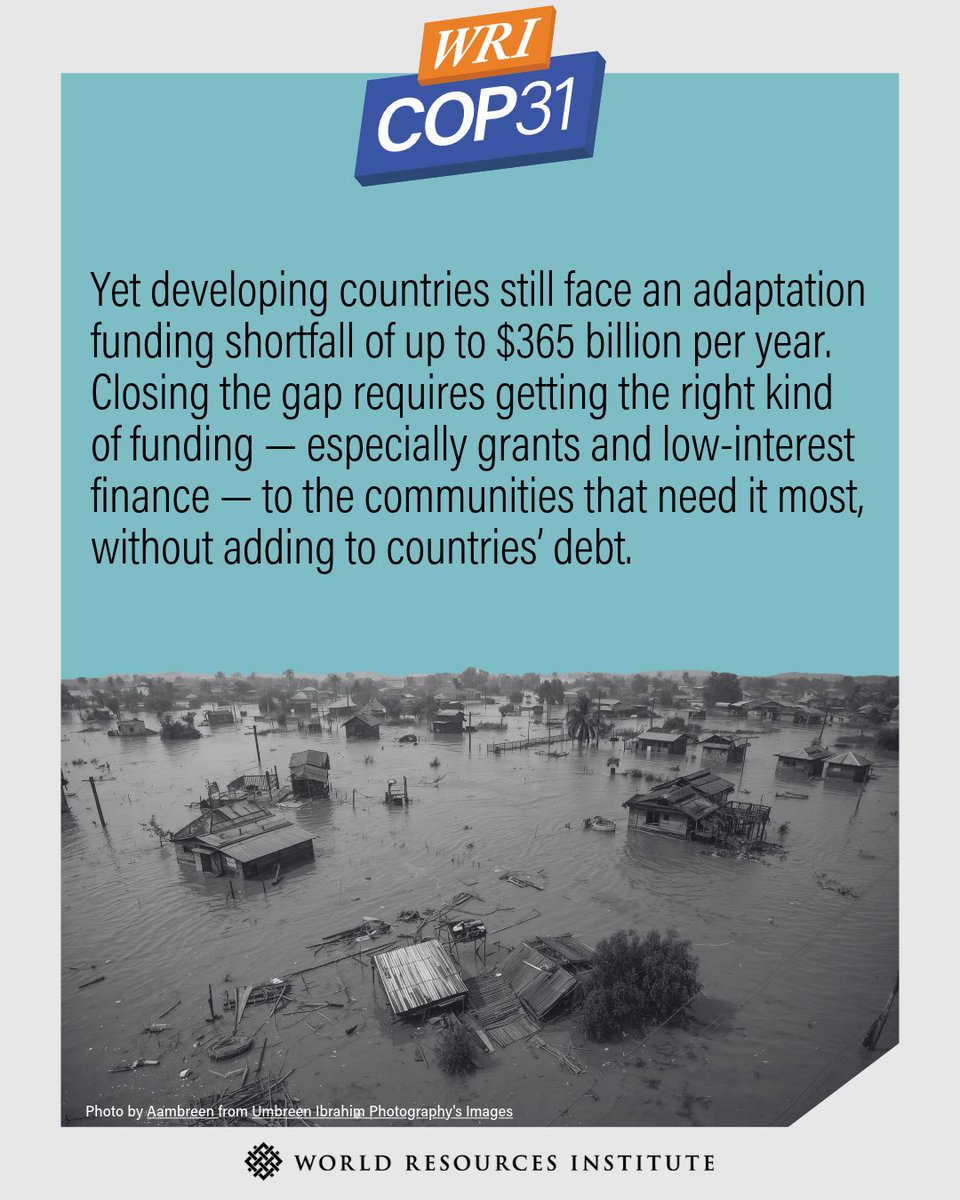
➡️Finance progress: Governments should take concrete steps to deliver on the global goal of tripling adaptation finance by 2035, and scale up all types of climate finance toward the $1.3 trillion per year goal — including by working with companies, insurers and banks to encourage investments in more resilient economies.
➡️Access to finance: Countries and finance actors should agree on clear and concrete actions to enhance access to adaptation finance — especially for the poorest and most vulnerable countries. The COP Presidency’s Access to Finance statement launched ahead of COP is a step in the right direction.
➡️Indicators of success: COP31 should serve as a vital stepping stone toward completing negotiations on the Global Goal on Adaptation (GGA) at COP32 in Ethiopia next year. Negotiators in Antalya must keep momentum by establishing a technical task force to develop the Belem Adaptation Indicators.
Dive deeper into issues to watch at #COP31: https://t.co/fhkbhzqWTO
The resilient, low-carbon transition could create 375 million jobs & reshape work for hundreds of millions more. At #COP31, explore how to turn this potential into quality jobs & stronger livelihoods👇
📅 10 Nov, 2:00–3:30 PM
📍 Blue Zone, Special Event Room 4
🔗 https://t.co/LUJl1gBNzV
Step up adaptation and resilience at #COP31.
In Africa, adaptation cannot be separated from cities. In this video, Aklilu Fikresilassie, Director, Thriving Resilient Cities, @WRIafrica explains why.
Visit WRI's resource hub regularly for the latest commentary, analysis, events and more: https://t.co/EmYLdbBykO
Now is the time for decision-makers to focus on successful implementation of climate action plans — not just headline pledges — to secure a better future.
Progress at COP31 will require that governments move forward on their own national climate plans and strategies, as well as cooperate with other countries, cities and initiatives.
Learn more about the issues to watch at COP31: https://t.co/fhkbhzqWTO
#COP31Türkiye #COP31Antalya #COP31
While national governments may set climate targets, it's cities, states and regions that frequently determine whether those targets are achieved.
Watch Michael Doust, Urban Efficiency & Climate, @WRIRossCities, share what success for cities would look like at #COP31.
Dig deeper into this with the latest Insights piece, For COPs to Deliver on Climate Goals, National Ambition Must Be Met with Local Action", featured on WRI's COP31 Resource Hub➡️ https://t.co/EmYLdbBykO
The challenge of building data centers responsibly is threefold: How can we protect the environments, wallets and livelihoods of people living near a data center?
We need to:
1) power data centers with more clean energy
2) mitigate electricity cost increases due to data centers' energy needs
3) develop governance that minimizes harms to nearby residents and ensures data centers provide tangible community benefits.
While the load growth spurred in part by data centers poses a system-wide challenge, this is a unique opportunity to leverage rapid infrastructure investment for a stronger grid, expanded clean energy and more affordable electricity.
With good policy, the grid investments required for data center interconnection can benefit everyone➡️ https://t.co/cJZooVkx9u
The United States held its midterm elections on November 3, with voters deciding control of the U.S. House of Representatives and Senate, alongside gubernatorial, state legislative and local races across the country. The results will shape the political landscape for energy and climate policy at the federal, state and local levels.
Read full statement from David Widawsky, Director of World Resources Institute United States➡️ https://t.co/26hGZLn1SL