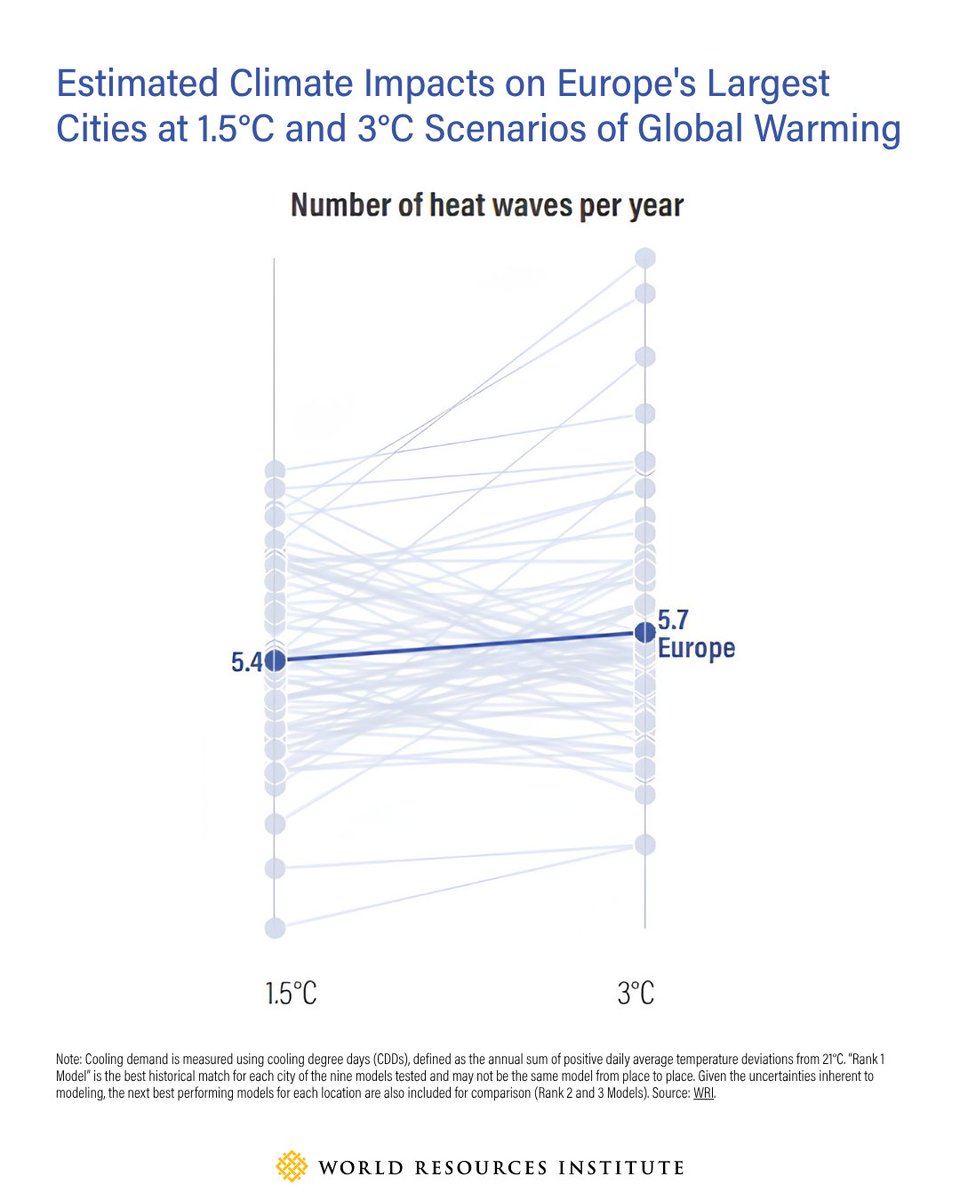
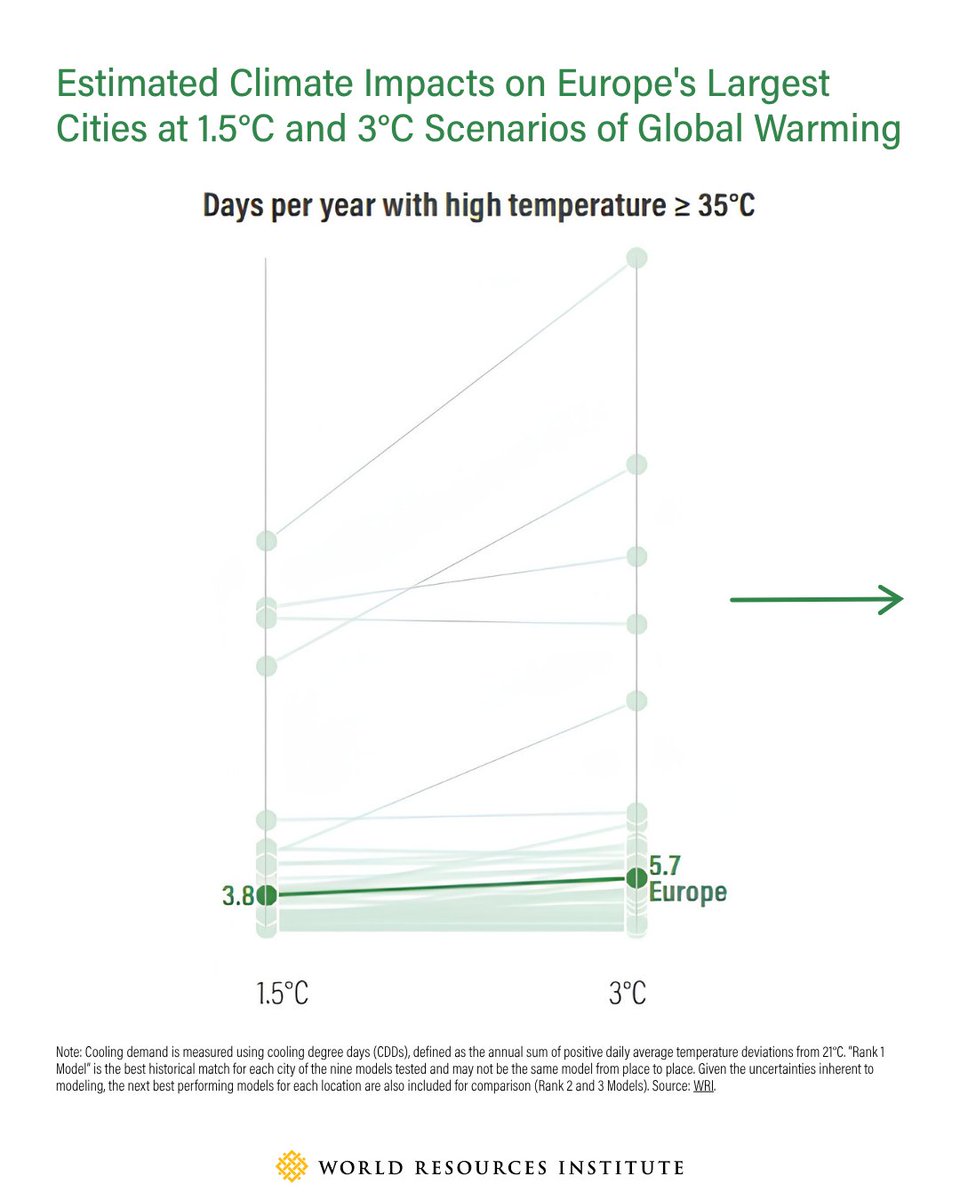
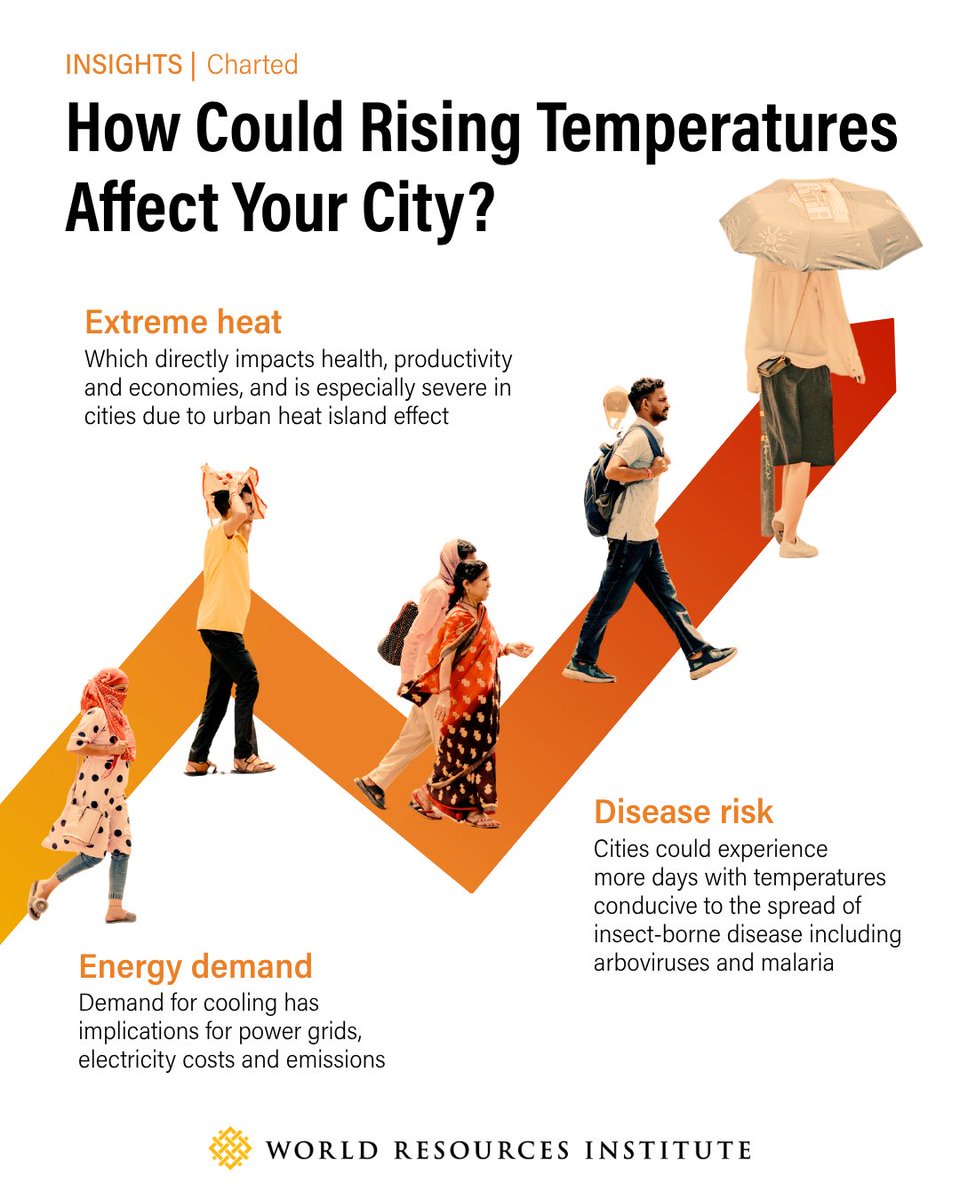
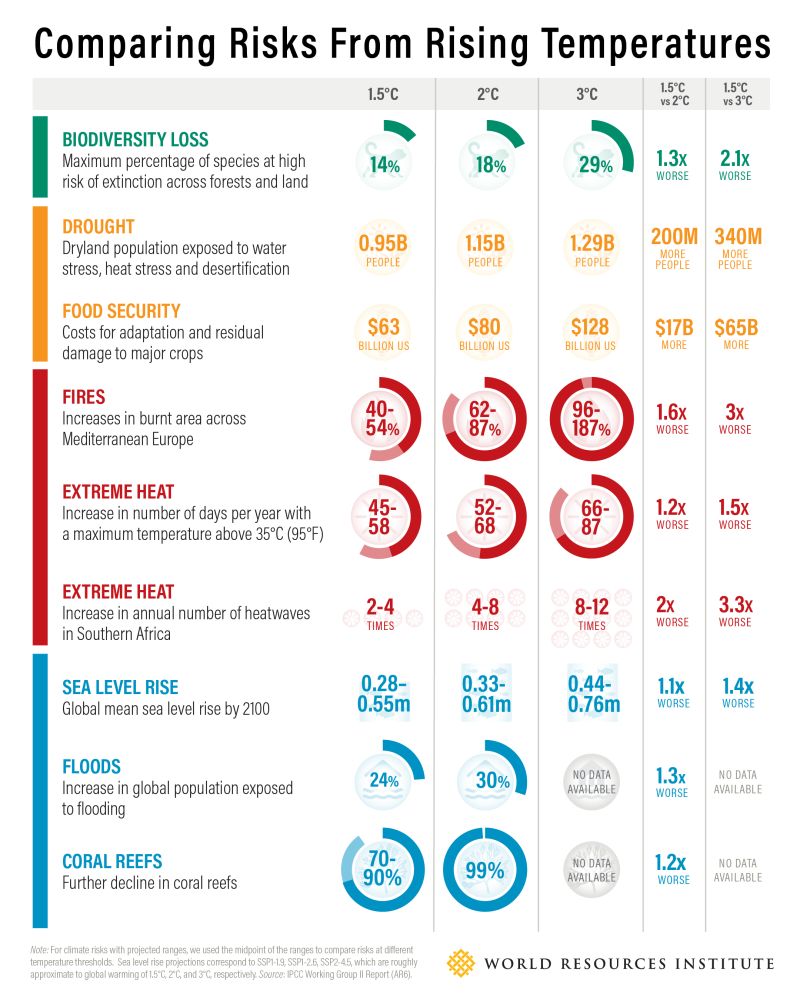
What can happen when temperatures rise in your city? Here are a few key impacts👇🌡️
While climate treaties trade in the language of degrees, it can be hard to imagine what people are likely to experience in their own neighborhood.
To help fill in the picture, we analyzed dozens of climate models to discover how 1.5 and 3 degrees C of global warming might affect your city: https://t.co/6vuvYyptoe
Brazil, India and Indonesia have made important strides in climate adaptation planning. But turning national strategies into effective local action remains a major challenge.
New research from @WRIBrasil, @WRIIndia and @WRIIndonesia explores why, highlighting the need for vertical integration. Explore the key findings: https://t.co/roCzWg2wMB
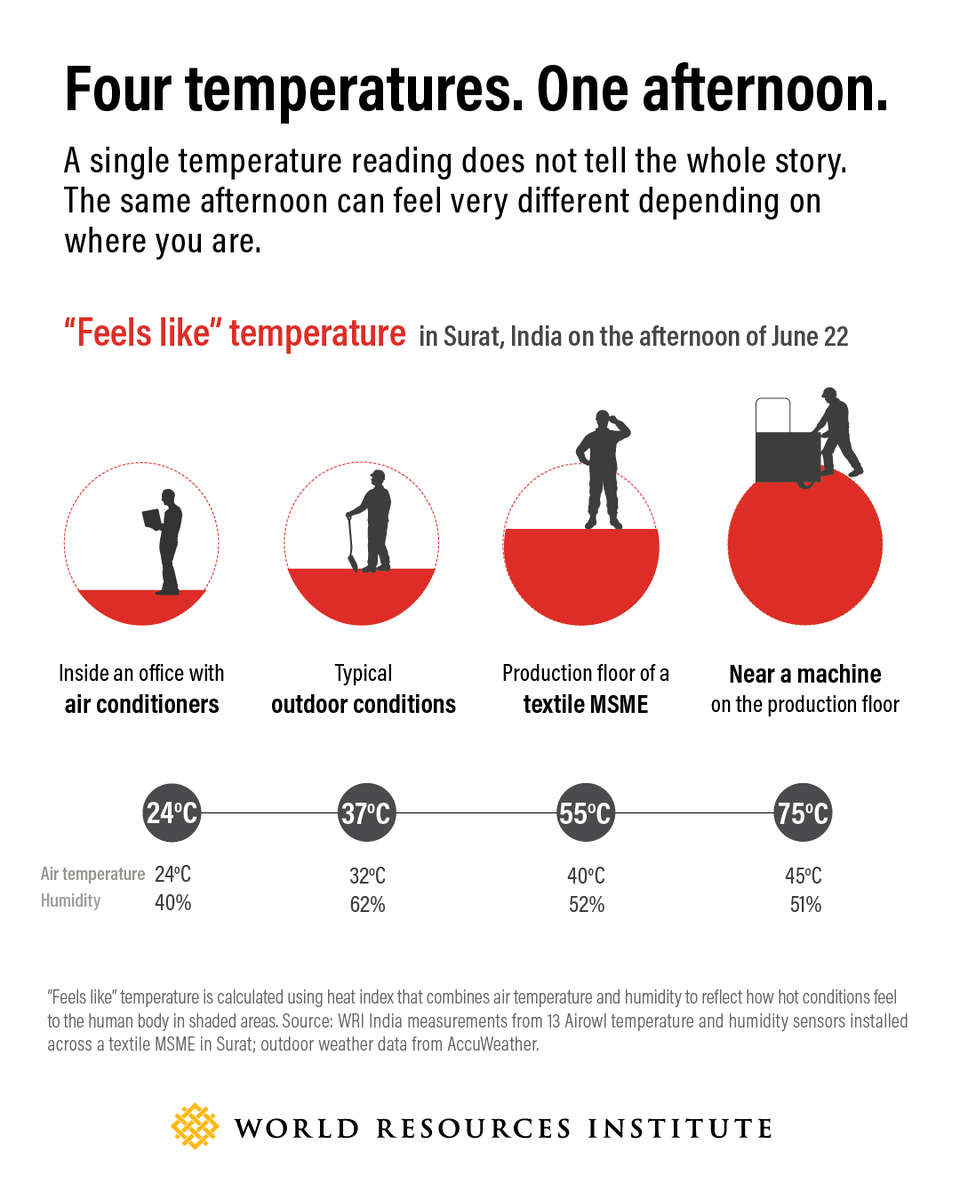
☀️The same afternoon can feel very different depending on where you are.
Take a textile business in Surat, India, for example. On June 22, while the "feels like" temperature outdoors was 37°C, conditions on the production floor felt like 55°C.
Near machines, it was around 75°C.
@WRIIndia's findings highlight how workplace heat is shaped not only by outdoor weather, but also by machinery, humidity, ventilation and design: https://t.co/okvCJqHec7
Every year, nearly 1/2 of Rwanda’s food supply goes uneaten, equal to a loss of 12% of its GDP.
But there are solutions: small businesses in Rwanda are building a blueprint for circular food systems across Africa➡️ https://t.co/ZeVkBGgLzg
🌡Limiting global warming to 1.5°C has been the world's North Star for climate action. A critical benchmark against which policies are set and progress is measured.
So, what happens if we breach it?
We break it down➡️ https://t.co/97dAY9oWi4
🫘As July 4th barbecues fire up for the 250th anniversary of the United States, a bean burger might do more for the climate than a beef one.
It takes 20 times less land and emissions per gram of protein.
We answer six of the most common, and most contested, questions about beef’s climate impact🔗 https://t.co/QdGhc1lFI5
Extreme heat is not only uncomfortable, it can also be deadly. In Europe, it’s estimated to have killed more people in 2025 than road crashes.
Two WRI experts unpack responses to extreme heat, and what more is needed: https://t.co/YXXwSucXyE
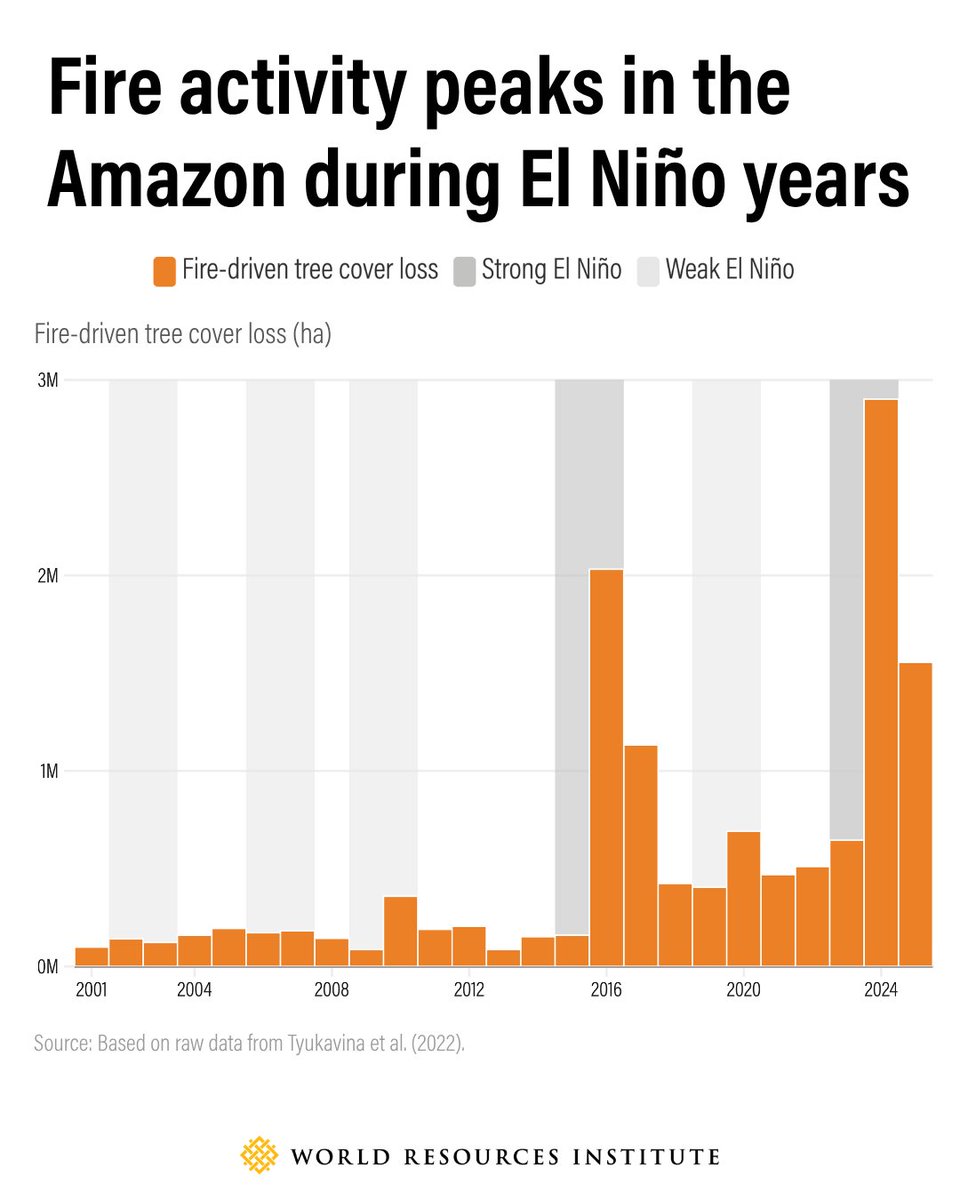
In South America, El Niño tends to reduce rainfall during the wet season, leaving the subsequent dry season even more arid and fire-prone. This is particularly true in the Amazon, where forests are not well-adapted to fire.
WRI experts answer questions on what a Super El Niño could mean for water, food and forests and how communities can prepare👉 https://t.co/xaOCY7QooX
Ocean-based climate solutions could potentially exceed one-third of the total emissions reductions needed to meet global climate goals.
But perhaps even more compelling is the wide range of co-benefits that come with them:
⛈️Protecting coastal communities from storms
👔Providing jobs
🐟Harboring wildlife
🍽️Improving food security
Watch the full video to learn more: https://t.co/ByvZEm6mDg
🌡️🥵Extreme heat is reshaping daily lives.
WRI Experts unpack how heat is affecting daily life, how communities are already adapting and what more is needed to prepare for a hotter future➡️ https://t.co/YXXwSucXyE
🌡️In cities around the world, extreme heat is no longer a short-term event or seasonal disruption. It’s a growing daily pressure that is reshaping how people live, move and work — and it’s getting worse.
#WRIExplains the cascading impacts of heat in cities and offer tangible, scalable solutions that cities can use to develop effective, far-reaching strategies here👉 https://t.co/ufiyNydE1S
NEW 📝 We looked at climate finance "beyond the usual suspects," examining 14 of the largest economies outside the UNFCCC's Annex II.
These countries aren't obligated to provide climate finance. But they do—over $100 billion since 2013.
🧵
https://t.co/ZKm5nH0rTT
Brazil, India and Indonesia have made important strides in climate adaptation planning. But turning national strategies into effective local action remains a major challenge.
New research from @WRIBrasil, @WRIIndia and @WRIIndonesia explores why, highlighting the need for vertical integration. Explore the key findings: https://t.co/O4ouwuWsyB
🌱🛰️Data from TerraFund, the financing arm of WRI’s #RestoreLocal initiative, shows that when restoration is designed with communities at its center and then tracked rigorously, these projects do more than just repair ecosystems.
📖Learn more here➡️ https://t.co/rNUhCDfmHt
When surfaces like pavement, rooftops and buildings are exposed to direct sunlight, they absorb and store heat, releasing it back into the air long after the sun goes down.
Trees interrupt that process. Learn how➡️ https://t.co/KzZwhQrhWZ
🔥 Record-breaking heat is striking #cities across Western Europe.
In a @CNN interview with @MaxFosterCNN, @WRIRossCities' Eric Mackres explained that passive cooling solutions — like shade structures, cool roofs & urban trees — are 🔑 to tackling extreme urban heat.
Read more ➡️ https://t.co/3PUa9HVZKI
#LCAW2026 #LondonClimateActionWeek
Today at #LCAW2026, the 🆕 CHAMP Subnational Advisory Council met for the 1st time.
A group of mayors & regional leaders from around the 🌏, the group will shape #CHAMPclimate’s strategic direction, advocacy priorities & implementation efforts.
➡️ https://t.co/WuZ46CLYnJ
A WRI analysis of 69 of Europe’s largest cities – home to 165 million people, or about 22% of the continent’s population – found that the number of days at 35 degrees C (95 degrees F) or more could rise by 53% if global temperatures increase by 3 degrees C. Heat waves would also last longer under this scenario, making their impacts more severe.
👀Look at data on Europe’s rising urban heat and explore how cities can adapt by pairing efficient, low-carbon air conditioning with long-term passive cooling solutions➡️ https://t.co/P4aUwaajNc
📱Carbon calculators usually focus on your personal footprint.
@WRIclimate’s new calculator, built for policymakers, city planners, companies & institutions (instead of only individuals), asks: How to measure the projected impact of climate-forward behaviors at scale?
Try it here: https://t.co/oCkr2B71w3
🚨STATEMENT: Today, UN Secretary-General António Guterres delivered a Special Address on the Global Response to the Climate and Energy Crises at #LondonClimateActionWeek.
Drawing on the latest scientific evidence, he made the case that the worsening climate crisis and growing energy insecurity share a common root: the world's continued dependence on fossil fuels, and that the path forward lies in renewable energy, international cooperation and science-based action.
2️⃣He announced two new efforts: an AI Environmental Transparency Initiative, calling on all major AI companies to disclose the carbon, water and land impacts of their systems and power them with renewable energy by 2030, and a global call to action to slash methane emissions, one of the fastest-acting drivers of global warming. He also called for more systemic approaches to resilience and for mobilizing public and private, domestic and international finance to invest in adaptation and future-ready infrastructure.
Read the full statement from WRI's President & CEO Ani Dasgupta: https://t.co/SxWiuHUTUk
#LCAW2026