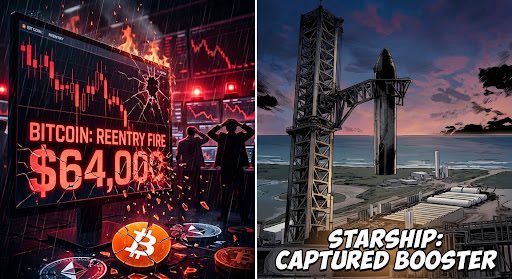
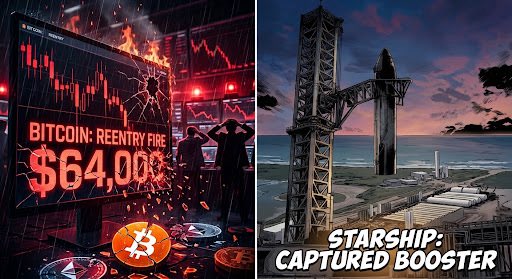
Bitcoin is currently plunging through $64,000, bleeding over 17% in days as ETF outflows, macro inflation fears, and index reshuffles trigger massive liquidations. Weak hands are screaming that the bull run is dead.
They are looking at the fire and missing the physics.
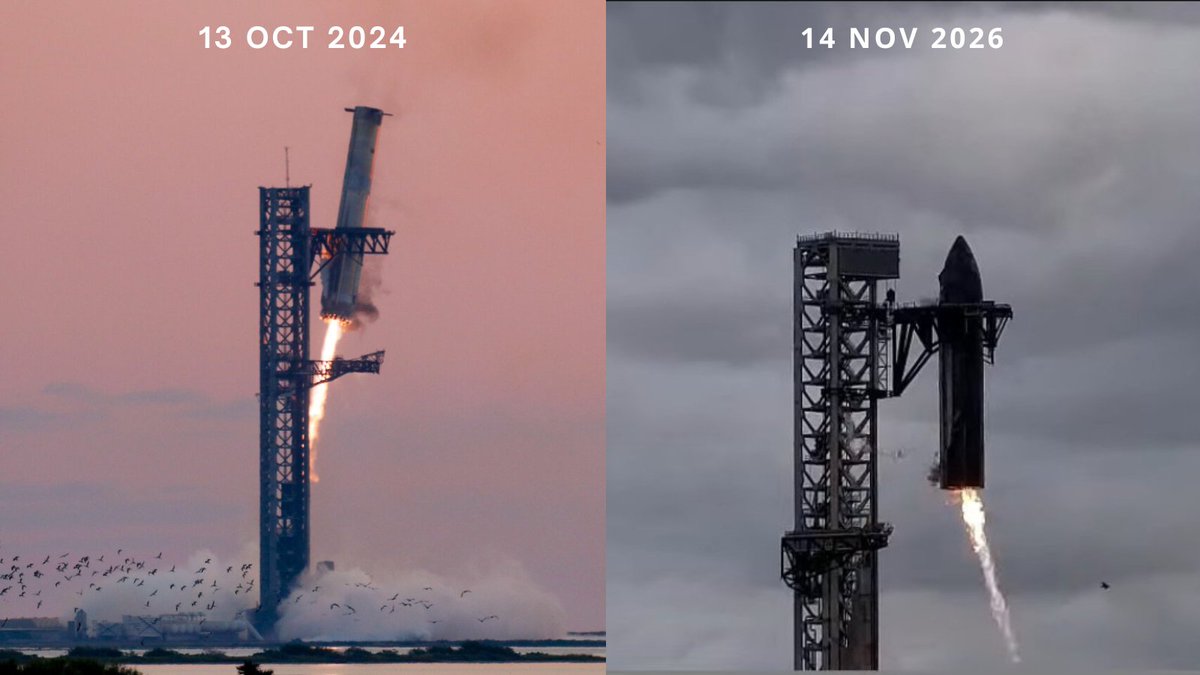
Look at what SpaceX just pulled off by catching Starship mid-air. To return from orbital velocity, Starship has to slam into the atmosphere at Mach 25, enduring a 1,500°C plasma inferno in a controlled "belly flop" before firing its engines at the absolute last second to flip vertical and lock into the Mechazilla chopsticks.
That is literally Bitcoin right now.
What you are witnessing isn't a crash—it is atmospheric reentry. You cannot shed the excess leverage and weak speculative froth of an orbital rally without enduring violent friction and peak heat. Every liquidation cascade, every panicked headline, is just the heat shield doing its job, burning off the tourists while keeping the core protocol completely intact.
Here is the trajectory from here:
1. The "Belly Flop" Shakeout: Expect maximum turbulence right around this $60K–$64K zone. Forced sellers and index-driven outflows are peaking.
2. The Last-Second Flip: Just when sentiment hits absolute zero and bears declare victory, structural liquidity will ignite. The reversal won't be a slow grind—it will be a violent vertical flip.
3. The Catch & Relaunch: Institutional "chopsticks" are waiting at the bottom to absorb the supply. Once caught, Bitcoin doesn't just recover; it refuels for a faster, heavier payload to new all-time highs.
In aerospace and in crypto, the "experts" always confuse reentry heat with destruction—right before the rocket lands intact.
Strap in. Do not get shaken out during the plasma phase. 🚀🟠 #Bitcoin #BTC #SpaceX #Starship #Crypto
@elonmusk From "impossible" to catching Starship out of mid-air. Decades of vision, relentless engineering, and pure grit. Truly witnessing a monumental leap for humanity! 🚀🔥 #SpaceX#Starship
Catching the Super Heavy booster was historic, but catching Starship itself is on an entirely different level of engineering greatness.
Here is why catching the upper stage is exponentially harder—and why it changes everything:
1. Orbital Velocity vs. Suborbital Hop
The booster separates at the edge of space moving around Mach 5–7. Starship has to hit orbital velocity—nearly Mach 25 (7.8 km/s). Shedding that massive kinetic energy requires slamming back into Earth's atmosphere at hypersonic speeds.
2. Surviving the Reentry Inferno
While the booster comes back relatively "cold," Starship endures ~1,500°C plasma during reentry. Thousands of heat shield tiles and its stainless steel airframe have to survive extreme thermal expansion—and then immediately execute pinpoint mechanical docking seconds later.
3. The "Belly Flop" to Vertical Flip
The booster stays mostly vertical on its way down. Starship falls horizontally like a skydiver, using aerodynamic flaps to glide, before lighting its engines at the last second to violently swing vertical and zero out its velocity right between the Mechazilla chopsticks. Zero margin for error.
4. Fragile Structure, Extreme Precision
To maximize payload to orbit, Starship's walls are built as light as possible. Designing catch pins that can survive reentry heat without melting, yet absorb massive structural loads during a mid-air catch, is a triumph of material science.
Catching the booster solved cheap access to the edge of space. Catching Starship unlocks 100% rapid reusability—turning rockets into commercial airliners and making a multi-planetary future truly possible. 🚀🪐✨ #SpaceX #Starship #Aerospace #Engineering
Never bet against a team of engineers who treat "impossible" as just another technical hurdle.
What makes this milestone so extraordinary isn't just the sheer physics of catching a massive spacecraft mid-air—it’s the decades-long trajectory of relentless iteration. From the early skepticism surrounding reusable rockets, to the first Falcon 9 landing in 2015, to catching Super Heavy in 2024, and now catching Starship itself[span_0](start_span)[span_0](end_span). Each breakthrough is a testament to first-principles thinking, rapid failure, and refusing to settle for the status quo.
We aren't just watching a rocket land; we are watching the foundational infrastructure of a multi-planetary civilization being built in real time[span_1](start_span)[span_1](end_span). Huge respect to the entire SpaceX team for turning science fiction into engineering reality. 🚀🪐✨ #SpaceX #Starship #Engineering #Mars
Bitcoin has fallen below $66,000. But what should really worry us may not be the crash itself — it may be that an entire era is being put to the test.
As of November 15, Bitcoin is trading around $65,640, down 13.34% over the past seven days and nearly 48% from its all-time high.
But three signals matter more than the price itself.
First, leverage is destroying itself.
Futures trading volume is roughly 10.6 times spot volume, while long liquidations have vastly outnumbered short liquidations.
This is more than investors turning bearish. It’s a forced exodus of capital, as leveraged positions are systematically wiped out.
Second, institutional conviction is not unconditional.
U.S. spot Bitcoin ETFs have begun experiencing net outflows. When traditional finance starts pulling back liquidity, Bitcoin is not immune.
Third, and perhaps most importantly, there is a deeper question worth considering:
Bitcoin has always told a story about scarcity. But markets don’t price scarcity alone. They price liquidity, too.
The 21-million-coin supply cap won’t change. But investors’ balance sheets will. Institutional risk appetite will. The cost of borrowing will.
That’s why an asset whose long-term narrative appears unchanged can still experience a brutal repricing.
I’ve always believed that the most fascinating question about Bitcoin isn’t whether it will reach $100,000, $200,000, or even $1 million.
It’s that Bitcoin is forcing us to confront a much deeper question:
If an asset’s value depends on everyone believing it has value, who becomes the last buyer when even its most devoted believers suddenly need cash?
A crash cannot prove Bitcoin is finished. Scarcity cannot guarantee that its price will rise forever.
What truly matters isn’t the next candlestick on the chart.
It’s how many people will still be willing to put real money behind Bitcoin after this storm passes.
The market will eventually deliver its verdict.
@czbinanceprd Uncertainty is just another word for mispriced risk. While the timeline is busy panic-selling the noise, asymmetric capital is quietly accumulating. That’s how every major cycle actually bottoms.
@RabbiJeffx@grok As someone shipping AI agents and workflows daily, the biosecurity risk isn't sci-fi—it's a very real engineering constraint. When you build autonomous systems with broad tool-access, guardrails aren't optional.
@Polymarket Peter Schiff has successfully predicted 500 of the last 0 crypto crashes. Meanwhile, Polymarket pricing a sub-$20k drop at just 1% tells you everything you need to know about traditional gold bugs vs reality.
Streaming 26,387 km/h orbital telemetry live via Starlink V3 while deploying a whole constellation—and prepping for the first-ever orbital Ship catch. People still watch this like a sci-fi movie, not realizing they’re looking at the future unit economics of global compute and space logistics.
The wildest part of Flight 15 isn’t just the breathtaking view—it’s the relentless orchestration behind it: precise orbital insertion, 26 Starlink V3 deployments, real-time video relay, and an upcoming tower catch, all running like a tightly coupled autonomous system. Hardware truly moving at software speed. @elonmusk 🚀