You Need to Go Offline to Read Anurag Minus Verma’s Book
The book argues how India lacks comparable informational, creative, and intellectual sustenance for ordinary people.
Rajiv Thind✍️
https://t.co/s4Z7EwPXw6
@BeckyLTuch Also…
Dear writers,
Our lit-mag strongly encourages submissions from those marginalized by gender, class, sexuality, race, ethnicity, nationality, politics, unemployment, bankruptcy etc.
N.B. — As long as you have some connection to an American university MFA program.
@ProfRavikantK "...the coming together of Savarna spokespersons across ideological lines..."
This fiasco shows how "Savarna" power operates through the legal, cultural and academic institutions it controls.
Rightist goons, lefty-liberal-Gandhians - all on the same page, actively or silently.
@ProfRavikantK@surajyengde and Ravikant. If possible, please submit an 800-word fact-based opinion piece for Conversation. They require submitters be from affiliated universities.
Suraj has submitted a piece for them before. You might co-write it.
https://t.co/0hfNBp9nYV
Today, while most young Indians chase professional degrees at IITs and IIMs for high-paying jobs, the reading and production of literature has become highly professionalised within academia. The same phenomenon affects Hindi literature.
https://t.co/MhShKkKuuO
Rajiv Thind✍️
@ProfRavikantK@the_hindu Pretty nice.
Arguably the first English-language book from a mainstream publisher to examine Indian popular culture through a Dalit-Bahujan lens - the 75% of India.
@confusedvichar’s book is a worthy follow-up.
Took too long, though. It’s bloody 2025!
@confusedvichar Happy to see this published & also concerned.
"It is my first winter as the father of a baby girl. Her presence should be a source of unbridled joy, but it brings a new layer of anxiety over what the air pollution is doing to her still developing organs..."
Take care, Delhi.
My review of David Cohen's biography of Jacinda Ardern speaks for itself.
That said, this Vaccine Knight called me a "lefty writer" reviewing a book about "a lefty politician".
The ironies in this whole comment are worth a chuckle.
https://t.co/ce3QSaheCS
@thecaravanindia Great headline - “Swami Tharoor” !
Politicised & commercialised religion has made spirituality dull and distorted.
Meera Nanda’s God Business (2011) is a solid intro, though dated: https://t.co/tJlhHTLTYK
If I may, here’s my piece (ABC/Scroll): https://t.co/qdGHpCpFXy
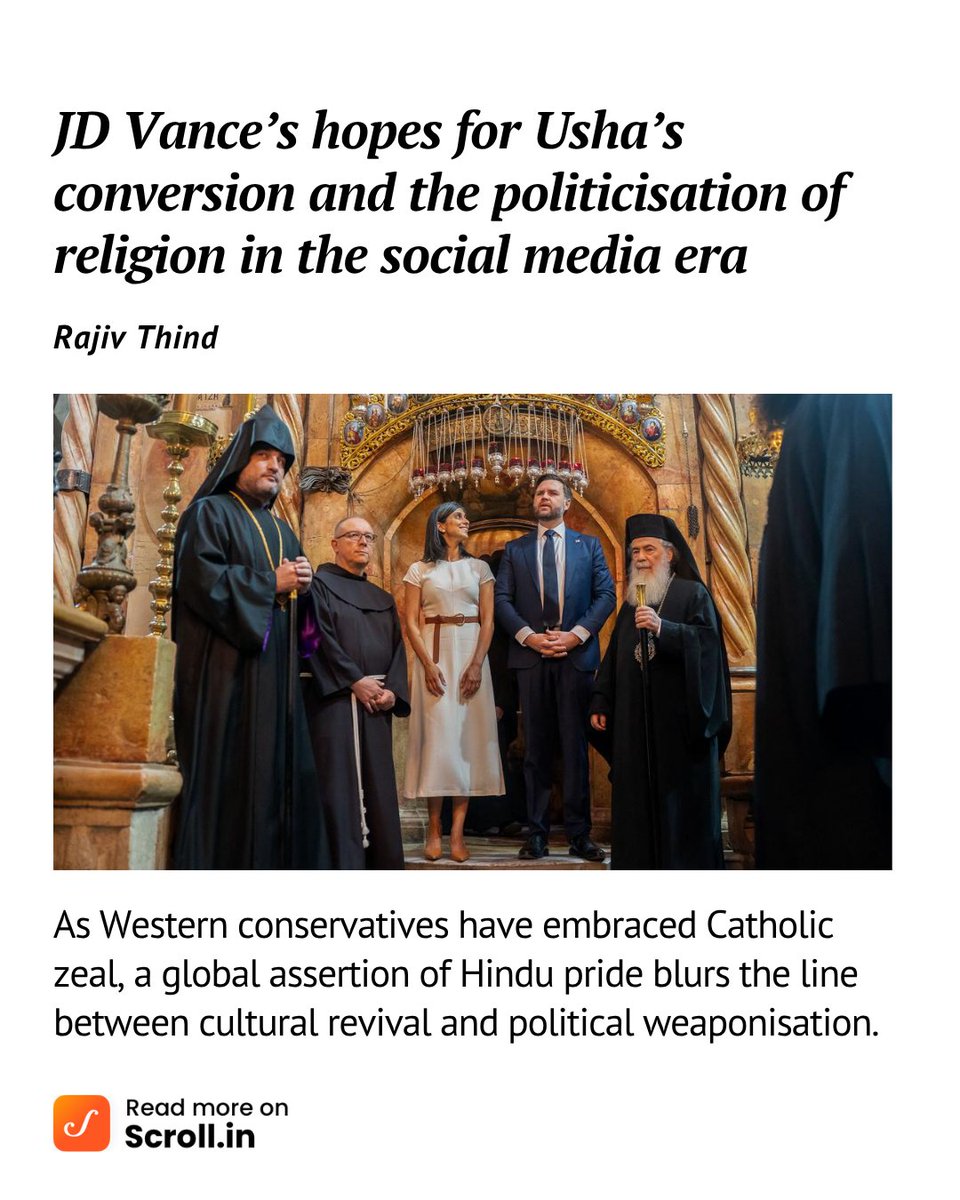
This episode serves as a stark reminder that the politicisation of religion is intensifying in the age of social media, making our world an increasingly intolerant and dangerous place for ethnic, religious and gender minorities. https://t.co/WPwfjoZWqH
✍️ @WriterRajiv
Weaponising Christian identity for the purposes of disharmony, slander or prejudice is blasphemy against the teachings of Christ.
https://t.co/Py1DmaTx12
Over against the opportunism of populists like JD Vance & Hindu nationalists, we need to reclaim the universal and humane core of religion.
✍️Rajiv Thind
Here’s my piece on J.D. Vance, Usha Chilukuri Vance, and the social media wars of religion.
My attempt to explore the grey areas behind the headlines.
https://t.co/qdGHpCpFXy
@surajyengde Most "educated" Hindu Indians are illiterate when it comes to reading and analyzing their own religious texts.
You can’t expect an objective view of a religious text from a religious leader.
I wouldn’t ask a fundamentalist Christian pastor objective questions about the Bible!
@surajyengde That said, I prefer to read and critique the Manusmriti rather than burn it.
One can argue it holds historical and literary value.
It's a mishmash of ideas—no single author named "Manu" wrote it. It evolved over time through various compiled writings.
@surajyengde Most "educated" Hindu Indians are illiterate when it comes to reading and analyzing their own religious texts.
You can’t expect an objective view of a religious text from a religious leader.
I wouldn’t ask a fundamentalist Christian pastor objective questions about the Bible!
@BeckyLTuch Narrative Magazine pioneered high submission fees in the 2000s—sometimes as much as $25.
Gradually, almost all magazines adopted this practice.
A fee equal to postage is fair, and prevents spamming; anything more is extortion.